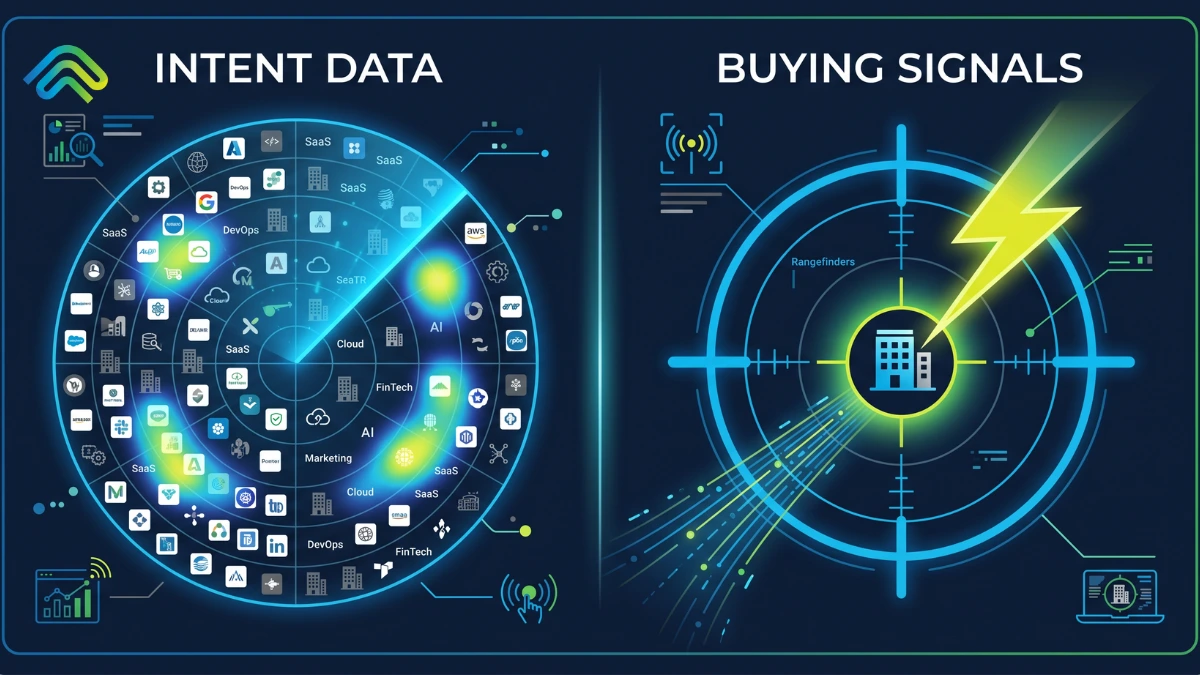
Most sales leaders have everything in line: Bombora for intent; ZoomInfo for contact information; a CRM system full of behavioral data. And still, the pipeline is empty. If you look closely, most sales reps are cold-calling accounts that haven’t responded in 3 months. Simply, the timing of the outreach is just wrong!
Even after having all essential and relevant data – what’s the result? Missed quarters. Longer sales cycles. Reps are burning out on effort that never converts.
The problem is not a shortage of data. The problem is that most B2B sales teams treat buying signal and intent data as interchangeable. But, they are not. One tells you where to look. The other tells you when to move. Confuse between these two, and it is impacting your overall quarter sales. You are guessing in a well-dressed spreadsheet (in the era of Artificial Intelligence).
While you can efficiently use buying signals and intent data together to increase your overall revenue. This guide draws a clean line between the two and shows how modern B2B revenue teams are using them together to build a faster, more predictable pipeline in 2026.
What are Buying Signals in Sales?
A buying signal is a real, measurable action or behavioral shift in a target account that indicates a prospect may be moving toward a purchase decision. To understand what makes these signals valuable, it helps to look at the level of certainty they provide.
The key idea here is clarity. A buying signal is not a hunch or an account simply “looking active.” It is a concrete event that has already happened.
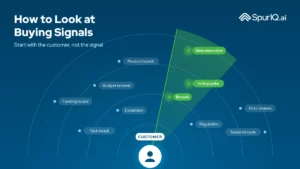
For example, a decision-maker visiting your pricing page multiple times, a company announcing a new funding round, or a new VP of Sales joining and likely re-evaluating tools. These signals indicate that priorities are shifting and a buying window may have just opened. For a seller who is paying attention, this creates a clear and time-sensitive opportunity to act.
What is B2B Intent Data in Sales?
B2B intent data is behavioral information collected about companies based on their online research activity. It captures the digital trail a business leaves behind when employees research topics, compare vendors, read review content, or consume educational material related to your product category.
There are two types worth knowing:
1. First-Party Intent Data
First-party intent data is generated from your own digital properties. It is reliable because it reflects direct interaction with your brand. You own it, you can act on it immediately, and there is no middleman interpreting it for you.
Common first-party signal sources include:
- Website page visits and time on site
- Content downloads (whitepapers, guides, case studies)
- Email opens and clicks
- Webinar registrations and attendance
- Demo or trial requests
- Pricing page visits
2. Third-Party Intent Data
Third-party intent data is aggregated from external sources that track which companies are engaging with relevant topics across thousands of properties. When a cluster of employees at a target account starts consuming content around “sales automation” or “CRM integration,” that creates a third-party intent surge worth paying attention to.
Some of the most significant third-party signal sources include:
- Publisher networks
- B2B review platforms
- Content sites
The Leading Intent Data Vendors
When evaluating the best intent data providers, most B2B teams rely on a mix of trusted platforms.
- Bombora is widely considered the industry standard for third-party B2B intent data. It operates a co-op of more than 5,000 B2B publisher sites and flags when a company’s research activity on a topic surges above baseline. Solid choice for enterprise ABM programs.
- 6sense maps buying journeys using AI and predictive modeling. It is particularly strong at dark funnel visibility, surfacing accounts that are researching solutions before they have ever touched your website.
- G2 and TrustRadius provide first-party intent based on actual review and comparison behavior on their platforms. When a buyer is actively comparing tools on G2, that is high-quality, context-rich intent with a commercial signal already attached.
- ZoomInfo Intent layers third-party behavioral data on top of its core contact and company database, making it practical for teams that want signals and enriched contact data in a single workflow.
The honest limitation of intent data:
It is probabilistic. It tells you someone at a company has been researching a topic. It does not tell you who, what their budget looks like, whether they hold any authority, or how close they are to a decision. That gap is exactly where buying signals become essential.
What is the Difference Between Buying Signal and Intent Data?
Intent data tells you who might be interested. On the other hand, buying signals tell you what just happened and why you should be on the phone right now.
Intent data is probabilistic. It is built from patterns of content consumption across publisher networks, review sites, and third-party content hubs. It flags that something might be happening within an organization, but it does not confirm that a decision has been made, a budget has been approved, or that the person conducting the research has any buying authority.
On the other hand, buying signals are deterministic. A new VP of Sales joining, a funding round closing, and a competitor’s contract lapsing. These are facts, not patterns. They tell you a window just opened, and that window closes fast. Research shows that vendors who reach out to a newly funded company within 48 hours see conversion rates four times higher than those who wait.
There is also a critical identity gap most teams ignore.
Intent data tells you the company, not the person. A topic surge at a 2,000-person enterprise confirms that someone inside is researching your category, but it stops there. You do not know if it is the CFO evaluating a budget shift or an intern writing a market report.
Buying signals cut through that ambiguity. A named decision-maker visiting your pricing page three times this week is not a pattern. It is a person with a clear intent you can act on today.
The table below draws the line:
| Factor | Buying Signals | Intent Data |
| Nature | Deterministic: something happened | Probabilistic: something might be happening |
| Buyer Stage | Mid-to-late funnel | Early funnel |
| Actionability | Act within hours | Needs scoring and interpretation first |
| Identity | Contact or company-specific | Account-level, often anonymous |
| Risk if Used Alone | Misses the early pipeline | Creates noise; many accounts are not ready |
But here is what most comparison guides miss: neither intent data nor buying signals create revenue on their own. They create opportunity. What happens in the next 15 minutes decides whether that opportunity becomes a pipeline or leaks. So, you must be quick with your execution to actually move forward the revenue.
Why Buying Signals Matter to Modern B2B GTM Teams
Here is a hard truth most sales leaders already feel but rarely say out loud: by the time a prospect fills out your demo form, you are probably already too late.
Gartner research confirms that B2B buyers spend only 17 percent of their total buying time in direct contact with potential vendors, meaning 80 percent of the journey happens entirely without you. They are researching, comparing, and shortlisting vendors before a single sales conversation takes place. Does that inbound form fill your team’s celebration? In most cases, the buyer has already made up their mind.
This is the world where buying signals were built.
Being First is Not a Nice-To-Have. It Is the Whole Game.
Think about the last deal your team lost. Chances are, it was not because your product was inferior. It was because someone else got there first, built the relationship earlier, and shaped how the buyer thought about the problem before you even knew they had one.
The research from primary sources makes this impossible to ignore:
- According to 6sense’s 2025 B2B Buyer Experience Report, 95 percent of the time, the winning vendor is already on the buyer’s Day One shortlist. Four out of five deals are won by the vendor that the buyer preferred before the sales contact was even made.
- Gartner found that 73 percent of B2B buyers actively avoid suppliers who send irrelevant outreach.
Read that again. The shortlist is mostly set on “Day One”. Which means the question is not whether you will close the deal when the buyer reaches out. The question is whether you were already in the room when they started thinking about it.
Buying signals are how you get in that room.
Not All Signals are Equal. Here is What Actually Predicts a Purchase.
A lot of teams track signals. Very few track the right ones. So let us talk about what the research actually says moves the needle. As per Bloomberry:
- An analysis of 1 million B2B software purchases found that companies adopting enterprise AI tools, making recent tech stack changes, or rapidly growing their headcount are consistently among the highest-intent prospects.
- Companies that recently closed a funding round made 25 percent more software purchases in the following six months than those whose last funding was further in the past.
- Leadership changes are one of the most powerful and underused signals of all. A new C-suite executive almost always reviews existing vendors and evaluates fresh solutions within their first 90 days. That is a window. Most reps miss it entirely because they were not watching.
These are not patterns to observe from a distance. They are triggers. And triggers demand a response – fast.
The Real Reason Deals Die Has Nothing to Do With Your Product
Sit with this for a moment. Most lost deals were not lost because the product was wrong. They were lost because the timing was wrong. Outreach arrived before the need existed, or two weeks after someone else had already walked in the door.
Buying signals fix that problem. A rep who reaches out because a new CFO just joined a target account has a reason to call. A rep who sends a message because a competitor’s contract just lapsed has context to offer. The prospect does not feel interrupted. They feel understood. That shifts the conversation completely.
6sense’s research shows that buyers who ranked their shortlist before speaking with any seller went on to purchase from the first vendor they contacted 84 percent of the time.
Buying signals are what put you in that position.
Why B2B Intent Data Matters to Modern GTM Teams
If buying signals tell you when to move, intent data tells you where to look.
Most GTM teams are not short of accounts to pursue. They are short on answers. Which of these 10,000 accounts in your TAM actually care about what you sell right now? Which ones are quietly researching your category while your reps are burning time on cold outreach that goes nowhere? That is the problem intent data was built to solve, and it solves it before a single call is made.
Intent data surfaces accounts showing active research behavior so teams can prioritize outreach and personalize messaging based on what prospects are actually investigating right now, not what they clicked on six months ago.
What It Actually Does for Your GTM Motion
Intent data does not just help you find accounts. It changes how every function in your revenue team operates. This is how it actually plays out in real scenarios:
- Earlier engagement: You reach accounts while they are actively researching, not after they have already made a shortlist and locked in a preferred vendor.
- Better prioritization: Rather than working through a cold 10,000-row account list, reps focus time on accounts showing genuine in-market behavior right now.
- Smarter personalization: When you know a prospect has been consuming content on a specific topic for 3 weeks, your outreach stops feeling like a cold pitch and becomes a timely conversation.
- Churn prevention: If an existing customer starts researching alternatives, intent data surfaces that risk before the renewal conversation goes sideways.
It Also Changes How You Forecast
Most teams treat intent data as a prospecting tool and stop there. That is a mistake. An account surging on relevant topics for three consecutive weeks and now visiting your pricing page is a fundamentally different pipeline opportunity than one that has done neither.
Forrester points out that intent signal intensity indicates whether a prospect is in early research, actively evaluating, or nearing a decision, allowing teams to time outreach precisely rather than guess.
When that feeds into pipeline scoring, forecasts get cleaner, resource allocation gets sharper, and the gap between marketing-qualified and sales-ready finally starts to close.
How to Use Buying Signals Across Your GTM Motion
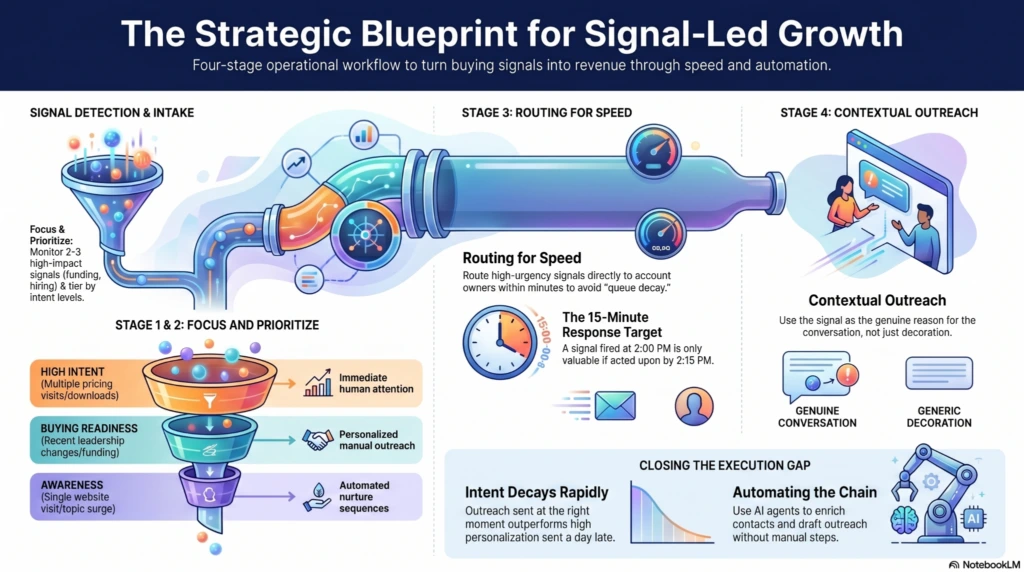
Knowing signals matter is the easy part. Knowing what to do the moment one fires is where most teams either build a real competitive edge or quietly let the opportunity expire. The workflow breaks into four stages, and each one matters.
Stage 1: Signal Detection
Start by identifying which signals are most predictive for your specific ICP. A funding round is a strong signal for a SaaS platform selling to growth-stage companies. A new CHRO hire is a strong signal for an HR tech vendor. A competitor’s contract lapse is a strong signal for almost anyone.
It is always better to pick two or three high-impact signals for your ICP, such as funding rounds, job postings, or leadership changes, build a routine around monitoring them, and create one tailored outreach play for each signal type before expanding further.
Sources to pull from include job board APIs for hiring signals, news monitoring tools for funding and leadership changes, CRM behavioral data for first-party engagement, intent platforms for topic surge data, and call recording platforms for conversation-level signals such as competitor mentions or pricing questions.
Stage 2: Prioritization
Not all signals carry equal weight. A prospect who visited your pricing page once is not the same as one who visited three times, downloaded a case study, and opened two outbound emails in the same week.
Salesmotion recommends tiering your signals clearly: high-intent signals deserve immediate human attention, buying-readiness signals warrant personalized outreach, and awareness-level signals should enter automated nurture sequences.
Accounts with multiple simultaneous signals should be treated as a high-priority pipeline without exception. Stack-rank by combining event type, recency, contact seniority, and ICP fit score.
Stage 3: Routing
Speed matters more than most teams realize. Waiting for a signal to land in a queue or be picked up in a weekly review is not a strategy. It is a missed deal. Intent decays quickly. Straightforward outreach sent at the right moment consistently outperforms highly personalized messaging sent even a day too late.
For example, a VP of Operations visits your pricing page at 11 AM. By 11:20 AM, the assigned rep has their contact details, visit history, and a suggested opening message ready. That is not exceptional execution. That is what a good routing infrastructure makes routine. Route high-urgency signals directly to the account owner with full context. Do not route to a queue. Queues kill the timing window every time.
Stage 4: Outreach
Signal-led outreach works because the rep has a genuine reason to reach out. For example, a mid-market SaaS company just closed a Series B. Your rep reaches out within 48 hours, references the announcement, and offers to show how similar companies used that growth window to consolidate their sales stack before headcount doubled.
That is not a cold pitch. It is a timely conversation.
Generic outreach with a signal dropped in as decoration is still generic. The signal should be the reason the conversation exists.
The Gap Most Teams Never Close
The practical challenge most teams hit is not signal detection. That part is largely solved in 2026. It is what happens after the signal fires. A pricing page visit at 2 PM is only valuable if a rep acts on it by 2:15 PM with the right context. Most teams still depend on human memory somewhere in the chain to notice, remember, and act.
That is the gap SpurIQ was built to close. Its two agents, Lead IQ and Deal IQ, automatically turn detected signals into executed actions, enriching the contact, drafting the outreach, routing to the right rep, and logging everything in CRM without a single manual step.
How to Use Intent Data to Identify Sales Qualified Leads
Intent data is most powerful as a filtering and prioritization layer, not as a direct trigger for outreach. An intent spike is not a reason to call. It is a reason to prepare, warm the account, and wait for the confirmation signal.
Step 1: Build an Intent-Qualified Watch List
Start by identifying ICP accounts that are surging across two or more topics directly relevant to your product. Add these accounts to a watch list and move them into an active nurture track. The goal at this stage is brand presence, not outbound pressure. Deploy relevant content, targeted ads, and light-touch personalized email to stay visible while the research phase plays out.
Step 2: Layer Firmographic Filters
Raw intent data has significant noise. Before a signal reaches a sales rep, filter it by company size, industry, existing tech stack, and estimated budget range. An account surging in ‘sales automation’ with 12 employees is a very different situation from one with 400.
Step 3: Define SQL Thresholds
Set clear, documented criteria for when an intent-flagged account becomes a sales-qualified lead. A practical framework: intent score above a defined threshold on two or more relevant topics, confirmed ICP fit on firmographic criteria, and at least one first-party engagement action in the previous 14 days. Keep the definition tight. Loose SQL definitions send reps chasing accounts that are not yet ready to buy.
Step 4: Align Intent Data With Buying Signals for Confirmation
The strongest signal combination in modern B2B sales is an intent spike followed by a concrete buying signal. An account that has been researching your category for several weeks, and then a new budget holder joins or a competitor’s contract lapses. That combination is as close to a confirmed buying window as any dataset can provide.
Knowing how to use intent data to identify sales qualified leads ensures reps only engage when there is real buying potential, not just early-stage curiosity. Plus, prioritize these accounts above everything else and respond with urgency. That window will not stay open long.
How SpurIQ Helps You Use Both Buying Signal and Intent Data
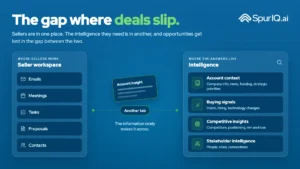
Most revenue teams do not have a data problem. They have an execution problem. Signals fire every day across your CRM, website, call recordings, and intent platforms. The buying window opens. And somewhere between the dashboard and the rep, it quietly closes again.
That is the signal-to-action gap. And that is exactly what SpurIQ is built to close.
SpurIQ connects both buying signal and intent data, identifies the next best action, and ensures reps act before the opportunity disappears. No extra tools. No chaos. Just execution.
Intent data, finally put to work
Instead of sitting in dashboards, SpurIQ turns intent into action. When an account shows real interest, it:
- Identifies the right contacts
- Explains why they’re in-market
- Drafts a personalized outreach
- Routes it to the right rep instantly
So, with SpurIQ, your team doesn’t just see intent, but act on it.
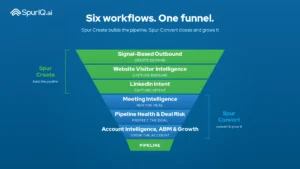
From pipeline creation to deal conversion
Most tools help you find opportunities or manage them..
But, SpurIQ does both in one flow:
- Create: Finds in-market accounts and triggers timely outreach
- Convert: Guides follow-ups, flags risks, and keeps deals moving
No missed signals. No dropped balls. No relying on memory.
Just consistent, system-driven revenue execution. See how SpurIQ closes the gap between signal and action.
Conclusion
Buying signal and intent data are not competing strategies. There are two lenses on the same buyer journey: one showing you where latent demand exists and the other confirming that a specific, actionable event has just occurred.
Most teams pick one and build their entire motion around it. Intent-only teams generate large volumes of early-stage accounts that sales reps cannot prioritize. Signal-only teams react to individual events without the broader context of what an account is actually doing.
The teams closing deals in 2026 are not the ones with the best data stack. Every competitor has access to roughly the same signal sources. The differentiator is execution speed: the ability to go from signal to meaningful, relevant outreach in minutes, not days.
Whether you use SpurIQ or build your own execution layer, the principle holds: the opportunity does not wait. Neither should the rep.
Frequently Asked Questions (FAQs):
Can a company use both buying signal and intent data at the same time?
Yes. In fact, this is the most effective approach for modern B2B GTM teams. Intent data identifies which accounts to monitor and warm up, and buying signals indicate when to act with direct outreach. Used together, intent data builds your priority list, while buying signals act as the final trigger for engagement.
What is B2B intent data, and how is it collected?
B2B intent data is behavioral information based on how businesses research products or services online. There are mainly two types of intent data:
First-party intent data comes from your own channels, such as website visits, content downloads, and email engagement
Third-party intent data is collected from external sources like publisher networks, review platforms, and broader web activity
Platforms like Bombora, 6sense, and ZoomInfo analyze and score this data for sales and marketing teams.
How do I know when an intent-flagged account is ready for sales outreach?
An intent spike alone is usually not enough. It often signals early-stage research.
A stronger trigger includes:
Sustained intent activity over time
A confirmed ICP (ideal customer profile) match
At least one direct behavioral signal, such as a website visit, content download, or key event
When these align, the account is far more likely to be ready for a meaningful sales conversation.
What are some examples of buying signals in B2B sales?
Common buying signals that indicate momentum and a higher likelihood of near-term action are as follows:
A new VP of Sales, CRO, or CFO joining a company
A recent funding round (Series A, B, or C)
Multiple visits to a pricing page in a short period
A cluster of job openings in a relevant department
A prospect re-engaging after a long period of inactivity
Which intent data providers are considered the best in 2026?
Some of the most widely used platforms include:
Bombora for third-party topic surge data
6sense for predictive intent and dark funnel insights
G2 and TrustRadius for high-quality review-based intent
ZoomInfo for combined intent and contact data
TechTarget for technology-focused buyer intent
The right choice depends on your ICP, budget, and whether you need standalone intent data or a full GTM platform.