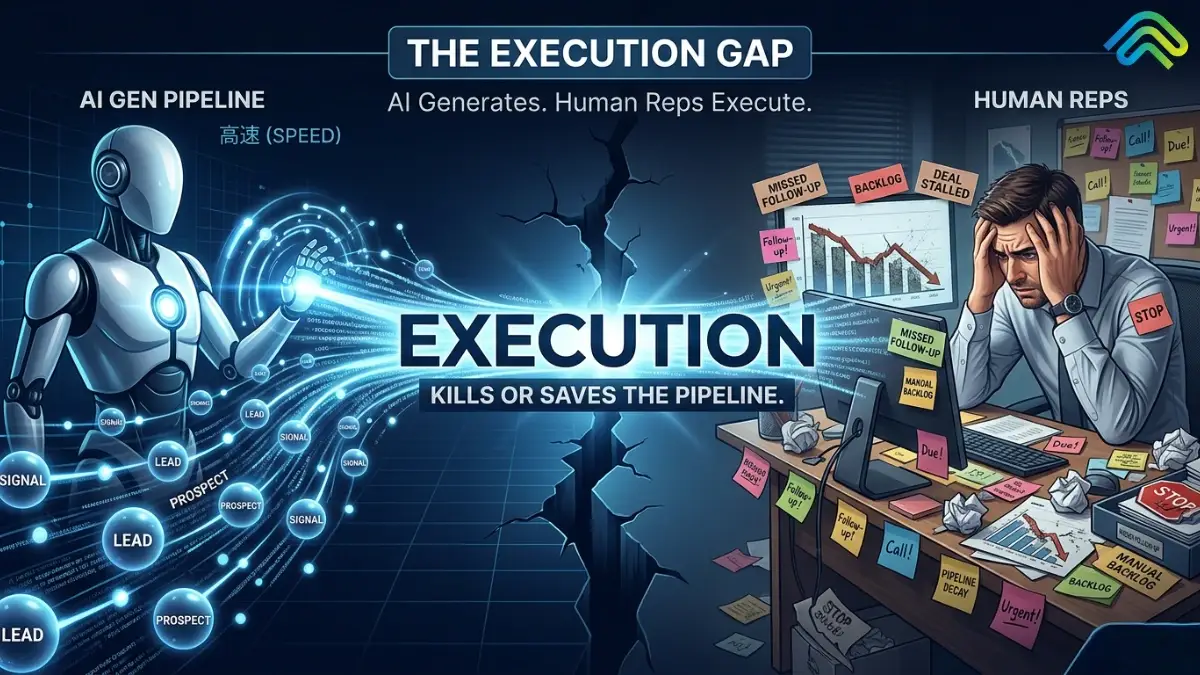
Every AI SDR on the market makes the same promise: automate your outbound sales, send personalized messages at scale, qualify leads in real time, and book meetings while your team sleeps. And to be fair, many of them deliver on that promise. At least for the first touch.
The problem is what happens after.
An AI outbound agent can find the right buyer, craft a compelling cold email, and get a reply. But the moment that reply arrives, the moment a lead becomes a real opportunity, execution falls back on humans. CRM updates happen late, follow-ups get missed, buyer research doesn’t happen before calls, and deals that looked alive quietly decay in the pipeline.
That gap between generating a lead and consistently executing every revenue action after it is not an SDR problem. It is an execution problem. And it is where most AI SDR tools stop and where revenue starts slipping.
This guide covers what an AI SDR actually is, how AI outbound agents work, the real differences between AI and human SDRs, how to choose the right tool for your sales team, and why the smartest B2B teams in 2026 are pairing their AI SDR with a revenue execution layer that owns the follow-through.
What Is an AI SDR?
An AI SDR (artificial intelligence sales development representative) is software that uses AI to automate the tasks a human SDR would normally handle: prospecting, lead qualification, personalized outreach, cold email sequences, follow-ups, and meeting scheduling. Think of it as a virtual sales rep that operates around the clock, sending personalized messages based on buyer data without needing breaks, holidays, or ramp time.
The core capability that separates an AI SDR from basic sales automation is intent. A traditional email sequencer sends email A on day one and email B on day three regardless of what the prospect does. An AI SDR reads signals in real time, a prospect visiting your pricing page, a company announcing funding, a decision-maker changing jobs and adjusts its messaging, timing, and channel based on what those signals mean.
In practical terms, an AI SDR handles six core functions across the sales process:
- Automated prospecting and lead enrichment: Scrapes LinkedIn, company databases, and public sources to build and enrich lead lists that match your ideal customer profile.
- Personalized outreach at scale: Crafts cold email and LinkedIn messages based on real buyer context, recent news, tech stack, hiring patterns, social activity, not just mail-merge tokens.
- Lead qualification and scoring: Analyses responses, engagement signals, and ICP fit to determine which leads are worth pursuing and which should be deprioritised.
- Follow-up automation: Manages multi-step sequences across email and LinkedIn, adjusting cadence and messaging based on how the prospect engages.
- Reply handling: Detects intent behind replies, handles objections, answers basic questions, and routes qualified conversations to human reps.
- Meeting scheduling: Books meetings directly into rep calendars, handles timezone logic, and manages rescheduling, without back-and-forth friction.
AI SDR vs Human SDR: An Honest Comparison
The AI SDR versus human SDR debate has a clear answer: you need both, but for different reasons.
AI outbound agents dominate on scale, consistency, and cost. A human SDR costs $75,000–$100,000 annually and typically generates 15–20 qualified opportunities per month. An AI SDR platform runs $500–$2,000 monthly and can produce 40–60 qualified opportunities at comparable quality. The economics are hard to argue with.
But scale is only half the story. Here is where each excels:
| Capability | AI SDR | Human SDR |
| Speed | Responds to inbound leads within minutes, 24/7 | Average response time is 48 hours; 73% of leads never get a first reply |
| Personalization | Data-driven; pulls context from intent signals, LinkedIn, and CRM | Intuition-driven; reads cultural nuances, emotional cues, and unscripted situations |
| Consistency | Never misses a follow-up, never has an off day | Variable; affected by fatigue, motivation, and competing priorities |
| Relationship building | Limited; handles early-stage outreach well but can’t build trust over complex deal cycles | Excels; empathy, rapport, and judgement win complex B2B deals |
| Cost | $500–$2,000/month | $75,000–$100,000/year plus benefits and ramp time |
| Qualifying leads | Instant scoring based on engagement and ICP fit | Nuanced judgement on deal complexity, org dynamics, and buying committee alignment |
The smart play is not replacing your sales team with AI. It is using AI agents to handle the volume-heavy, repetitive work at the top of the funnel, prospecting, cold outreach, initial qualification and freeing your human reps to focus on relationship building, complex conversations, and closing.
SaaStr reports the average SDR tenure is just 14 months, with 52% leaving within a year. Every time an SDR leaves, you lose 3–4 months of ramp time. An AI SDR eliminates that churn entirely. It does not get promoted, poached, or burned out.
How AI Outbound Agents Actually Work?
An AI outbound agent runs on a four-stage cycle that mirrors what a strong human SDR does, but at a speed and scale no human can match.
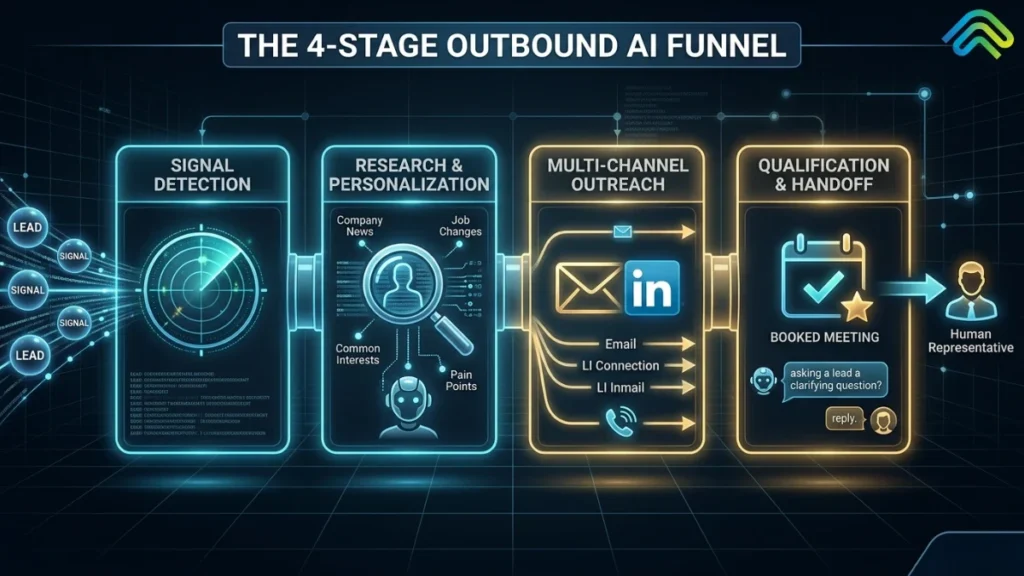
Stage 1: Signal Detection and Targeting
The agent monitors intent signals across multiple data sources: website visits, content downloads, job changes, funding announcements, tech stack changes, and social activity. When a signal fires that matches your ideal customer profile, the agent identifies the right contact and moves to outreach.
This is the shift from volume-based cold outreach to signal-based selling. Instead of blasting 10,000 generic emails, the AI targets accounts that are already showing buying behaviour. Signal-based outbound campaigns consistently achieve 15–25% reply rates, compared to the 3–5% average for untargeted cold email.
Stage 2: Research and Personalisation
Once a target is identified, the agent enriches the contact with buyer intelligence: company context, recent news, tech stack, org chart, and any previous interactions logged in the CRM. This context powers genuinely personalised messages, not the “Hi {first_name}, I noticed your company {company_name}” template that everyone ignores.
Stage 3: Multi-Channel Outreach
The agent executes outreach across email, LinkedIn, and sometimes SMS or phone, adjusting channel, tone, and timing based on the prospect’s engagement pattern. Follow-ups are not time-based (“send email 2 on day 3”) but behaviour-based (“send a follow-up referencing the case study they clicked”).
Stage 4: Qualification and Handoff
When a prospect replies, the agent detects intent, interested, objecting, requesting information, or not a fit and responds accordingly. For qualified leads, the AI books meetings directly into rep calendars and syncs all context to the CRM so the rep walks into the call fully prepared.
The Blind Spot Every AI SDR Shares
Here is the part that none of the competitor blogs mention.
Every AI SDR on the market is designed to generate pipeline. They find buyers, send personalized outreach, qualify leads, and book meetings. And they do it well.
But what happens after the meeting is booked? After the discovery call? After the proposal is sent?
The AI SDR hands the deal to a human rep and from that moment, execution depends entirely on whether the rep remembers to:
- Research the buyer before the call
- Update the CRM with call notes and next steps
- Send a contextual follow-up within 24 hours
- Surface deal risks to their manager before it is too late
- Keep the CRM accurate so forecasts actually mean something
The data says they usually don’t:
- 52% of sales reps never make a second follow-up attempt, despite 80% of deals needing 5–12 touchpoints to close.
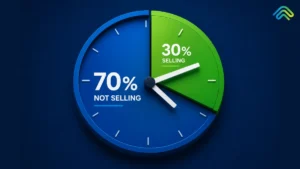
- 70% of a rep’s week goes to non-selling activities, admin, data entry, research, and CRM updates.
- 45% of contacts never get logged in CRM systems. Leadership cannot coach what they cannot see.
- Deals idle for 30+ days have an 80% lower probability of closing. Yet most teams have no system to detect or prevent this.
This is the signal-to-action gap. The AI SDR generates the signal. The rep is supposed to execute the action. But nobody owns the space between signal and action — and that is where revenue quietly leaks.
Why Revenue Execution Is the Missing Layer After AI SDR?
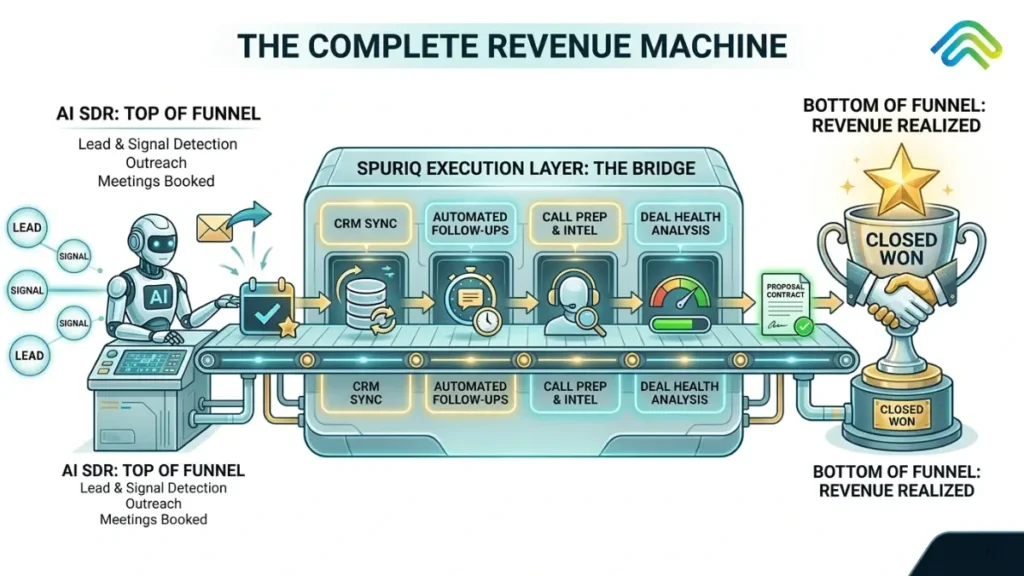
This is the problem SpurIQ was built to solve.
Most AI SDR conversations frame the problem as a pipeline generation problem: how do we get more leads, more replies, more meetings? And that is a real problem. But revenue leaks in two places, before pipeline exists and after pipeline exists. AI SDRs address the first leak. Nobody addresses the second.
SpurIQ is a revenue execution platform that turns buyer and pipeline signals into executed actions. It sits on top of the tools your team already uses, Salesforce, HubSpot, Outreach, Gong and automates the execution that falls through the cracks after the AI SDR does its job.
The Create Track: Signal-Led Outbound
SpurIQ’s Create track works at the stage where AI SDR output enters the revenue process. When a new lead is detected, from a booked meeting, an email reply, an inbound form fill, the system automatically enriches the buyer profile with contextual research, logs the interaction in the CRM, prepares talking points for the rep, and ensures the first response happens within minutes.
Think of it as the execution layer that picks up where your AI outbound agent stops. The AI SDR books the meeting. SpurIQ makes sure everything that needs to happen before, during, and after that meeting actually happens.
The Convert Track: System-Driven Follow-Through
Once a deal is in motion, SpurIQ’s Convert track takes over. It analyses call transcripts, drafts contextual follow-up emails, scores deal health, flags risks to managers, and keeps CRM data accurate, all without the rep touching a keyboard.
In live pilots, CRM data quality jumped from roughly 40% to 95% within three weeks. Reps reclaimed 30–60 minutes per day. Deals that previously sat idle for 30+ days started moving through the pipeline again.
How to Choose the Right AI SDR for Your Sales Team?
With dozens of AI SDR tools on the market, the choice depends on your team’s stage, stack, and sales motion. Here are the questions that actually matter:
What is your primary pain?
If your sales team has plenty of pipeline but deals are stalling, an AI SDR alone will not fix the problem, you need execution support downstream. If your team is struggling to fill the top of the funnel, an AI outbound agent is the right starting point.
Does it work with your existing stack?
The best AI SDR integrates natively with your CRM (Salesforce, HubSpot), your sequencing tools (Outreach, Salesloft), and your conversation intelligence (Gong). If it requires you to rip and replace your current tools, the implementation cost will likely outweigh the benefit.
How does it handle the handoff?
This is the question most teams forget to ask. When the AI SDR books a meeting or qualifies a lead, what happens next? Does the context transfer cleanly to the CRM? Does the rep get full buyer intelligence before the call? Is there a system that ensures follow-through, or does execution fall back on memory?
Can you measure execution, not just activity?
Open rates and reply rates are important, but they are not revenue metrics. Look for tools that connect outbound activity to pipeline outcomes, meetings booked, opportunities created, deals closed. And look for visibility into execution quality: are follow-ups happening on time? Is the CRM current? Are deals getting stuck?
The Bottom Line
AI SDRs and AI outbound agents have fundamentally changed how B2B sales teams build pipeline. They find buyers faster, send smarter cold outreach, qualify leads in real time, and book meetings at a fraction of the cost of a human SDR team.
But generating pipeline is only half the equation.
The teams winning in 2026 are not just asking “How do we generate more leads?” They are asking “What happens to every lead after we generate it?”
The AI SDR creates the opportunity. Revenue execution ensures it does not die of neglect. Together, they form a complete system, from first signal to final close — where nothing falls through the cracks because execution is owned by the system, not by human memory.
Frequently Asked Questions(FAQs):
Q. What is an AI SDR?
An AI SDR is an AI-powered sales development representative that automates prospecting, personalized outreach, lead qualification, and meeting scheduling. It handles the repetitive top-of-funnel sales tasks that consume the majority of a human SDR’s time.
Q. Can an AI SDR replace a human SDR?
For top-of-funnel outreach and lead qualification, yes. AI SDRs handle volume, consistency, and speed better than humans. But for relationship building, complex deal management, and nuanced objection handling, human sales reps remain essential. The best results come from a hybrid model.
Q. What is an AI outbound agent?
An AI outbound agent is an AI-driven system that automates the full outbound sales cycle: detecting intent signals, enriching buyer data, sending personalised messages across email and LinkedIn, handling replies, qualifying leads, and booking meetings.
Q. How much does an AI SDR cost?
Pricing ranges from $40/month for basic cold email tools to $35,000+/year for enterprise-grade autonomous agents. Mid-range platforms like AiSDR ($900/month) and Reply.io ($300–$500/month) offer the best balance of automation depth and affordability for growing teams.
Q. What happens after the AI SDR books a meeting?
This is where most AI SDR implementations fall short. After the meeting is booked, execution — buyer research, CRM updates, follow-ups, deal risk management, falls back on human memory. Revenue execution platforms like SpurIQ automate this downstream execution so nothing slips through the cracks.
Q. What is the signal-to-action gap?
The signal-to-action gap is the space between detecting a revenue signal (a reply, a meeting, a stalled deal) and completing the action required to move that signal toward revenue. Most B2B teams lose 20–30% of potential revenue because this gap is not systematically closed.