You just got off a great sales call. The buyer was engaged. They leaned in when you showed them that specific workflow. They asked good, probing questions about implementation. You mutually agreed on the next steps, smiled, and ended the Zoom meeting.
Now you are back at your desk, staring at your inbox, and you have exactly 30 minutes before your next scheduled call.
What you do in those next 30 minutes will fundamentally decide whether this deal closes or quietly dies in the pipeline. If you have been searching for exact frameworks on how to write follow-up email after sales call meetings to keep momentum alive, this guide is your answer.
The data on post-call behavior is staggering. According to internal studies at SpurIQ, 52% of sales reps never follow up twice. Worse, the buyer’s memory of your call decays rapidly. Applying the Ebbinghaus forgetting curve to B2B sales reveals that your buyer will forget roughly 50% of your conversation within 24 hours. However, reps who send a highly relevant follow up email after sales call wrap-ups within 30 minutes see 2.4x higher reply rates compared to those who wait until the next day (Sopro 2026).
This guide isn’t about the vague philosophy of “staying in touch.” It is an execution manual. A high-converting sales call follow up email is a strategic asset. Below, you will find 12 tailored templates organized by exact scenarios-from post-discovery to stalled deals. You will also get the timing framework that dictates which template wins, the subject lines that actually get opened, and a breakdown of the critical mistakes that kill follow-ups before they are even read.
Why Most Follow-Up Emails Fail
Before you copy and paste a template, you need to understand why your current follow-ups are being ignored. Modern buyers are inundated with automated cadences and generic check-ins. Your sales call follow up email strategy has to stand out. If your email falls into one of these five failure patterns, it will be archived instantly.
The 5 Failure Patterns
- Failure 1 – They are sent too late. The buyer’s memory of your call has already faded. If you wait 24 to 48 hours to send your recap, your buyer has already sat through three other vendor meetings, fought two internal fires, and cleared their inbox twice. Your context window has permanently closed.
- Failure 2 – They are entirely generic. Starting an email with “Great to connect today” followed by canned next-steps language signals that you, the rep, weren’t fully present. The buyer immediately reads it as an automated template-because it is one. When personalization drops, the reply rate craters. (Note: While a sales call follow up email requires a slightly different initial hook to remind them who you are, post-meeting emails must be hyper-personalized).
- Failure 3 – They lack a specific, low-friction commitment. Vague words like “Let me know your thoughts” or “How does your calendar look next week?” leave the cognitive burden of the next step entirely on the buyer. Buyers do not move deals forward; reps do. If you aren’t proposing a specific day, time, and agenda, you are creating friction.
- Failure 4 – They miss the buyer’s actual concern. If the buyer raised deep pricing concerns or implementation anxieties on the call, your follow-up email cannot happily summarize feature benefits. The follow-up must directly address the specific friction point that was actually discussed. Ignoring objections in the follow-up signals that you weren’t listening.
- Failure 5 – They never get sent at all. This is the biggest failure mode in B2B sales. The rep got busy. The next call ran long. A Slack notification distracted them. By Tuesday morning, the call is completely forgotten. Whether it’s a critical late-stage check-in or a simple follow up email after sales call connections, forgetting to hit send turns an opportunity into one of 47 stalled, decaying deals in the pipeline.
Every template in this guide is built to structurally address Failures 1 through 4. Failure 5-the very real problem of emails simply not getting sent-is a structural workflow issue, and we will come back to how top teams solve it in the final section of this guide.
12 Sales Call Follow-Up Email Templates That Win Deals
This is the core of your execution strategy. Below are 12 follow up sales call script examples, mapped to specific scenarios in the sales cycle.
Every follow up script for sales calls below is designed to be copied, pasted, and adapted. Always replace the bracketed information [Like This] with highly specific details from your call.
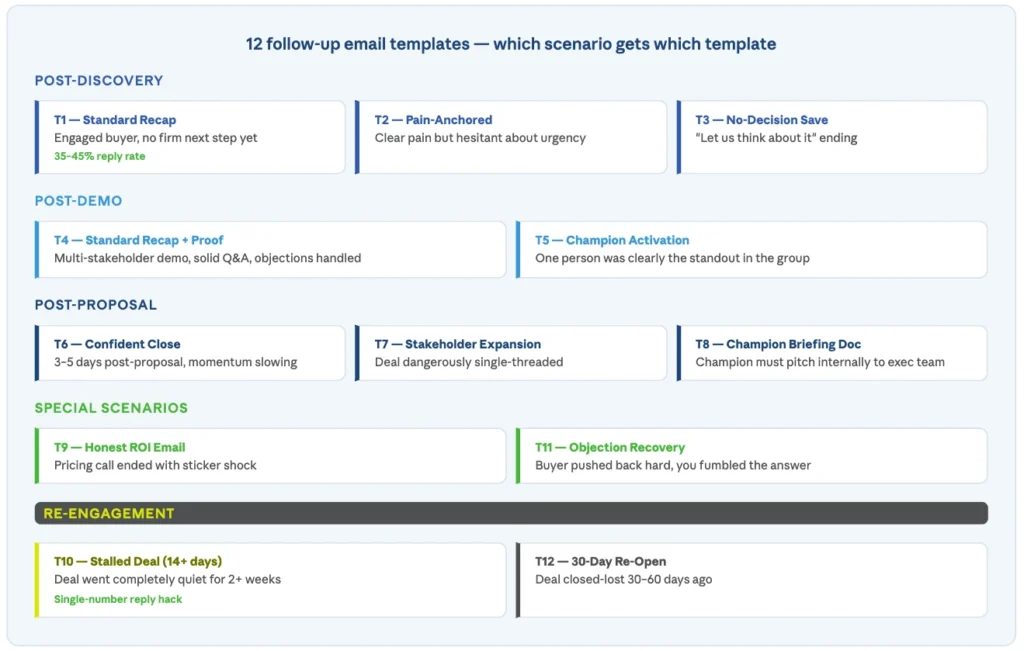
Template 1: Post-Discovery Call – The Standard Recap
Scenario: You just finished a discovery call. The buyer was engaged, shared some pain points, but no concrete, calendar-booked next step was committed to on the call.
When to send: Within 30–60 minutes of the call ending.
Subject line: Recap from our call + next steps
Hi [First Name],

Thanks for the call today. Three things I took away:

[Specific challenge they mentioned] is currently costing [specific impact they shared].

You’re evaluating [solution category] because [specific reason].

Your timeline is [their stated timeline].

Based on what you shared, here’s what I think makes sense as a next step: [specific action - e.g., “I’ll prepare a 20-minute walk-through showing how teams in your situation typically solve [specific challenge]. Does Thursday at 2 PM work?”].

If I’ve missed anything or got something wrong, just reply and let me know.

Thanks,

[Your name]
Why it works: This template relies on the rule of three. By listing three highly specific details they shared, you prove active listening. Proposing one concrete next step removes the decision-making burden from the buyer. Finally, the “safety valve” at the end reduces resistance and invites a low-pressure correction, which often sparks a reply. In B2B SaaS contexts, variations of this framework yield 35–45% reply rates.
Template 2: Post-Discovery Call – The Pain-Anchored Recap
Scenario: During discovery, the buyer expressed clear, distinct pain but seemed highly hesitant about the urgency or the effort required to change.
When to send: Within 60 minutes of the call ending.
Subject line: Cost of waiting on [their specific challenge]
Hi [First Name],

Thanks for the conversation. I’ve been thinking about what you shared - specifically [the pain they mentioned].

A few teams we’ve worked with had similar situations. The pattern we keep seeing: every quarter the problem stays unsolved, the cost compounds. For [their context], it usually shows up as [specific cost - missed quota, lost deals, churned customers, lost time].

I’m not trying to push you toward a fast decision. But I’d hate for the timing to be wrong by the time we talk again.

What would be the one thing that would help you decide if this is worth a deeper conversation? Happy to send something specific if it would help.

Thanks,

[Your name]
Why it works: It addresses their hesitation head-on, which builds immediate trust. Instead of pitching features, it reframes their inaction as a tangible cost, creating urgency without applying aggressive sales pressure.
Template 3: Post-Discovery Call – The No-Decision Save
Scenario: The discovery call ended with the dreaded phrase, “Let us think about it and get back to you.” This is a classic indicator of a no-decision outcome.
When to send: Within 2 hours of the call ending.
Subject line: Two questions before you decide
Hi [First Name],

Thanks for being honest at the end of our call about needing time to think. Most buyers in your position do.

Before you do, two questions that might save you time:

What would have to be true for this to be an obvious yes for you?

What’s the cost of staying with [current state / current solution] for another quarter?

No need to reply with detailed answers. But if you sit with both questions for ten minutes, you’ll know whether to invest more time exploring this with us or move on.

Either answer is fine. I’d rather you make the right call than the fast one.

Thanks,

[Your name]
Why it works: It reframes “I need to think about it” from a stall tactic into a structured internal decision exercise. By stating “Either answer is fine,” you signal massive professional confidence and detach from the outcome.
Template 4: Post-Demo – The Standard Recap with Proof
Scenario: You delivered a standard product demo to multiple stakeholders. The demo went well, objections were handled, and it is time to solidify next steps with a tailored follow up email after sales presentation.
When to send: Within 30 minutes of the demo ending.
Subject line: Demo recap + the one thing I’d revisit
Hi [First Name] (cc: [Other Stakeholders]),

Thanks to everyone for the demo today. The questions you raised about [specific thing] were sharp - here’s a quick recap:

What we covered:

[Use case 1 they cared about]

[Use case 2 they cared about]

[Specific feature/workflow they pushed back on or asked deeper questions about]

Where I’d revisit: [The specific concern or unresolved question]. Here’s a [link/document/short video] that addresses it directly.

Proposed next step: A 20-minute call with [specific person from buyer side, e.g., their technical evaluator] to walk through [specific aspect]. I’ve sent it a few times - [Tuesday 10 AM, Wednesday 2 PM, Thursday 4 PM]. Pick whichever works.

Thanks,

[Your name]
Why it works: This executes perfect multi-threading by CCing all stakeholders, keeping the whole buying committee aligned. It intentionally highlights the area of pushback rather than sweeping it under the rug, providing immediate proof/resources to resolve it.
Template 5: Post-Demo – The Champion-Activation Email
Scenario: During a group demo, one specific person was clearly the most engaged. They asked the smartest questions and seemed to grasp the value immediately. This is your potential champion.
When to send: Within 60 minutes of the demo ending.
Subject line: Quick thought on what you said about [specific topic]
Hi [First Name],

Really appreciated your perspective on [specific topic they engaged with deeply]. That kind of clarity is rare in evaluations like this.

One thing I want to flag: based on what you said, I think [Your Product] could solve [specific challenge they mentioned] faster than the rest of your team realises. Most evaluators in your position become the internal voice for change - and that’s usually how decisions like this get made.

If you want, I can put together a one-page summary you could share internally. Just the facts, nothing salesy. Lots of evaluators have told me that’s the most useful thing I can give them.

No pressure either way. Just wanted to acknowledge that you got it.

Thanks,

[Your name]
Why it works: Champion activation is arguably the highest-leverage move in modern B2B sales. This email validates their intelligence, which drives internal commitment.
Template 6: Post-Proposal – The Confident Close
Scenario: The proposal has been sent. The buyer has had it for 3 to 5 days, and the once-active conversation is starting to slow down.
When to send: 3–5 business days after the proposal was sent.
Subject line: Where are we?
Hi [First Name],

It’s been a few days since the proposal went over. I want to be direct with you, because I think you’d appreciate it more than another “just checking in” email.

Where are we?

Three possibilities I’m guessing at:

You’re still building internal alignment and need more time - totally normal, just tell me where you are.

You’ve got a specific concern you haven’t raised yet - I’d much rather hear it now than guess at it.

The timing has shifted and this is no longer a priority - also fine, just say so and I’ll stop chasing.

Whichever it is, a one-line reply tells me how to be useful to you from here.

Thanks,

[Your name]
Why it works: This is the highest-converting check-in pattern in modern sales. It is highly direct without crossing the line into aggression. By explicitly naming three plausible scenarios, you give the buyer easy psychological “outs.”
Template 7: Post-Proposal – The Stakeholder Expansion
Scenario: The proposal is stalling, and your internal radar tells you this deal is dangerously single-threaded. Only one person is truly engaged, and they lack the power to sign.
When to send: 5–7 business days after the proposal is sent, right when momentum dips.
Subject line: Who else should be in the conversation?
Hi [First Name],

I know you’ve been the main person on this evaluation, and I appreciate that.

From my experience working with companies like [Their Company], decisions like this usually involve [specific roles - e.g., “the CFO for budget validation, the CTO for technical sign-off, and the head of [their function] for adoption planning”].

Who else internally would benefit from being looped in at this stage? Happy to set up a 30-minute conversation tailored to whoever you think is most relevant. Often it accelerates the decision - not the other way around.

Thanks,

[Your name]
Why it works: It addresses the reality of complex buying committees without accusing the contact of lacking authority. You offer to do the administrative work of setting up the call, and logically frame expanding the committee as a way to speed up the process.
Template 8: Post-Champion Call – The Internal Briefing Doc
Scenario: You just finished a 1:1 sync with your champion who now has to go pitch your solution to their executive team or board.
When to send: Within 2 hours of the call.
Subject line: Your internal briefing doc
Hi [First Name],

As promised, here’s the briefing doc you can share internally with [stakeholder names you discussed].

The one-pager covers:

The problem [Their Company] is solving

Why this matters in [specific business context they shared]

How [Your Product] specifically addresses it

Investment and timeline

3 references from companies similar to yours

Use it however helps. Edit it, add your own framing, ignore the parts that don’t apply. The goal is to make your internal conversation easier, not give you another thing to manage.

If you want, I can join the [stakeholder] conversation directly. Or stay in the background and let you run it. Whatever works for you.

Thanks,

[Your name]
Why it works: It treats your champion like the actual buyer. You are providing them with an asset, not a marketing pitch. Giving them permission to “edit it or ignore parts” makes it feel like their own internal document.
Template 9: Post-Pricing Call – The Honest ROI Email
Scenario: You just got off a call where pricing was revealed. The buyer experienced sticker shock, raised immediate concerns, or showed distinct hesitation about the investment.
When to send: Within 60 minutes.
Subject line: The ROI math, made simple
Hi [First Name],

I heard you on the pricing point. It’s a fair question.

Here’s the math the way I’d look at it if I were in your seat:

Investment: [specific cost]

Time to value: [realistic timeline]

Most teams in your situation see [specific outcome] within [timeframe]

The conservative ROI math: [specific calculation tied to their numbers]

If the math doesn’t work, I’d rather hear that now than push you into something that doesn’t fit. If it does, here’s what the next step looks like: [specific action].

Either way, want to give you something concrete to react to.

Thanks,

[Your name]
Why it works: Avoidance kills deals. This email acknowledges the specific pricing concern instantly. Showing the math transparently builds immense credibility.
Template 10: Re-Engaging a Stalled Deal
Scenario: You had great momentum, but the deal has been dead quiet for 14+ days. You suspect it is slipping away.
When to send: Day 14–21 of total silence.
Subject line: Closing this out?
Hi [First Name],

It’s been a couple of weeks since we last spoke, and I want to respect your time.

Three options for where this stands:

Still active - you’re working through internal alignment and just need more time. Tell me what would help.

Stalled - something shifted and the timing’s wrong. I’d rather know than chase.

Done - you’ve made a different decision. Also fine, just close the loop with me.

A one-line reply with the number that matches gets us both clarity. No long explanation needed.

Thanks,

[Your name]
Why it works: Silence is usually driven by the buyer feeling guilty that they haven’t made progress. This email removes the guilt. By asking for just a single number in reply, you lower the friction of responding to almost zero.
Template 11: After a Negative or Hesitant Response
Scenario: The buyer pushed back hard on the call. They raised a complex technical objection or competitor comparison that you fumbled or didn’t fully resolve in the moment.
When to send: Within 4 hours of the call.
Subject line: I heard you on [specific concern]
Hi [First Name],

I want to come back to what you said about [specific objection or concern].

I don’t think I gave you a fully satisfying answer in the moment. Here’s what I should have said:

[Specific, direct response to the objection. 3–5 sentences. Acknowledge the concern, reframe if appropriate, offer evidence or a different angle.]

Does this address what you were getting at? If not, I’d rather take another shot at it than gloss over it.

Thanks,

[Your name]
Why it works: Radical self-awareness builds enormous trust. Going back to specifically address a weak answer proves you respect the buyer’s intellect and care more about getting it right than sounding perfect.
Template 12: The 30-Day Re-Open
Scenario: A deal was marked closed-lost or went totally silent over a month ago. You want to re-open the door without sounding desperate.
When to send: 30–60 days after the deal was lost or went silent.
Subject line: 30 days later – has anything changed?
Hi [First Name],

It’s been about a month since we last spoke. I’m not writing to chase - I’m writing because I’ve been thinking about [specific challenge they had].

A few things have changed in that time:

[Specific update relevant to their pain - a new feature, a new case study, market data, an industry shift]

[Specific update 2]

If any of this changes how you’re thinking about it, happy to talk again. If not, no follow-up needed - I’ll close the loop on my end.

Thanks,

[Your name]
Why it works: You are providing a legitimate, value-driven reason to re-engage rather than just bumping a dead thread. Explicitly stating that you will close the loop if they don’t reply removes their anxiety about a never-ending drip campaign.
Subject Lines That Get Opened
Your follow-up email is useless if it is never opened. Your sales follow-up email subject lines dictate 50% of your success. If your subject line looks like an automated marketing blast, the buyer’s brain will filter it out before they consciously process the words.
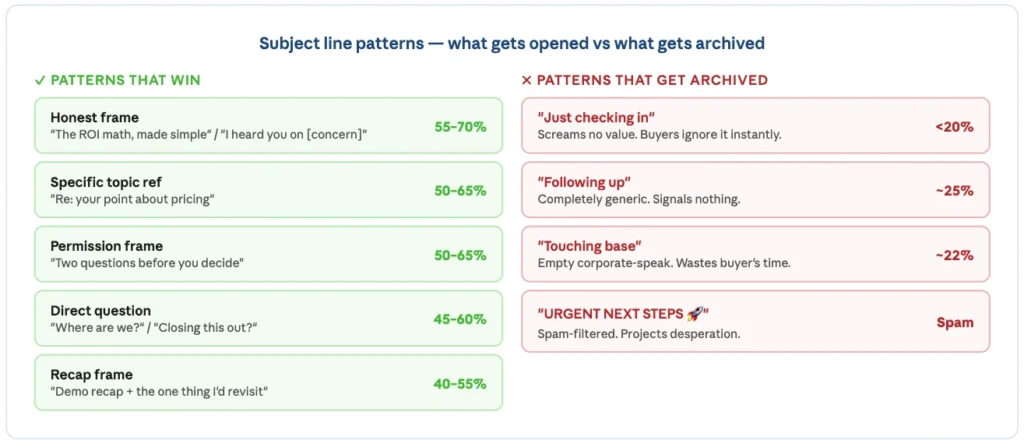
The 6 Subject Line Patterns That Win in 2026
- The Direct Question: “Where are we?” / “Closing this out?” / “30 days later – has anything changed?”
- Why it works: It is highly specific, applies low pressure, and cuts through corporate jargon. Open rates typically sit at 45–60%.
- The Specific Topic Reference: “Re: your point about pricing” / “Follow-up on the API question from Thursday”
- Why it works: It references something incredibly concrete from the live call, immediately signaling that this is a 1-to-1 human email. Open rates: 50–65%.
- The Recap Frame: “Recap from our call + next steps” / “Demo recap + the one thing I’d revisit”
- Why it works: It is purely utility-driven. The buyer knows exactly what is inside. Open rates: 40–55%.
- The Permission Frame: “Two questions before you decide” / “Quick thought”
- Why it works: It promises a low ask and a quick read. Open rates: 50–65%.
- The Honest Frame: “The ROI math, made simple” / “I heard you on [concern]”
- Why it works: Radical directness signals confidence and intrigue. Open rates: 55–70%.
- The Curiosity Gap: “Something I should have said yesterday” / “One thing about your team”
- Why it works: It pulls the reader in psychologically. Open rates are high (50–65%), but beware-the reply rate strictly depends on your email delivering a solid payoff.
Subject Line Patterns to Avoid Like the Plague
- “Just checking in” – This is the most ignored subject line in modern B2B sales. It screams “I want something from you but have no value to add.” Open rates hover under 20%.
- “Following up” – Completely generic. It signals nothing. Opens at around 25%.
- “Touching base” – Empty corporate-speak that wastes the buyer’s time. Opens at 22%.
- All caps or emoji-heavy – (e.g., “URGENT NEXT STEPS 🚀“). These are instantly flagged by enterprise spam filters and project deep desperation to the buyer.
The Timing Framework – When to Send Each Type
As highlighted in the data, your speed-to-lead and speed-to-follow-up are among the strongest predictors of your ultimate reply rate. Knowing exactly when to send follow-up email after sales call touchpoints is critical.
The absolute best template in the world, sent three days too late, will lose to an average template sent in the perfect psychological window. Use this framework to govern your execution:
| Template Type | Optimal Send Window | Why This Window Wins |
| Post-discovery recap | 30–60 minutes after call | Buyer’s memory of the call is at its peak; reinforces immediate engagement. |
| Post-demo recap | Within 30 minutes | Demos generate the highest emotional engagement; capture that momentum instantly. |
| Post-demo champion | 60 minutes | Allows you a moment to accurately identify the right person, but catches them while the demo is fresh in their mind. |
| Post-proposal check-in | 3–5 business days | Gives the buying committee enough time to circulate the document, but triggers before they lose momentum. |
| Stakeholder expansion | 5–7 business days | Hits right at the point where single-threaded deals naturally begin to stall out. |
| Stalled deal re-engage | 14–21 days of silence | Enough time has passed to validate it is truly stalled, removing the pressure of immediate follow-ups. |
| 30-day re-open | 30–60 days post-loss | Long enough for their situation to have changed or their current patch to have failed. |
(For a deeper dive on how timing impacts conversion across your entire pipeline, review the latest speed-to-lead metrics).
Mastering the Internal Context
Sending the right email is only part of the equation. Understanding why a buyer is reacting a certain way requires connecting their behavior to wider company signals.
Are they stalling because they don’t have a budget, or because a competitor is suddenly in the mix? Being able to read the signal-to-action gap in your B2B GTM stack allows you to choose between Template 6 (The Confident Close) and Template 9 (The Honest ROI Email) with pinpoint accuracy.
Furthermore, utilizing advanced AI deal risk scoring can tell you precisely when a deal is shifting from “evaluating” to “stalled,” ensuring you trigger Template 10 exactly on day 14, rather than blindly hoping they email you back.
Sales leaders often debate how many sales call follow-up emails. The answer isn’t a fixed number, but a contextual cadence based on these real-time buyer signals and the timing framework mapped out above.
The Execution Gap: Solving the “Not Sent” Problem
We have established the templates, the subject lines, and the exact timing windows. We have solved Failures 1 through 4.
But what about Failure 5? What happens when these emails simply never get sent?
This is where the tactical reality of sales breaks down. AEs and SDRs are managing dozens of active opportunities, handling internal meetings, and trying to source new pipelines simultaneously. Relying on sheer willpower and sticky notes to ensure a customized Post-Demo Champion email goes out exactly 60 minutes after a call is a losing strategy.
This is an execution problem, and it requires an execution solution.
This is where SpurIQ steps in. As a comprehensive revenue execution platform, it is designed to bridge the gap between knowing exactly what you should do and actually getting it done at scale.
Through its advanced Deal IQ capabilities, SpurIQ monitors your active pipeline and meeting schedules. It doesn’t just give you a generic cadence tool; it understands the context of your deals. When you log off a highly-scored discovery call, SpurIQ is the layer that ensures the right template from this very guide is surfaced, populated with the right variables, and queued up to send in that critical 30-to-60-minute window.
It eliminates the “I forgot to follow up” excuse entirely. It takes the cognitive load of timing, template selection, and stakeholder mapping off the rep’s shoulders, allowing them to focus entirely on the human elements of the deal-customizing the variables, handling the complex objections, and actually selling.
(To see how automating these critical follow-up workflows fits into your broader pipeline strategy, explore our guide on modern revenue operations strategies ).
Your Next Steps
You have the detailed Sales Call Follow-Up Email templates. You have the timing framework. Bookmark this page.
The next time you end a Zoom call, do not switch over to Slack. Do not go grab another coffee. Open your inbox, pull the matching scenario template from this list, drop in your specific variables, and hit send within 30 minutes.
Watch what happens to your reply rates.
FAQs (Frequently Asked Questions):
How do you write a follow-up email after a sales call?
Send within 30–60 minutes of the call. Reference three specifics the buyer said. Acknowledge any concerns raised. Propose one concrete next step with a specific time. Keep it under 200 words. Sign off with your name only, no corporate signature padding.
When should I send a follow-up email after a sales call?
Within 30–60 minutes for discovery and demo calls, the buyer’s memory peaks early. Within 4 hours for follow-ups addressing objections (allow time to craft a thoughtful response). For proposals, wait 3–5 business days before checking in. For stalled deals, 14–21 days of silence is the right re-engagement window.
What’s a good subject line for a sales follow-up email?
The highest-opening subject lines are direct questions (“Where are we?”), specific topic references (“Re: your point about pricing”), or honest framing (“The ROI math, made simple”). Avoid “just checking in,” “following up,” and “touching base”, these open at under 25%.
How many follow-up emails should I send?
In B2B, three follow-ups across two weeks is the sweet spot for active deals. For stalled deals, send a re-engagement email at the 14–21 day mark, then a final close-out email at 30 days. After that, move to a 30–60 day re-engagement cadence rather than continued chasing.
How do I make sure follow-up emails actually get sent?
Templates and discipline aren’t enough, 52% of reps still miss follow-ups even when they have both. The reliable solution is structural: automated post-call detection that drafts the follow-up, pulls specific quotes from the transcript, and routes it back to the rep for a quick review. Revenue execution platforms like SpurIQ are built specifically for this layer.
What’s the difference between a follow-up email after a cold call vs after a sales call?
Cold call follow-ups need to re-establish context, the buyer doesn’t remember you. Sales call follow-ups assume context exists — the buyer just spoke with you. Cold call follow-ups should reference specific value props; sales call follow-ups should reference specific things the buyer said.
Should I attach the proposal to my follow-up email?
Only if the buyer explicitly asked for it on the call. Otherwise, send the recap email separately and the proposal as a follow-up later in the day. Mixing the two reduces engagement on both, buyers either skim the recap or skip straight to pricing without context.
What should I include in a follow-up email after a sales presentation?
Recap of what was covered, the one specific concern or question that needs follow-up (always include this, it acknowledges pushback), a clear next step with proposed times, and a low-pressure closing. Keep it under 250 words. CC all stakeholders who attended the presentation.