B2B sales (business-to-business) is the process of selling products or services from one business to another business, rather than to individual consumers.
That definition has not changed. What has changed is everything around it. The real question is not just what is b2b sales, but how they function in the current buyer-driven market.
B2B sales is undergoing its biggest structural shift in two decades. Buyers are no longer waiting for a sales rep to educate them. According to 6Sense, 81% of B2B buyers now choose their preferred vendor before they ever pick up the phone with a salesperson. This shift has forced sales teams to rethink how they engage prospects, personalize outreach, and identify buying intent much earlier in the journey.
As a result, AI has moved from a pilot experiment to a daily operating reality. A Salesforce report found that 81% of sales teams use it somewhere in their workflow. Furthermore, capital efficiency has become non-negotiable, with median CAC payback now stretching to 20-23 months, according to Benchmarkit (2025). The selling motion that drove revenue in 2019 is not the one driving revenue in 2026.
If we simplify the B2B sales meaning, it is still about businesses selling to businesses, but the way it happens has become far more complex, data-driven, and signal-led.
In this guide, we’ll discuss the following:
- What is b2b sales
- How it differs from B2C.
- How does B2B sales work across different stages
- The core roles involved in B2B sales
- How the B2B sales process works from start to finish
- The skills that drive sales success
- The tools powering modern sales teams
- The key trends shaping B2B sales in 2026
So, without any delay, let’s begin the guide!
What is B2B Sales?
B2B sales, or business-to-business sales, is the process where companies sell products or services to other companies rather than to individual consumers. Unlike B2C sales, B2B transactions usually involve higher deal values, longer decision-making cycles, multiple stakeholders, and more detailed evaluation processes.
In practice, B2B sales work very differently from consumer purchasing. A person buying a laptop may decide in a single afternoon. A company purchasing an enterprise software platform, however, often goes through several stages before making a final decision.
This process may include:
- Security and compliance reviews
- Formal RFP (Request for Proposal) submissions
- Legal and procurement approvals
- Budget sign-offs from finance teams
- Product demos for multiple stakeholders
- Discussions involving six to ten decision-makers across departments
Because of these steps, the buying journey can stretch across several weeks or even months.
That complexity is not a flaw in the system. It reflects the scale of what is at stake. A poor enterprise-level software decision can lead to millions in losses, operational disruption, reduced productivity, and long-term business challenges. The buying process takes longer because the risks, investments, and expectations are significantly higher.
Common B2B Sales Examples
B2B sales occur across almost every industry, from technology to manufacturing. Here are some common real-world examples below:
- SaaS and software: Salesforce empowers enterprise teams to conquer thousands of deals in a single, seamless CRM. On the other hand, Slack turns scattered email threads into faster, more connected teamwork.
- Manufacturing and equipment: Caterpillar Inc. supplies heavy machinery to construction and infrastructure companies, where every purchase is a major investment carefully evaluated by engineering, operations, and finance teams.
- Professional services: Deloitte helps Fortune 500 companies navigate complex business challenges, while agile marketing agencies sell SaaS startups the demand generation support they need to grow faster without building a full in-house team.
- Cloud Infrastructure: Amazon Web Services gives startups the computing power to scale from a small operation to millions of transactions. That too, without investing in their own data centers.
- Industry Materials: Steel manufacturers provide the high-precision materials that automakers rely on, backed by strict quality standards and long-term supply agreements.
- Wholesale and Distribution: Distributors supply products in bulk to restaurants, hotels, and retailers, working behind the scenes to keep everyday customer experiences running smoothly.
B2B Sales vs B2C Sales: What’s the Real Difference?
The main difference between B2B and B2C is not a footnote. It influences every decision a sales organisation makes. From hiring and pipeline structure to performance measurement, it also shapes the overall B2B sales strategy.
For a closer look at how inbound and outbound operate differently within B2B itself, see what is the actual difference between inbound and outbound B2B sales:
| Dimension | B2B Sales | B2C Sales |
| Buyer | The buyer is usually a business, company, or organisation purchasing for operational or growth needs. | The buyer is typically an individual consumer purchasing for personal use. |
| Average deal size | Deal sizes are usually larger, ranging from $1,000 to $1M+ in annual contract value (ACV). | Purchases are generally smaller, typically between $5 and $1,000. |
| Sales cycle | The sales cycle can take 30 days to 18 months, with 90–120 days being common in SaaS. | Buying decisions are usually made within minutes, hours, or a few days. |
| Decision-makers | B2B purchases often involve 6–10 stakeholders as part of a buying committee. | The decision is usually made by 1–2 people, such as an individual or a partner. |
| Purchase rationale | Businesses focus on ROI, efficiency, and long-term value, though emotions still influence decisions. | Consumers are more influenced by emotions, lifestyle preferences, and impulse buying. |
| Evaluation process | Buyers often go through demos, trials, RFPs, security checks, and legal reviews before purchasing. | Buyers mainly rely on reviews, photos, ratings, and quick product comparisons. |
| Marketing approach | Marketing is usually account-based, signal-led, and focused on educational content. | Marketing depends more on ads, social media, branding, and mass-market campaigns. |
| Relationship intensity | B2B sales focus on long-term partnerships and multi-year contracts. | B2C purchases are often transactional or one-time interactions. |
| Sales team structure | Companies often have specialised teams such as SDRs, AEs, CSMs, and RevOps professionals. | Many B2C businesses rely more on marketing or self-service purchasing than on dedicated sales teams. |
| Margin profile | Businesses usually earn higher margins per deal but close fewer deals overall. | Companies depend on lower margins per deal with much higher sales volume. |
The biggest difference between B2B and B2C sales is the buying committee. While a consumer can make a decision alone, B2B purchases usually require approval from multiple stakeholders, each with different priorities.
For example, IT focuses on security, finance looks at cost, sales cares about adoption, and end users want a tool that makes their work easier. That is why multi-threading is so important in B2B sales. Successful reps build relationships with several decision-makers, because deals that rely on just one internal champion are far more likely to stall or fall apart.
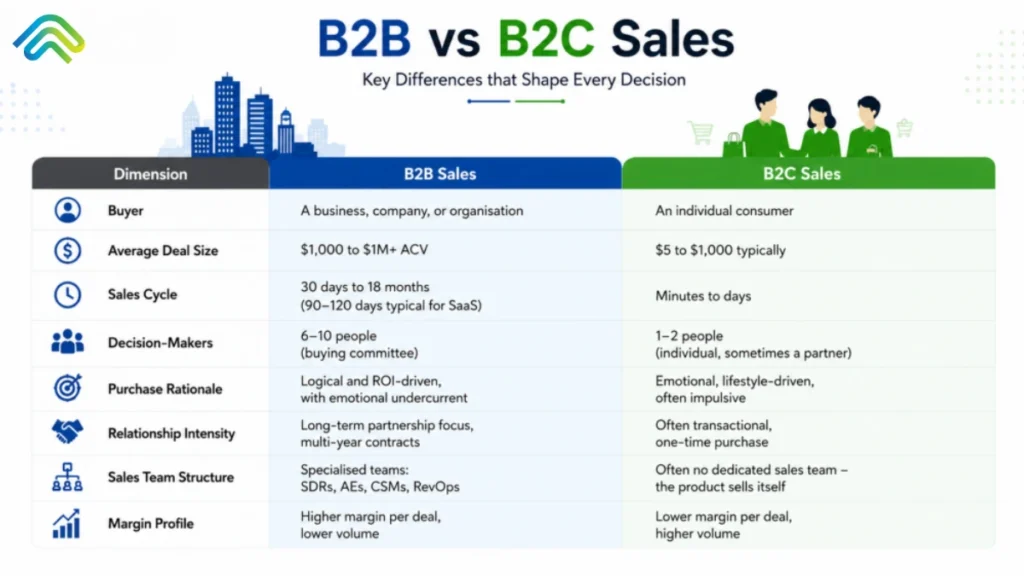
B2B vs B2C sales comparison – Spuriq.ai
The Modern B2B Sales Process
The B2B sales process has seven stages. Each stage demands a different skill set, a different type of conversation, and a different goal. The best sales organisations execute all seven with consistency. Outbound prospecting and outbound lead generation continue to play a critical role in the early stages of pipeline creation, especially in modern B2B revenue teams.
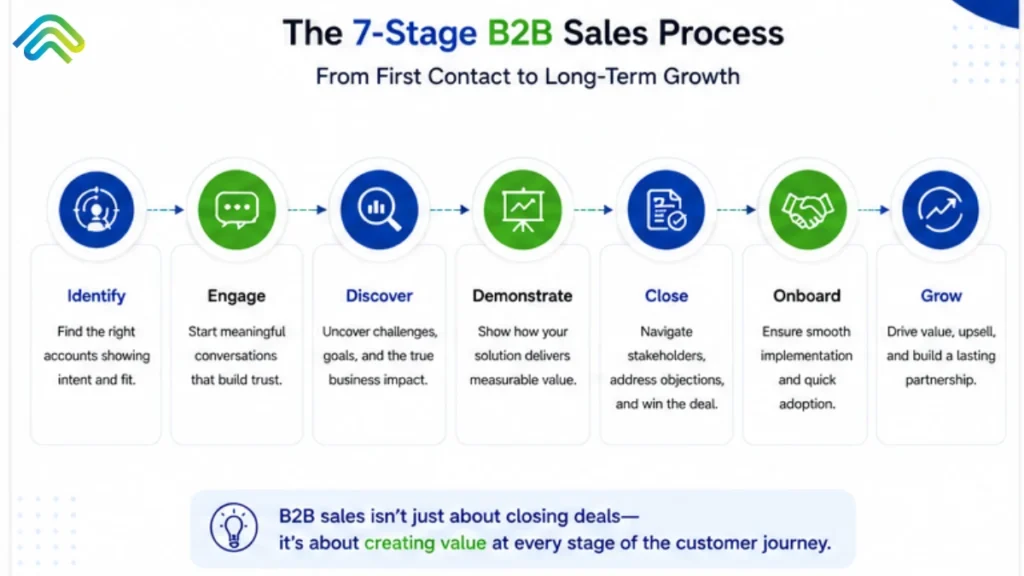
Stage 1: Prospecting
Every deal starts with a list, but not just any list. Great prospecting means identifying the right accounts before outreach even begins. In practice, this means building a list of companies that match the ideal customer profile and then finding the right contacts within them.
In 2026, the best teams are not working from static databases. They are chasing signals. A logistics software company does not cold email every operations director it can find. It looks for companies that just raised a Series B, opened new warehouse locations, or started hiring supply chain roles. Those are not coincidences. They are evidence that a problem worth solving is actively in play. Signal-led prospecting consistently beats volume-led outbound prospecting in reply rate and pipeline quality.rica
Stage 2: Qualification
Chasing every lead is a fast way to exhaust your team and miss your number. Qualification is the discipline of deciding, early and honestly, whether a prospect is genuinely worth pursuing.
Frameworks like MEDDIC, MEDDPICC, BANT, and SPICED exist for exactly this reason. They bring structure to a decision that can otherwise drift on optimism. Ideally, 50–60% of leads should be disqualified at this stage. That is not a failure rate. It is the process of protecting your pipeline, your forecast, and your reps’ time.
Stage 3: Discovery
This is the stage that decides everything, even though it looks like just a conversation. Discovery is where you earn the right to sell by first proving you understand.
A cybersecurity platform selling to a healthcare IT director does not pitch product features in the first 30 minutes. It asks about last quarter’s audit, the compliance gaps the board is watching, and what another breach would actually cost. Good discovery shortens every stage that follows. A bad discovery makes every stage that follows harder than it needs to be.
Stage 4: Demo and Presentation
The demo is not a product tour. It’s a proof. Proof that what you heard in discovery connects directly to what your product can do. The best demos are specific, tailored, and increasingly involve the full buying committee in a single session: the economic buyer, the end user, and the technical evaluator. Alignment in one call beats three weeks of internal relay.
Stage 5: Proposal and Negotiation
The proposal translates the conversation into commercial terms. Pricing, contract terms, payment schedules, implementation commitments. And then the waiting. Legal has redlines. Procurement has timelines. Finance has constraints that did not exist before the demo.
Reps who move through this stage efficiently are the ones who have built relationships across the buying committee long before Stage 5 arrived.
Stage 6: Close
The deal is signed, the contract is executed, and commercial terms take effect. Simple in theory, layered in practice. Modern close runs through digital platforms like DocuSign or PandaDoc, alongside structured procurement workflows.
Enterprise deals go further, adding a final round of security and compliance reviews that simply did not exist in most contracts five years ago. The finish line has more gates than it used to.
Stage 7: Post-Sale Expansion
The initial deal is the starting line, not the finish line. The real value of a B2B customer compounds over time through renewals, upsells, and cross-sells. A company that sells a 10-seat licence in January and expands to a 200-seat enterprise agreement by December did not get there by accident. It happened because a CSM maintained an active relationship, tracked usage signals, understood where new pain was emerging, and brought the right conversation at the right moment.
Net Revenue Retention (NRR) is the metric that captures this motion. Best-in-class B2B SaaS teams achieve 130-150% NRR, meaning revenue from existing customers grows faster than churn erodes it. Teams that deprioritise post-sale expansion are not just leaving money on the table. They are building a business that has to sprint just to stand still.
Who is Involved in B2B Sales?
Every role in a B2B sales organisation owns a specific part of the revenue motion. The structure varies based on how the company goes to market, but the core functions stay consistent. As sales teams evolve, AI SDR and AI BDR models are also beginning to reshape how companies handle prospecting, qualification, and early-stage outreach.
| Role | What They Do | Typical US Salary Range |
| SDR (Sales Development Rep) | SDRs focus on outbound prospecting and are responsible for identifying potential buyers, starting conversations, and booking qualified meetings for Account Executives. | $50K–$80K base + bonus |
| BDR (Business Development Rep) | BDRs often manage inbound lead qualification while also supporting outbound outreach to identify new business opportunities. | $50K–$80K base + bonus |
| Account Executive (AE) | Account Executives manage the full sales cycle, from discovery and qualification through negotiation and closing deals. | $80K–$200K+ OTE |
| Sales Engineer (SE) | Sales Engineers support the sales process by handling technical demonstrations, solution architecture discussions, and product-specific questions alongside the AE. | $120K–$220K+ OTE |
| Sales Manager | Sales Managers coach sales representatives, conduct pipeline reviews, monitor performance, and help teams achieve quota targets. | $140K–$250K+ OTE |
| VP Sales / Head of Sales | The VP of Sales or Head of Sales oversees sales strategy, team hiring, forecasting, and overall revenue execution across the organisation. | $200K–$400K+ OTE |
| Customer Success Manager (CSM) | Customer Success Managers focus on post-sale relationships by driving customer retention, renewals, and account expansion opportunities. | $80K–$180K OTE |
| RevOps / Sales Ops | Revenue Operations and Sales Operations teams manage systems, reporting, forecasting, analytics, and operational processes across the revenue organisation. | $110K–$220K+ |
| CRO (Chief Revenue Officer) | The Chief Revenue Officer oversees all revenue-generating functions, including sales, marketing, and customer success. | $300K–$1M+ OTE |
Why Team Structure Matters
The structure of a B2B sales team reveals a lot about how a company approaches selling. Different team setups reflect different B2B sales strategies, customer expectations, and market dynamics.
For example, an outbound-focused enterprise software company typically includes:
- A large SDR team to handle prospecting and lead generation
- Multiple AEs organised by territory or deal size
- Sales Engineers to support technical evaluations and demos
- A dedicated RevOps team to manage tools, processes, and workflows
In contrast, a product-led growth (PLG) company may not rely on SDRs at all. Instead, it uses product usage data to identify engaged users and start sales conversations at the right time.
Neither approach is universally better. Each model is designed around how customers prefer to buy and how the business chooses to grow in its specific market.
How Long is the B2B Sales Cycle?
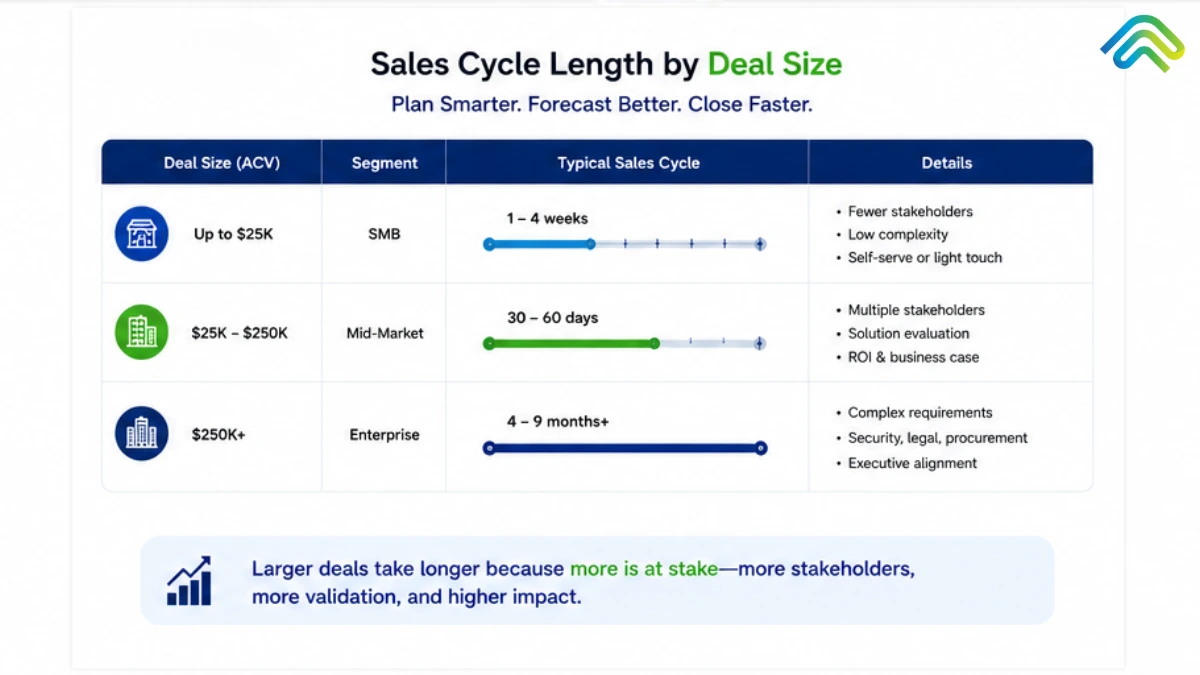
There is no fixed timeline for a B2B sales cycle because the length of the process depends heavily on factors such as deal size, buyer complexity, approval layers, and the number of stakeholders involved. Some smaller deals can close within a few weeks, while large enterprise agreements may take several months or even more than a year.
In 2026, the median B2B SaaS sales cycle is approximately 84 days (SaaSHero benchmarks). However, this average does not fully reflect the wide variation in sales cycles across different deal sizes and market segments.
| Deal Size | Typical Sales Cycle | Key Drivers |
| Under $5K ACV (SMB) | Sales cycles usually close within 1–4 weeks because purchasing decisions are often made by a single buyer. | Lower risk and fewer approvals help speed up the process. |
| $5K–$25K ACV (Mid-market) | Mid-market deals generally take 30–60 days because finance and manager approvals are commonly required. | Budget reviews and internal discussions increase the timeline. |
| $25K–$100K ACV (Mid-enterprise) | Mid-enterprise sales cycles often last 60–120 days due to procurement and multi-team evaluations. | Buying committees and procurement reviews slow decisions. |
| $100K–$500K ACV (Enterprise) | Enterprise agreements usually take 4–9 months because legal, compliance, and security reviews become more detailed. | Contract negotiations and cross-functional approvals extend the cycle. |
| $500K+ ACV (Strategic) | Strategic deals can take 9–18 months or longer because executive approvals and RFP processes are often involved. | Executive buy-in and custom contract negotiations lengthen the process. |
A small software purchase can close within weeks when a single buyer makes the decision using a company card. Enterprise deals are a different story as their approvals often involve multiple departments and stakeholders.
Large enterprise deals typically require approval from:
- Procurement teams
- Legal and compliance departments
- Information security teams
- Multiple executives and decision-makers
In 2026, B2B sales cycles are 20–30% longer than in 2022. Decision-making is becoming slower across nearly every deal segment. Buying committees grow from 4-6 to 6-10 stakeholders, and businesses enforce stricter budget and ROI expectations.
Essential Skills for Success in Modern B2B Sales
When evaluating what is b2b sales, it’s equally important to understand the human skills behind it. Today, understanding what skills do B2B salespeople need means looking beyond traditional selling techniques. Buyers today are more informed, more cautious, and expect real value in every conversation.
Let’s look at the skills that matter most in modern B2B sales.
1. Discovery Skills
The most successful sales professionals know how to ask the right questions and truly listen to the answers. Strong discovery skills help reps uncover real business challenges, understand who makes decisions, and identify what is creating urgency for the buyer.
Sales reps who listen before pitching consistently close more deals because they focus on solving problems instead of simply selling products. In fact, reps with strong discovery skills often close 2–3x more deals than those who jump into pitching too early.
2. Strategic Curiosity
In 2026, buyers often complete a large part of their research before speaking to a sales representative. They compare competitors, read reviews, and watch demos independently. That is why modern reps must go beyond product features.
The ability to understand the buyer’s industry, market pressures, and long-term goals allows sales professionals to bring fresh insights that buyers may not have considered.
3. Multi-Threading Relationships
Relying on one contact inside a company can put an entire deal at risk. Decision-makers change roles, leave companies, or lose influence. Skilled sales reps build relationships with multiple stakeholders, including executives, end users, procurement teams, and technical evaluators. This creates stronger, more stable deals that can survive internal changes.
4. Writing and Communication Skills
Modern B2B sales rely heavily on emails, proposals, and asynchronous communication. A clear and well-written follow-up email can maintain momentum far better than repeated meetings.
Strong writing skills help reps communicate value clearly, address objections early, and guide buyers through the decision-making process with confidence.
5. Forecasting and Tool Literacy
High-performing sales reps are honest about deal risks and pipeline challenges. Accurate forecasting helps managers provide better support and make smarter business decisions. At the same time, understanding CRM systems, automation platforms, and sales tools has become essential.
Reps who use technology effectively move faster, stay organised, and deliver a better buyer experience.
6. Emotional Resilience
Rejection is part of every sales career. The ability to recover quickly, stay motivated, and maintain focus after setbacks is what separates long-term performers from everyone else. In modern B2B sales, resilience is not about ignoring rejection; it is about learning from it and moving forward with confidence.
Common B2B Sales Methodologies
A sales methodology provides B2B sales teams with a structured way to qualify leads, conduct discovery conversations, and move deals forward. Most successful companies do not use every framework at once. Instead, they usually combine one qualification method with one conversational selling approach to create a clear and consistent sales process.
Let’s look at some of the most widely used B2B sales methodologies and how they help sales teams close deals more effectively.
1. MEDDIC / MEDDPICC
MEDDIC is one of the most widely used frameworks in enterprise sales. It focuses on understanding important factors such as business metrics, the economic buyer, decision criteria, decision process, pain points, and internal champions.
MEDDPICC expands this further by adding paper process and competition. The framework helps reps identify whether a deal is truly likely to close and improves forecast accuracy.
2. BANT
BANT stands for Budget, Authority, Need, and Timeline. It is a simpler and faster qualification framework commonly used in SMB and mid-market sales.
While BANT helps identify whether a buyer is financially ready, it may not always reveal the true urgency behind the problem. It also may not show whether the solution is the right long-term strategic fit for the buyer.
3. SPIN Selling
SPIN Selling focuses on asking smart questions around Situation, Problem, Implication, and Need-Payoff. Instead of directly pitching a product, reps guide buyers toward understanding the true cost of their challenges. This method works especially well for complex B2B solutions.
4. Challenger Sale
The Challenger approach encourages reps to teach, tailor, and take control of conversations. Rather than simply responding to buyer requests, Challenger reps bring fresh industry insights and challenge existing assumptions. This approach often helps buyers see problems they had not fully recognised before.
5. Solution Selling
Solution Selling is an older sales framework focused on identifying customer pain points and matching them with the right solution.
Many modern B2B sales methodologies are built on the foundations of solution selling because the core idea remains highly effective. The approach focuses on understanding the problem first and then recommending the best solution.
6. Consultative Selling
Consultative Selling is a broader approach where the sales rep acts more like an advisor than a traditional salesperson. Instead of simply pitching products, the rep focuses on understanding the buyer’s goals, challenges, and business priorities before offering guidance and solutions.
7. SPICED
SPICED stands for Situation, Pain, Impact, Critical Event, and Decision. This methodology is commonly used by customer success teams for customer retention and account expansion.
It helps teams understand changing customer priorities, emerging challenges, and the urgency behind renewal or upsell decisions.
How Teams Actually Choose Methodologies?
Most B2B sales teams choose a single primary qualification framework for their market. Enterprise companies often rely on MEDDIC, while mid-market and SMB teams commonly use BANT. They then combine it with a conversational approach, such as Challenger Sale or SPIN Selling.
Teams that try to apply five frameworks simultaneously often create confusion and produce incoherent sales behaviour.
Modern B2B Sales Tech Stack
The modern B2B sales tech stack has six distinct layers. Each layer handles a different part of the revenue motion, and most high-performing teams use tools from at least four of the six. Together, these systems support broader revenue operations strategies by helping sales, marketing, and customer success teams operate with better alignment and visibility across the pipeline.
| Layer | What It Does | Common Vendors |
| CRM (System of Record) | A CRM platform stores and manages customer accounts, contacts, opportunities, and sales activities in one centralized system. | Salesforce, HubSpot, Pipedrive |
| Sales Engagement | Sales engagement platforms help sales teams automate outbound communication, manage follow-up sequences, and streamline multi-channel outreach. | Outreach, Salesloft, Apollo |
| Conversation Intelligence | Conversation intelligence tools record, transcribe, and analyze sales calls to provide insights into customer interactions and deal progression. | Gong, Chorus, Salesloft Conversations |
| Data and Enrichment | Data and enrichment platforms provide verified contact information, company details, and buyer intent signals to support more accurate prospecting. | ZoomInfo, Apollo, Clay, Common Room |
| Revenue Intelligence | Revenue intelligence platforms improve forecasting, monitor pipeline performance, and identify potential deal risks for sales teams. | Clari, Aviso, BoostUp |
| Revenue Execution Layer | The revenue execution layer identifies buying signals, recommends next actions, and supports workflow execution across the sales technology stack. | SpurIQ |
Two major changes have reshaped the B2B sales tech stack in the past 2 to 3 years.
- The first is AI.
It is no longer a standalone tool. Today, AI works across the entire sales stack. It helps write outbound emails, score leads, summarise calls, draft follow-ups, and automatically update CRM records. As a result, sales teams can work faster and maintain greater consistency at scale.
- The second is the rise of the revenue execution layer.
Many teams have access to better data, forecasting, and CRM tools, but execution remains a challenge. Many organisations still rely on rep discipline rather than dedicated technology to ensure important actions happen consistently. This layer helps bridge the gap between insight and action by ensuring follow-ups, tasks, and next steps happen consistently.
This is where revenue execution platforms are becoming increasingly important. Rather than relying solely on manual effort, these platforms help sales teams act on critical signals automatically and at scale. SpurIQ is built specifically to solve this challenge.
SpurIQ is a revenue execution platform built for the modern B2B sales stack. It sits on top of existing GTM tools such as Salesforce, HubSpot, Outreach, and Gong, helping teams orchestrate execution across the entire stack.
- Lead IQ handles signal-led outbound execution by detecting buying signals, drafting contextual outreach, routing messages through sequencers, and logging activities in CRM.
- Deal IQ focuses on deal progression by identifying stalled opportunities, drafting re-engagement messages, and alerting managers when next steps are delayed.
The result is a more consistent sales process where strategy translates into execution across the entire revenue team.
Modern B2B Sales Tech Stack
What’s Changing About B2B Sales in 2026?
B2B sales are evolving faster than ever. These are not small improvements to existing processes. Major shifts are changing how businesses buy, how sales teams engage prospects, and how revenue is generated. Companies that adapt to these changes will gain a competitive advantage, while those that rely on outdated sales tactics risk falling behind.
For a closer look at the execution challenge this poses for inside sales teams, see “Why Sales Reps Aren’t Selling.“
Here are the five biggest trends shaping B2B sales in 2026.
Shift 1: Buyers Do Most of the Research Before Speaking to Sales
81% of B2B buyers choose their vendor before talking to sales (6Sense). 94% use generative AI as their primary research tool during evaluation (Forrester 2026). Modern B2B sales has to assume the buyer is most of the way through their decision before the rep enters the conversation.
Shift 2: Signal-Based Selling Replaces Volume Outbound
Traditional volume-based outreach is becoming less effective. The average cold email reply rate dropped to just 3.43% in 2026, according to the Instantly Benchmark Report. In contrast, signal-based selling consistently generates 15–25% reply rates by reaching prospects when buying intent is highest.
The most successful sales teams are not sending more emails. They are identifying real buying signals and delivering relevant outreach at the right moment.
Shift 3: AI Supports Sales Teams Rather Than Replacing Them
AI SDR and BDR platforms such as Artisan, 11x, and Regie are automating many repetitive prospecting tasks, including list building, outreach sequencing, and activity logging. Modern teams are also adopting AI SDR outbound agents to streamline signal-led outreach and improve the efficiency of outbound execution.
This allows human sales professionals to spend more time on conversations, relationship building, strategic judgment, and managing multiple stakeholders. The companies seeing the best results use AI to support their sales teams, not replace them.
Shift 4: Forecast Accuracy Has Become a Business Priority
Forecasting is no longer just a sales management metric. According to Gartner, only 7% of B2B sales organisations achieve forecast accuracy above 90%. In a market where profitability and capital efficiency receive intense scrutiny, boards and executives increasingly view forecast accuracy as a critical business KPI.
Shift 5: The Execution Gap Becomes the New Frontier
Companies have invested heavily in CRM platforms, intent data, forecasting tools, and sales intelligence solutions. Yet many still struggle with execution. Follow-ups are missed, CRM records become outdated, and buying signals often go unanswered.
The next stage of B2B sales growth will focus on closing the gap between knowing what should happen and ensuring it actually happens. For many revenue teams, solving this execution challenge will be one of the most important priorities over the next three to five years.
Bottom Line
B2B sales is the process of selling products or services from one business to another. The definition is simple. The discipline behind it in 2026 is not.
Buyers have changed. They arrive better informed with clearer expectations. AI has changed how teams prospect, research, qualify, and follow up. Capital efficiency is no longer optional. The reps and organisations winning today operate on a very different model from the one they did five years ago.
The fundamentals are still the fundamentals. Discovery, multi-threading, writing clarity, and forecast honesty have always set top performers apart. But modern B2B teams need more than just the fundamentals. Signal-based prospecting, AI-augmented workflows, and a reliable execution layer are no longer competitive advantages. They are table stakes.
Whether you’re building a B2B sales team, stepping into a sales role, or rebuilding a motion that stopped working, this is the moment to get the foundation right. Then get deliberate about what sits on top of it. Teams that combine strong fundamentals with modern execution capabilities are compounding revenue right now. The ones that don’t are working harder for smaller results.
Most revenue doesn’t disappear at the strategy level. It gets lost in the gap between strategy and execution. Closing that gap is the real work, and it’s exactly what SpurIQ is built for.
SpurIQ is the revenue execution platform that makes modern B2B sales actually work. See how it operationalises strategy across the GTM stack.
Frequently Asked Questions:
What is B2B sales in simple terms?
B2B sales simply mean one business selling to another business instead of selling to individual customers.
For example:
A software company selling tools to enterprises
A consulting firm helping other companies grow
A manufacturer supplying machines to factories
In short, it’s all about business-to-business transactions where value is built for companies, not consumers.
What is the difference between B2B and B2C sales?
The key difference lies in who you sell to and how decisions are made.
B2B sales:
Sold to companies or organisations
Deals are larger (often $1K to $1M+)
Takes weeks or months to close
Involves 6–10 decision-makers
B2C sales:
Sold directly to individuals
Smaller purchase value (usually under $1K)
Decisions happen quickly, sometimes in minutes
Usually 1–2 decision-makers
In simple terms, B2B is logic-driven and structured, while B2C is faster and often emotional.
What are B2B sales examples?
B2B sales happen across almost every industry. Some common examples include:
A CRM platform like Salesforce is sold to enterprises
Cloud services like AWS used by startups and companies
Consulting services offered by firms like Deloitte
Communication tools like Slack used by teams
Heavy machinery is sold to construction companies
Each of these shows one business helping another business operate, grow, or scale.
What is the B2B sales process?
The B2B sales process usually follows a clear step-by-step journey:
Prospecting: Finding the right potential customers
Qualification: Checking if they are a good fit
Discovery: Understanding their real challenges
Demo: Showing how the solution works
Proposal: Discussing pricing and terms
Close: Final agreement and contract signing
Post-sale expansion: Renewals and upselling
Most SaaS deals take 30–120 days, depending on complexity and deal size.
How long is a typical B2B sales cycle?
The sales cycle depends on the type of deal, but here’s a simple breakdown:
SMB deals: 1–4 weeks
Mid-market deals: 30–60 days
Enterprise deals: 4–9 months
Large strategic deals: 9–18 months
On average, B2B SaaS deals take around 84 days. In recent years, cycles have become longer because more people are involved in decision-making, and approvals are stricter.
Who is involved in B2B sales?
B2B sales involve both a sales team and a buying team.
Sales side:
SDRs (find and qualify leads)
AEs (handle and close deals)
Sales Engineers (technical support)
Sales Managers (guide and forecast)
CSMs (manage existing clients)
RevOps (systems and performance tracking)
Buying side:
Decision makers controlling the budget
End users who use the product
Technical teams are checking compatibility
Procurement teams handling contracts
B2B sales is successful when all these groups align on value and trust.
What skills are needed for B2B sales?
Strong B2B sales professionals usually master a few core skills:
Asking the right questions (discovery)
Managing multiple stakeholders (multi-threading)
Clear and persuasive communication (writing + speaking)
Honest forecasting and pipeline control
Emotional resilience in handling rejection
Using tools and technology effectively
Among all, great discovery skills often make the biggest difference in success.
What tools do B2B sales teams use?
Modern sales teams rely on a mix of tools that support every stage of the process:
CRM systems: Salesforce, HubSpot
Sales engagement tools: Outreach, Salesloft
Call analysis tools: Gong, Chorus
Data tools: ZoomInfo, Apollo
Revenue forecasting tools: Clari, Aviso
Execution tools: Platforms that help teams act on insights
Most high-performing teams use at least 4–6 of these layers together.
Is B2B sales a good career?
Yes, but it depends on your mindset and consistency.
Here’s the reality:
Top performers can earn $250K to $1M+ annually
Average performers earn around $80K to $150K
The job includes pressure, targets, and frequent rejection
But it also offers something powerful:
Fast career growth
High income potential
Skills that transfer into leadership, strategy, or entrepreneurship
In simple terms, B2B sales is demanding, but highly rewarding for those who stick with it and learn fast.