B2B outbound lead generation is the proactive process of identifying and reaching out to potential business customers who haven’t yet engaged with your company. You pick the timing. You pick the target. That’s the outbound lead generation meaning in plain terms, and it’s what separates it from inbound, where the buyer comes to you first.
Outbound has a reputation problem, and it’s worth addressing head-on. Reply rates have fallen hard over the past several years. The most recent Instantly 2026 Cold Email Benchmark Report, drawn from billions of emails, puts the average cold email reply rate at 3.43% in 2026, with top performers exceeding 10%. Other major studies land in a similar range, with average reply rates commonly cited between 1% and 5% as per Martal. Some older comparisons claim reply rates were much higher a decade ago, but that specific historical figure could not be independently verified against a primary source, so treat any “2015 baseline” number you see floating around as directional, not exact.
Here’s the part that matters more than the decline. Outbound itself isn’t broken. Undirected outbound is. Buyers are drowning in templated messages that could have been sent to anyone. A generic list blasted at scale gets ignored, and it should.
The 2026 shift is simple to state and harder to execute. The best B2B outbound lead generation teams don’t send more messages; they focus on reaching the right prospects with relevant conversations. They send fewer, better-timed messages to prospects who are already showing buying behaviour. This is the move from volume-based outbound to signal-based outbound, and it’s the framework the rest of this guide walks through.
Inbound vs Outbound Lead Generation: The Real Relationship
The outbound vs inbound lead generation debate never quite dies, and most of it is framed wrong. Teams often treat inbound and outbound as rivals fighting for the same budget. That framing misses the point. They solve different problems.
| Factors | Outbound Lead Generation | Inbound Lead Generation |
| Who initiates contact | Your sales team takes the initiative by reaching out to potential customers through channels such as email, phone calls, LinkedIn, or cold outreach. | The prospect initiates the conversation after discovering your business through search engines, content, referrals, social media, or other marketing efforts. |
| Speed to pipeline | Outbound can generate sales opportunities quickly, often within a few days, making it ideal for businesses that need immediate pipeline growth. | Inbound usually takes longer to produce results because it relies on building content, SEO authority, and brand visibility before prospects begin reaching out consistently. |
| Cost per lead | The cost per lead is generally higher due to investments in prospecting tools, sales teams, and outreach campaigns, but spending remains predictable and easier to control. | The cost per lead tends to decrease over time because high-quality content and organic traffic continue generating leads without requiring proportional increases in spending. |
| Conversion rates | Initial response rates may be lower because prospects are contacted unexpectedly, but qualified prospects often show strong buying intent once they engage. | Prospects usually have higher purchase intent from the beginning since they actively searched for a solution and chose to contact your business. |
| Deal sizes | Outbound is particularly effective for targeting high-value enterprise or mid-market accounts where personalized outreach is essential. | Inbound supports businesses across a broader range of deal sizes, from small businesses to enterprise clients, depending on the content and audience attracted. |
| Targeting control | You have complete control over which companies, industries, job titles, and decision-makers your team contacts, allowing for highly focused campaigns. | Your control is more limited because the people who discover your business are influenced by search behavior, content visibility, and market demand. |
| Scalability | Outbound scales by expanding your sales team, improving processes, and investing in outreach tools and automation platforms. | Inbound scales as your content library grows, your search rankings improve, and your organic visibility attracts a larger audience over time. |
| Best-fit company stage | Outbound is best suited for early-stage companies or businesses that need to build a sales pipeline quickly and generate revenue in the short term. | Inbound is most effective for established businesses that have invested in brand awareness, SEO, and content marketing to create a sustainable flow of qualified leads over the long term. |
The best teams in 2026 don’t pick one over the other. They use outbound to generate pipeline control and market feedback, and inbound to compound brand awareness and reduce friction on outbound sequences. Conversion rates at every stage of the outbound funnel improve once both motions are feeding each other instead of competing for credit.
Here’s how the Hybrid Flywheel works:
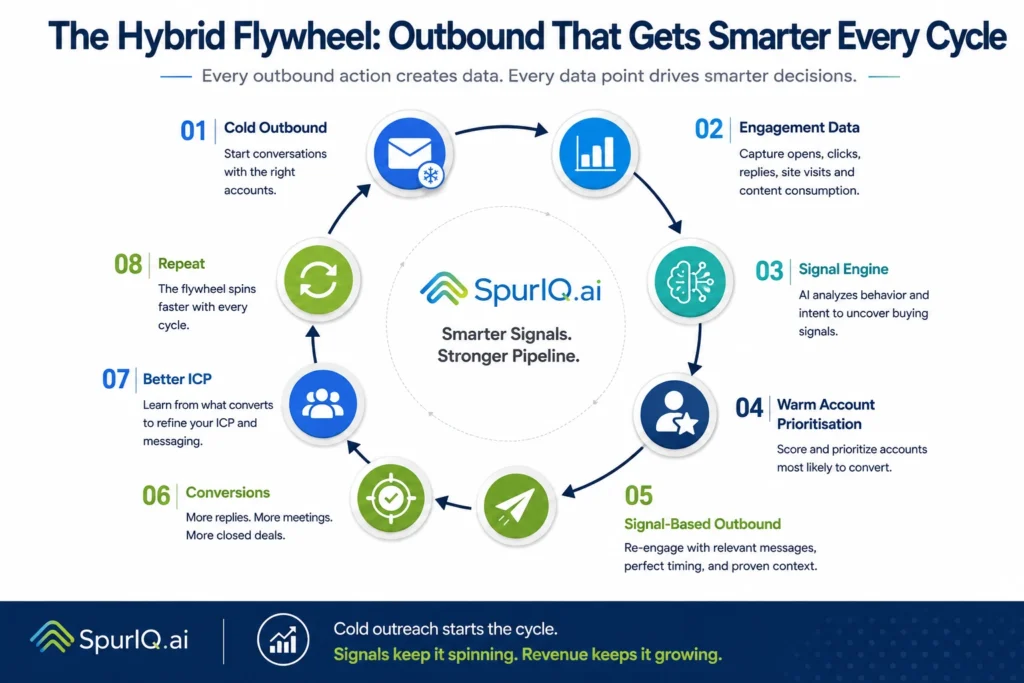
Each cycle provides better market feedback, improves targeting, and helps both your outbound and inbound efforts become more effective over time. For a deeper look at this specific flywheel, see our companion piece on signal-based outbound versus cold outbound.
The 5-Step Outbound Lead Generation Process
A successful B2B outbound lead generation strategy is built on the right process, not just more emails or calls, ensuring sales teams connect with qualified prospects at the right moment. Reaching the right prospects with the right message at the right time is what drives consistent results.
The five steps below cover the core stages and outbound lead generation best practices for building a predictable and scalable pipeline.
Step 1. Define Your ICP, Beyond Firmographics
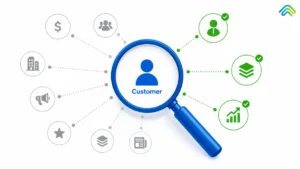
Most ICP documents stop at company size and industry. That’s not enough anymore. A modern ICP layers three things together, including firmographic data, technographic data, and behavioral signals.
Firmographic data covers company size, industry, and revenue. Technographic data covers what tools a company already runs. Behavioral signal data covers trigger events, meaning real-time actions like funding rounds, leadership changes, or hiring surges.
Here’s why the behavioural layer matters so much. Research from the Ehrenberg-Bass Institute, based on work by Professor John Dawes, found that only about 5% of B2B buyers are in-market at any given time.
The other 95% aren’t ready yet. Your ICP definition determines whether your outbound reaches the active 5% or gets sprayed across the other 95% who simply aren’t buying right now. This is also the document your sales development representative (SDR) team should be working from every day, not a slide that gets built once a year and forgotten.
Step 2. Build Signal-Enriched Prospect Lists
A list is only as good as the day it was built. Contact data decays fast, and the range is wider than most teams expect. Conservative estimates, as per Landbase, put annual B2B contact data decay at around 22.5%, while higher-turnover segments can see decay rates climb as high as 70% a year. That means a list built six months ago could already be a third dead, depending on the industries you’re targeting.
This step covers three things working together. Data enrichment fills in missing fields. Contact verification checks that emails and numbers are still valid. Signal layering adds real-time trigger data on top of the static firmographic base. Without naming a specific vendor, the tool categories you need here are data providers, intent platforms, and IP identification tools.
Step 3. Choose Your Channels, and Layer Them
No single channel carries an outbound program on its own anymore. Effective outbound sales lead generation relies on combining multiple channels instead of depending on just one.
Cold email outreach, cold calling, LinkedIn, and multi-channel outreach each play a different role, and picking the right mix depends on who you’re trying to reach and how they prefer to be contacted.
Here’s how the four core channels perform heading into 2026.
- Cold email: Average reply rates sit around 3.43%, based on billions of emails analysed by Instantly’s 2026 benchmark report. Top performers using personalised, signal-timed outreach are seeing 15% to 25% reply rates, according to research compiled by Digital Bloom and reported through Martal’s outbound benchmarks.
- Cold calling: The average success rate for booking a meeting sits around 2.3%, per Cognism’s 2026 data. While email often gets the spotlight, phone outreach continues to play a critical role. According to ZoomInfo’s Pipeline Benchmark Report, 57% of C-level and VP buyers prefer phone calls as the first point of contact, making it one of the most effective channels for reaching senior decision-makers. Direct dials convert at meaningfully higher rates than calls routed through a switchboard.
- LinkedIn prospecting and social selling: Most effective as a relationship and authority-building layer, not a standalone closing channel. It works best when used to warm up a prospect before an email or call lands.
- Multi-channel sequences are also called omnichannel sequences: Layering three or more channels together lifts response rates by roughly 40% compared to single-channel outreach, according to the 2026 benchmark analysis from Salesmotion. On persistence, research from Outreach’s 2026 Icebox report found it takes an average of 7.4 touches to book a meeting, and other 2026 studies found that over 90% of successful conversions happen by the sixth touch or later.
Here’s a simple outbound lead generation sequence you can use as a starting point. One of the most practical outbound lead generation examples is a multi-touch sequence that combines LinkedIn, email, and phone outreach over two weeks.
| Day | Channel | Action |
| Day 1 | Send connection request | |
| Day 2 | First-touch email, under 80 words | |
| Day 4 | Phone | Call plus voicemail |
| Day 7 | Follow-up referencing a specific signal | |
| Day 10 | Comment or direct message | |
| Day 14 | Phone | Second call attempt, different time of day |
Step 4. Personalise at Scale, Without Losing Relevance
Personalisation runs on a spectrum, from basic templates to fully custom outreach. Your goal is relevance without losing scale.
- Generic templates: The same message goes out to every prospect, regardless of role, industry, or trigger event. It scales effortlessly and gets ignored just as fast.
- Token-based personalisation: A name, company, or job title gets merged into a template. It reads less robotic, but the substance underneath is still identical for everyone.
- Signal-based personalisation: The message references something specific and current, a funding round, a new hire, a product launch, a hiring spike. It shows the prospect that research happened before the send, not after the bounce.
- Fully customised outreach: Each message is built from scratch for one account, pulling together strategy, pain points, and context unique to that buyer. It’s the most relevant approach and the least scalable one.
Signal-based personalisation hits the right balance for most teams, relevant enough to matter, scalable enough to run at volume.
This is also where AI and sales automation earn their place: the clearest case of AI in outbound lead generation actually working. It spots signals, pulls together insights, and drafts the first version of the message, freeing reps to focus on the conversation instead of the research.
Step 5. Measure What Matters, the Signal-Based KPI Shift
Most outbound programs still measure activity. Emails sent. Calls made. Those numbers reward volume, not outcomes.
The 2026 shift is to signal-based metrics instead.
- Signals detected: Real buying signals are caught across every source you’re monitoring.
- Signals acted on within their response SLA: How many got a follow-up before the window closed?
- Signal-to-meeting rate: How many actioned signals turned into a booked conversation?
- Pipeline generated per signal type: Which signal categories actually produce revenue, so you know where to focus.
See our companion guide on B2B buying signals for the full taxonomy.
Once a signal turns into a reply, lead qualification takes over, sorting contacts into MQL and SQL before a rep gets involved. Keep that handoff fast. Signal decay works against you the longer a lead sits unqualified, and a slow qualification step can undo what the signal layer just built. The goal stays the same across all five steps: a predictable pipeline instead of a lucky quarter and a sales pipeline that holds up under forecast scrutiny.
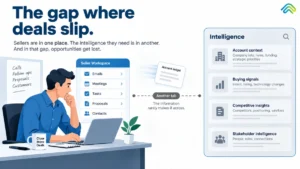
This is where most outbound teams break down. Signals fire, reps are in meetings, CRM stages sit idle, and follow-ups slip past the decay window. SpurIQ sits at this exact execution layer, monitoring signals across the tools your team already uses and making sure every signal gets routed, actioned, and measured within its SLA window automatically. See how the signal-to-action gap plays out across the GTM stack.
Top 3 Outbound Strategies That Define 2026
Channel advice only gets you so far. These three outbound lead generation techniques go beyond generic channel advice, and they’re the strategic models that separate the teams booking meetings consistently from everyone else.
Strategy 1: Signal-Based Prospecting
Prioritise prospects based on real buying signals, not static contact lists. Funding rounds, hiring surges, leadership changes, tech stack shifts, and intent surges all indicate that a company may be more ready to buy. A business that just raised a Series B and started hiring five SDRs is fundamentally different from one showing no signs of growth.
This is where a Signal Tier Framework becomes useful, ranking signals by strength and urgency. See our companion piece on signal-based outbound versus cold outbound for the full framework.
Strategy 2: Account-Based Outbound
Focus your outreach on high-value accounts rather than individual contacts. This approach aligns closely with account-based marketing (ABM), where a single company is treated as a market of one. Instead of relying on one decision-maker, map five to ten stakeholders across the account.
Everyone receives a consistent narrative, but the messaging is tailored to their role. When the VP of Sales, the CFO, and the Head of Marketing all hear from you in the same week, your outreach becomes much harder to ignore.
Strategy 3: Authority-Triggered Outbound
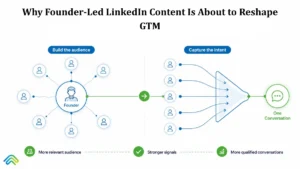
Build credibility before the buying signal appears. Share valuable content and engage with your target market on platforms like LinkedIn to establish familiarity and trust. Then, when a buying signal emerges, your prospects already recognise your name.
Signals determine when to reach out, while authority increases the likelihood that they’ll respond. Together, these factors turn cold outreach into warmer, more effective conversations.
Also Read: Outbound Sales Strategy: 7 Proven Plays That Actually Work in 2026
The Outbound Tech Stack for 2026
Most teams over-invest in finding people and sending messages, and almost completely ignore making sure the right action happens at the right time. That gap creates a stack that detects opportunities and then leaks them through the cracks. Let’s check it.
| Layer | What It Does | What Breaks Without It | Example Tools |
| Layer 1: Signal Detection | It captures buying signals from first-party sources such as your website and product usage, as well as third-party sources like intent data, review sites, and job boards. | Without this layer, you end up targeting your entire addressable market instead of the roughly 5% of buyers who are actively in the market at any given time. As a result, every outreach becomes a cold guess. | Bombora, G2 Buyer Intent, 6sense, Clearbit Reveal, LinkedIn Sales Navigator |
| Layer 2: Data Enrichment | It verifies contact information, fills in missing fields such as direct dial numbers and reporting structures, and keeps records accurate and up to date. | Without this layer, you have buying signals but no reliable way to reach the right person. Bounce rates increase, and because B2B data can decay by 22% to 70% each year, enrichment cannot be treated as a one-time task. | Apollo, ZoomInfo, Cognism, Clay, UserGems |
| Layer 3: Orchestration | It sequences messages across multiple channels, manages cadence timing, handles A/B testing, and routes replies efficiently. | Without this layer, reps must manually copy and paste information between tools, follow-ups are often missed, and outreach sequences remain limited to a single channel. | Outreach, Salesloft, Instantly, Lemlist, HubSpot Sequences |
| Layer 4: Execution and Measurement | It ensures that every signal-triggered action is completed within its SLA window, tracks signal-to-meeting conversion by signal type, and continuously improves signal scoring through a feedback loop. | Without this layer, signals remain unactioned on dashboards, reps miss high-priority engagement windows, and teams cannot identify which signal types actually generate pipeline. This is also the layer that many organizations are still missing entirely. | CRM native reporting, Gong, Chorus, revenue execution platforms |
Build vs Buy: Cost Benchmarks by Team Size
The right stack depends on your team size, deal size, and how much engineering time you can realistically spend on integrations. Here’s what realistic monthly spend looks like at three stages.
| Tier | Team Size | Monthly Cost | What You Get | What You’re Missing |
| Starter | 1 to 3 reps | $500 to $800/month | You get one or two tools that cover signal detection and enrichment, while orchestration is handled manually through spreadsheets and native CRM sequences. | You do not have access to automated sequencing or Layer 4 capabilities. Reps must manage every step of the process manually. This setup works well only when lead volume remains low, and the team follows a disciplined workflow. |
| Growth | 3 to 10 reps | $2,000 to $3,000/month | You get three to four tools that cover Layers 1 through 3, along with semi-automated orchestration and basic CRM reporting. | Layer 4 still requires manual management. As your stack grows, integration overhead typically increases and may require 5 to 10 hours of RevOps maintenance each week. Signal-to-meeting attribution also remains approximate rather than fully accurate. |
| Enterprise | 10+ reps or $50K+ ACV | $5,000+/month | You get an integrated platform or managed technology stack that covers all four layers, supports full automation, and provides signal attribution. | You should expect a longer implementation period, which often takes four to eight weeks. The system also requires dedicated RevOps support for ongoing management. If your ideal customer profile (ICP) is not fully validated, there is a real risk of investing more than your business needs. |
Cost per lead varies significantly by industry. According to 2026 benchmarks from Prospeo, average CPL ranges from around $91 in eCommerce to $982 in higher education, while B2B SaaS averages approximately $237 per lead. Any flat “$50 to $700 per lead” figure you see quoted elsewhere should be treated as a rough industry-wide spread rather than a precise benchmark, since actual cost per lead swings hard by vertical and channel mix. A higher cost per lead can still be the right call if it improves your LTV: CAC ratio, since outbound often targets larger accounts with stronger long-term retention than lower-cost inbound leads.
Layer 4 is where most stacks fall apart. Teams detect signals, enrich contacts, and build sequences, but nobody ensures the follow-up actually happens within the decay window. SpurIQ connects to the tools your team already uses across Layers 1 through 3 and ensures every signal is routed, actioned, and measured automatically. No rip-and-replace. Just the accountability layer your stack is missing. See what revenue execution actually means.
Common Outbound Mistakes (And How to Fix Them)
Most outbound programs don’t fail because of poor tools. They fail because of a few common mistakes that weaken response rates, waste good prospects, and slow pipeline growth.
Mistake #1: Sending Before Qualifying
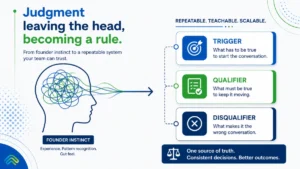
Most teams skip signal validation entirely and blast their entire list. If you’re doing this, you’re burning your best accounts with a message that was never built for them. Fix this by applying the Signal Tier Framework before any outreach goes out.
Mistake #2: Single-Channel Dependency
Email-only or LinkedIn-only outreach shows declining results over time, and performance data support this shift. If your pipeline depends on a single channel, one algorithm change or spam filter update can quickly slow your growth. Fix this by using coordinated multi-channel sequences with 8 to 12 touches spread across three to four weeks.
Mistake #3: Ignoring Email Deliverability and Sender Reputation
If your inbox placement rate is weak, nothing else matters because your message never reaches a real prospect. Industry benchmarks show global average inbox placement at around 84%, while well-managed campaigns aim for 95% or higher as per Validity 2025 Benchmark, cited via Unify and Martal.
Fix this with a dedicated sending domain, a four-to-six-week warm-up period, and a daily send limit of around 30 to 40 emails per inbox on fresh domains to protect sender reputation over time, according to LeadRiver 2026 State of B2B Outbound.
Mistake #4: Activity Metrics Instead of Signal Metrics
Measuring emails sent only rewards volume, not quality. A better approach is to monitor detected signals, timely follow-ups within your SLA, and the percentage that turn into booked meetings.
Mistake #5: No Feedback Loop
If you are not tracking which signal types actually generate pipeline and refining your ICP based on that data, your outbound strategy will not improve over time. Fix this with a monthly signal attribution review to identify what works and where adjustments are needed.
Also Read: Best Outbound Sales Software in 2026: A Buyer’s Guide by Stack Layer
The Bottom Line
B2B outbound lead generation in 2026 isn’t about volume anymore. The most effective lead generation outbound approach focuses on precision, timing, and creating meaningful conversations with high-value prospects. If you define a tight ICP, detect buying signals early, reach out across multiple channels inside the signal’s decay window, and measure success by signal-to-meeting conversion instead of emails sent, you’ll build the kind of pipeline that holds up in a forecast review.
The competitive advantage is no longer who has the biggest list. It’s who acts on signals fastest.
SpurIQ is the revenue execution layer that turns outbound signals into executed actions, within the decay window, across the tools your team already uses. Learn more at SpurIQ.
Frequently Asked Questions:
Q. What is outbound lead generation, and how to generate outbound leads effectively?
Outbound lead generation is a proactive approach where businesses identify and reach out to potential customers instead of waiting for them to discover the brand. It typically includes strategies such as cold email, LinkedIn outreach, account-based marketing, and targeted sales campaigns.
Q. What is the difference between inbound and outbound lead generation?
Inbound and outbound lead generation differ mainly in how prospects are reached:
Inbound lead generation: Attracts potential customers through content marketing, SEO, social media, and organic search.
Outbound lead generation: Involves directly contacting prospects through channels like email, LinkedIn, and sales outreach.
Best approach: In 2026, high-performing teams often combine both methods to create a more consistent and predictable pipeline.
Q. What are the best outbound lead generation strategies for 2026?
The most effective outbound strategies focus on relevance, timing, and personalization:
Signal-based prospecting: Reaching out when prospects show buying signals, such as hiring changes, funding updates, or technology shifts.
Account-based outbound: Creating targeted campaigns for high-value accounts instead of broad outreach.
Multi-channel sequences: Combining email, LinkedIn, calls, and other touchpoints to improve engagement.
Q. How much does outbound lead generation cost?
Outbound lead generation costs vary depending on the industry, target audience, channels, and campaign complexity. According to Prospeo:
Cost-per-lead benchmarks can range widely, from around $91 to $982, depending on the industry.
In B2B SaaS, the average cost to acquire a lead is often around $237.
However, cost per lead alone does not determine success. Higher CPL can still deliver a strong ROI when targeting accounts with higher deal values.
Q. Is cold email still effective in 2026?
Yes, cold email can still generate results when it is targeted, personalized, and based on relevant buying signals.
Generic mass emails often struggle because prospects receive too many similar messages.
Signal-based outreach improves timing and relevance.
Average reply rates may be around 3.43%, while highly personalized campaigns can achieve significantly higher engagement rates, as per Instantly.
Q. What are the best outbound lead generation tools?
A complete outbound technology stack usually includes multiple layers:
Signal detection tools: Identify buying triggers and market activity.
Data enrichment tools: Improve prospect accuracy and contact information.
Outreach platforms: Manage campaigns and automate follow-ups.
Analytics and CRM systems: Track performance, conversions, and pipeline impact.
Many teams invest in finding prospects but overlook measurement and optimization, which limits long-term improvement.
Q. Should I outsource outbound lead generation or build it in-house?
The right choice depends on your business stage, goals, and internal resources.
Outsourcing works well when your ideal customer profile is already defined, and you need faster execution.
Building in-house works better when you are still testing your market, refining messaging, and learning directly from customer conversations.
Many companies eventually combine both approaches by keeping strategy in-house while using external support for scaling.