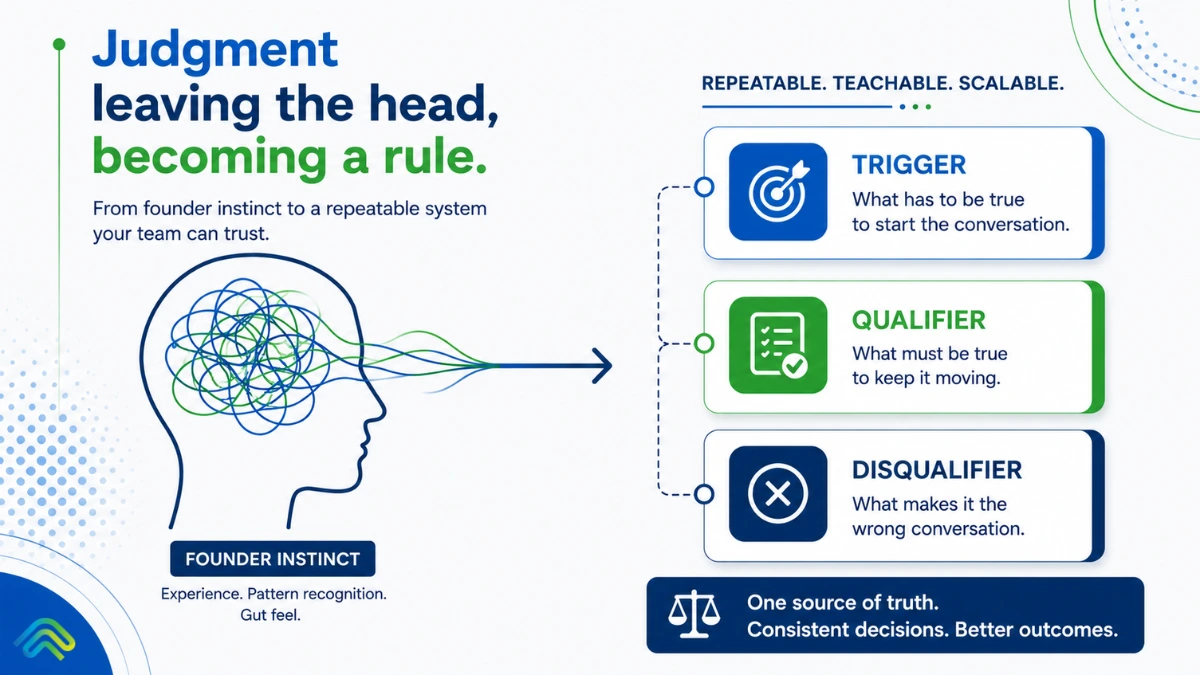
Founder-led sales works. That’s the problem.
In the early days, you are the sales team. You can look at an account and know in ten seconds whether it’s worth chasing. You know which line makes a skeptical buyer lean in, which proof point closes the deal, when to push and when to walk. You’re not following a process, you are the process. And it works, because the whole thing runs on your judgment.
Then you hire. And you meet the uncomfortable truth about founder-led sales: the thing that made it work is the thing that won’t scale. Your judgment is trapped in your head, and it turns out it’s remarkably hard to get out.
This is a piece about that transfer, how to move from being the system to building one. First, what actually breaks (it’s more specific than “we need process”). Then the method: what to write down, what to turn into rules, and what to deliberately leave human.
The break: what stops working at the first and third hire
It doesn’t fall apart all at once. It breaks in two predictable places.
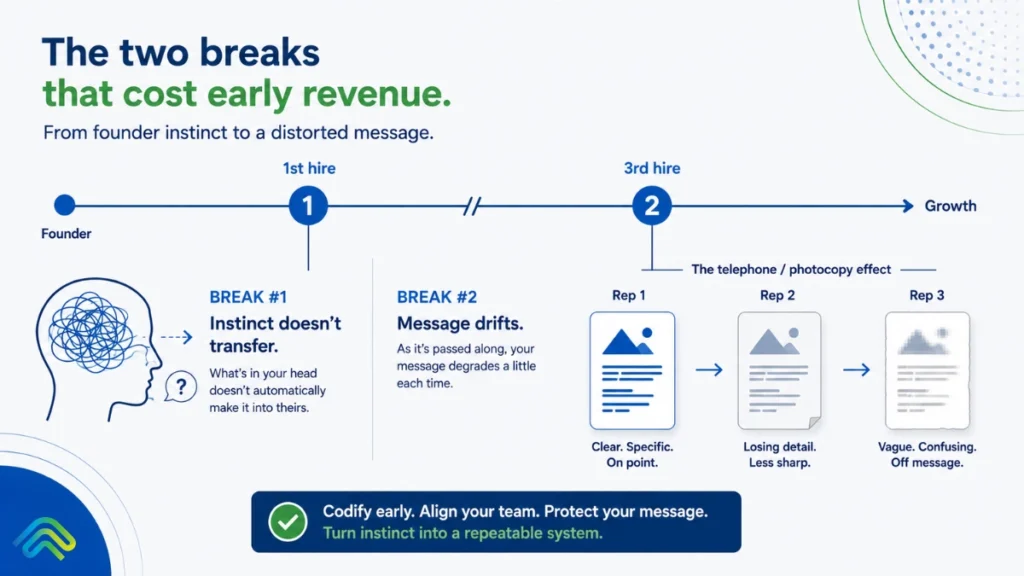
At the first hire: the instinct doesn’t transfer
You hire a rep. You hand them the ICP slide, a few call recordings, and a Notion doc. You tell them to “shadow me for a couple of weeks and you’ll get it.” And then you wait for them to get it, and mostly, they don’t. Not because they’re bad. Because you gave them the definition, and what actually closes deals is the instinct.
You can look at an account and decide in ten seconds. Your new rep got the slide that says “mid-market B2B SaaS, 50–500 employees.” That slide is a description of the accounts you’ve already decided are good. It carries none of the reasoning that let you decide. So the rep chases the wrong accounts confidently, and you can’t understand why they can’t see what’s obvious to you. It’s obvious to you because it’s in your head. It was never anywhere else.
By the third hire: the message drifts
Now it compounds. Rep one learned the pitch from you. Rep two learned it partly from you and partly from rep one. Rep three learned it from rep two’s interpretation of rep one’s version of you. Every hire is a photocopy of a photocopy, and the positioning drifts a little each time.
By the third or fourth rep, the version of your company being sold in the market barely resembles the one that actually wins. Nobody did anything wrong. There was just no source of truth, only a game of telephone that started in your head and got quieter with every handoff.
And the whole time: you’re the bottleneck
So what do you do? You stay involved. You sit in on every deal that matters. You rewrite the important emails. You approve the big accounts. You take the hard calls yourself “just this once,” which becomes every time. You hired a team to get sales off your plate, and somehow you’re more involved than ever.
You scaled headcount, but you didn’t scale yourself. Your company’s growth is now capped by the size of your calendar. – Arush Lakhani (CEO & Co founder of SpurIQ.ai)
That’s the transfer problem in one line: the judgment that made early sales work is trapped in the one person who can’t be in every conversation. Until you get it out, hiring just adds people who need you more.
The shift: stop being the system, start building one
The fix isn’t “hire better” or “train harder.” You can’t train your way out of this, because training is just you transferring instinct one person at a time, verbally, and hoping it sticks. That’s the game of telephone again.
The fix is to get your judgment out of your head and into something every rep can run, and, increasingly, something a workflow can help run too. That transfer has three parts, and most founders only ever attempt the first one:
- What you write down — the context. The knowable stuff about how you sell.
- What you turn into rules — the judgment. The instinct that feels un-writable but isn’t.
- What you keep human — on purpose. The parts that shouldn’t be systematised at all.
Get all three right and you’ve built a system that carries your judgment. Get only the first and you’ve built a wiki nobody reads. Let’s take them in order.
Also Read: SpurIQ Revenue Engine: How it Turns One Request Into an Executed Campaign
What to write down: the context
Start with the knowable. This is the memory of how your company sells, and there’s more of it than founders expect:
- Products and the use cases that actually land
- ICP and buyer definitions
- Positioning and messaging
- Proof points, the case studies and numbers that move deals
- Your sales process and qualification rules
- Playbooks for the plays you run repeatedly
- Account history, who you’ve talked to, what happened
Here’s the catch, and it’s the whole point of this section: “written down” and “written down properly” are not the same thing. Most companies have the slide version of all of this. The slide version describes. A system needs the version that lets a rep, or a workflow, actually decide.
The difference is sharpest with your ICP. An ICP slide is a definition. An ICP rule set is what a system can act on:
| The slide version (a description) | The system version (a rule that decides) |
|---|---|
| ICP: “mid-market B2B SaaS, 50–500 employees” | ICP rule: uses HubSpot, hired a VP of Sales in the last 90 days, has 3+ AEs but no RevOps hire yet |
| Messaging: “we help teams sell faster” | Messaging rule: the value prop, proof point and tone mapped to each segment and persona |
| Proof: “we have case studies” | Proof rule: which case study and which number to use for which segment and which objection |
| Qualification: “we know a good fit when we see one” | Qualification rule: the explicit qualifiers and disqualifiers a rep can check in order |
The left column is what you present to investors. The right column is what a new rep can execute on their first day, and what a workflow can help run without you in every conversation. The gap between them is exactly the gap that keeps you on every call. Closing it is most of the work, and the easier half.
What to turn into rules: the judgment
Now the hard half, and the one that actually differentiates a scalable motion from a documented one. The context is knowable, you just have to write it carefully. The judgment feels different. It feels like instinct, like something you can’t put into words. “I can just tell.”
But “I can just tell” is not magic. It’s pattern recognition you’ve stopped noticing you do. And patterns can be extracted, if you interrogate them honestly. These are the questions that pull instinct into the open:
- How do your best sellers recognise a good account? What do they see that others miss?
- What do they check before reaching out?
- What event makes them believe the timing is right, now rather than in six months?
- What makes them walk away? (The disqualifiers matter as much as the qualifiers.)
- Which industry-specific events signal a real, funded problem, the triggers only an insider would know to watch?
A worked example: turning “I can just tell” into a rule
Let me show you what this looks like, because it’s more concrete than founders expect.
A founder tells me, “I can just tell when a company is about to need us.” Great, that instinct is worth a lot. So I push: what do you actually see? What’s true about a company right before it becomes a perfect customer?
We dig, and it comes out in pieces. “They’ve usually just hired a VP of Sales. They’re posting SDR roles. And their careers page shows they’re building an outbound team for the first time, you can tell they’ve never done it before.” Then, unprompted: “But if they already have a RevOps person, I don’t bother. They’ll build it in-house.”
There it is. The instinct just became a rule:
| Trigger: hired a VP of Sales in the last 90 days AND posting SDR roles AND no prior outbound infrastructure. Disqualifier: an existing RevOps leader. That is a signal and a qualification rule a new rep can check, and a system can watch for automatically. |
Notice what happened. “I can just tell”, the least transferable thing in the company, became four concrete conditions any rep can apply and a workflow can be set up to watch for. The founder’s ten-second read is now available to someone who’s been there ten days. That’s the transfer. Do it for how you qualify, how you time outreach, how you spot risk, and you’ve moved the most valuable thing in the business out of one person’s head.
What stays human on purpose?
Here’s where a lot of founders get nervous: “if I write it all down, am I turning my team into robots?” No, because the goal was never to systematise everything. The goal is to systematise the repeatable judgment so your people spend their time on the judgment that isn’t.
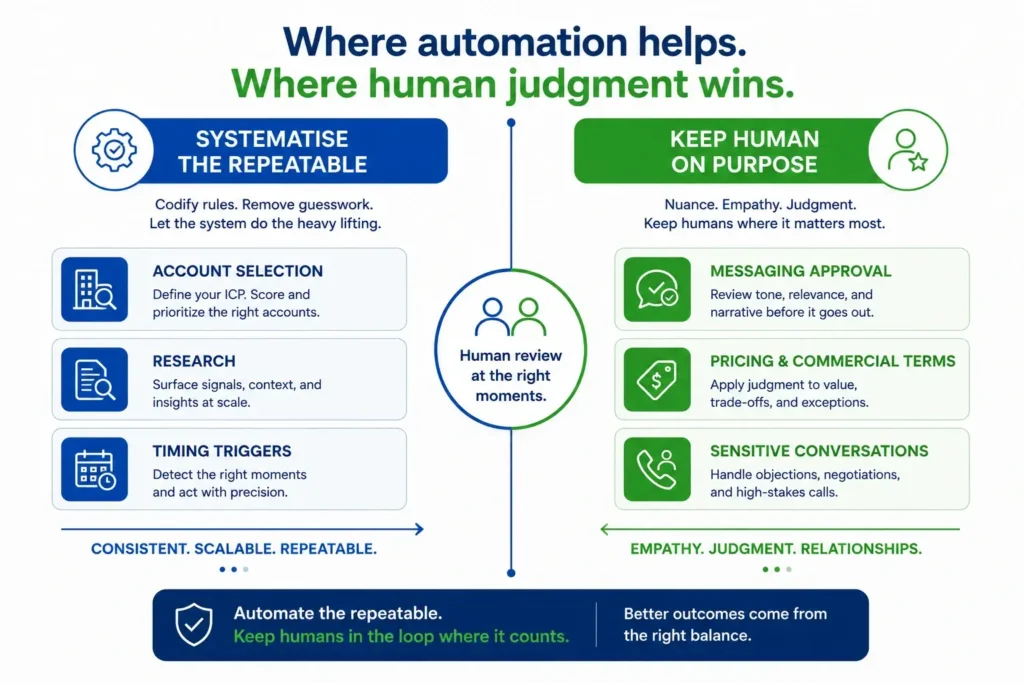
So decide, deliberately, what stays human:
- Messaging approval. Let the system draft in your voice, especially early, but a human signs off before it goes out. The draft is automated; the standard isn’t.
- Commercial judgment. Pricing, negotiation, concessions, deal structure. The stuff where the right answer depends on a relationship and a moment, not a rule.
- Customer communication. The actual relationship. The hard conversation. The moment a deal wobbles and someone needs to pick up the phone.
- Anything sensitive. A champion leaving, a renewal at risk, a founder-to-founder call. If it needs a human, keep it human.
Frame this as a design choice, not a gap. A good system doesn’t remove people, it removes the manual, repeatable work so the people you hired spend their week on the parts that actually need them. Systematise the judgment that’s mechanical. Keep the judgment that’s relational.
Also Read: 15 B2B Buying Signals That Actually Predict Revenue in 2026
The payoff: update one memory, not every rep
Do the transfer and two things change that you’ll feel within a quarter.
You update one memory instead of retraining every rep. When your ICP sharpens or your messaging shifts, you change it in one place, and everyone, and every workflow, is working from the new version the same day. No all-hands re-training. No drift. No “did that memo reach the new reps?” The game of telephone is over, because there’s finally a source of truth to point at.
New hires start from your judgment instead of rebuilding it. Rep five begins where you are, with your qualification rules, your proof mapping, your timing triggers already loaded, not where rep one began. Ramp time collapses, because nobody has to reverse-engineer your instinct from call recordings ever again.
And the thing you actually wanted at the start: you stop being the bottleneck. The deals that matter no longer all route through your calendar, because the judgment that made you necessary now lives in the system.
That one shared memory, your context, your rules, your history, in one place that everything reads from, is what we call a Revenue Brain. This whole exercise is how you build one.
“That one shared memory, your context, your rules, your history, in one place that everything reads from, is what we call the Company Brain. This whole exercise is how you build one. It’s the memory layer inside a wider system, the Revenue Brain, that also brings in expert sales logic, live buying signals and connected execution.”
Also Read: From Spray and Pray to Signal-Led Outbound: How to Make the Shift in 2026
Start with one workflow, not everything
One warning, because it’s how these efforts usually die: don’t try to systematise your entire motion in a quarter. Founders who attempt the big-bang version, document everything, rule everything, automate everything, produce a giant unfinished wiki and quietly give up.
Pick one workflow instead. Ideally the one where your judgment is most trapped and most valuable, for most founders, that’s how you pick and qualify accounts, because it’s the decision you make on pure instinct dozens of times a week. Write down that context. Turn that instinct into rules, the way we did above. Ship it. Watch a new rep use your judgment without you in the room. Then do the next one.
The system compounds one workflow at a time. And unlike the wiki, a working workflow proves its value immediately, which is what earns you the room to build the next.
Founder-led sales doesn’t have to die when you scale. It has to be transferred. Your ten-second instinct stops being the thing only you can do, and becomes the default every rep starts from. That’s not losing what made your sales special. That’s finally making it repeatable.
Want help making the first transfer? Book a walkthrough and we’ll take one workflow, usually how you pick and qualify accounts, and turn your judgment into a system your whole team can run, in about 10 minutes.
Frequently asked questions:
Q. What is founder-led sales?
It’s the early stage where the founder is effectively the sales team, closing deals on instinct, judgment and relationships rather than a documented process. It works brilliantly early on, because the whole motion runs on the founder’s judgment. It stops working when you try to scale it beyond the founder.
Q. Why does founder-led sales stop working as you scale?
Because the founder’s judgment is trapped in their head. New hires get the ICP slide and the pitch deck, the definition, not the instinct behind it. Messaging drifts a little with every hire, and the founder becomes the bottleneck on every deal that matters. You scaled headcount but not the judgment that made sales work.
Q. How do you transition from founder-led to system-led sales?
In three moves: write down the context properly (as rules a system can act on, not slides that only describe), turn the founder’s judgment into explicit signal and qualification rules, and deliberately decide what stays human. Then start with one workflow rather than trying to systematise everything at once.
Q. Isn’t this just writing an ICP document?
No, that’s the part most companies do and it isn’t enough. A slide describes the accounts you already decided were good; a rule set carries the reasoning that let you decide. The differentiating work is extracting the judgment, turning “I can just tell” into concrete triggers, qualifiers and disqualifiers a rep or a system can act on.
Q. What should stay human when you systematise sales?
Messaging approval, commercial judgment (pricing and negotiation), customer communication, and anything sensitive. Systematise the judgment that’s repeatable; keep the judgment that’s relational. A good system removes the manual work so your people spend their time on the parts that actually need a human.
Q. What should I systematise first?
The one workflow where your judgment is most trapped and most valuable, usually how you pick and qualify accounts, since founders make that call on instinct constantly. Get that one working end to end, prove it, then move to the next. The system compounds one workflow at a time.