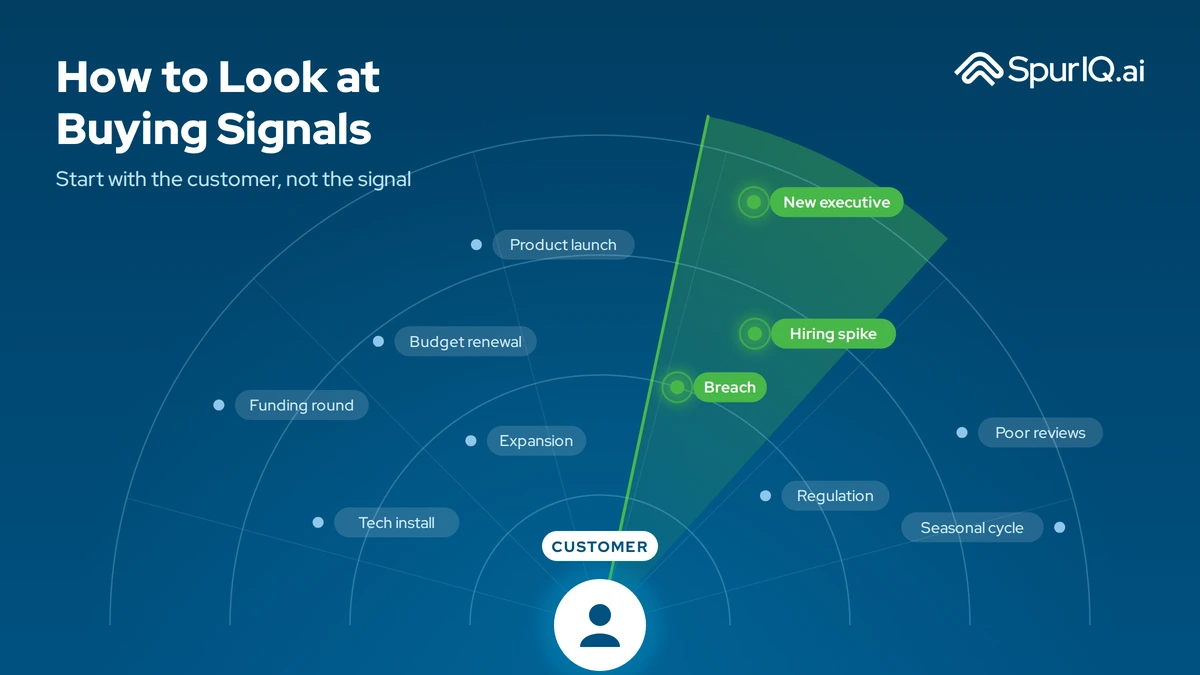
Most teams build a signal database first and ask what it means later. The better sellers do it the other way round, and it changes everything about what they say.
If you have read our earlier pieces on what buying signals are, the fifteen that actually predict revenue, and how signals differ from intent data, you already know the vocabulary. This one is about something those guides deliberately left alone: not which signals exist, but how to think about them so they lead to the right conversation with the right person.
Because here is the uncomfortable truth. You can detect every signal in the market, score it perfectly, and respond inside the decay window, and still send a message that lands flat. The reason is almost always the same. The team started with the signal instead of starting with the customer.
Here are the “15 B2B Buying Signals That Actually Predict Revenue (With Response Playbooks)”
Most teams approach buying signals backwards
The usual starting question is: what signals can we find?
Funding, Hiring, Leadership changes, Website visits, Technology installs, Product launches Reviews, etc. It feels productive, because the list gets long fast.
But none of those is inherently a buying signal.
A funding round is just a fact until you can explain why it makes a particular company more likely to buy your product. A signal only becomes useful once you understand three things: why a particular customer would buy what you sell, what changes inside their business when that need becomes urgent, and who actually cares about that change.
That is why a good signal process does not start with the signal at all. It starts with the customer.
Step 1: Understand why customers buy
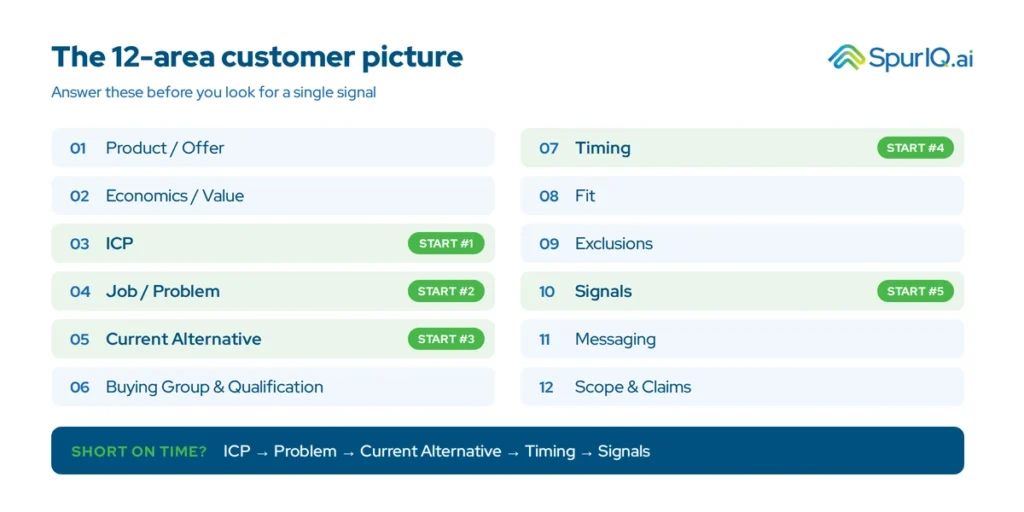
Before looking for a single signal, build a picture of the customer. We look across twelve areas. You do not need perfect answers to all of them, but the more of them you can answer honestly, the sharper your signals become.
- Product / Offer. What exactly are we selling, and what does it help the customer do?
- Economics / Value. Why is solving the problem worth paying for? Does it increase revenue, reduce cost, save time or reduce risk?
- ICP. What kinds of companies are actually good customers?
- Job / Problem. What is going wrong, or what is the buyer trying to achieve?
- Current Alternative. What are they doing today instead: another vendor, an internal team, spreadsheets, manual work, or nothing?
- Buying Group & Qualification. Who feels the problem, who champions the solution, who owns the budget, and what makes an opportunity real?
- Timing. What tends to happen immediately before a company decides to buy?
- Fit. What needs to already be true for the solution to work?
- Exclusions. Which companies may look like prospects but are actually poor fits?
- Signals. What observable information would tell us a company probably needs the solution now?
- Messaging. Which personas should we speak to, and what does each one care about?
- Scope & Claims. What markets, proof points, case studies and claims can we actually stand behind?
If you are short on time, get five of these right first, in this order:
ICP → Problem → Current Alternative → Timing → Signals.
Once those five are clear, you can normally start turning customer knowledge into observable buying signals. Everything downstream depends on this sequence, which is exactly why most signal programmes that skip it end up loud and irrelevant.
Step 2: Translate customer understanding into signals
Now the question changes. Instead of asking what signals exist, you ask: what could we observe from outside the company that suggests one of those buying conditions has just become true?
That single reframe turns a generic signal into a specific one. A few examples of how it works in practice:
- If customers tend to buy when they expand into a new geography, then expansion becomes a signal.
- If an existing process breaks once a company passes 500 employees, then crossing that headcount becomes a signal.
- If buyers typically rip out a particular technology to adopt yours, then the presence of that technology becomes a signal.
- If fraud incidents create urgency, then app reviews mentioning account takeovers become a signal.
- If a new executive usually kicks off change, then leadership movement becomes a signal.
Notice what these have in common. Each one is tied to a reason this specific customer buys. The goal is not to maintain the biggest database of generic triggers. It is to identify the handful of signals that make sense for this product, this ICP and this buying problem. A smaller list of well-reasoned signals beats a huge list of noise every time.
Not every signal does the same job
Here is something most teams miss entirely. Signals do not all point to the same outcome. It is tempting to treat every signal as “this account may be ready to buy now,” but different signals do genuinely different jobs. Knowing which job a signal does changes what you do with it.
| Signal type | Example | What it actually does |
|---|---|---|
| Identifies a new customer | A company gets incorporated | Surfaces a prospect that did not exist before. The account is brand new to your universe. |
| Creates urgency | A company suffers a hack or breach | Moves an existing prospect from “someday” to “now.” The need was always there; the event made it urgent. |
| Opens a new category | A new government regulation lands | Makes a whole segment addressable that was not before. It is not one account, it is a market. |
These are not interchangeable. A new incorporation tells you who to add to the list. A breach tells you which existing account to call today. A regulation tells you that an entire category of companies just acquired a problem you solve. Same word, “signal,” three very different plays.
But all three share one rule. Each signal has to marry the service you offer to the prospect’s specific need. A regulation only matters if your product helps companies comply with it. A breach only matters if you reduce that risk. Without that link, a signal is just a piece of news that happens to be true.– Vijay Agarwal, Co-Founder SpurIQ
Some of the best signals never show up in the news
Almost every signal people chase is an event you detect when it happens: a funding round, a hiring spike, a leadership change, a review. All of them assume something appeared in a feed somewhere. But an entire class of high-value signals never shows up in the news at all, because they are predictable and recurring rather than newsworthy.
Think of the agri domain. Sowing and harvest cycles arrive on a calendar every year. Nobody publishes “planting season has begun” as breaking news, yet for the right product that moment is a stronger buying signal than any funding announcement. The same is true of fiscal year-ends, budget-renewal windows, annual compliance and filing seasons, and contract-renewal dates. They are seasonal, they repeat, and a competitor relying purely on a news feed will never see them coming.
That is exactly why they are valuable. Because they do not surface in the usual places, most teams miss them. If you understand your customer well enough to know when their need reliably peaks, you can be in the conversation before anyone who is waiting for a headline. Predictable does not mean weak. Often it is the opposite.
Step 3: The same signal means different things to different buyers
This is where signal-based outbound gets genuinely interesting, and where most automation quietly falls apart. Finding a signal does not tell you what to say. The same event means completely different things depending on who is reading it.
Take one signal: a company has suddenly ramped up hiring. Watch how the meaning shifts by role.
| Same signal | Seen by | What it probably means to them |
|---|---|---|
| Hiring spike | CEO | Growth, and the challenge of scaling the company efficiently. |
| Hiring spike | Chief Sales Officer | Onboarding dozens of sellers and getting new reps productive fast without losing consistency. |
| Hiring spike | CFO | Rapidly rising payroll and pressure to show ROI on that investment. |
Same company. Same signal. Three completely different implications.
It gets sharper when several signals appear at once. Imagine an account has hired a new executive, launched a new product, picked up poor customer reviews, and started hiring engineers. It is tempting to label the account “high intent” and send everyone the same message. That is a mistake.
- For the CTO, the engineering expansion and its architectural implications matter most.
- For the CPO, the customer reviews and product friction are far more relevant.
- For the CEO, the combination may point to a broader problem with scaling the business.
The account is one thing. The interpretation is many. Which is why signals need a persona-specific priority layer, not a single account-level label.
Step 4: Prioritise signals before you write the message
When multiple signals fire, the instinct is to cram them all into the opening paragraph. Resist it. Work through three questions in order instead:
- Which signal is most relevant to this persona?
- Which signal connects most directly to the problem our product solves?
- Which signal is recent enough to create a credible reason for reaching out now?
The signals that do not win this contest are not wasted. They still push the account up your priority list. So an account might score highly because four relevant things are happening at once, while the actual message references only the one signal that matters most to that specific buyer.
Signal scoring decides whom you prioritise. Signal interpretation decides what you say.
Keeping those two jobs separate is one of the simplest ways to lift reply rates without touching your data sources at all.
Step 5: Turn the signal into a business hypothesis
The final move is the one that separates real personalisation from the fake kind. Your message should not just repeat the data back at the buyer.
Weak personalisation is:
“Saw you’re hiring salespeople.”
That is an observation. It proves you have a data feed, nothing more. Good signal-based messaging goes one step further and proposes what the signal probably means for them:
“Saw you’re adding quite a few sellers. Usually at that stage the challenge shifts from finding good reps to making sure the way your best reps sell actually gets replicated across the team.”
You have moved along a simple chain:
Observation → implication → relevant problem.
That is the point where a signal stops being a data point and starts being a reason for the buyer to reply.
The complete workflow
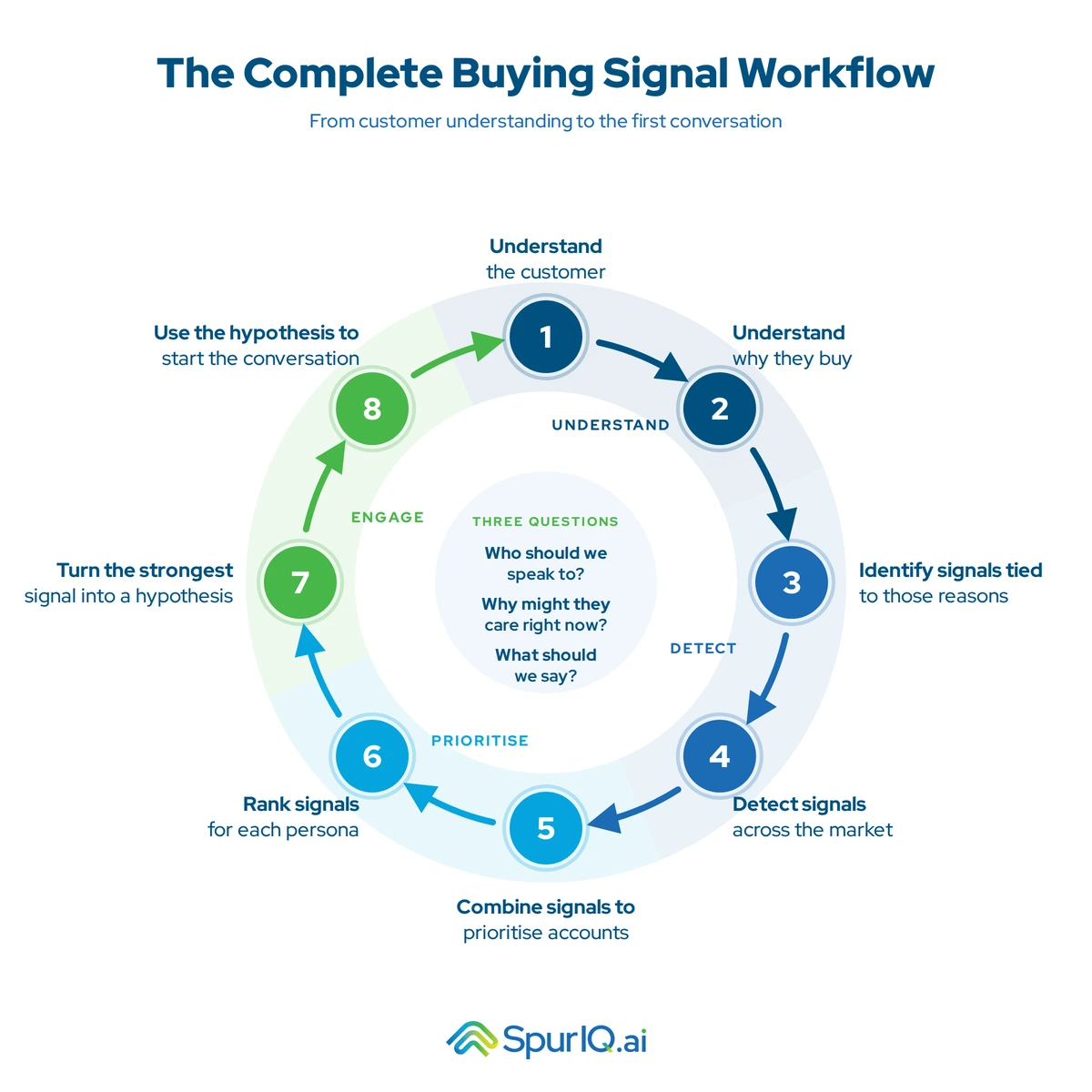
Put it together and the whole approach reads as one clean sequence:
- Understand the customer.
- Understand why they buy.
- Identify observable signals tied to those reasons.
- Detect those signals across the market.
- Combine signals to prioritise accounts.
- Rank signals differently for each persona.
- Translate the strongest signal into a business hypothesis.
- Use that hypothesis to start the conversation.
Buying signals are not valuable because they hand sellers more data. They are valuable when they help answer three much more important questions:
- Who should we speak to?
- Why might they care right now?
- And what should we actually say to them?
That is the difference between finding signals and building a signal-driven GTM motion.
Where SpurIQ fits
This is the exact thinking behind how SpurIQ approaches signal-based outbound inside LeadIQ. During setup we work through the customer picture first, the same twelve areas, so the signals we detect are the ones that actually mean something for that business, not a generic feed of funding and hiring alerts.
From there, the customer’s own sales judgment, who to prioritise, which signal matters to which persona, and what hypothesis to lead with, is captured as expert sales logic so it can be applied consistently rather than living only in the head of your best rep. Signal-Based Outbound is the workflow we run live today; we deliver it as a managed workflow, configured around how your team sells.
Conclusion
The teams that win with buying signals are rarely the ones with the most signals. They are the ones who understand their customer well enough to know which signals mean something, who cares, and what to say when one fires.
So before you expand your signal stack again, run the sequence in reverse. Start with why your customers buy. Translate that into a short list of observable signals. Interpret each one through the eyes of the specific person you are writing to. Then turn the strongest signal into a hypothesis worth replying to.
Do that, and signals stop being noise on a dashboard and start becoming the opening line of your best conversations.
Build More Pipeline. Close More Deals.
Frequently asked questions:
Q. Isn’t it faster to just buy a list of signals and start reaching out?
Faster to start, slower to results. A generic signal feed tells you something happened, not why it matters to a specific buyer. Without the customer understanding underneath, you end up sending confident messages about events the buyer does not connect to any problem you solve. Starting with the customer takes a little longer up front and makes every message after it sharper.
Q. How many signals should we actually track?
Fewer than you would expect. The aim is not the biggest database, it is the handful of signals genuinely tied to why your customers buy. A short, well-reasoned list you can interpret and act on beats a long list you can only detect. If you cannot explain why a signal predicts a purchase for your product, it does not belong on the list yet.
Q. Do all buying signals mean the same thing?
No, and treating them as if they do is a common mistake. Some signals identify a brand-new prospect, like a company being incorporated. Some create urgency for an existing prospect, like a security breach. Some open a whole new category at once, like a government regulation. Each does a different job, so each leads to a different action. What they share is one rule: the signal only counts if your service genuinely connects to the need it creates.
Q. What about signals that never appear in the news, like seasonal ones?
Those are often the most valuable. Recurring, calendar-driven signals, agricultural cycles, fiscal year-ends, compliance seasons, renewal windows, never surface as breaking news, so teams that only watch news feeds miss them entirely. If you understand when your customer’s need reliably peaks, you can reach them before anyone waiting for a headline. Predictable does not mean weak.
Q. What’s the difference between signal scoring and signal interpretation?
Scoring decides whom you prioritise; interpretation decides what you say. An account can score highly because several relevant signals are firing at once, while the message you send references only the single signal that matters most to that particular persona. Keeping the two separate is what stops you from cramming every trigger into one paragraph.
Q. Should we send the same message to everyone at a “high intent” account?
No. A high account score is not a message. The same signal means different things to a CEO, a CFO or a CTO, so a single account-level label should never collapse into a single email. Rank the signals per persona, then lead each buyer with the one most relevant to them.
Q. How is this different from your other buying-signals articles?
Those cover what signals are, the fifteen that predict revenue, and how signals differ from intent data, essentially the what and the how-to-detect. This piece is about the thinking layer: how to start from customer understanding, translate it into the right signals, interpret the same signal differently by persona, and turn it into a business hypothesis. Read together, they cover detection and judgment.