
The CRM is finally becoming something you talk to instead of something you fill in. That is real progress. It also solves the easier half of the problem.
Something good is happening to sales tools, and it is worth saying so plainly.
Salesforce and HubSpot are shipping headless versions. Sales tools are opening up so they can plug straight into Claude and assistants like it. The CRM is turning into something a seller can talk to, instead of a set of fields they have to sit down and fill in.
This matters more than it might sound. Sellers have avoided CRM screens for twenty years, and not because sellers are lazy. The screens were built for the person reading the pipeline report, not the person out creating the pipeline. So making the whole thing conversational is a genuine step forward, and it deserves to be called one.
The trouble is that it only solves half the problem, and it is the easier half.
A better interface is still an interface you have to go to
Here is the part that gets lost in the excitement. A conversational interface is still an interface. It still lives somewhere. And that somewhere is almost always another tab.
We have swapped a bad screen for a good chat window, and that is a real upgrade. But the chat window is still not where the seller is working, so the motion has not actually changed. The seller stops what they are doing, leaves, asks the question, reads the answer, and comes back to where they were. Better to talk to than to fill in, but still a place you have to travel to.
Why fetching is what actually slows revenue down?
This is the heart of it, and it is the part almost nobody prices in. Every time the intelligence a seller needs lives somewhere other than where the seller already is, the seller has to go and get it. Call that fetching.
Fetching sounds trivial, but it is not. Fetching is labour, and labour gets skipped when a seller is busy, which is always. A rep between two calls with an inbox full of live deals is not going to open another tab to check whether anything changed at an account. It is not that they do not care. There is no time, the check is optional, and optional things are the first to lose.
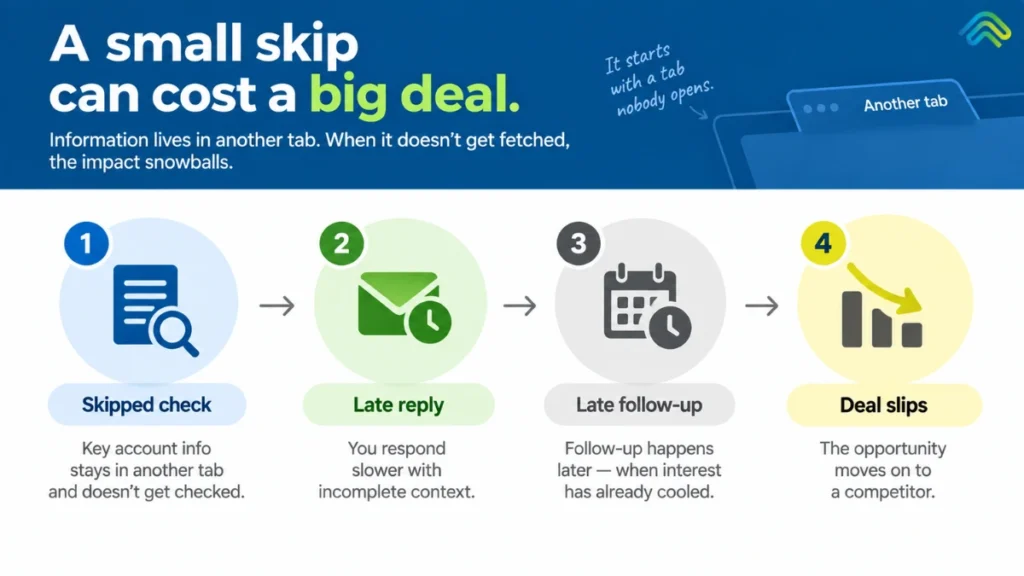
Follow the chain through. A skipped check becomes a late reply, a late reply becomes a late follow-up, and a missed change becomes a risk nobody saw coming. Late responses are exactly how deals slip.
The gap between what the system knew and what the seller actually did is where revenue quietly leaks out.
The system had the intelligence. The seller had the intent. The distance between them was a tab nobody had time to open.
What this looks like on an ordinary Tuesday?
Forget frameworks for a second. Here is what this looks like on an ordinary Tuesday. Each one is the same shape: a moment, where the seller actually is when it happens, what happens today, and what should happen instead.
1. Before the meeting
The seller opens their calendar to see what is next. That glance is the moment they want to know who they are meeting, what happened last time, what was left open, and what has changed at the account since.
But that intel lives in a different platform. Checking it means leaving the calendar. So it usually does not get checked, and the seller walks into the call running on whatever they happen to remember.
The context needed to be sitting right there on the calendar entry, at the second they looked at it.
2. After the meeting
The call ends, and the seller goes straight to their mailbox, because the very next thing they have to do is send the follow-up. So that is where the summary and the next actions need to be, right there in the inbox.
Not in a notetaker dashboard they have to open. Not behind a link they have to click. If the follow-up has to wait until they go and fetch the summary from somewhere else, it goes out tomorrow instead of in the next ten minutes. And that small delay is the whole problem, shrunk down to a single email.
3. Inside the CRM
A seller opens an account or a deal record. The summary of that account and what matters about it right now should be there, in the record they just opened. Not sitting in an adjacent tool that reads the CRM and reports on it somewhere else.
The common thread, said plainly: the intelligence is not the hard part. The delivery point is.
| The moment | What happens today | What should happen |
|---|---|---|
| Before the meeting | Intel sits in another platform, so it does not get checked. The rep walks in on memory. | The context is on the calendar entry, the moment they glance at it. |
| After the meeting | The summary lives in a dashboard or a link. The follow-up slips to tomorrow. | The summary and next actions are in the inbox, where the reply gets written. |
| Inside the CRM | An adjacent tool reads the CRM and reports elsewhere. | The account summary is in the record the seller just opened. |
Why systems of record miss this by design
None of this is a knock on the CRM, which is doing exactly what it was built to do. The trouble is what it was built to do in the first place.
A CRM is a system of record. It exists to describe what already happened. It asks the seller to come to it, after the fact, and write down what took place.
Making that conversational makes it faster to describe the past. That is useful. But it does not move the intelligence any closer to the moment a decision actually gets made. By the time the seller sits down to summarise, the reply has already been sent, the meeting is already over, and the risk that was sitting in an email three weeks ago is already a slipped quarter.
Faster description of the past is not the same as help in the moment. Those are two different jobs, and only one of them saves a deal.
Why the fix is to move the intelligence, not the seller?
There is a tidy version of the future where sellers give up the CRM entirely and run their whole day out of an AI assistant. Maybe that happens one day, and it is a nice thought.
It is not the behaviour change on offer today, though. Sellers are not going to move to where the AI lives, and twenty years of them avoiding the CRM should have taught the industry that much. People work where they work.
So the first real step is the opposite one. Do not ask the seller to come to the intelligence. Take the intelligence to where the seller already is. Their inbox, calendar, browser, CRM record itself and the phone in their hand.
That is not a grand prediction. It is just the working view of what actually changes behaviour now, rather than what might change it eventually.
One question that filters most GTM tools
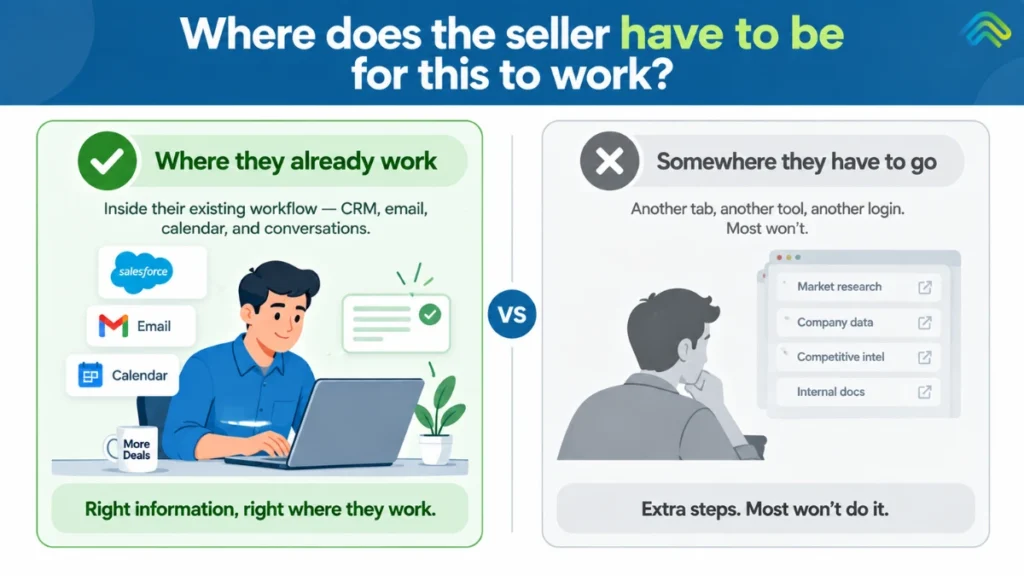
If you are buying or building sales tooling, you can cut through most of the noise with a single question.
Where does the seller have to be for this to work?
If the honest answer is anywhere other than where they already work, you have not bought sales intelligence. You have bought another place to go and get it. And most of the team, most of the time, will not go.
That is not cynicism about your team. It is just what twenty years of CRM adoption data already told us. The tools that get used are the ones that show up where the work is already happening.
What your best sellers already do in their head
There is a reason this matters so much, and you can see it in how your strongest reps operate.
Before a good seller sends a meaningful email, they run a quick check in their head. Maybe eight seconds. And it is remarkably consistent across the strong ones. It goes something like:
- Who is actually on this thread, and is the person who signs the contract one of them?
- What did they ask two emails ago that I quietly never answered?
- Have they slipped from saying “we” to saying “I,” which usually means my champion has lost the room?
- Is this the third reschedule?
- Am I talking to the person who likes me, or the person who actually decides?
None of this gets logged. It never reaches the CRM. It is the highest value work in the entire deal, it lives inside one person’s head, and it walks out of the door the day they leave.
“The goal was never to make the CRM easier to talk to. It is to make that eight second check happen every time, for every seller, at the moment it matters.” – Arush lakhani, Co Founder SpurIQ
Bringing that check to where the seller already works
This is the whole idea SpurIQ is built around. Rather than giving sellers a better place to go and ask questions, the intelligence is delivered to where they already work, so the check that used to live only in your best rep’s head starts happening for everyone, at the moment of the email, the meeting, or the record they just opened.
It is also why our GTM command centre reads from and executes across the stack a team already uses, the inbox, the calendar, the CRM and the rest, instead of asking anyone to move into a new tool. The intelligence comes to the seller, so the seller never has to stop and fetch it.
Final Words
Conversational sales tools are a real improvement, and the industry is right to be excited. But a better interface is still an interface, and every interface a seller has to travel to carries a fetching cost that busy sellers will keep skipping.
The win is not a nicer window to go and ask questions in. It is intelligence that arrives where the decision is already being made, on the calendar entry, in the inbox, inside the record, so the check your best seller runs in eight seconds happens for the whole team, every time it counts.
Ask where the seller has to be. If the answer is not “right where they already are,” the deal will keep slipping in the gap.
Build More Pipeline. Close More Deals.
Frequently asked questions:
Isn’t a conversational CRM already the fix everyone wanted?
It fixes the interface, which is real progress. Talking to the CRM beats filling in forms. But a chat window is still a place the seller has to go to, usually in another tab. The harder problem is delivery: getting the intelligence to where the seller already works so they do not have to stop, leave and come back. A better interface solves the easier half.
What do you mean by “fetching”?
Fetching is the work of going to get intelligence that lives somewhere other than where you are. Opening another tool to check an account before a call is fetching. It sounds trivial, but it is labour, and busy sellers skip labour that is optional. Skipped checks turn into late replies, late follow-ups and risks nobody saw coming, which is how deals slip.
Are you saying the CRM is the problem?
No. The CRM is doing exactly what a system of record is meant to do: describe what already happened. The limitation is structural. It asks the seller to come to it, after the fact. Making that conversational describes the past faster, but it does not move intelligence closer to the moment a decision gets made. Both jobs matter; only one of them saves a live deal.
Won’t sellers just run their whole day out of an AI assistant eventually?
Maybe, one day. But that is not the behaviour change available today. Sellers have avoided moving into the CRM for twenty years; they are unlikely to move into a new assistant either. People work where they already work. The realistic first step is to bring the intelligence to them, in the inbox, calendar, browser and CRM record, rather than waiting for them to relocate.
How do I evaluate a GTM tool against this idea?
Ask one question: where does the seller have to be for this to work? If the answer is anywhere other than where they already work, you have bought another place to go and get intelligence, and most of the team will not go there consistently. The tools that actually get used show up inside the seller’s existing workflow.