Every GTM team right now is being sold an AI sales agent, yet the category remains a complete mess. If you lead a revenue organization, your inbox is likely overflowing with pitches for these tools. Between 2025 and 2026 alone, hundreds of new AI sales agents flooded the market, each promising to automate your pipeline, scale your outreach, or magically double your revenue.
If you lead a revenue organization, your inbox is likely overflowing with vendor pitches. Gartner predicts that by 2028, a third of all enterprise AI interactions will use autonomous agents rather than simple chat interfaces. Because of this massive shift, between 2025 and 2026 alone, hundreds of new AI sales agents flooded the market.
The result? GTM teams are drowning in point solutions that generate endless activity but fail to move the needle on actual revenue. We are being sold a vision of autonomous growth, but the reality on the sales floor is often just more dashboard fatigue, siloed data, and unexecuted tasks.
This guide provides a clear, hype-free definition of what an AI sales agent actually is, how it operates beneath the hood, and – most importantly – what the vast majority of these tools get fundamentally wrong. We will break down the mechanics of these systems and reveal why generating activity is not the same as executing revenue. By the end, you’ll understand why the future of B2B sales doesn’t rely on adding more noise to your tech stack, but on closing the gap between a buying signal and a completed action.
What is an AI Sales Agent?
AI Sales agent is a software system that autonomously performs multi-step sales tasks – such as account research, outreach drafting, lead qualification, CRM updates, and risk detection – using a combination of Large Language Models (LLMs), real-time data signals, and complex workflow logic.
Unlike traditional sales software, which simply stores data until a human acts on it, a true sales AI agent is capable of reasoning, decision-making, and execution. It doesn’t just hold the list; it works the list.
However, the market is rife with mislabeled tools. To cut through the noise, GTM leaders need to understand the distinct differences between an AI sales agent and legacy or adjacent technologies:
- AI sales agent vs. Sales copilot: A copilot assists; an agent acts. If a tool sits in a sidebar and helps a rep write a better email or summarizes a call when prompted, it is a copilot. It relies entirely on human initiation. AI agents for sales, by contrast, operate autonomously in the background, initiating workflows based on triggers without waiting for a human to push a button.
- AI sales agent vs. Chatbot: A chatbot handles conversation; an agent handles multi-step work. While a chatbot can answer pricing questions on your website, a sales agent AI can notice a target account visiting your pricing page, cross-reference that intent data with your CRM, identify the correct buying committee, and autonomously draft and queue an outreach sequence for the account owner.
- AI sales agent vs. Sales automation: Automation follows rigid rules; an agent uses reasoning. Traditional automation relies on simple “if/then” logic (e.g., if a lead downloads a whitepaper, send email template A). If the situation deviates even slightly from the rule, the automation breaks. An AI agent uses LLMs to interpret unstructured data, adapt to nuance, and determine the next best action dynamically.
How AI Sales Agents Work?
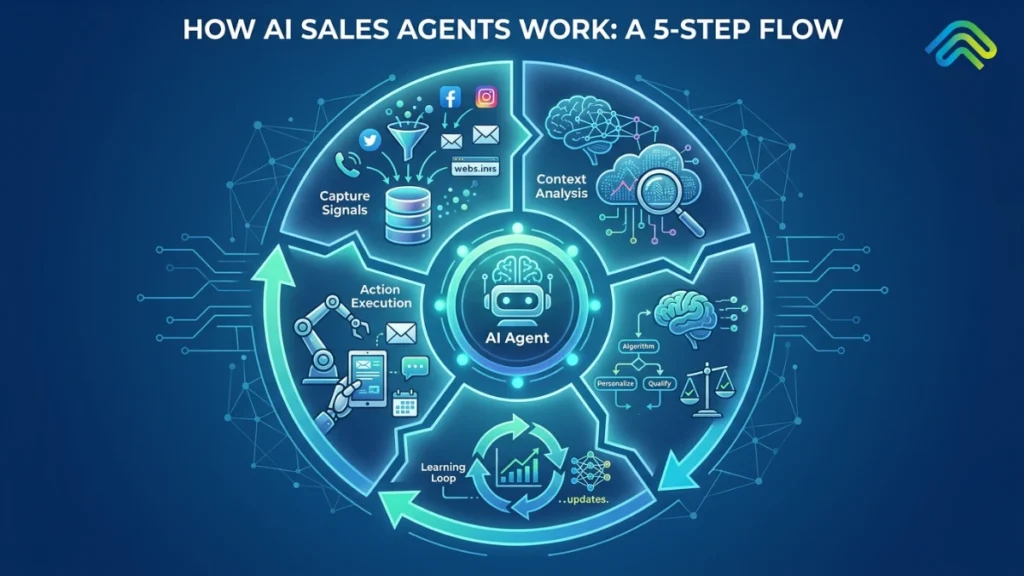
The GTM agent role in AI sales is fundamentally about processing information and turning it into momentum. To do this, data-driven AI agents in B2B sales explained, operate across a five-stage loop:
Step 1: Capture Signals
The process begins with listening. The agent ingests data from across your ecosystem. These signals can be explicit (a prospect filling out a demo request) or implicit (a target account showing high intent on third-party sites, a champion changing jobs, or a stalled deal sitting in a specific CRM stage for too long). This includes intent data, product usage metrics, CRM events, email/calendar activity, and contact enrichment feeds.
Step 2: Assess Context
A raw signal is useless without context. In this stage, the agent stitches disparate signals together to form a cohesive, account-level or deal-level picture. If an intent tool flags a company, the agent cross-references your CRM to see if there is an active opportunity, checks past closed-lost notes, and maps the current buying committee. It builds the “why” behind the interaction.
Step 3: Decision Making
Armed with context, the agent uses its LLM reasoning capabilities to determine the next best action. You will understand whom you should reach out to, what channels you should use, what messaging framework best aligns with your customer’s specific pain-points, and the most optimal time to engage with your potential customers.
Step 4: Action / Execution
This is where the rubber meets the road. The agent executes the decision – drafting the hyper-personalized email, sending the LinkedIn connection request, updating the CRM fields, or routing the highly qualified lead to the appropriate Account Executive.
Step 5: Learning Loop
Finally, the agent measures the outcome of its actions. Did the email bounce? Did the prospect reply? Did the deal advance to the next stage? The system ingests this feedback to refine its future targeting, messaging, and timing.
The Crucial Flaw: While this five-step loop looks perfect on paper, it represents a massive signal-to-action gap in reality. Most tools handle steps 1 through 3 perfectly. They capture signals, assemble context, and make brilliant decisions. But they stop short at step 4. They recommend actions to reps rather than executing them. They handle step 5 barely at all. As we’ll explore later, this failure to execute is where revenue teams are losing the most money.
The Main Types of AI Sales Agents
There are mainly five types of AI sales agents: Prospecting or Research agents, Outbound Outreach Agents, Conversational/Voice agents, Deal Execution Agents, and RevOps/Orchestration Agents. These AI agents for sales and marketing are categorized by specialized functions and deployed across the revenue lifecycle.
| Sales AI Agent Types | What It Does | Typical Use Case |
| Prospecting / Research Agents | These agents search the web and your databases to build targeted account lists, enrich contact details, and flag real-time buying signals. | Sales teams use them for top-of-funnel targeting and expanding their Total Addressable Market (TAM). |
| Outbound Outreach Agents | These agents use account research to automatically draft and send highly personalized emails and LinkedIn messages. | Teams use them to automate SDR workflows and scale their outbound pipeline creation. |
| Conversational / Voice Agents | These agents handle live conversations by making outbound calls or answering inbound dials to qualify leads. | They are ideal for managing off-hours routing and automating outbound sales calls for lead qualification. |
| Deal Execution Agents | These agents monitor active deals, draft follow-up emails, update CRM fields, and alert managers about stalled opportunities. | Sales leaders deploy them to boost AE productivity, keep forecasts clean, and enforce sales methodologies. |
| RevOps / Orchestration Agents | These agents act as the connective tissue for your tech stack by routing data between tools and enforcing workflow rules. | RevOps teams rely on these AI agents to streamline sales pipeline management and maintain operational consistency. |
While point solutions in these categories can provide incremental lifts in efficiency, GTM leaders are increasingly realizing that siloed agents create disjointed buyer journeys. True scale requires these functions to communicate and execute seamlessly.
Benefits of AI Sales Agents
For B2B organizations looking for the AI sales agents with the highest ROI, the primary benefits include:
- Faster Coverage of Larger Account Universes: Human SDRs can deeply research and personalize outreach only for a handful of accounts per day. AI agents can process thousands of signals and execute personalized, multi-channel outreach across your entire TAM simultaneously, ensuring no high-intent account goes untouched.
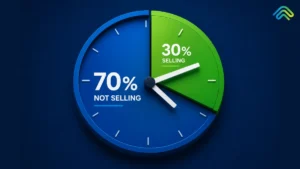
- Reduced Manual Administration: The latest Salesforce State of Sales report reveals that reps still spend over 70% of their time on non-selling activities like data entry. AI sales agents handle this administrative busywork, freeing up human sellers to build relationships and negotiate complex deals.
- More Consistent Follow-Up SLAs: Humans forget. Humans get sick. Humans prioritize the deal right in front of them over the lead that came in 10 minutes ago. AI agents ensure that every inbound lead is engaged within minutes, and every post-demo follow-up is sent exactly when promised, enforcing Service Level Agreements (SLAs) with zero fail rate.
- Better Signal-to-Outreach Timing: In modern sales, timing is everything. Engaging a prospect five minutes after they view a pricing page yields drastically different results than engaging them five days later. Agents detect and act on these signals instantly.
- Onboarding Acceleration: Using AI agents sales training new reps becomes significantly faster. Because the AI is handling the complex orchestration of outreach and CRM hygiene, new hires can focus entirely on mastering the product, the pitch, and customer conversations rather than learning the intricacies of a bloated tech stack.
However, these benefits are only fully realized when targeting, messaging, and execution all work together flawlessly. And unfortunately, for most teams, they don’t.
What’s Missing: The Signal-to-Action Gap
Here is the uncomfortable truth about the current state of GTM technology: we do not have a data problem, and we do not have an activity problem. We have an execution problem.
Most AI sales agents today fall into two distinct, fundamentally flawed categories: they either recommend or they generate.
Recommending agents analyze calls, score leads, and suggest next actions. They tell your reps, “Account X is showing high intent,” or “Deal Y is at risk because the champion left.” But these recommendations sit passively in dashboards, waiting for a human to log in, notice them, and decide to act.
Generating agents, on the other hand, produce massive amounts of raw activity. They write thousands of emails, make hundreds of dials, and draft endless meeting notes. But this activity stacks up without strategic follow-through, and without updating the systems of record.
Neither of these is the same as executing revenue outcomes. When you rely on recommendation and generation without enforcement, your CRM decays silently, high-intent deals go idle, and revenue leaks twice in your modern B2B team:
- Before pipeline exists (The Creation Leak): The right buyers show the right signals at the right time, but because reps are overwhelmed by dashboards and manual research, those signals are missed. The outreach never happens.
- After pipeline exists (The Conversion Leak): A great discovery call happens, but the follow-up lags. The mutual action plan is abandoned. Next steps aren’t enforced, and deal risk surfaces far too late in the quarter to save the opportunity.
Most AI sales agents only attempt to plug one of these leaks, and they only do it at the “recommend” or “generate” layer. They do not enforce the actual work.
“Recommending an action and enforcing it are not the same thing. Dashboards don’t close deals; executed workflows do.” – CEO SpurIQ
The real gap in the market isn’t lead generation, and it isn’t deal management. It is the profound absence of a system that owns the execution between a buying signal and a completed action. To fix B2B sales, we need better execution, not more noise.
To dive deeper into this concept, read The Signal-to-Action Gap: Why Modern Revenue Teams Leak Twice.
What Execution-Focused AI Agents Actually Look Like?
To bridge the signal-to-action gap, GTM teams must move past copilot toys and fragmented point solutions. They need an execution layer for the GTM stack.
An execution-focused AI sales agent must meet a strict set of criteria to be considered enterprise-ready:
- It works with your existing stack: It does not require you to rip and replace your CRM, your sequence tool, or your data providers. It acts as the intelligent orchestration layer sitting on top of the tools you already pay for.
- It owns follow-through: It doesn’t just draft an email; it ensures the draft is sent. It doesn’t just summarize a call; it ensures the CRM is actively updated with the MEDDIC criteria. It ensures next steps are actually taken.
- It covers both leaks: It handles pipeline creation AND pipeline conversion through a unified engine, ensuring the buyer journey is seamless from first touch to closed-won.
- It gives leadership reliable visibility: Because it actually executes the work in the systems of record, GTM leaders get an accurate view of pipeline reality. Revenue predictability no longer depends on whether a rep remembered to log their activities.
SpurIQ is a revenue execution platform built entirely on this principle. It turns signals into executed actions across your existing GTM stack – through LeadIQ for signal-led outbound and DealIQ for system-driven follow-through. The platform doesn’t recommend a next step and hope a rep does it. It closes the loop. It creates and converts pipeline autonomously, ensuring that every high-value signal translates into a tangible, measurable action.
Ultimately, SpurIQ doesn’t just recommend actions or generate activity, it enforces executed follow-through across the existing stack, by implementing AI revenue action orchestration.
How to Evaluate AI Sales Agents in 2026?
If you are a GTM leader tasked with cutting through the vendor noise and finding the best AI sales agents 2026 has to offer, you need a rigorous evaluation framework. Stop looking at feature lists and start looking at execution capabilities.
Use this checklist when evaluating the best AI sales agents for outbound sales 2026 and full-funnel revenue execution:
- Signal Ingestion: Does the tool detect signals natively across your existing tools (intent providers, inbox, CRM, web analytics), or does it only function inside its own proprietary, walled garden?
- Action Enforcement: Does it stop at recommendation (alerting a rep in Slack or a dashboard), or does it execute the action end-to-end (drafting, queuing, and updating the system)?
- Full-Funnel Coverage: Does it cover both pipeline creation (prospecting) and pipeline conversion (deal execution), or does it only solve half the problem?
- CRM Hygiene: Does it keep your CRM completely current automatically, or does it still rely on rep discipline and manual data entry?
- Leadership Visibility: Does it give managers true execution visibility and forecast accuracy, or just another dashboard tracking raw activity volume?
- Integration Philosophy: Does it deeply integrate with your current tech stack, or does it demand a painful, months-long replacement of your core systems?
The best AI sales agents in 2026 won’t be the ones that send the highest volume of activity into the void. They will be the ones that definitively close the signal-to-action gap.
Curious about the differences between specific tools? Check out AI SDR vs. AI Sales Agent: What’s the Actual Difference?.
A Note on ‘How to Build an AI Sales Agent’
As AI becomes more accessible, technically minded RevOps leaders often search for how to build an AI sales agent or how to create AI sales agent workflows internally. The appeal is obvious: total customization and avoidance of vendor lock-in.
If you are exploring how to build AI sales agent infrastructure, you must understand the five core components required: the signal layer (APIs to ingest data), the context layer (vector databases to store knowledge), the decision layer (LLMs to reason), the execution layer (write-access APIs to your stack), and the feedback layer (analytics to measure outcomes).
However, a brutal reality check is necessary: the execution layer is incredibly difficult to build and maintain. Managing constant API changes, handling complex identity resolution across multiple platforms, dealing with rate limits, and building state-management logic so the agent doesn’t send duplicate emails or overwrite critical CRM data requires a dedicated engineering team.
For 99% of B2B organizations, building this internally is a distraction from selling. Most teams shouldn’t build. You are far better off buying a platform where the rigorous, unglamorous work of the execution layer is already solved for you.
Take the Next Step
In conclusion to this breakdown of modern GTM tools, remember that revenue doesn’t come from building more dashboards; it comes from executing the right actions at the right time. Stop settling for tools that recommend work and start deploying systems that enforce it.
See how SpurIQ acts as the ultimate execution layer, closing the signal-to-action gap across your existing stack to drive predictable, scalable growth.
Want to dive deeper into how the LeadIQ and DealIQ tracks work together to secure your pipeline?
FAQs:
Q. What is an AI sales agent?
An AI sales agent is autonomous software that uses large language models, real-time data signals, and workflow logic to perform multi-step sales tasks. Unlike traditional tools that wait for human input, agents actively research, engage prospects, and update systems of record independently.
Q. How are AI sales agents different from AI SDRs?
An AI SDR is typically a point solution focused solely on top-of-funnel outbound email generation. An AI sales agent is a broader, full-funnel capability that can handle prospecting, but also manages deal execution, CRM hygiene, and complex orchestration across the entire revenue pipeline.
Q. Are AI sales agents good for outbound sales calls?
Yes, specific voice-based AI agents are designed for outbound sales calls. They use conversational AI to navigate phone trees, deliver pitches, and handle basic objections. However, they are best utilized for high-volume, transactional dialing rather than complex, relationship-based enterprise B2B sales.
Q. Can AI sales agents qualify leads?
Absolutely. AI agents can instantly cross-reference an inbound lead against your ideal customer profile, check their intent signals, and engage them in multi-channel outreach to confirm BANT (Budget, Authority, Need, Timeline) criteria before routing them to an Account Executive.
Q. What’s the ROI of AI sales agents?
The ROI of AI sales agents is measured in increased pipeline velocity, higher win rates, and reduced operational costs. By automating research and data entry, reps regain 20-30% of their selling time, while instantaneous lead follow-up prevents high-value opportunities from leaking to competitors.
Q. Which AI sales agents are best for B2B in 2026?
The best AI sales agents for B2B in 2026 are execution-focused platforms that integrate with your existing tech stack. Instead of just recommending actions or generating raw activity, they enforce follow-through across both pipeline creation and conversion, fully closing the signal-to-action gap.
Q. Can AI sales agents handle both sales and marketing workflows?
Yes. Modern AI agents act as the connective tissue between GTM teams. They can take marketing intent signals (like webinar attendance) and seamlessly translate them into executed sales workflows (like personalized outbound sequences), ensuring alignment and preventing leads from falling through the cracks.