
What Is Revenue Leakage and Why Your Pipeline Isn’t the Problem?
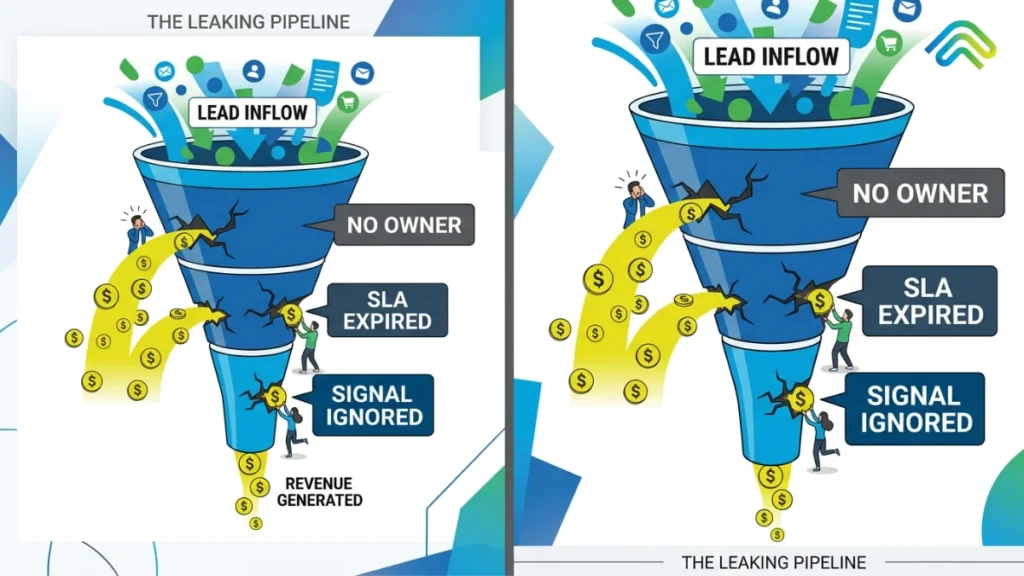
20–30% of revenue doesn’t disappear because your pipeline is thin. It slips away after the buyer has already signaled. Here’s what revenue leakage actually means in 2026 and how to stop it at its source. Picture a deal your team worked hard to move forward. The prospect opened your proposal four times in a 48-hour window. Your platform flagged the intent signal. The CRM note was logged. Someone was going to follow up, right after the next internal sync. Three days passed. The buyer went quiet. Then the email arrived: they’d signed with someone else. That’s not pipeline failure. That’s revenue leakage and it’s one of the most misunderstood, most expensive problems in B2B sales today. The conventional wisdom says revenue leakage is about billing errors, pricing inconsistencies, and missed invoices. And those things are real. But in 2026, the far larger and far more costly form of leakage happens somewhere else entirely: in the gap between a buyer signal and the action that was supposed to follow it. This piece is about that gap, what causes it, how to diagnose it and how to close it permanently. What Is Revenue Leakage? A Definition That Actually Fits 2026 Revenue leakage is the difference between the revenue a business should capture and the revenue it actually collects. It’s not because demand was absent, but because execution failed after the signal was present. That’s a deliberately different definition from the one you’ll find in most RevOps glossaries. The traditional revenue leakage definition focuses on back-office breakdowns: a discount that shouldn’t have been applied, a contract that renewed at the wrong tier, a service that was delivered but never invoiced. Those are real problems, and they deserve attention. But they describe a shrinking fraction of total leakage. The bigger story, the one that most organizations haven’t fully reckoned with — is this: buyers are generating more signals than ever. Intent data, engagement analytics, deal activity, usage patterns, buying committee movements. The signal infrastructure has never been richer. And yet revenue still leaks. Not because we can’t see the signals. Because the actions that should follow those signals aren’t consistent, aren’t fast and aren’t accountable. Insight ≠ Revenue. Revenue Execution = Revenue. The moment a signal fires without a corresponding action, you’ve already started leaking. There’s a name for this gap between signal and action. We call it signal-to-action latency. And in our experience working with B2B revenue teams, it’s the single largest driver of slipped revenue that almost nobody is directly measuring. 20–30% of potential revenue leaks post-buyer interaction, not from pipeline weakness, but from execution gaps that occur after signals are already present. (SpurIQ Revenue Execution Research) Also Read: Revenue Intelligence vs Revenue Execution: Why Insights Don’t Close Deals Revenue Leakage Examples: What It Actually Looks Like? Revenue leakage doesn’t usually look dramatic. It rarely shows up as a single catastrophic event. It shows up as a collection of small, preventable moments, each one a signal that existed and an action that didn’t follow. Here are five examples that illustrate the full picture, from the traditional to the execution-gap scenarios that define leakage in the modern revenue environment. 1. The Prospect Who Was Ready and Then Wasn’t A mid-market prospect spends two days re-opening your proposal, forwarding it internally, and visiting your pricing page three times. Every signal says this is a high-probability, near-close deal. The rep who owns the account is in back-to-back meetings. The alert sits in a dashboard. No follow-up fires automatically. By day four, the prospect has moved on, not because they lost interest, but because your competitor responded faster. The signal was there. The execution was not. That’s revenue leakage. 2. The Champion Who Moved On and Nobody Noticed Your internal champion at a key account accepts a new job. LinkedIn shows the move on the day it happens. Your CRM reflects it two weeks later, when someone manually updates the contact. By then, no re-engagement sequence has fired. The relationship has gone cold. The renewal is at risk. This is a signal-to-action gap measured in weeks, not hours. In a market where champions carry institutional relationships with them, that latency is often fatal to the deal. 3. The Renewal That Wasn’t Saved A long-standing customer’s usage data drops 30% over six weeks. Every customer success playbook says this pattern predicts churn. But the signal sits in a health dashboard. The CSM has sixteen other accounts. No automated outreach fires. The customer churns at renewal. This is bottom-of-funnel revenue leakage. The signal was rich. The execution ownership was absent. 4. The Discount That Didn’t Need to Happen A rep, trying to accelerate a deal close before quarter-end, applies a 15% discount without finance approval. The deal closes, but at an eroded margin. No workflow flagged the deviation. No approval path enforced the pricing governance. This is the classic example of revenue leakage and it’s real. But notice something: it, too, is an execution gap. The process existed. The enforcement of it did not. 5. The Hot Lead That Arrived at the Wrong Desk An inbound lead scores 94 out of 100 on your ICP model. It routes to an SDR who is already at capacity. The lead sits for 72 hours before first contact. By the time someone reaches out, the buyer has already spoken to two competitors. Signal-to-action latency at the top of the funnel. The lead was as warm as it gets. The routing and response execution failed. The Pattern Across All Five Examples:In every case, the revenue signal was present. Intent data. Engagement signals. Usage drops. Champion changes. ICP scores. The leak didn’t happen because the signal didn’t exist, it happened because no accountable, automated action followed the signal with sufficient speed. Why Revenue Leakage Is Getting Worse, Not Better? If you’d asked a revenue leader about leakage 5 years ago, the answer would have been about data quality, billing systems and contract management. Those are still valid concerns. But the dominant driver