
Who owns revenue execution in a B2B organization? In most companies, no one does, not explicitly, not systematically, not in a way that survives a missed quota conversation. Marketing claims the top of the funnel. Sales owns active deals. RevOps architects the CRM. Customer Success monitors retention signals. Each function holds a slice of the buyer journey, but no single team owns the real-time, systematic act of converting buying signals into immediate, accountable action.
This structural fragmentation is the RevOps accountability gap, the gray zone between knowing what needs to happen and guaranteeing it does. Closing it requires more than a cleaner RACI chart or a tighter SLA policy. It requires a dedicated revenue execution layer: a system that assigns ownership at the signal level, enforces deadlines and escalates when nothing happens. Without it, B2B revenue accountability remains theoretical and revenue leakage accountability sits with everyone and no one at the same time.
Walk Into Any Boardroom and Ask This Question
“Who actually owns the execution of our revenue strategy?”
You’ll get a confident, entirely fragmented chorus. Marketing insists they own top-of-funnel leads. Sales grabs the steering wheel for active deals. RevOps proudly points to the CRM architecture. Customer Success pulls up their health scores.
On paper, everyone owns revenue execution. In practice? Nobody does.
This is not a people problem or a motivation problem. It is a structural failure baked into how modern B2B GTM organizations are designed and it is the primary driver of revenue leakage that dashboards can see but cannot fix.
Revenue execution ownership in B2B is not just the act of selling. It is the real-time, systematic habit of turning buying signals into immediate, assigned, time-bound action. When execution ownership in GTM gets divided across departments without a unified layer enforcing it, critical signals fall through the cracks at the exact moments they matter most.
“In most B2B orgs, revenue execution is owned by everyone on paper and no one in practice.” — SpurIQ
How the Modern GTM Org Distributes and Drops Revenue Execution Ownership?
Modern B2B companies are built on specialization. That specialization is a genuine strength, until it fragments execution ownership GTM into four separate functions with four separate mandates, none of which includes “make sure the signal gets acted on before the buyer moves on.”
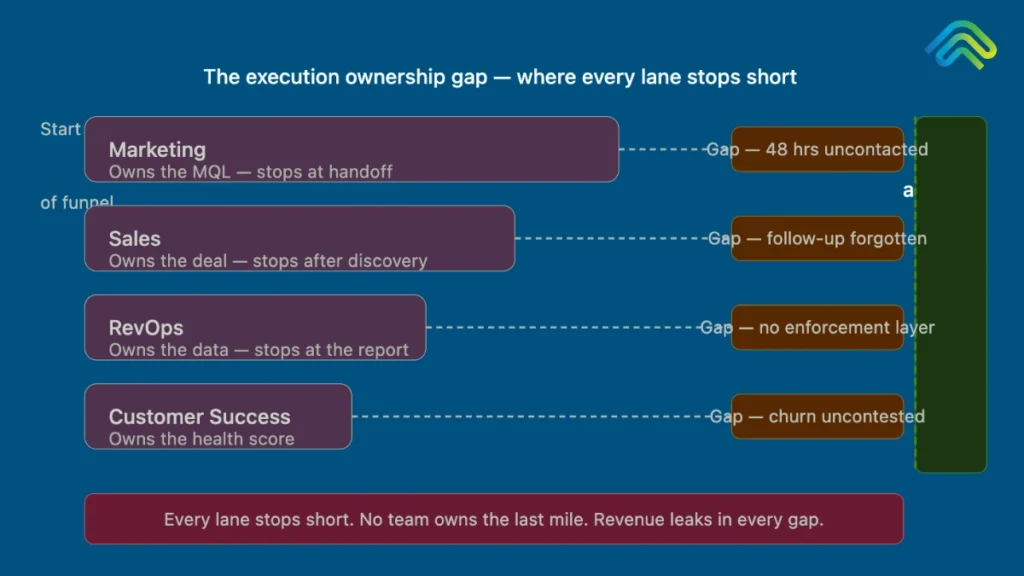
Here is exactly how revenue execution ownership in B2B gets fractured:
Marketing owns the top of the funnel
Demand gen teams grind for MQLs. They build the bridge to the buyer. Their mandate ends the moment the lead lands in the CRM. What happens to that signal in the next 48 hours is structurally not their problem and that gap is where revenue leakage accountability first goes missing.
Sales owns the conversation
AEs and SDRs own the pitch and the relationship. But they are human beings managing dozens of accounts simultaneously. Administrative follow-ups get deprioritized. Signals that should trigger immediate action sit unactioned in dashboards no one opened. The result is not a performance failure, it is an execution ownership GTM failure.
RevOps owns the architecture
They build the stadium and ensure the data flows cleanly. They do not play the game. Even the best RevOps teams ultimately flag “Stalled Deals” in a report and wait for a sales manager to ping a rep on Slack. This is the core of the RevOps accountability gap: RevOps designs the execution playbook; it does not and was never designed to, run it.
Customer Success owns retention signals
CS monitors product usage and NPS scores and knows when an account is trending toward churn. But they rarely own the automated commercial triggers that force timely intervention. By the time the data reaches someone who can act, the window has often closed. That is revenue leakage accountability failing at the bottom of the funnel.
Every team handles execution incidentally. No team owns it explicitly. This is what we call The Execution Ownership Gap, the most expensive structural flaw in modern B2B revenue accountability.
The Revenue Execution Ownership Breakdown by Role
| Role | What They Own | What They Drop |
| Marketing | Lead gen, MQL delivery, campaign ROI, messaging | Post-handoff engagement, real-time SLA enforcement |
| Sales | Pitching, relationship building, closing, forecasting | Signal tracking, CRM hygiene, systemic follow-ups |
| RevOps | Tooling architecture, data alignment, analytics | Actual execution of the playbook, real-time prospect outreach |
| Customer Success | Onboarding, adoption, health scoring, QBRs | Commercial triggers required to act on sudden churn signals |
This table is not an indictment of any of these functions. Each team is doing exactly what it was designed to do. The problem is that who owns revenue execution was never answered at the organizational design level. It was assumed to happen in the spaces between four well-resourced, well-intentioned teams.
It doesn’t.
The RevOps Accountability Gap: Why the Tragedy of the Commons Applies to Your Pipeline
In economics, the “tragedy of the commons” describes what happens when a shared resource is managed by everyone collectively and owned by no one specifically, it gets depleted. In the B2B GTM org, your buyer’s journey is that shared resource.
Because every team touches the buyer’s journey, every team assumes some other team is handling the granular follow-up. This is the RevOps accountability gap made structural: the bystander effect applied to B2B revenue accountability. The more people who can see a problem on a shared dashboard, the less any individual feels personally responsible for solving it.
The result is The Execution Ownership Gap: strategy is solid, data is present, tooling is expensive and the physical act of moving a deal forward dissolves in the ether between four capable, well-intentioned teams.
For a deeper look at how this plays out at the signal level, see our analysis of the Signal-to-Action Gap in modern GTM stacks.
The 3 Places Revenue Leakage Accountability Goes Missing in B2B Orgs
Revenue leakage accountability doesn’t fail randomly. It fails at three predictable, structural handoff points, the same three points in virtually every B2B org, regardless of headcount, tech stack, or how well-defined the process looks on paper.
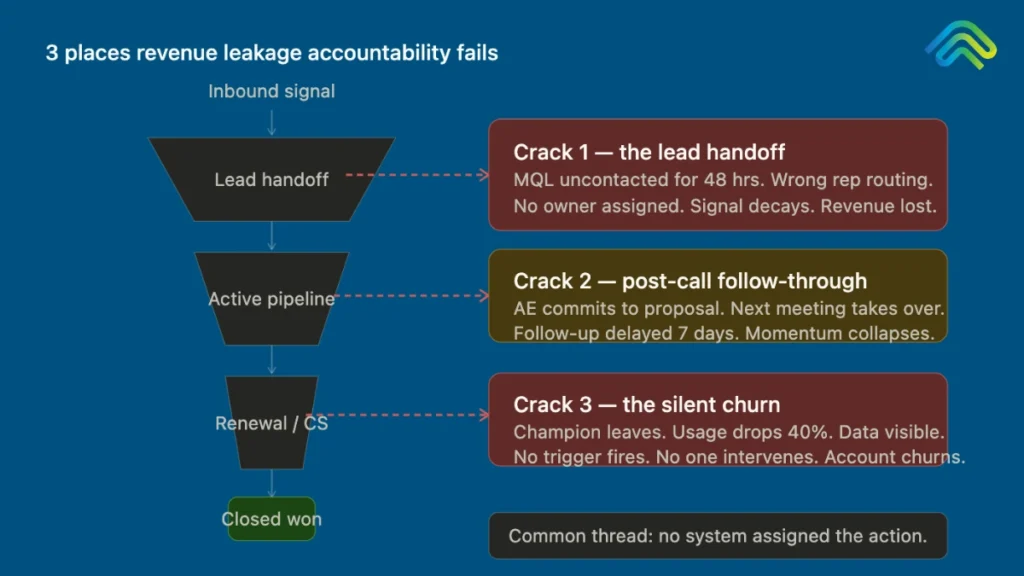
1. The Lead Handoff
Marketing generates a qualified lead. The signal sits uncontacted for 48 hours because it routed to the wrong rep, or the rep was closing out the quarter. The probability of qualifying a lead drops over 80% after the first five minutes. By hour 48, the signal is dead. The buyer moved on. No one in the org is accountable for the miss, because revenue execution ownership in B2B broke down at the handoff itself, where accountability was implicit, not assigned.
2. Post-Call Follow-Through
An AE runs an excellent discovery call and commits to a tailored proposal and a technical deep-dive session. They walk straight into their next meeting. The CRM doesn’t get updated. The follow-up doesn’t happen for a week. The buyer interprets the silence as disorganization. Momentum, the single most fragile asset in enterprise sales, collapses. This is execution ownership GTM failure: no system enforced the committed next step, so it didn’t happen.
3. The Silent Churn
A champion at a key enterprise account departs. Product usage drops 40% over six weeks. The data is fully visible in the analytics tool. But no automated trigger forces the Account Manager to intervene before the renewal becomes a cancellation. The account churns. The post-mortem reveals everyone could see the signals. No one was assigned to act on them. This is revenue leakage accountability at its most expensive and most preventable.
Why RevOps Doesn’t Close the RevOps Accountability Gap And Wasn’t Designed To?
RevOps is one of the most valuable structural innovations in modern B2B GTM. It is not the solution to revenue execution ownership in B2B and understanding why is critical before investing in the wrong fix.
RevOps builds the map. It designs the plays. It ensures data is clean and reporting reflects reality. This work is essential. But a map does not drive the car.
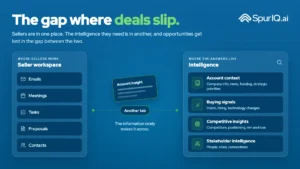
Even the best RevOps teams leave the execution layer to human memory and discretion. They flag stalled deals. They build dashboards. They create Slack alerts. All of that work produces one output: a notification. And a notification is not execution. It is a request for execution, one that can be deprioritized, ignored, or simply missed.
The RevOps accountability gap is not a failure of RevOps. It is a category gap. RevOps solves the design problem. Revenue Execution solves the action problem. Both are necessary. Only one currently exists in most B2B orgs.
Revenue Execution is the system layer that closes the gap between RevOps design and real-world action. — SpurIQ CEO
What True Revenue Execution Ownership Actually Requires?
To move from theoretical GTM strategy to measurable outcomes, higher win rates, lower CAC, better net revenue retention, B2B revenue accountability must be redefined at the architectural level. True execution ownership in GTM requires four non-negotiable capabilities:
Real-time signal detection: The moment a buyer views a pricing page, opens a contract for the fifth time, or drops off a renewal call, the system catches it. Not at the next weekly pipeline review. Instantly.
Automated action, not rep judgment: Execution cannot depend on whether a rep feels like following up today. The system triggers the next step automatically based on signal severity and context — without requiring a human to notice it first.
Accountability without memory: Humans are structurally poor at consistent execution across dozens of accounts simultaneously. The execution layer enforces compliance by making inaction impossible to hide: tasks are assigned, SLAs are running, escalations fire automatically.
End-to-end, handoff-free flow: Handoffs are where deals die and where revenue leakage accountability collapses. True ownership means an unbroken chain of action from the first marketing touch to a signed contract, with no gray zones where accountability is assumed rather than assigned.
The Revenue Execution Maturity Model: Where Does Your GTM Org Sit?
Understanding revenue execution ownership in B2B starts with an honest assessment of where your org sits today. Most leadership teams overestimate their maturity by at least one stage.
Stage 1 — Ad-Hoc (The Wild West) Execution ownership GTM is entirely individual. Reps manage follow-ups via sticky notes and unread inbox flags. No SLAs exist. Revenue leakage is massive, unmeasured and blamed on rep performance.
Stage 2 — Process-Defined (The Illusion of Control) RevOps has built dashboards and defined plays. Managers nudge reps in 1:1s. But execution still relies entirely on human compliance — and when compliance slips, the process is invisible. This is where the RevOps accountability gap is most acute: the process exists, but nothing enforces it.
Stage 3 — Trigger-Assisted (The Transition) Basic automations handle some signals — new lead auto-responders, late-stage email sequences. But complex mid-funnel actions and cross-functional handoffs still require human initiation. Automation covers roughly 20% of execution needs. Revenue leakage accountability persists in the other 80%.
Stage 4 — Systemic Ownership (True Execution) A dedicated Revenue Execution platform autonomously detects signals and launches the appropriate workflow — without waiting for human notice. Execution ownership in GTM is assigned at the signal level. SLAs are system-enforced. Escalation is automatic. B2B revenue accountability becomes operational, not aspirational.
Most B2B organizations sit between Stage 2 and Stage 3. They have the data. They have the architecture. They are missing the execution layer that makes all of it produce consistent action.
The One Question That Exposes Your Execution Ownership Gap
Pull up your GTM stack and ask this in your next leadership meeting:
“For every revenue signal we generate, form fill, pricing page visit, usage drop, contract open, who is explicitly accountable if it goes unactioned? What is their SLA? What happens to that accountability if the SLA is missed?”
If the answer is “the individual rep,” you do not have revenue execution ownership in B2B. You have hope, well-structured, dashboard-supported hope, but hope nonetheless.
If the answer is “the system enforces it and escalates automatically,” you have reached Stage 4. That is where win rates climb and churn becomes predictable.
For a direct look at how this manifests in CRM tools, see why revenue dashboards expose problems but don’t fix revenue.
How SpurIQ Closes the Execution Ownership Gap?
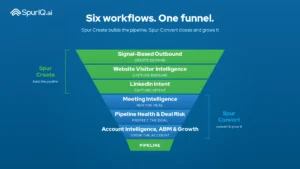
SpurIQ was built because the RevOps accountability gap exists, the execution ownership GTM problem is structural and no existing technology category was designed to solve it. SpurIQ is not a CRM, an intent tool, or a dashboard. It is the Revenue Execution layer — the autonomous system that takes over the follow-through every other tool was never designed to guarantee.
Lead IQ closes revenue leakage accountability at the top of the funnel. When marketing generates a signal, Lead IQ guarantees instant, contextual routing and automated first-touch engagement. The lead black hole is structurally eliminated — not manually policed.
Deal IQ locks down execution ownership in GTM at the bottom of the funnel. It monitors active pipeline health in real time, tracks buyer engagement with proposals and collateral and forces timely action on the deals most likely to close. Reps don’t need to remember. The system enforces.
When a signal fires in SpurIQ, the rep doesn’t receive a notification. They receive an assigned task, with full buyer context, recommended action, a live SLA timer and an automatic escalation path to VP Sales if the window closes untouched.
Signal to action: under 15 minutes. Not under 15 days.
This is what revenue execution ownership in B2B looks like as a system, not a function hoping to own it, but a platform guaranteeing it.
Key Takeaways for CROs, VP Sales and RevOps Leaders
Who owns revenue execution by default in B2B? No one. It must be built deliberately into the architecture not hoped into existence through better processes and clearer job descriptions.
The RevOps accountability gap is structural, not cultural. Blaming reps for missed follow-ups when no system enforces follow-through is an organizational design failure, not a performance management issue.
Revenue execution ownership in B2B requires a dedicated action layer. RevOps is the design function. Revenue Execution is the action function. Expecting RevOps to deliver execution outcomes is the most expensive category confusion in modern GTM.
Revenue leakage accountability cannot be fixed with dashboards. Visibility tells you where the leak is. Execution ownership is what stops it.
Stage 4 is achievable. But it requires the right layer, not a better dashboard, a bigger RevOps team, or another round of enablement training.
SpurIQ is the Revenue Execution layer for modern B2B GTM organizations, closing the Execution Ownership Gap between what your stack knows and what your team actually does.
FAQs:
Who owns revenue execution in a B2B company?
Who owns revenue execution in most B2B organizations is the wrong question, because the honest answer is that no one does, not explicitly. Marketing owns lead generation, Sales owns pipeline conversations, RevOps owns process architecture and Customer Success owns retention signals. Because each team holds a slice, B2B revenue accountability for the actual act of converting signals into time-bound actions falls into the structural gap between them. Leading organizations close this by deploying a dedicated Revenue Execution platform that assigns ownership at the signal level, making revenue execution ownership in B2B a system function rather than an assumed responsibility distributed across four departments.
What is the RevOps accountability gap?
The RevOps accountability gap is the structural space between what RevOps is designed to do, build process, maintain data integrity, produce analytics and what revenue execution actually requires: real-time, automated, accountable action at the signal level. RevOps flags the problem. Revenue Execution owns the fix. The gap exists because RevOps was never architected to be an action layer. It was architected to be a design and reporting layer. The RevOps accountability gap widens every time a dashboard alert fires, no one acts within the critical window and no system escalates the miss automatically.
Why does revenue leakage happen between Sales, Marketing and RevOps?
Revenue leakage accountability breaks down at handoff points, the moments between functions where explicit ownership is never defined. When a lead passes from marketing to sales, execution ownership GTM sits in a gray zone: not enforced by marketing, not yet owned by sales, not tracked by RevOps. The bystander effect compounds this: because the signal is visible to multiple people on a shared dashboard, each person assumes someone else is handling it. Without a system that assigns named ownership at the moment the signal fires, revenue leakage accountability remains collective, which functionally means nonexistent.
How is Revenue Execution different from RevOps?
Revenue execution ownership in B2B and RevOps serve fundamentally different functions. RevOps is strategic and architectural: it designs the process, maintains the CRM, aligns data across systems and surfaces analytics. Revenue Execution is operational and action-oriented: it converts those analytics into mandatory, assigned, time-bound seller actions — automatically, without depending on human memory. The simplest distinction: RevOps tells you a deal is stalling. Revenue Execution assigns a named owner, starts an SLA clock and escalates to VP Sales if no action is taken. Closing the RevOps accountability gap requires building both, not expecting one to do the work of the other.