Your reps are putting in the hours. The sequences are running. The calendar still isn’t filling up.
That’s not a motivation problem. It’s a system problem.
Outbound sales in 2026 are harder to execute than it was two years ago, and not because buyers stopped buying. The average cold email reply rate has dropped to 3.43%, as per Instantly’s 2026 Cold Email Benchmark Report. Google and Microsoft tightened deliverability rules based on engagement signals, so low-quality volume now actively hurts your domain. According to Gartner, B2B buyers spend only 17% of their purchasing time meeting with potential suppliers, doing the rest of their research independently, on their own terms.
Teams that kept doing what worked in 2022 are the ones watching reply rates fall and pipeline shrink. Teams that rebuilt their approach around relevance, timing, and signal-led outreach are still growing. 80% of high-performing B2B teams rely on outbound as a key part of their revenue strategy as per the Outreach Prospecting 2025 Report.
The gap between those two groups isn’t budget or headcount. It’s how they built the system.
By the end of this guide, you’ll have a clear view of what is sales outbound in 2026, how it works across seven stages, where the process breaks down for most teams, and what separates a repeatable system from a sequence of tasks that slowly stop working.
Ready to go straight to execution? Start with Outbound Sales Strategy with seven proven plays that actually work in 2026.
What is Outbound Sales?
Outbound sales is the seller-initiated motion where reps proactively reach out to fit-profile prospects who haven’t raised their hand yet, with the goal of creating a qualified pipeline. The outbound sales meaning hasn’t changed over the years, but the execution has changed considerably.
No waiting for intent signals, no form fills, no inbound leads. That is the outbound sales definition that holds across every market and every segment. In modern B2B outbound, that means a deliberate, signal-informed, multi-channel approach. Identifying the right accounts, choosing the right moment to reach out, and initiating contact with the prospect didn’t ask for but is likely to find relevant.
The sales outbound definition extends beyond the initial reach-out to cover the full motion: the channels in modern B2B outbound sales include cold email, phone (direct dial and power dialer), LinkedIn outreach, video messages, direct mail, and events.
Most sequences combine three or more of these rather than running a single channel.
Two roles run the outbound motion in most B2B organizations. The SDR (Sales Development Representative) or BDR (Business Development Representative), which is a synonym in most companies, creates the meeting. The AE (Account Executive) runs the discovery and closes the deal. At smaller companies or earlier stages, a full-cycle rep covers both.
For a broader grounding in what B2B selling involves across the full funnel, see our what is B2B sales guide.
Inbound vs Outbound Sales: The Foundational Difference
The foundational difference between inbound and outbound sales is who initiates contact. Inbound starts when a prospect raises their hand. Outbound starts when a rep does. Everything else, lead temperature, speed to revenue, predictability, and cost structure, flows from that single distinction.
Here’s how the two models compare, when each one dominates, and how most high-performing B2B teams combine them.
| Factor | Inbound Sales | Outbound Sales |
| Who initiates | Prospect contacts you | Rep contacts prospect |
| Lead temperature | Warm: prospect expressed interest | Cold: no prior intent signal |
| Speed to revenue | Slower (depends on the content flywheel) | Faster (rep can create a pipeline directly) |
| Predictability | Variable: depends on traffic volume | More controllable: rep drives activity |
| Cost structure | High upfront content investment | Ongoing rep headcount and tooling |
Inbound dominates when a company has an established brand, a mature content and SEO engine, and enough organic demand to fill the funnel. It scales without proportional headcount.
Outbound dominates when you’re entering a new market, operating in an undefined or niche category, working with a small total addressable market, or running a founder-led GTM with no inbound flywheel yet. You need a pipeline faster than a content strategy can deliver it.
Most modern B2B revenue teams run a hybrid model: inbound signals, website visits, content engagement, intent spikes, and feed outbound timing. A prospect who just read three blog posts is a better cold call target than one who has never heard of you. That shift in how signals and outreach interact is what makes the seven-stage outbound process work differently in 2026 than it did two years ago. For the full comparison, see our Inbound vs Outbound Sales: Which Model Wins in 2026 guide.
Outbound Sales in B2B: What Makes It Different
B2B outbound and B2C outbound share the same basic motion, but the execution is structurally different. In B2C, a single buyer makes a fast decision at low ACV. In B2B outbound sales, you’re selling higher ACV solutions to companies, which means longer sales cycles (weeks to months), multiple decision-makers, formal evaluation processes, and a channel mix that weights LinkedIn, phone, and email far above social ads or direct mail.
Gartner’s data puts it clearly: the average B2B buying group includes 6 to 10 decision-makers, and buyers spend only 17% of their total purchasing time meeting with potential suppliers. If there are three vendors in the running, your rep gets roughly 5 to 6% of the buyer’s calendar. That alone changes how outbound has to work.
Three factors make outbound sales B2B more dependent on precision over volume than ever before:
1. Signals
A company that just raised funding, posted a new VP of Sales role, or had their champion change jobs is a different conversation than a company that hasn’t changed in a year. Signals are the timing mechanism that turns a cold reach-out into a relevant one.
2. Timing
B2B buyers are not in active evaluation mode most of the time. Reaching the right company at the wrong moment produces nothing. Reaching the same company when an internal trigger fires, such as a leadership change, a budget approval, or a competitor displacement, changes the entire probability of response.
3. Multi-threading
Targeting one stakeholder at an account and expecting them to champion a six-figure purchase internally is the most common single-point-of-failure in B2B outbound. Multi-threading, reaching 2 to 3 stakeholders at the same account across the buying committee, is the difference between a contact-level pitch and an account-level play. The full treatment lives in the strategy post.
7 Stages of Modern B2B Outbound Sales Process
Most outbound fails not because the channels are wrong but because the process is incomplete. Here are the seven stages that make outbound work as a system, not a checklist.
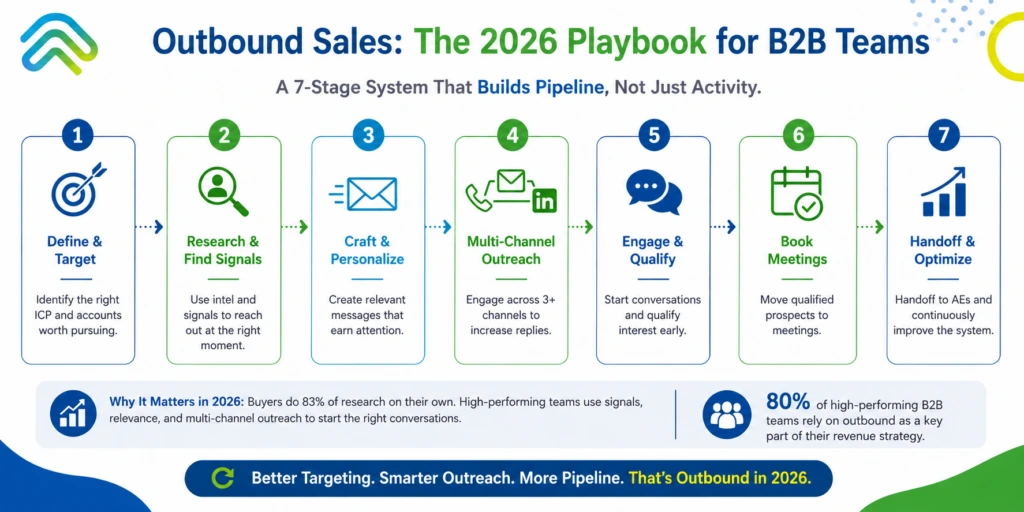
Stage 1: ICP Definition
A good ICP goes beyond firmographics. Layer in technographics (what tools they use), buying signals (what behaviors predict readiness), and buying-committee structure (who needs to be in the room). An ICP that only says “SaaS companies, 50 to 500 employees, US-based” will generate volume with no conversion. See what is GTM engineering to understand how to build the ICP architecture that drives targeting decisions.
Stage 2: Account Selection
The highest-performing outbound teams work named account lists of 200 to 500 companies rather than importing 10,000 names from a database. Quality at the top of the funnel determines everything downstream. A smaller, curated list with strong fit and signal coverage will always outperform a broad list with weak targeting.
Stage 3: Data Enrichment
Before any outreach begins, each account needs verified contact data, role mapping (who owns the budget, who influences, who blocklists), tech stack detection, and recent trigger events. Most teams source this through tools like Clay, Apollo, or Cognism. Enrichment quality is the single variable that drives deliverability and relevance before a word of copy is written.
Stage 4: Signal Detection
Modern outbound succeeds by identifying the right time to engage, using buying signals instead of static prospect lists. Eight signal categories matter most in a 2026 B2B context:
- Funding announcements: New capital signals GTM investment and vendor evaluation
- Hiring signals: Open roles in sales, marketing, or RevOps indicate active growth
- Executive job changes: A new VP of Sales creates a 90-day window of influence
- Intent spikes: Third-party intent data showing the account researching your category
- Website de-anonymization: Identifying companies visiting your site without filling out a form
- G2 and review platform activity: A company researching competitors is actively evaluating
- Competitor mentions: A prospect publicly discussing a competitor problem is an opening
- Champion job changes: A prior champion moving to a new company is a warm re-engagement
For a complete taxonomy, see 15 B2B buying signals and For how signals compare to intent data, see buying signals vs intent data.
Stage 4: Personalized Multi-Channel Sequencing
A modern B2B outbound sequence runs 10 to 18 touches across 4 to 12 weeks, depending on segment and ACV. Channels are sequenced, not run in parallel, so each touch builds on context from the last. Email anchors most sequences. LinkedIn handles relationship warmth. The phone converts engagement into conversations.
Video adds a human signal when other channels have not landed. The sequencing architecture, cadence ratios, and channel-specific tactics are covered in full in Outbound Sales Strategy guide.
Stage 5: Reply Handling and Qualification
Generating replies is only half the job. The real value comes from how quickly and effectively your team qualifies prospects, handles objections, and moves promising conversations toward a sales opportunity. Reply handling, routing positive responses, triaging objections, and running a fast qualification framework are the steps most teams under-invest in relative to the effort spent on prospecting. A poorly handled reply destroys the value of a well-built sequence.
Stage 6: Meeting to Opportunity Handoff
The clean SDR-to-AE transition, with full context, notes, signal history, and qualification data passed, is the seam between the Create side of outbound and the Convert side. Most outbound advice ends at “meeting booked.” That is where pipeline leaks start. The next section covers exactly where that handoff breaks and what it costs your pipeline.
Outbound Sales Channels and Roles in 2026
Modern B2B outbound runs across six channels and three core roles. Which channel you use matters less than where it sits in the sequence and who owns it.
| Channel | Best For | Typical Cadence Role |
| Cold email | Cold email is best for high-volume, top-of-funnel outreach. | It serves as the primary touchpoint throughout the sequence. |
| Phone | Phone calls are best for engaging qualified prospects and high-value deals. | They are typically used between touches three and five. |
| LinkedIn is best for building relationships and engaging buying committees. | It runs alongside email, with connections made before the pitch. | |
| Video | Video messages are best for adding a personal touch to outreach. | They are usually used between touches five and seven. |
| Direct mail | Direct mail is best for enterprise accounts and re-engaging cold prospects. | It acts as a strategic touchpoint for high-value accounts. |
| Events | Events are best for meeting buying committees in person. | Outreach should happen both before and after the event. |
The channel mix is only half the picture. How your team is structured determines who runs each channel, at what stage, and against which accounts.
| Role | Owns | Best Fit |
| SDR / BDR | SDRs and BDRs own prospecting, sequencing, and meeting creation. | This role is best for companies with enough deal volume to support specialization. |
| AE | AEs own discovery, multi-threading, deal management, and closing. | This role is best for scaling B2B companies, especially for high-ACV deals from Stage 4 onward. |
| Full-cycle rep | Full-cycle reps own both pipeline creation and closing. | This role is best for early-stage or smaller B2B companies where specialization is not yet practical. |
Most scaling B2B organizations run a 1:2 to 1:4 SDR-to-AE ratio, meaning one SDR creates enough meetings to keep two to four AEs pipeline-full. The economics only work when the SDR’s sequencing quality is high enough to produce qualified meetings, not just booked ones.
Why Outbound Sales Still Works in 2026
Outbound is more effective than ever for the teams that have adapted. It is less effective than ever for the teams that didn’t. That is not a contradiction. It is the result of a structural split that happened over the past three years.
Here is what changed.
- Deliverability Tightened: Google and Microsoft moved to engagement-based filtering from 2024 to 2025. Domain reputation is now a managed asset. Senders who blast generic emails to purchased lists are not just getting lower reply rates; they’re burning their sending infrastructure. Warm domains, authenticated sending, and sub-2% bounce rates are table stakes, not best practices.
- Buyer Attention Fragmented: Decision-makers receive more outreach than ever and have developed near-perfect filters for generic pitches. The bar for what earns a reply has moved from “relevant” to “demonstrably relevant.” A message that clearly reflects knowledge of the recipient’s current situation cuts through. One that doesn’t get deleted in under two seconds.
- AI-Saturated Inboxes: AI-generated outreach scaled volume without scaling quality. Buyers have developed pattern recognition for synthetic personalization. Real, signal-grounded relevance is now the differentiator, not better copy on a generic template.
What replaced the old model: signal-led targeting, multi-channel orchestration, and a clear division between what AI handles (research, enrichment, sequencing, CRM updates) and what humans handle (judgment calls, qualification conversations, objection handling, relationship-building).
The numbers anchor this. According to Gartner, B2B buyers spend only 17% of their purchasing time meeting with potential suppliers, doing the rest of their research independently. That means your rep’s window to influence the decision is narrower than ever, which is exactly why precision matters more than volume. 80% of high-performing B2B teams still rely on outbound as a key revenue source, as per the Outreach Prospecting 2025 Report. The platform-wide average cold email reply rate sits at 3.43%, according to Instantly 2026 Benchmark, but top-performing campaigns using micro-segmentation, signal-based targeting, and continuous A/B testing exceed 10%. The gap between average and elite has never been wider. The math favors precision, not volume.
Common Outbound Sales Mistakes B2B Teams Still Make
The biggest outbound failures rarely come from a single bad email or cold call. They stem from structural mistakes that quietly reduce pipeline performance over time. Here are six common outbound sales mistakes B2B teams still make in 2026.
1. Treating Outbound as a Volume Game
More activity is not more pipeline. The math broke when reply rates dropped below 5%, and email infrastructure became a managed asset. A rep sending 500 generic emails a day is not building a pipeline. They are burning their sender domain and their manager’s patience. Volume without signal-led targeting is an expensive way to get ignored.
2. Static ICP that Never Gets Refreshed
The ICP is a living artifact. The accounts that closed last quarter teach you which signals predicted fit. The deals that stalled or churned tell you which assumptions were wrong. Most teams build an ICP in quarter one and never revisit it. The data to update it sits in the CRM. Nobody pulls it.
3. Letting Deliverability Decay Quietly
Sender reputation is an asset, not a setting you configure once. Bounce rates creeping above 2%, spam complaint rates above 0.1%, and misconfigured authentication are silent performance killers. Most teams notice the problem six months after it started, after half their pipeline emails never reach the inbox.
4. Stopping Execution at “Meeting Booked”
The leak that no outbound playbook covers. 80% of B2B deals require 5 or more follow-ups to close (Brevet Group), yet most SDRs give up after 3. Even when a meeting gets booked, poor SDR-to-AE handoff, missing context, and no post-meeting follow-through turns a qualified opportunity into a stalled deal. Outbound that doesn’t convert is just an expensive activity. This is the structural problem SpurIQ is built to close.
5. Hero-Dependent Execution
One good rep carrying the team looks like a performance. It is actually fragility. When that rep leaves, gets promoted, or has a bad quarter, the pipeline collapses. Outbound has to be a system that replicates results across a team, not a skill set that lives in one person’s muscle memory.
6. Tool Sprawl Without an Orchestration Layer
Ten-plus disconnected tools, each generating signals, logging activities, and creating tasks, with none of them talking to each other. Reps spend more time context-switching between tools than actually selling. For a full breakdown of what tool sprawl costs and how it happens, see sales tool sprawl.
From Outbound Activity to Predictable Revenue Execution
B2B revenue leaks in two places. Before the pipeline exists, when outbound activity doesn’t convert to qualified meetings. And after the pipeline exists, when meetings don’t convert to closed deals because follow-through is inconsistent, CRM is stale, and deals go cold without anyone noticing. Most outbound advice addresses the first leak only. Both leaks have to close before outbound activity compounds into revenue.
SpurIQ is a revenue execution platform that closes both leaks. It works as one system with two tracks, sitting on top of your existing stack, including Gmail, HubSpot or Salesforce, Calendar, and LinkedIn. There is no rip-and-replace and no new CRM. The execution layer connects what you already have.
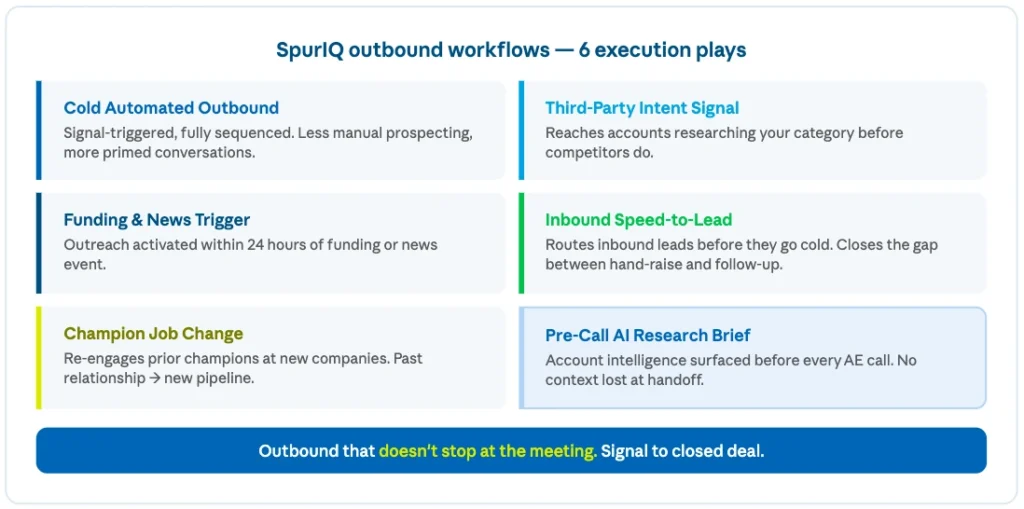
The outbound workflows map directly to the process covered in this guide.
- Cold Automated Outbound Engine
Delivers signal-triggered, fully sequenced outbound designed for new account creation, so reps spend less time prospecting manually and more time on conversations that are already primed. - Third-Party Intent Signal Outbound
Reaches accounts showing category intent before competitors do, putting your outreach in front of buyers while they are actively researching solutions like yours. - Funding and News Trigger
Activates outreach within 24 hours of a prospect’s funding or news event, catching accounts at the moment they are most likely to be evaluating new vendors. - Inbound Form Speed-to-Lead
Routes and responds to inbound leads before they go cold, closing the gap between a prospect raising their hand and a rep actually following up. - Champion Job Change
Re-engages prior champions the moment they move to a new company, turning a past relationship into a new pipeline opportunity instead of letting it go untracked. - Pre-Call AI Research Brief
Surfaces account intelligence before every AE conversation, so no context is lost at handoff and reps walk into calls already informed.
Leaders care about outbound that doesn’t stop at the meeting. That means faster follow-up, cleaner CRM data, fewer stalled deals, and a forecast that reflects reality instead of rep optimism.
To see where your revenue is leaking, book a 10-minute walkthrough of your Revenue Engine Diagnosis with SpurIQ.
Outbound in 2026: What’s Changing, What’s Staying the Same
Outbound is more effective than ever for the teams that have adapted and less effective than ever for the teams that haven’t. The difference comes down to three things: what they stopped doing, what they kept, and what they built that didn’t exist before.
- What’s Gone for Good: Spray-and-pray email blasts. List buying without signal context. Single-channel outbound motions that treat LinkedIn, email, and phone as separate campaigns instead of a coordinated sequence. Treating activity volume as a proxy for pipeline quality. These don’t just underperform. They actively damage the sending infrastructure and rep credibility required for the plays that do work.
- What’s Staying: The seller’s responsibility is to initiate the conversation. The discipline of structured, multi-touch follow-up. The value of one-to-one relevance: a message that clearly speaks to the recipient’s specific situation. These fundamentals have not changed. The teams that still win are the ones who execute them with more precision, not less effort.
- What’s New: The orchestration layer between signal and action. Outbound no longer runs well as a manual, rep-driven process at scale. The teams building a durable pipeline in 2026 have a system that detects the signal, routes to the right workflow, executes across channels, and closes the loop back to the CRM, automatically, with human judgment applied at the points where it creates the most value. That layer is what makes outbound compounds instead of grind.
Frequently Asked Questions:
Q. Is outbound sales still effective in 2026?
Yes, but only when it’s done strategically. While generic, high-volume outreach has become less effective, signal-led and personalized outbound continues to deliver strong results.
Modern outbound succeeds by:
– Prioritizing accounts showing buying signals
– Personalizing outreach across multiple channels
– Maintaining strong email deliverability
– Using verified contact data and clear ICPs
– Coordinating SDR and AE handoffs effectively
Teams that adapt to these practices continue to build a predictable pipeline, while outdated volume-based approaches struggle to generate responses.
Q. What’s the difference between outbound sales and lead generation?
Lead generation focuses on finding and attracting potential buyers, while outbound sales is the complete process of turning those leads into qualified opportunities. Lead generation is primarily measured by the number and quality of leads it produces, whereas outbound sales includes prospecting, outreach, follow-ups, qualification, and handoff to the sales team. In simple terms, lead generation fills the pipeline, and outbound sales converts that pipeline into revenue opportunities.
Q. What’s the difference between outbound sales and prospecting?
Prospecting is a part of outbound sales that focuses on identifying ideal customers, researching target accounts, and finding the right contacts. Outbound sales is the complete process of reaching out to prospects, following up, qualifying leads, and moving opportunities through the sales pipeline. In short, prospecting creates opportunities, while outbound sales converts those opportunities into revenue.
Q. Who owns outbound: sales or marketing?
Outbound execution is typically led by the sales team, particularly SDRs or BDRs, while marketing supports the process.
A successful outbound program usually works like this:
– Sales: Prospecting, outreach, qualification, and meeting generation
– Marketing: ICP research, messaging, content, campaign support, and intent signals
– Both teams: Share insights to improve targeting, messaging, and conversion rates
The strongest revenue teams treat outbound as a shared strategy rather than a siloed function.
Q. How long does outbound take to show results?
Outbound sales typically start generating qualified meetings within 2–4 weeks, while a meaningful pipeline often takes 6–8 weeks to build. Results become more predictable over time as teams refine their targeting, messaging, and follow-up processes. Poor data quality, unclear ICPs, low email deliverability, generic outreach, and inconsistent execution can delay outcomes. Successful outbound programs rely on continuous optimization and consistent effort rather than immediate results.