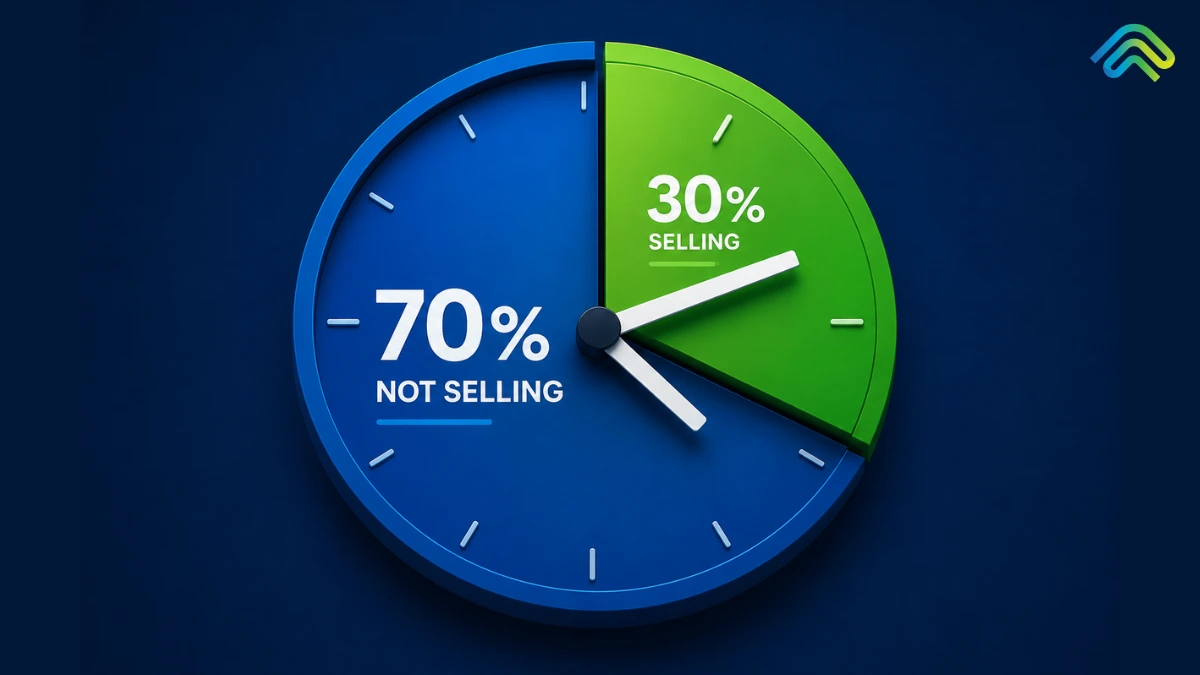
Run the numbers on your sales team’s week. A standard 40-hour week. Your reps spend roughly 11.2 of them actually selling on calls, in demos, pushing deals forward, and closing. The other 28.8 hours? CRM updates. Account research. Internal meetings. Chasing bad data. Scheduling. Email triage.
You hired good people. You bought good tools. You ran training cycles, built playbooks, and brought in enablement. Even after investing in tools and training, your reps are still spending under 30% of their week actually selling.
Here is where it shows up: according to Ebsta x Pavilion 2025 GTM Benchmarks, 78% of sellers missed quota in 2025, up from 69% the year before. That is not a talent problem. That is sales rep time wasted, 28.8 hours per rep per week, compounded across a full year, finally surfacing in the revenue numbers.
These two statistics are not a coincidence. They are the same problem, measured from different angles.
This guide answers four questions. Where does the 70% actually go? Why has every fix made it worse? What separates the top 14% of sales reps from everyone else? And what does a real structural fix look like in 2026?
Where do the 28.8 Non-Selling Hours Actually Go?
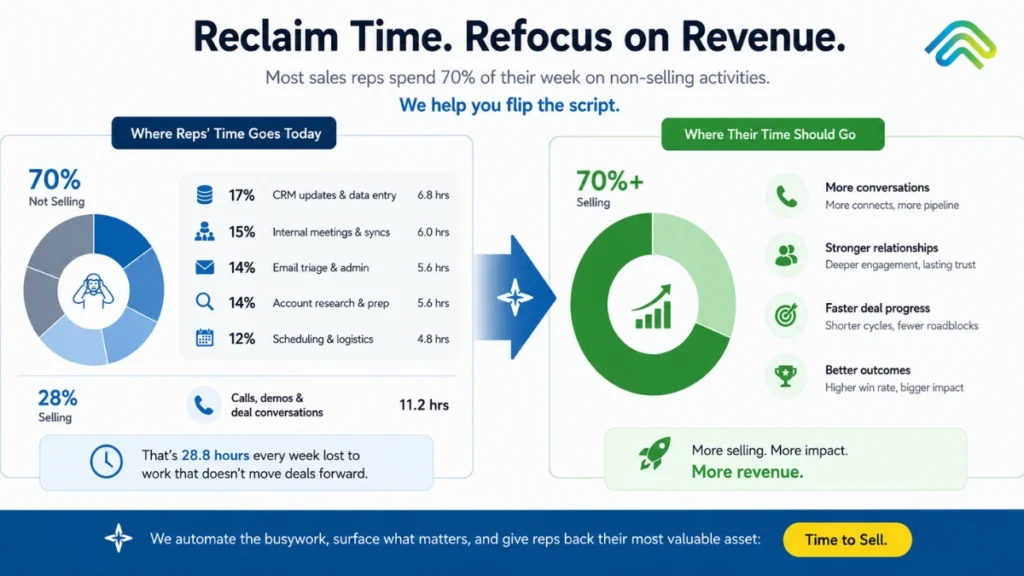
The Forrester Activity Study tracked 3,031 sales reps across industries and found the average rep burns nearly two full days every week on administrative work alone. According to Salesforce’s 2025 State of Sales report, when you ask how much time do sales reps spend selling, the answer is only 28 to 30% of their week on direct selling activities. Add account research, internal meetings, and tool navigation, and the picture gets considerably worse.
Here is what a realistic 40-hour week looks like for a mid-market B2B rep:
| Activity | % of Week | Hours/Week | Revenue Impact |
| Active selling (calls, demos, negotiations) | 28% | 11.2 hrs | Direct |
| Account research and call prep | 14% | 5.6 hrs | Indirect |
| CRM data entry and pipeline updates | 17% | 6.8 hrs | None |
| Internal meetings and syncs | 15% | 6.0 hrs | Minimal |
| Email triage and admin | 14% | 5.6 hrs | None |
| Scheduling and logistics | 12% | 4.8 hrs | None |
That is 28.8 hours per week producing zero direct revenue. Over a full year, each rep loses the equivalent of 37 selling weeks to work that does not move deals forward. Multiply that across a 20-rep team, and you are burning 740 selling weeks of revenue capacity every single year.
The Bad Data Tax
One of the quietest drains in any sales organisation is data quality. Research from ZoomInfo and Everstage shows how much time sales reps waste on admin connected to inaccurate contact data: 27.3% of their working week. That works out to roughly 546 hours per year per rep spent dialing wrong numbers, emailing bounced addresses, and researching contacts who left their company months ago.
This is not a minor inconvenience. It is the single largest hidden cost in most sales organisations, and it never appears on any P&L line. When a rep spends two hours researching a prospect only to discover their champion has already left, they have not just lost those two hours. They have lost the momentum, the preparation, and the motivation that come with genuinely productive work.
The Meeting Trap
According to Salesmotion, Internal meetings take up nearly 15% of a typical sales rep’s workweek. Some are worth it: deal reviews that surface blind spots, coaching sessions that sharpen skills, pipeline inspections that improve forecasting.
However, most are not. Standing syncs with no agenda, cross-functional updates that should have been an email, and forecast reviews where reps read CRM data aloud into a screen; all of these are structured time theft dressed up as work.
Though it is not to cancel every meeting, you need to apply some standard to internal time that good sales leaders apply to customer-facing time. Every recurring meeting needs a clear output requirement. If a standing meeting has not produced a decision, a coaching moment, or a concrete next action in its first two occurrences, cancel it.
Why Every Previous Fix Failed?
Every leader reading this has tried at least one of these. Most have tried all four. Here is why each one falls short of the actual problem.
Fix 1: “We’ll Buy a Tool for That”
The reflex when reps are drowning in admin is to buy technology that handles it. A new sequencer. New conversation intelligence. New data enrichment. New CRM. The instinct is always the same: when the problem gets louder, add a tool.
It sounds logical. But it delivers consistently poor results.
Salesforce data shows the average rep now uses eight different tools to close a single deal. Gartner’s September 2024 survey of 1,026 sellers found that 72% feel overwhelmed by the number of tools they are expected to use. Sellers who feel overwhelmed by their tools are 45% less likely to hit quota.
The math is uncomfortable. Every individual tool comes with a defensible ROI story. But the cumulative cost of switching between eight systems, managing separate logins, learning interface updates that arrive every quarter, and mentally reconciling conflicting data across platforms quietly erases most of those individual gains.
Every tool added to reduce workload has also added a new layer of tool-management workload on top. For a closer look at how stack complexity compounds this problem, see how tool sprawl drains revenue capacity.
Fix 2: “We’ll Hire More Enablement”
Enablement teams write playbooks. They build training programmes. They produce battle cards, call frameworks, and objection-handling guides.
None of it changes where the time goes. A rep with a perfect playbook still spends 17% of their week on CRM data entry, as the Forrester Activity Study of 3,031 reps and Salesforce’s 2025 State of Sales both confirm. The playbook does not enter the data.
Here is the precise limit of what enablement can do:
Companies with best-in-class enablement strategies see 84% of reps achieve quota (CSO Insights, 5th Annual Sales Enablement Study). Win rates improve. Onboarding shortens. Coaching conversations get sharper. Those are real gains, and every one of them lands on the 28-30% of time reps already spend selling.
Enablement multiplies the value of the selling time that already exists. It does not recover the 70% that never reaches the selling point at all.

Fix 3: “We’ll Train Reps Better”
Training sharpens skills. It does not eliminate tasks.
Even the most thoroughly trained rep still has to manually log call activity, update CRM deal stages, draft follow-up emails from scratch, chase missing contact data, and schedule next steps. Better training for the same job means reps do that job more efficiently. It does not change what the job contains.
The reps who emerge from the best training programmes are still performing the same 28.8 hours of non-selling activities every week. They are just doing it with better technique.
Fix 4: “We’ll Consolidate the Stack”
This is the dominant conversation in sales leadership right now, and specifically the loudest one of 2025 and 2026. Tool sprawl is the diagnosis. Consolidation is the cure. Cut from eight tools to four, reduce switching overhead, simplify the workflow.
Consolidation is necessary. It is not sufficient. Going from eight tools to four cuts cognitive load, but the underlying work stays completely intact. CRM data still needs to be entered. Follow-ups still need drafting. Research still needs to be done. Reps just do all of it across fewer tabs.
Every failed fix has optimised the wrong thing. They make the non-selling work faster, cheaper, or less fragmented. Not one of them eliminates the non-selling work itself. That gap is the entire problem.
The practitioners who have lived through all four cycles are not confused about the diagnosis. Veterans in the RevOps community are not debating whether the problem exists. They are asking whether any fix will ever be structural rather than cosmetic. That scepticism is earned.
What the Top 14% of Reps Actually Do Differently
The Ebsta x Pavilion 2025 GTM Benchmarks analysed 655,000 opportunities and found something stark: just 14% of sellers drive 80% of revenue. That is an 11x performance gap between the top tier and everyone else.
Top performers do not have more hours in their day. When you look at sales productivity statistics, research from Abstrakt shows they spend 35 to 40% of their week on active selling, compared to the 28% average. That 7 to 12 percentage point difference adds up to five to eight additional selling weeks per year.
Ebsta data highlights another important dimension of this gap, showing that delayed engagement can reduce win rates by 113%. The top 14% of performers are not only selling more, but also closing deals faster. When a buying signal appears, they act on it the same day. The bottom 86% often respond days later, or not at all, because manual research and admin backlogs slow them down. Speed is not a soft skill here. It is a measurable, quantified separator between winners and the rest.
Where Top Performers Get the Extra Hours
Four consistent habits explain where the extra selling time comes from, and they map directly to the question of how to free up sales rep time.
- They eliminate research redundancy. Average reps research the same account multiple times because they never centralise what they find. Top performers research once, store everything in a structured and retrievable format, and reference it across every subsequent interaction with that account. Research once. Use it many times.
- They have a system for follow-ups. Average reps start every follow-up from a blank page. Top performers have pre-built frameworks, sequenced timing, and automated triggers wherever possible. They spend minutes completing follow-up communications, not hours composing them. For a template framework, see how to build a sales call follow-up email system.
- They protect the calendar. Top performers block fixed selling hours and decline any meeting that does not produce a decision or a coaching moment. The calendar is a revenue asset to them, not a shared resource anyone can claim.
- They automate CRM updates. Top performers have tooling configured so that call activity, email engagement, and deal stage changes are captured automatically as they work. The CRM updates itself, or close to it. The rep stays focused on the next conversation rather than logging the last one.
The thread running through all four habits is the same. Top performers have not outworked their peers. They have removed the non-selling activities from their own workflow through a combination of process discipline and automation. The bottom 86% are still doing all of it manually, and most have come to accept the 70% time loss as an unavoidable condition of the job.
It is not unavoidable. It is structural. And structures can be changed.
The Hidden Cost: What This is Actually Costing You
The time problem has a financial translation that most sales leaders have never sat down to calculate.
- The math: If your average rep carries a $1.5M quota and spends only 28% of their week actually selling, you are paying for a full-time seller and getting part-time selling output. Recovering just 10 percentage points of selling time, moving from 28% to 38%, is the equivalent of adding 35% more rep capacity without making a single new hire.
- For a 20-rep team: Recovering 10 percentage points of selling time is roughly equivalent to hiring 7 additional reps. At a fully-loaded rep cost of around $200,000 per year, that is $1.4M in avoided hiring cost, before you count the revenue contribution of the recovered selling hours. Neither number shows up on any budget line, because the sales rep time wasted on non-selling work is invisible. It gets absorbed quietly by the missed quota rather than being flagged explicitly as a cost item.
- The quota miss connection: The 78% miss rate in 2025 was not caused by bad reps or bad market conditions. It was caused by reps having structurally insufficient selling time to hit targets that were built on the assumption of full selling capacity. Quotas have not adjusted for the time tax. Reps have absorbed it.
- The morale tax: There is also a morale dimension that compounds the financial one. Experienced sellers who have spent years in the profession and still find that sales reps spend 70% of their time on admin are acutely aware of the gap. That awareness becomes burnout. Burnout becomes attrition. Attrition becomes a compounding hiring and onboarding cost that makes the original time problem worse every quarter.
The Actual Fix: Automate the Execution, Not Just the Tools
Every fix reviewed above optimised the wrong layer. Tools make the non-selling work faster. Enablement makes reps smarter at doing it. Consolidation makes it less scattered. Not one of them removes the work itself.
The fix that none of those approaches will name is this: the non-selling work has to be done by something other than the rep. Not made faster. Not centralised. Removed from the rep’s workflow entirely and handed to an automated execution layer that runs on top of the existing stack. This is the only real answer to how to reduce sales admin time at a structural level.
What Execution Automation Actually Means
Here is what that actually looks like in practice.
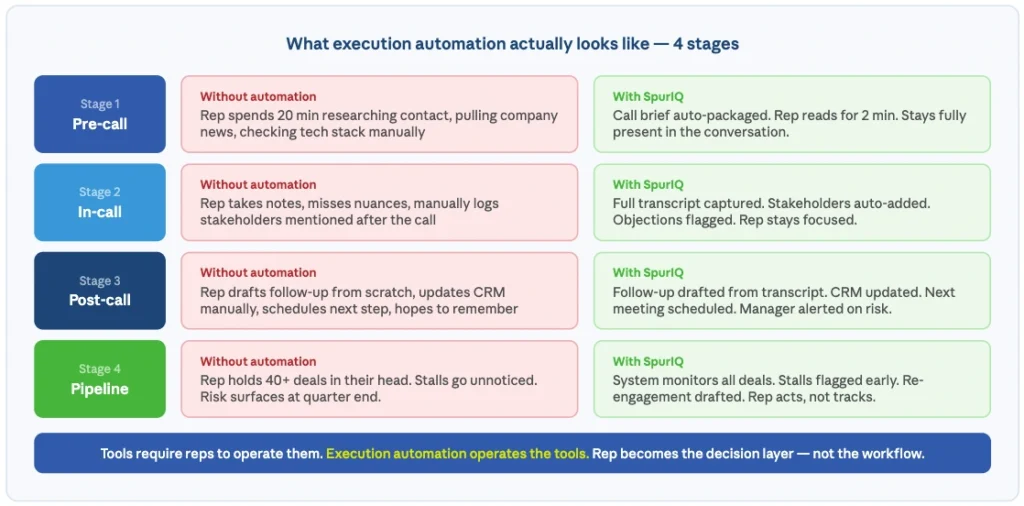
- Pre-call execution. Before a sales rep dials, the system has already researched the contact, surfaced recent activity, pulled relevant company news, mapped the account’s tech stack, and packaged a call brief. The rep does not spend 20 minutes researching. They spend two minutes reading.
- In-call execution. During the call, conversation intelligence captures the full transcript. Stakeholders mentioned get added to the deal record automatically. Objections raised get flagged. Commitments made get tracked. The rep does not take notes. The system does, and the rep stays completely present in the conversation.
- Post-call execution. After the call, the system drafts the follow-up email using actual content from the transcript, not a generic template. It schedules the next meeting based on what was committed to. It updates the CRM with deal stage progression. It alerts the manager if a deal risk flag has changed. The rep reviews and approves. They do not draft from scratch.
- Pipeline execution. Across the rep’s full book of open deals, the system monitors engagement gaps, sentiment shifts, stakeholder dropouts, and stage time against a historical baseline. Stalling deals get flagged before they slip. Re-engagement outreach gets drafted automatically. The rep does not have to hold every deal in their head at once. The system holds it for them.
The distinction between this and adding more tools is precise. Tools require the rep to operate them. Execution automation operates the tools. The rep stops being the workflow and becomes the decision-maker sitting at the top of it.
This is the architecture SpurIQ was built around. SpurIQ is a revenue execution platform that sits on top of your existing GTM stack, including Salesforce, HubSpot, Outreach, and Gong, and automatically handles the non-selling work that currently consumes 70% of a rep’s week.
- Lead IQ owns pre-call research and outbound execution: account context gets packaged before the call, contextual outreach gets drafted from real signals, and CRM gets updated automatically.
- Deal IQ owns post-call follow-through: contextual follow-ups drafted from actual call transcripts, automatic CRM stage progression, and manager alerts on deal risk. Reps stop being the workflow. They become the decision layer at the top of it.
To see how this fits into a broader revenue operations approach, see revenue operations strategies for 2026.
How to Get Started: The First 30 Days
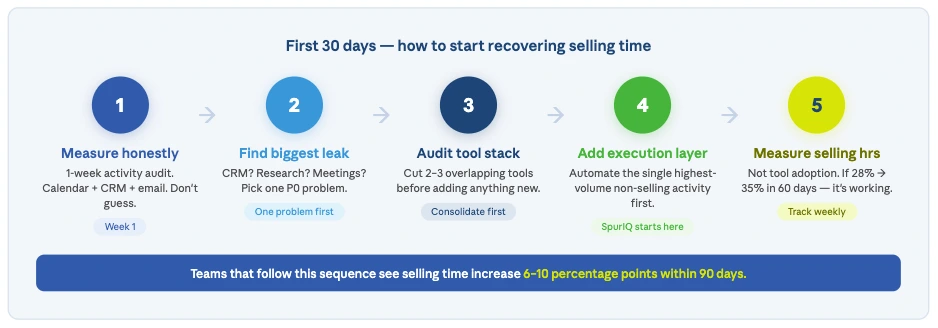
Recovering selling time is an operational redesign, not a software purchase. Here is a practical sequence for the first 30 days.
Step 1: Measure your current selling time honestly
Do not guess. Run a one-week activity audit across three to five reps using calendar data, CRM activity logs, and email metadata. Categorise where every hour actually goes. Most sales leaders who do this exercise are genuinely surprised by what they find.
Step 2: Identify your single biggest time leak
Is it CRM updates? Account research? Internal meeting volume? Bad data navigation? Pick the one activity consuming the most non-selling time and treat it as a P0 problem. Do not try to fix everything at once.
Step 3: Audit your tool stack for redundancy
Most teams discover two or three tools performing overlapping functions. Eliminate what you can before adding anything new. Consolidation before automation is the right order of operations.
Step 4: Add an execution layer for the biggest leak
Do not try to automate everything on day one. Start with the single highest-volume non-selling activity, usually post-call follow-up or CRM updates, and automate that one thing first. Prove the return in recovered selling time before expanding scope.
Step 5: Measure recovered selling hours, not tool adoption
Tool adoption is an input metric. The number that actually matters is whether the rep’s selling-time percentage moves. Track it weekly. If it shifts from 28% toward 35% within 60 days, the intervention is working.
Teams that follow this sequence properly typically see selling time increase by 6-10 percentage points within 90 days. That translates into a measurable improvement in quota attainment by the following quarter.
The Bottom Line
The 70% non-selling time problem is not new. Forrester, Salesforce, and Ebsta have been documenting it for over a decade. The numbers have not improved. They have gotten worse.
What is different in 2026 is that every previously credible fix has now visibly failed, and the failure is showing up directly in the revenue numbers. Tools made cognitive load heavier. Enablement added training without removing tasks. Consolidation reduced overhead without eliminating the underlying work. Quota miss rates climbed to 78%, the worst on record in B2B sales.
The structural fix that actually works is not making the sales reps “not selling problem” more manageable at the margins. It is removing the non-selling work from the rep’s workflow entirely. Automated execution, owning CRM updates, follow-up drafting, research packaging, and activity logging on top of your existing stack, is the only intervention that meaningfully moves selling-time percentages.
Ready to recover your reps’ selling time?
SpurIQ is the revenue execution platform that automates the work consuming 70% of your reps’ week. See how SpurIQ reclaims selling time.
Frequently Asked Questions:
How much time do sales reps actually spend selling?
Less than you’d expect. The average B2B sales rep spends only 28 to 30% of their week on actual selling: calls, demos, and negotiations. That finding comes from both Salesforce’s 2025 State of Sales report and a Forrester study of over 3,000 reps, so it is not an outlier.
The remaining 70 to 72% of the week gets consumed by:
– Research and account prep
– CRM updates and data entry
– Internal meetings
– Admin tasks
– Jumping between tools
Top performers do better, reaching 35 to 40% selling time, but they get there through deliberate process discipline and automation, not harder work.
Why are sales reps not selling more?
It comes down to three structural problems that have nothing to do with rep effort or attitude:
Tool overload: The average rep uses eight tools to close a single deal, and the switching overhead across a week adds up fast.
Bad data: 27% of working time is lost navigating stale contact records: bounced emails, disconnected numbers, and accounts nobody has updated in months.
Manual execution at scale: CRM updates and follow-up drafting simply cannot keep pace with the volume of activity a modern rep is expected to handle.
Better training or stack consolidation can make these problems slightly more efficient. They cannot eliminate them.
What percentage of time do sales reps spend on admin?
Around 31% of the average rep’s week goes to sales admin tasks alone. The breakdown looks like this:
CRM data entry: 17%
Email triage: 14%
Account research: 14%
Internal meetings: 15%
Add those up and non-selling activity totals around 70 to 72% of the working week. The Forrester Activity Study found this pattern holds consistently across industries and company sizes, which means it is not a culture problem at any one company. It is a structural one across the profession.
Why are tools making sales productivity worse, not better?
Each tool usually has a reasonable ROI case on its own. The problem is what happens when you stack eight of them together. Reps spend their days:
– Switching between platforms
– Reconciling data that conflicts across systems
– Absorbing UI updates they never asked for
– Managing separate logins for everything
The cognitive overhead wipes out most of the individual gains. Gartner research shows 72% of sellers feel overwhelmed by their tools, and sellers in that state are 45% less likely to hit quota. The answer is not stripping the stack down for the sake of simplicity. It is consolidating execution so that tools run automatically in the background rather than demanding rep attention to function.
What is the best way to reduce sales admin time?
Reduce the admin work itself, not just the number of tools creating it. The structural fix is automated execution, where AI handles the following automatically on top of the stack already in place:
– CRM updates
– Follow-up drafting
– Research packaging
– Activity logging
Revenue execution platforms like SpurIQ are built specifically for this layer. They sit on top of Salesforce, HubSpot, Outreach, and Gong without requiring any rip-and-replace of existing infrastructure.
How are current sales trends changing the rep’s day-to-day job?
Three shifts are reshaping what the job actually looks like in 2026:
AI-driven execution automation is removing manual non-selling work from the rep’s plate in a meaningful way for the first time.
Buyer response expectations have made fast follow-through a baseline requirement rather than a competitive advantage.
Signal-based selling means reps now act on real-time triggers rather than working through static lead lists.
The reps doing well in this environment have made a genuine mindset shift: they see themselves as decision-makers at the top of an automated workflow, not as the people manually executing every step of it.
How do top sales reps get more selling time?
Four habits consistently separate the top 14% from everyone else:
Centralise account research: Build a single, reusable account brief rather than re-researching the same accounts repeatedly.
Systematise follow-ups: Template and automate follow-up sequences instead of drafting from scratch after every call.
Protect selling hours: Treat peak selling time as non-negotiable and push back on internal meeting creep.
Use passive CRM logging: Choose tooling that captures activity automatically so nothing requires manual entry.
Together, these habits recover five to eight additional selling weeks per year compared to the average rep.