Nearly every article answering the question in this headline is published by a company selling an AI BDR. Read enough of them, and the pattern shows up fast. Each one concludes that AI will not replace your reps, then closes with a demo link for a product built to do exactly that.
We don’t have that problem to work around. SpurIQ is not an AI BDR, so this is the honest version of the answer, not the version written to protect a sales motion.
This piece breaks the BDR job into its actual parts rather than treating it as one job to save or cut. The article explores where AI already matches or outperforms junior BDRs, where human expertise still matters most, and what the broader hiring data really reveals when viewed as a complete picture.
This blog also covers where AI BDRs fail in practice, and how a founder or Head of Sales should decide whether to hire, automate, or do both. No hype, no doom. A straight answer to a question most vendors can’t afford to answer straight.
What is an AI BDR?
An AI BDR is software that automates the core tasks of business development. Prospecting, account research, first-touch outreach, qualification, and meeting booking run through an AI agent instead of a person. In practice, what is an AI BDR for outbound sales comes down to automating those same tasks for new-business prospecting rather than inbound handling.
BDR and SDR get used almost interchangeably across most sales organizations. Where teams do draw a line, BDR tends to skew toward outbound and new-business generation, while SDR covers a broader mix of inbound and outbound work. For a full breakdown of how these agents work under the hood and what they automate, see AI SDR and outbound agents. For where the tools fall short, see how AI sales agents work and where they fall short.
This post is about the role, not the software behind it. The rest of this piece asks a different question. Not what an AI BDR is, but whether the BDR job survives one.
What a BDR Actually Does All Day
You can’t honestly answer whether AI replaces a BDR without first being specific about what the job actually contains. “BDR” isn’t one task. It’s roughly ten of them, stitched together under a single title. A realistic week for a BDR carrying a real quota touches all of the following.
- Building and maintaining the target account list
- Researching accounts and contacts for context before a first touch
- Keeping an eye on buying intent and important sales triggers.
- Writing and personalizing first-touch outreach
- Running and maintaining multi-touch sequences
- Handling and classifying replies
- Live cold calls and real-time objection handling
- Qualification conversations against ICP and stated need
- Navigating internal politics to find the actual champion
- CRM logging, handoff notes, and pipeline hygiene
Some BDR tasks have a much greater impact than others. An inaccurate target list limits who you can reach, but failing to handle a prospect’s objection at the right moment can cost the opportunity altogether. Treating them as one undifferentiated job is exactly what makes “can AI replace a BDR” impossible to answer honestly, since the real answer is different for each line above.
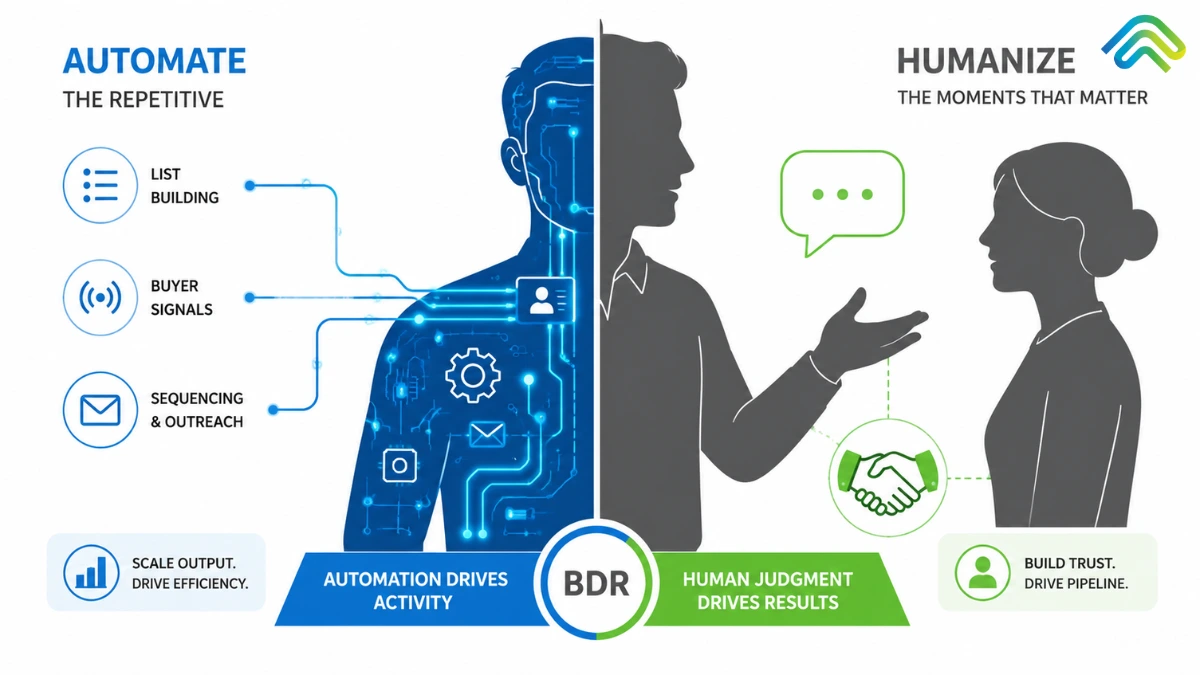
Salesforce’s own research puts reps spending roughly 70 percent of their time on non-selling work, a figure that lines up with how this list actually breaks down. The majority of these tasks are repetitive, process-driven activities. Only a handful require judgment that depends on being in the room, or on the call, with another person. For more on where that time goes, see reps spend 70% of their time not selling.
So the real question isn’t whether a BDR, as a whole role, can be replaced. It’s which of these ten tasks can be, and what’s left standing once they are. That’s what the next two sections rule on, task by task, rather than in the abstract.
What AI Genuinely Replaces
On the tasks below, a human doing the work manually in 2026 is no longer the defensible default. This is also how AI BDR enhances sales scalability becomes clear, since consistency at volume is exactly what scaling requires.
Here is the honest ruling on each.
| Task | Honest ruling |
| List building and enrichment | AI can build and update prospect lists much faster than a person. It continuously finds new contacts, enriches missing information, and keeps lists current without requiring hours of manual work. |
| Account and contact research | Research that once took several minutes per prospect can now be done in seconds. AI quickly gathers company details, recent updates, and contact information, giving sales reps a solid starting point before outreach. |
| Signal monitoring | AI never stops watching for buying signals such as funding announcements, hiring activity, leadership changes, or website visits. Tracking thousands of accounts at once is unrealistic for a person but routine for AI. |
| First-draft outreach | AI is good at creating a strong first draft for emails or messages, helping reps save time. However, the best results still come when a salesperson reviews and personalises the message before sending it. |
| Sequence scheduling and follow-up | AI makes sure every follow-up happens on time, and no prospect is forgotten. Instead of relying on a rep to remember every touchpoint, it keeps outreach moving consistently from start to finish. |
| CRM logging and handoff notes | Updating CRM records, logging activities, and preparing handoff notes are repetitive administrative tasks. AI can handle them automatically, giving sales reps more time to focus on customer conversations instead of paperwork. |
On these six, a human doing them by hand is no longer defensible. Alongside this, how AI BDR improves lead qualification becomes evident through its ability to score and prioritize prospects before a sales rep steps in. That isn’t a threat to the role. It’s the removal of the part of the job that nobody, including the best reps on any team, was ever particularly good at. For a practical look at applying this in a live motion, see applying AI to prospecting.
What AI Can’t Replace
The other side of the ledger looks different. These tasks stay human, and the gap isn’t closing quickly.
| Task | Why it stays human |
| Real-time objection handling | Buyers rarely follow a script. They hesitate, change direction, or raise unexpected concerns that require reading tone, context, and intent in the moment. AI can respond to anticipated objections, but experienced reps adapt to the ones that emerge during a live conversation. |
| Qualification judgment | Checking whether a prospect matches predefined criteria is straightforward. Determining whether a problem is genuine, budgeted, and likely to become a priority requires judgment that goes beyond what any qualification framework can capture. |
| Internal politics and champion-building | With roughly six stakeholders in a typical B2B deal, someone has to work out who really decides and who quietly blocks. That’s relationship work, not a data problem. |
| Trust in the first conversation | Early sales conversations depend on credibility, empathy, and the ability to build rapport. Buyers are more willing to share business challenges and uncertainties with someone they trust than with an automated system following a script. |
| Strategic judgment when signals conflict | Sales signals rarely point in the same direction. A prospect may show strong buying intent while budget freezes or organisational changes suggest otherwise. AI can execute a defined strategy, but deciding when the strategy itself should change remains a human responsibility. |
| Knowing when to break the process | Every sales process has exceptions. Experienced BDRs recognise when a high-value account deserves a personalised approach instead of the standard playbook. AI optimises for consistency, while people know when breaking the rules produces a better outcome. |
The pattern underneath all six is consistent. AI is strongest where the work is high-volume and rule-based, and weakest where it is ambiguous and relational. The BDR job contains real amounts of both, which is exactly why replace-or-not is the wrong frame to put on it.
Is the BDR Role Actually Shrinking? What the Data Shows
At first glance, the two most frequently cited studies on this topic seem to contradict each other. One suggests the BDR role is shrinking, while the other shows teams expanding after adopting AI. The tension is real, but it disappears once you look at what each study is actually measuring.
- The compression evidence: According to Fullcast’s 2026 Benchmarks Report, AE headcount grew by 32.1%, while SDR headcount increased by only 3.2% during the same period. The report describes this shift as sales organizations moving from a traditional pyramid structure to a more diamond-shaped model.
- The counter-evidence: According to 6sense’s 2026 State of the BDR Report, companies using AI saw BDR teams grow and perform better, with 58% of organizations reporting team growth and only 8% reporting headcount reductions in 2026. In these organizations, AI strengthened the role instead of replacing it.
The key is that both findings can be true at the same time. BDR headcount is still growing, but much more slowly because the responsibilities attached to the role are changing. Manual list building, prospect research, and other repetitive tasks are increasingly handled by AI, while the remaining work centers on conversations, qualification, and account strategy. In other words, the BDR role isn’t disappearing. The junior, task-heavy version of it is.
For founders, that changes the hiring equation.
- Hiring multiple junior BDRs to spend their time on manual research and list building means investing in work that is rapidly being automated.
- Hiring one experienced BDR supported by systems that handle the repetitive workload is often the more effective long-term approach. This is also how to improve BDR performance with AI, allowing experienced reps to focus on conversations, qualification, and strategy instead of administrative work.
- This is also one of the clearest ways to improve BDR performance with AI, since automation removes administrative work and allows top-performing reps to focus on the conversations and decisions that actually move deals forward.
The takeaway is just as important for BDRs themselves. The tasks being automated were never what made great reps valuable. Long-term career growth belongs to professionals who excel at relationship building, qualification, objection handling, and strategic conversations, not simply those who generate the highest volume of activity.
Where AI BDRs Actually Fail
The category rarely gets honest treatment here, especially when buyers ask which AI BDR software drives the highest conversion rates. In reality, conversion rates depend far more on data quality, segmentation, and execution than on the software itself.
Four failure modes show up repeatedly, and none of them are really about the AI. Let’s see:
Failure #1. Bad inputs get amplified, not corrected:
A vague ideal customer profile or sloppy segmentation doesn’t get fixed by automation. It gets executed faster, and at greater volume, which only exposes a weak strategy sooner rather than later. The AI isn’t creating the flaw; it’s just running it at scale.
Failure #2. Burning the addressable market:
Deployed without clean data, defined territories, and proper account assignment, an AI BDR becomes a high-volume, low-value outreach engine that damages the sender’s reputation and exhausts a finite total addressable market. Unlike a bad quarter that can be corrected the next one, a market can only be contacted badly once. Once trust with an account is burned, it’s rarely recoverable.
Failure #3. Volume without judgment:
More touches sent to worse-fit accounts is not more pipeline; it’s noise moving faster. This is the same spray-and-pray failure that has existed since the earliest outbound playbooks, just running at a faster clip and with less human oversight to catch it.
Failure #4. The handoff gap:
Many AI BDR deployments book the meeting and stop there. Without context carried into the conversation itself and into the CRM, meeting quality drops, reps walk in unprepared, and the forecast stays unreliable. Because nobody can trace what actually happened after the meeting was set.
None of these four are AI failures in any meaningful sense. They’re execution-infrastructure failures that AI happens to make visible faster than a human team would.
The Better Question: What Should You Systematize?
“Can AI replace my BDR?” is the wrong question, because it treats the role as one indivisible job, and section three already showed that it isn’t.
The better question is which parts of this job should run as a system, and which parts should stay owned by a person. The answer follows directly from the two rulings above. Systematize the high-volume, rule-based layer. Keep humans on the ambiguous, relational layer.
That reframe also exposes a real problem with a lot of what gets sold as an AI BDR today. Many of these products are built to imitate a person, complete with a named persona standing in for a rep, rather than to run the system underneath a real one. Imitating a rep is a product decision. It isn’t a customer outcome.
Systems That Don’t Pretend to Be People
There’s a real difference between software built to imitate a rep and software built to remove the manual layer sitting beneath one. SpurIQ is the second kind: a revenue execution platform, not an AI BDR.
It has no persona and doesn’t pretend to be a person. It doesn’t replace conversations. The people already on a sales team continue to own every customer interaction.
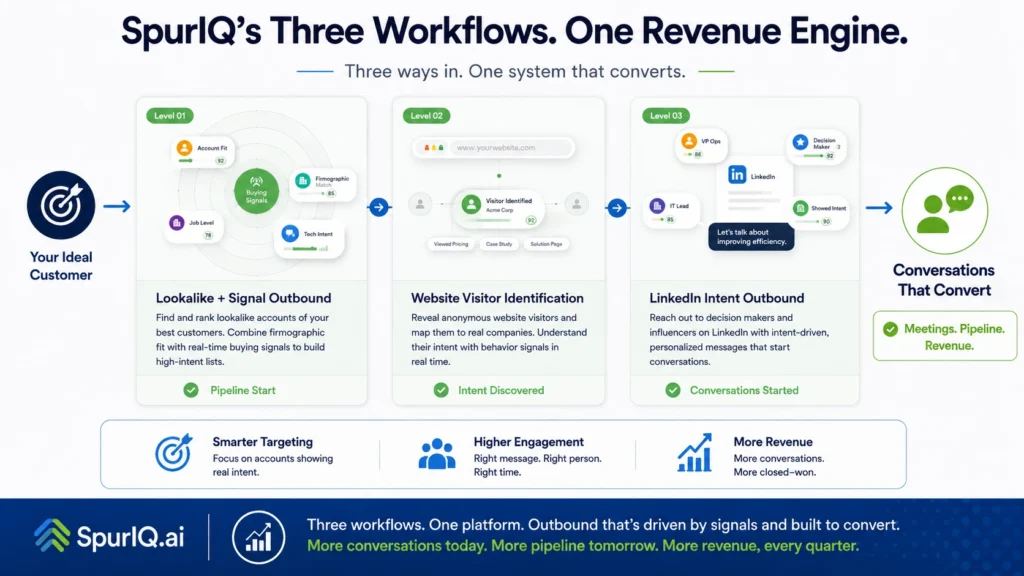
Instead, SpurIQ runs the workflows underneath those conversations, including:
- Signal-Based Outbound: Covers list building, enrichment, and signal monitoring, replacing repetitive manual work.
- Website Visitor Identification: Turns anonymous website traffic into named, outreach-ready accounts.
- LinkedIn Intent Outbound: Converts content engagement into contextual outreach instead of generic cold outreach.
Together, these three workflows demonstrate how to use AI for BDR outreach, replacing repetitive manual work while allowing sales reps to focus on meaningful customer conversations.
Because it runs on a team’s existing stack, including HubSpot or Salesforce, Gmail, and LinkedIn, it’s designed, deployed, and managed within the team’s current workflow rather than layered on top of undefined territories and poor-quality data. That avoids the exact failure mode discussed earlier. There’s no rip-and-replace approach required.
The outcome for founders is straightforward:
- The manual layer stops consuming valuable rep time.
- Sales reps spend more time on high-value conversations and relationship building.
- Teams get greater efficiency without losing the human element that drives successful selling.
See which parts of your outbound motion should run as a system. Book a 10-minute walkthrough.
Should You Hire a BDR or Automate? A Decision Framework
This is a headcount decision for most founders, so it deserves a framework rather than a generic answer. If you’re asking, “How do I select the best AI BDR solution?”, start by identifying which parts of the BDR workflow should be automated instead of simply comparing software features.
| Factor | Which way to lean |
| Stage | If your sales motion is already repeatable and founders are consistently generating meetings, adding a BDR can help scale outbound efforts. If you’re still refining your messaging, ICP, or sales process, automate repetitive tasks first and avoid scaling an unproven approach. |
| ACV | High-value, multi-stakeholder deals benefit from experienced BDRs who can build relationships and navigate complex buying decisions. For lower-value, higher-volume sales, automation often delivers a stronger return on investment. |
| Bottleneck | Ask where deals are slowing down. If qualified opportunities are piling up without enough people to handle them, hiring makes sense. If the challenge is generating enough qualified conversations, improving prospecting with automation is usually the better first step. |
| Data readiness | AI performs best when your CRM, ICP, and account data are reliable. If your data is incomplete or inconsistent, fix those foundations before investing heavily in automation. |
| Motion complexity | Relationship-driven, consultative sales still rely heavily on human judgment. High-volume, repeatable outbound motions are far better suited to automation, especially for research, outreach, and follow-up tasks. |
The economics are worth being blunt about. Compare a fully-loaded BDR’s cost and ramp time against the cost of tooling plus execution, and the risk isn’t symmetric the way most of this content pretends it is. A bad hire costs a company six to nine months. A badly-deployed AI BDR can cost it a meaningful slice of its addressable market. Neither decision here is low-stakes, and treating either one as the safe default is a mistake.
The Honest Answer
Can AI replace a BDR (Business Development Representative)? No. AI replaces the manual, repetitive layer of the role, not the judgment, relationship-building, and strategic conversations that make great BDRs valuable.
What’s gone is manual list-building, cold research, and follow-up admin. What stays is judgment, trust, live conversation, and internal politics. What’s new is the expectation that the manual layer runs as a system rather than sitting on a person’s plate by default.
The teams that win in 2026 won’t be the ones who replaced their reps, or the ones who refused to change anything about how the role works. They’ll be the ones who worked out which half of the job belongs to a system, and which half never did.
Frequently Asked Questions (FAQs):
Q. Can AI replace a BDR (Business Development Representative) in 2025 and 2026?
No. While AI now handles many repetitive, process-driven responsibilities, it cannot replace the human skills that drive successful sales conversations. The role is evolving rather than disappearing, with AI supporting the mechanical work and people owning the strategic, relationship-based work.
AI can automate:
List building
Prospect research
Signal monitoring
Outreach sequencing
CRM updates
Initial lead qualification
Humans still own:
Objection handling
Building trust
Complex qualification decisions
Navigating multiple stakeholders
Strategic account conversations
Q. What’s the difference between an AI BDR and an AI SDR?
The two terms are often used interchangeably, but some organizations make a distinction based on sales responsibilities. An AI BDR is usually associated with outbound prospecting, while an AI SDR may support both inbound and outbound sales motions.
In general:
AI BDR: Primarily supports outbound and new-business generation.
AI SDR: Typically handles a broader mix of inbound and outbound qualification.
Q. Are BDR jobs disappearing because of AI?
Not entirely. BDR headcount is growing more slowly as AI automates repetitive work, but the role itself remains important. Instead of eliminating jobs, AI is reshaping them by removing manual tasks and increasing the value of strategic selling skills.
What’s changing:
Routine administrative work is becoming automated.
Relationship-building and consultative selling are becoming more valuable.
Companies increasingly prefer experienced, AI-enabled BDRs over larger junior teams.
Q. What can an AI BDR do better than a human?
AI performs best where speed, scale, and consistency matter more than human judgment. It can process large amounts of data and execute repetitive tasks without slowing down.
AI excels at:
Building prospect lists
Researching accounts
Monitoring buying signals
Managing follow-up sequences
Keeping CRM data up to date
Q. What should stay human in business development?
Business development still depends heavily on human judgment, empathy, and communication. These are areas where AI remains a supporting tool rather than a replacement.
Human strengths include:
Handling live objections
Evaluating buyer intent
Building trust with prospects
Identifying internal champions
Knowing when to adapt or break the standard sales process
Q. Should a startup hire a BDR or use AI first?
The right choice depends on your company’s stage, sales complexity, and data maturity. AI is often the better starting point for automating repetitive work, while hiring makes more sense once you have a repeatable sales process.
Consider hiring first if:
Your ICP is well-defined.
Your sales process is repeatable.
Your team lacks capacity for qualified conversations.
You sell high-value, relationship-driven deals.
Consider AI first if:
Your messaging or ICP is still evolving.
Your CRM or customer data needs improvement.
Your team spends too much time on manual prospecting.
You want to automate repetitive tasks before expanding headcount.