If you’re a founder, CEO, or Head of Sales wondering which is better, inbound sales or outbound sales. It might be the wrong assessment. Instead, you should assess what proportion, at what stage, and in what sequence you should run inbound sales vs outbound sales.
Being a founder, CEO, or Head of Sales, you should decide where to put the next $1M of GTM budget, you don’t need another “just run both” post. Every guide on the first page of Google already says that. You need a concrete answer.
Here’s what this guide covers. You’ll learn what each sales motion is, how outbound vs inbound sales compare, when each approach works best, and the real cost differences between them. We’ll also explain why hybrid models succeed or fail, and share a stage-by-stage decision framework to help you determine the right inbound-outbound split for your business. No hand-waving. No RevOps jargon. Just practical insights, real numbers, and clear decisions.
What is Inbound Sales?
Inbound Sales is the motion where the buyer initiates. They find you through search, content, referrals, paid ads, webinars, or a product they tried on their own. By the time a rep gets involved, some level of interest already exists.
Common inbound channels include SEO, content marketing, paid search, webinars, referrals, product-led signups, and trade shows where prospects approach your team.
The job on the inbound side isn’t creating interest. It’s not losing it. Qualification and speed to lead are the whole game. A hand-raiser who doesn’t hear back within minutes cools off fast, and that lead is often gone for good.
What is Outbound Sales?
Outbound Sales are the motion where the seller initiates. Your SDR or AE reaches out to fit-profile prospects who haven’t raised their hand yet.
Outbound sales use channels like cold email, phone calls, LinkedIn, direct mail, personalized videos, and proactive event outreach to connect with potential buyers.
By 2026, outbound will have shifted from list-led to signal-led prospecting. Reaching out based on buying signals such as funding, hiring, or technology changes consistently outperforms static prospect lists. Multi-channel, sequenced outreach also delivers stronger results than relying on a single channel.
Outbound Sales vs Inbound Sales: The Direct Comparison
Inbound and outbound sales both drive revenue, but they work differently. Inbound attracts buyers already looking for a solution, while outbound reaches out to potential customers proactively. The table below compares both approaches across the factors that matter most for B2B growth.
| Factors | Inbound Sales | Outbound Sales |
| Who initiates | Buyer starts the conversation | Seller reaches out first |
| Lead temperature | Warm and already interested | Cold to warm, based on buying signals |
| Speed to first pipeline | Slower start, compounds over time | Faster results, scales with activity |
| Cost per lead | Lower as traffic and content grow | Higher, but predictable per SDR |
| CAC payback | Longer upfront, stronger long-term returns | Faster payback, steadier economics |
| Control over the pipeline | Limited to existing demand | Full control over target accounts |
| Pipeline predictability | Depends on search demand and content | Driven by consistent outreach execution |
| Lead conversion | Higher intent from inbound inquiries | Lower initial response, stronger after qualification |
| Sales cycle | Usually shorter because buyers are informed | Often longer as awareness is built |
| Ideal team structure | Marketing and AEs lead the motion | SDRs create demand, AEs close deals |
| Primary growth lever | SEO, content, and brand authority | Headcount, technology, and buying signals |
The real difference lies in how each motion drives growth. Inbound focuses on attracting qualified demand, while outbound gives you the ability to build a pipeline on your own timeline. Inbound builds long-term demand by attracting buyers already in the market, while outbound gives you the control to target high-value accounts and generate pipeline on your timeline. The strongest B2B organizations understand where each motion delivers the greatest advantage and invest accordingly.
When Inbound Sales Wins
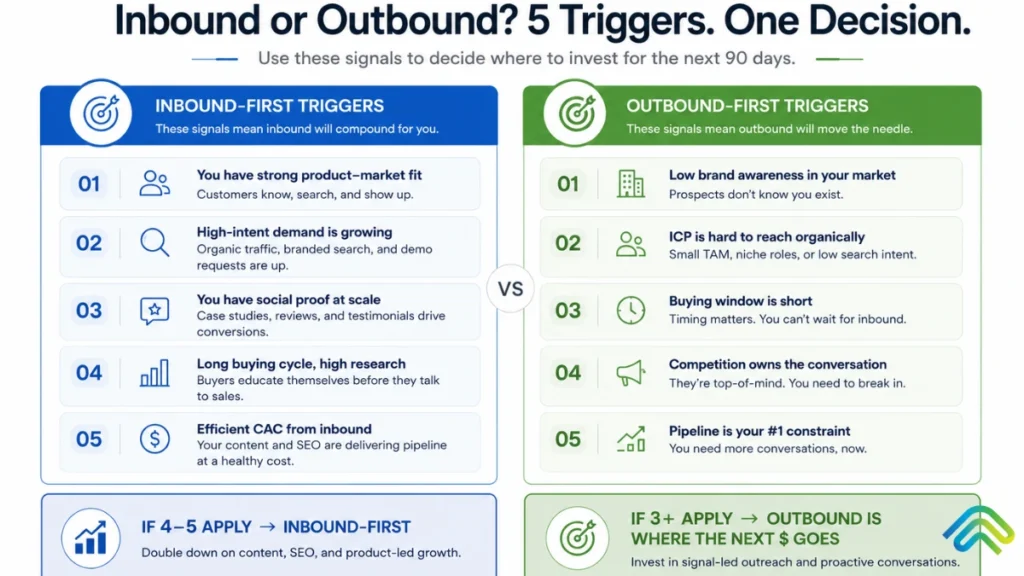
Inbound sales deliver the best results when buyers are already searching for solutions, and you have the time to build long-term demand. Here are five situations where inbound deserves the larger share of your GTM investment:
- Strong Demand: Inbound is the most effective method to drive customers when you reach out to the audience who are already searching for the products or services that you’re offering.
- Long Sales Cycles: It helps nurture prospects with valuable content and build trust before they make a purchasing decision.
- Established Founder Brand: A strong personal brand attracts qualified prospects through thought leadership and industry credibility.
- Long-Term Growth Focus: Inbound is ideal for businesses investing in a sustainable demand generation engine that compounds over time.
- Product-Led Growth (PLG): Free trials or freemium models allow users to experience the product before engaging with sales.
If all five apply, inbound-first is defensible. If two or fewer apply, outbound-first is the safer bet.
When Outbound Sales Wins
Outbound sales is the right choice when you need faster pipeline growth and greater control over who you target. Here are five scenarios where it delivers the best results:
- New or Undefined Market: Outbound helps create demand when buyers aren’t yet aware that your solution exists.
- Small, Well-Defined TAM: It enables you to directly reach the specific accounts and decision-makers you want to win.
- High Average Contract Value (ACV): High-value deals justify the investment in outbound teams and personalized outreach.
- Need for Faster Pipeline Growth: Outbound generates qualified meetings and pipeline much faster than waiting for inbound channels to grow.
- Founder-Led Selling: It helps founders book targeted meetings with ideal prospects instead of relying only on brand awareness.
If three or more apply, outbound is where the next dollar goes. Inbound layers in once you’ve got the runway to invest in it.
What Each Motion Actually Costs (and Returns)
Cost is one of the biggest differences when comparing inbound vs outbound sales cost effectiveness, but looking at cost alone can be misleading. Inbound requires a higher upfront investment before returns compound, while outbound delivers faster results with costs that scale alongside your team. Here’s how the numbers compare.
- Inbound cost structure: Content creation (in-house or agency), SEO tooling, paid amplification, and marketing salaries. Cost per lead is fixed to high upfront, then declines as content volume compounds, usually 12 to 18 months in.
- Outbound cost structure: SDR salary plus variable comp (roughly $60K to $120K fully loaded per SDR in the US), data and enrichment tooling ($15K to $50K a year), a sequencing platform ($10K to $30K a year), and AE capacity to convert what SDRs create. Cost is linear per hire. Each SDR adds roughly $150K a year of fully loaded cost and, at healthy performance, 40 to 80 qualified meetings a quarter.
- Cost per meeting: Inbound at scale runs $40 to $80. Outbound runs $110 to $180 for cold outreach and $30 to $80 when it’s signal-led rather than list-led.
- Cost per SQL: inbound runs $150 to $400. Outbound cold runs $400 to $800. Outbound signal-led runs $100 to $300.
- Payback: Inbound CAC payback typically runs 12 to 24 months once the content flywheel is actually running. Outbound CAC payback typically runs 6 to 14 months in mid-market B2B.
The better investment depends on your growth goals. Inbound rewards patience with lower long-term acquisition costs, while outbound delivers a faster pipeline with greater control. Choose the approach that solves your biggest constraint today, then layer in the other as you scale.
Lead Quality: Inbound vs Outbound Sales Qualified Leads Comparison
Cost tells you what you spend to generate a pipeline. Lead quality tells you what that pipeline is worth. While inbound and outbound can both drive revenue, they attract different types of buyers and deliver different business outcomes. The comparison below highlights where each approach performs best.
| Metric | Inbound Sales | Outbound Sales |
| Reply or Engagement Rate | Inbound sales typically generate higher engagement because buyers have already shown interest by searching for a solution or interacting with your content. | Outbound sales usually see lower response rates with cold outreach, although signal-led and personalized campaigns can significantly improve engagement. |
| Meeting-to-SQL Rate | Prospects who come through inbound channels are often actively evaluating solutions, resulting in a strong meeting-to-SQL conversion rate. | Outbound sales can achieve comparable or even higher meeting-to-SQL rates when outreach is focused on high-intent accounts that closely match your ideal customer profile. |
| ICP Match on Generated Leads | The quality of ICP fit varies because inbound leads depend on who discovers your website, content, or marketing campaigns. | Outbound consistently delivers a stronger ICP match because sales teams proactively target predefined ideal customer profiles. |
| Average Contract Value (ACV) | Inbound deals often have a lower average contract value because they include a broader mix of customers with different budgets and needs. | Outbound sales typically result in a higher average contract value since teams intentionally pursue larger, high-value accounts. |
| Win Rate from Qualified Opportunities | Qualified inbound opportunities generally have a higher win rate because buyers enter the sales process with existing interest and purchase intent. | Qualified outbound opportunities may have a slightly lower win rate because sales teams must first create demand, educate prospects, and build buying intent. |
Inbound wins on the volume of qualified conversations. Outbound wins on precision and deal size. Neither is universally “better quality.” They produce different profiles of pipeline, and most companies need both profiles at different points in their growth.
Balancing Inbound vs Outbound Sales: The Hybrid Model, and How it Fails
The fastest-growing B2B companies don’t rely on inbound or outbound alone. They combine both to build a steady, predictable pipeline. But running a hybrid strategy isn’t as simple as doing both. Without the right coordination, it creates missed opportunities, slower response times, and disconnected buyer experiences. Here are the three most common ways the hybrid model breaks down.
1. Slow inbound speed to lead:
Inbound signals age fast. A form filled out within five minutes converts at dramatically higher rates than one answered thirty minutes later, and most B2B teams average well over an hour. When outbound-trained reps handle inbound with cold-sequence discipline, the warm signal is dead before anyone replies.
2. Unrouted signals across motions:
Running both motions creates more signals, not fewer: website visits, content downloads, LinkedIn engagement, positive cold-reply intent. Most tech stacks capture these in separate silos. Without a routing layer connecting them, a large share is never acted on at all.
3. Outbound that ignores inbound intent:
Marketing runs a webinar on a specific topic, and two hundred people from your ICP attend. That same week, SDRs sequence a completely different pitch to a cold list. That’s not hybrid, that’s two motions running past each other. Real hybrid requires marketing and sales to share signal intent in something close to real time.
Hybrid works when there’s a routing layer connecting the two motions. This is exactly where inbound vs outbound sales for marketing operations teams tend to break down. Without one, you have two half-run motions competing for the same headcount and budget.
For a deeper look at building the outbound side of that motion, see our guide “Outbound Sales Strategy: 7 Proven Plays That Actually Work in 2026“
The Decision Framework: What to do at Your Stage
As your ARR grows, your GTM priorities change. Early-stage companies need a pipeline fast, while mature businesses can invest more heavily in compounding demand. Here’s how the balance typically shifts at each stage.
| Stage | Inbound % | Outbound % | Why |
| Pre-$2M ARR | 20 to 30% | 70 to 80% | Founder-led outbound is the primary motion. Inbound is a small content and SEO base to compound later. Don’t hire a marketing team yet. |
| $2M to $10M ARR | 30 to 50% | 50 to 70% | First real SDR team, first real content investment. Both motions ramp up; treat them as separate budget lines. |
| $10M to $50M ARR | 40 to 60% | 40 to 60% | Fully hybrid. Inbound is compounding and predictable; outbound covers targeted accounts and coverage gaps. Coordination becomes the real constraint. |
| $50M+ ARR | 50 to 70% | 30 to 50% | Inbound flywheel is now the majority contributor. Outbound gets surgical: expansion into new accounts, new-market entry. |
Two adjustments you’ll want to make to that table.
Start with ACV. If your ACV is above roughly $50K, you can push the outbound share up at every stage: the economics justify the SDR headcount. If you’re under roughly $10K, lean the other way and pull inbound share up, since outbound unit economics thin out fast at that price point.
Next, look at market maturity. If you’re in an established category with clear search demand, you can lean inbound earlier. If you’re in a new or undefined category, you’ll need outbound to build the awareness that inbound can later capitalize on.
This matters even more if you’re an enterprise sales leader managing a longer cycle and a higher ACV. In that case, the ACV adjustment above will usually pull your split toward outbound, regardless of stage.
Running Both Without One Starving the Other
The fastest-growing B2B teams don’t just run inbound and outbound side by side. They run both through a single execution layer that captures signals from every source, website visits, form fills, funding announcements, job changes, LinkedIn engagement, and routes each one into the right action.
That’s the layer SpurIQ is built to be: a revenue execution platform that closes the signal-to-action gap on both sides of the motion. Two tracks. One platform, sitting on top of the stack you already run: Gmail, HubSpot, or Salesforce, your calendar, LinkedIn. No rip-and-replace.
On the inbound side, that means signals like form fills and website visits get worked on the moment they happen, not hours later. On the outbound side, it means funding triggers, job postings, and lookalike-account signals feed directly into sequenced outreach instead of sitting in a spreadsheet. LeadIQ and DealIQ run as the two tracks of that same system, not two separate tools bolted together.
With the right execution layer in place, inbound signals are acted on quickly, outbound opportunities stay active, and CRM records remain accurate without constant manual updates.
See where signals are being lost across your motion. Book a 10-minute walkthrough.
The Right Question, and The Answer
Back to where we started. The wrong question is “which is better, inbound sales or outbound sales?” The right question asks in what proportion, at what stage, and in what sequence.
The honest one-line answer is this. At most B2B stages, the answer is both, but the split varies enormously by stage, ACV, and market maturity. A hybrid approach only works when a routing layer connects the two motions.
Frequently Asked Questions:
Q1. Inbound sales vs outbound sales: Which is better for B2B?
Neither inbound nor outbound is universally better. The right choice depends on your business stage, average contract value (ACV), and market maturity.
– Early-stage startups often benefit more from outbound because it generates a pipeline faster.
– High-ACV businesses usually prioritize outbound to target specific high-value accounts.
– Established categories with strong search demand can lean more on inbound.
– Companies above $10M ARR typically combine both motions to create predictable growth.
The most effective strategy is to invest in the approach that addresses your biggest growth challenge today, then add the second motion as your business scales.
Q2. What’s the cost difference between inbound and outbound sales?
Inbound and outbound sales ask for different kinds of investment, and they pay off on different timelines. Inbound builds a demand engine that keeps working for you long after the initial spend. Outbound builds a pipeline fast, but it needs steady fuel to keep going.
Inbound Sales
Costs more upfront: you’re investing in content, SEO, and marketing before you see results.
Gets cheaper over time, as your content and organic traffic start doing the work for you.
Best for building demand that lasts.
Outbound Sales
Needs ongoing investment: SDRs, prospect data, and sales tools don’t stop once you’ve paid for them.
Costs scale with capacity, but so does your pipeline. More reps, more pipeline, faster.
Best for predictable, short-term pipeline growth.
Q3. How do inbound and outbound sales impact the sales cycle?
Inbound sales often shorten the sales cycle because buyers have already researched the problem and are actively looking for solutions before speaking with a sales representative.
Outbound sales usually take longer because the sales team must first build awareness, educate prospects, and create demand before moving them through the buying journey.
Q4. Which produces higher inbound vs outbound sales leads quality?
Lead quality depends on how your business defines success.
– Inbound typically generates more high-intent conversations because buyers initiate contact.
– Outbound provides greater control over ICP targeting, often leading to larger deal sizes.
– Both approaches generate qualified opportunities but optimize for different business outcomes.
Rather than asking which produces better leads, focus on which type of pipeline your business needs most.
Q5. What’s the ideal split between inbound and outbound at the early stage?
For most companies below $2M ARR, outbound should drive the majority of GTM efforts while inbound lays the foundation for future growth.
Outbound: 70–80%
Inbound: 20–30%
Founder-led outreach usually delivers the fastest results, while investments in content and SEO begin compounding over time.
Q6. Can a small B2B team run both motions well?
Yes, but only if both motions are connected through a shared workflow.
Small teams are more likely to succeed when they:
– Route inbound and outbound signals into one system.
– Respond quickly to inbound inquiries.
– Share buyer signals between marketing and sales.
Keep CRM records updated automatically.
Without this coordination, opportunities are easily missed, and both inbound and outbound performance suffer.
Q7. How do you know when to add outbound if you’re inbound-only, or the reverse?
The right time to expand depends on what’s limiting your growth.
Add Outbound When:
– You need a pipeline faster than content and SEO can generate it.
– You’re entering a new market with little search demand.
– You need to target specific high-value accounts.
Add Inbound When:
– Buyers are actively searching for solutions like yours.
– You want to build a long-term demand generation engine.
– Your website is already attracting consistent, qualified traffic.
As your business grows, inbound and outbound work best as complementary growth strategies rather than separate initiatives.