AI Strategy

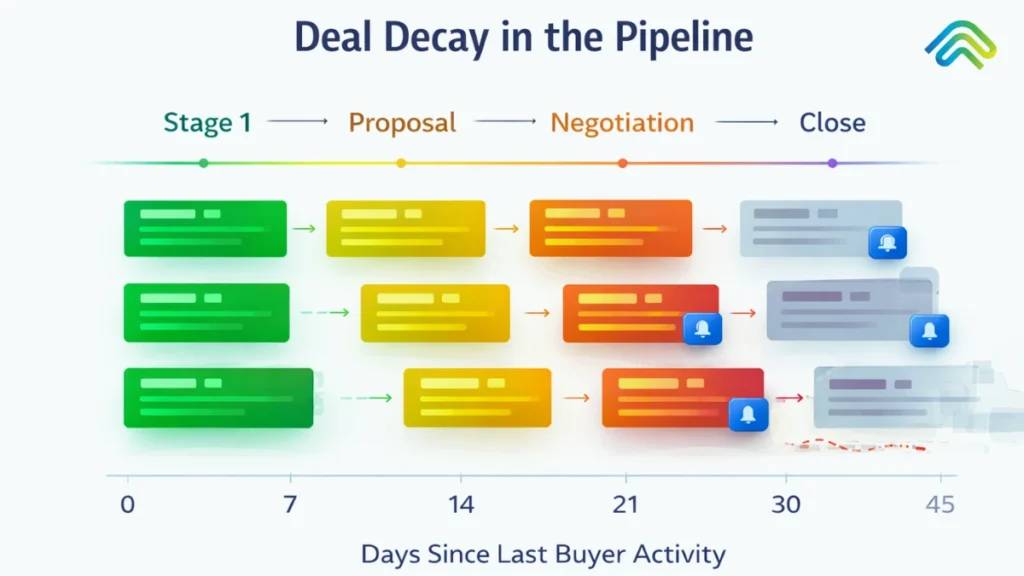
Deals Decay in the Pipeline
Thought Leadership, AI Strategy

Why Most Deals Don’t Get Lost — They Quietly Decay (And How to Stop It in 2026)

86% of B2B deals decay before they close. Most never formally die — they slowly lose momentum, one missed signal at a time, until the buyer quietly moves on. This is deal decay. And your pipeline is full of it right now. It’s week eleven of a thirteen-week quarter. You pull up the CRM. The pipeline looks respectable — $4.2 million across sixteen active deals. Seven of them are sitting in Proposal Sent or Negotiation. You scroll through. Something bothers you, but you can’t quite name it. Deal number three: last rep activity was a follow-up email, sent eleven days ago. No reply. Proposal was opened twice in the first 48 hours after delivery. Not once since. Deal number seven: champion’s last response was seventeen days ago. Before that, she replied within a few hours. The deal is still marked ‘on track.’ Deal number twelve: close date was pushed back for the second time last week. No reason logged. The rep notes say ‘waiting on procurement.’ Nobody in your system sent an alert. No escalation fired. No recovery play activated. From the outside, these deals look alive. From the inside, they’ve been deteriorating for weeks. This is deal decay and it’s the silent, invisible force behind most missed quarters in B2B sales. Not a competitor wins. Not a budget cut. Not a bad fit. Just a slow, quiet erosion of momentum that nobody’s system is built to catch. The deals killing your quarter aren’t the ones you lost. They’re the ones that are still technically open — and haven’t moved in three weeks. The uncomfortable truth is that most B2B revenue teams are extraordinarily good at diagnosing deal decay after it kills a deal. The CRM closed-lost data, the QBR postmortem, the manager coaching session — all useful, all retrospective. What very few teams have is a system that detects the early signals of decay and converts them into an automatic recovery action before the window closes. That’s what this piece is about. Not motivation. Not methodology. The execution architecture that stops deal decay before it costs you the quarter. What Is Deal Decay? A Definition Worth Owning Most sales vocabularies don’t have a clean word for this. You’ll hear ‘stalled deal,’ ‘stuck pipeline,’ ‘deal slippage,’ ‘pipeline rot.’ All of them gesture at the same phenomenon. None of them name it precisely enough to fix it. Here’s the definition: Deal decay is the gradual, often invisible deterioration of a sales opportunity — caused not by a formal rejection or competitive loss, but by the accumulation of small execution failures: missed follow-ups, stalled engagement, unanswered signals and the slow erosion of buyer momentum over time. A decayed deal never says no. It simply stops moving. That last line is the one that matters. A decayed deal never says no. There’s no rejection email. No ‘we’re going with a competitor.‘ Just silence and then more silence and then a close date that gets pushed again and then one day the deal is so cold that closing it would require starting over. And here’s what makes deal decay so dangerous: it looks fine in the CRM. The stage is still accurate. The dollar value is still in the forecast. The rep still believes it’ll close, maybe next quarter. The pipeline review passes it without a flag. And all the while, the deal is quietly dying. Deal Decay vs. Deal Loss — Why the Distinction Saves Revenue? This distinction matters more than most revenue leaders realize, because the two problems have completely different solutions. Deal Loss Deal Decay What happened? The buyer made an active decision — chose a competitor, cut the budget, or concluded it wasn’t the right fit. The buyer never made a decision. Momentum eroded. Nobody intervened. The deal quietly died of inaction. Who caused it? Often genuinely out of your control — pricing, product gap, competitive dynamics. Almost always a preventable execution failure. The signal existed. The action did not follow. How it shows up A clear closed-lost reason in the CRM. A conversation that ended. A deal stuck in a late stage for 30+ days. A forecast that never materializes. The fix Better positioning, qualification, competitive strategy. Execution infrastructure — a system that detects the decay signal and automatically recovers the deal before it’s terminal. Most revenue teams treat both as losses. They run the same postmortem, apply the same coaching, adjust the same qualification criteria. This is why pipeline stagnation is so persistent, the diagnosis is wrong, so the treatment doesn’t work. Deal decay isn’t a qualification problem or a rep performance problem. It’s an execution architecture problem. The Scale of the Problem Is Larger Than Most Teams Acknowledge 86% of B2B deals stall at some point during the buying process — not from competitive loss, but from momentum failure. (Forrester, 2024) That number should make you pause. Not 20%. Not 40%. Eighty-six percent. More than eight in ten deals experience a meaningful stall. And for the majority of those deals, the stall isn’t caused by a competitor, it’s caused by a gap in execution between a buyer signal and a corresponding action from the selling team. Consider the revenue math directly: if your team has $5M in active pipeline and your average deal touches at least one meaningful stall point, the question isn’t whether deal decay is affecting your number. It’s how much of your pipeline is already in decay right now and whether you have any system that’s watching. Why Deals Decay: 5 System Failures Nobody Talks About Most conversations about deal stagnation end up in the same place: ‘The rep needs to follow up more aggressively.‘ It’s the easiest diagnosis and it’s usually the wrong one. Deal decay is systemic. It happens across teams, across deal sizes, across industries. When something is that consistent, the cause is structural, not personal. Here are the five structural reasons deals decay and why better rep coaching doesn’t fix any of them: 1. Your CRM Records Activity. It
Revenue Intelligence vs revenue Execution
Thought Leadership, AI Strategy

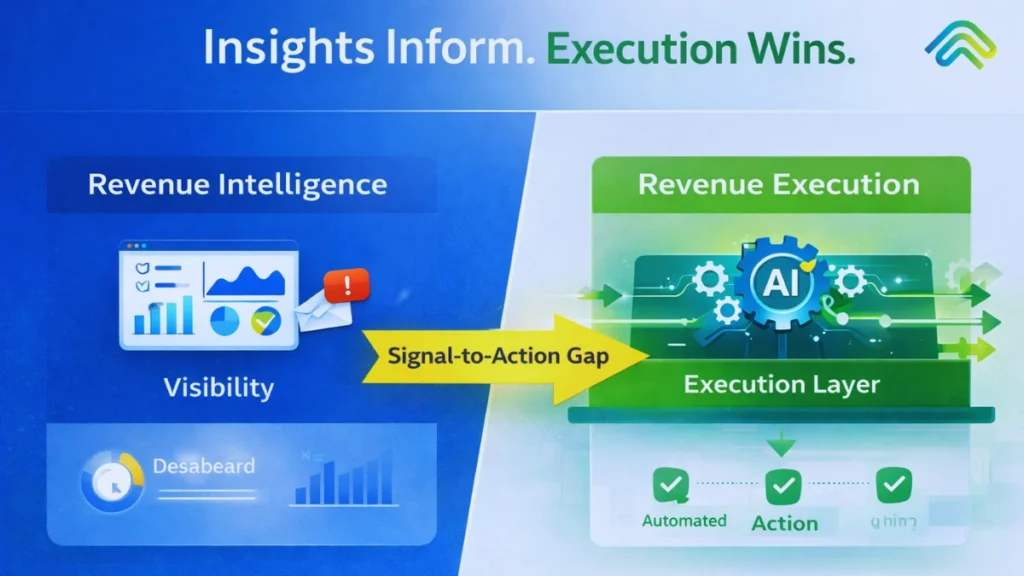
Revenue Intelligence vs Revenue Execution: Why Insights Don’t Close Deals

The Illusion of Visibility. Over the past five years, B2B companies have poured billions into revenue intelligence tools and revenue platforms. The promise was simple: better data leads to better revenue. As a result, dashboards improved. Forecasting accuracy improved. Executive visibility reached an all-time high. Yet, for all this visibility,revenue leakage remains a massive, systemic i`ssue. The root cause of this disconnect is a fundamental misunderstanding of what data actually does. Insight does not equal execution. And execution is what closes deals. When a buyer signals intent but the sales team fails to act immediately, revenue leaks. Industry analysis suggests that this post-signal inaction – the operational friction between knowing something and doing something about it costs B2B organizations between 20% and 30% of their potential revenue. The uncomfortable truth is that your revenue strategy likely isn’t broken. Your execution is. Welcome to the Signal-to-Action Gap. What Is Revenue Intelligence? Revenue Intelligence analyzes sales activities, pipeline data, buyer behavior, and forecasting metrics to provide predictive insights and performance visibility. It is designed to answer three critical questions: Typical Capabilities Include: Where It Lives: Revenue Intelligence is commonly integrated into CRM systems, Revenue Operations platform environments, and forecasting-centric platforms. For example, platforms like Clari and other “Run Revenue” systems do an exceptional job of optimizing forecasting visibility and providing executive oversight. But they all share one critical limitation: They stop at insight. What Is Revenue Execution? To solve the leakage problem, you must move beyond intelligence. Revenue Execution ensures that every revenue signal triggers the right action, at the right time, with strict accountability across the entire funnel. Instead of analyzing the past or predicting the future, Revenue Execution operates in the present. It answers: It operationalizes signals into automated, cross-functional action. If a deal stalls, it doesn’t just change a dashboard color to red; it triggers a workflow to fix it. The Core Distinction: Revenue Intelligence informs. Revenue Execution performs. Revenue Intelligence vs. Revenue Execution: The Core Distinction To understand why revenue leaks, you must understand the fundamental difference in how these two categories interact with your data. Revenue Intelligence is an observational layer. Revenue Execution is an operational layer. While Revenue Operations software optimizes process and reporting, Revenue Execution owns the physical outcome of that process. Consider how they compare across critical dimensions: Dimension Revenue Intelligence Revenue Execution Primary Goal Improve visibility: Understand the state of the pipeline and the accuracy of the forecast. Ensure action: Guarantee that the right steps are taken to advance or save the deal. Output Insights & forecasts: Dashboards, health scores, and predictive modeling. Triggered execution: Automated plays, mandatory tasks, and cross-functional escalations. Focus Predictive analytics: “Based on historical data, this deal has a 40% chance of closing.” Signal-to-action conversion: “This deal’s probability dropped; automatically alerting the VP to step in.” Dependency Human follow-up: Relies entirely on a rep remembering to check the dashboard and acting on it. Automated orchestration: Removes human memory from the equation, forcing the workflow. Value Moment Board reporting: Giving leadership confidence in the numbers at the end of the quarter. Revenue captured: Winning the micro-moments that prevent the deal from slipping mid-quarter. Why Insights Alone Fail to Close Deals? Having the best intelligence in the world is useless if the organization lacks the muscle memory to act on it. Insights fail to close deals due to four specific execution gaps: 1. Alert Saturation Sales leaders and reps are drowning in data. They receive deal risk scores, Slack alerts, and pipeline variance reports daily. When every notification is urgent, nothing is urgent. Without systemic enforcement of follow-up, reps simply tune the noise out. 2. Human-Dependent Execution Revenue platforms are great at flagging stalled deals. But then, they expect a busy, overwhelmed rep to manually prioritize a response. The reality is that human task prioritization breaks down under pressure. 3. Signal-to-Action Latency This is the time elapsed between a buyer engagement spike and the subsequent sales action. As documented in landmark research by Harvard Business Review, latency directly and severely reduces win probability. If you wait 24 hours to respond to a buying signal, the value of that signal approaches zero. This is the Signal-to-Action Gap. 4. Insight Without Accountability Revenue intelligence surfaces risk, but it rarely assigns ownership or enforces an intervention. If a deal slips silently and no manager is forced to intervene, the insight is worthless. The Revenue Execution Layer Missing in Modern Revenue Stacks Look at the modern B2B revenue stack: These are all excellent at surfacing intelligence. But nowhere in that stack is there a system that ensures escalation, automates play activation, closes mid-funnel dormancy, or triggers expansion actions. Insight leads to stalls. Execution leads to conversions. How Revenue (Action) Orchestration Bridges the Gap? To move from insight to execution, organizations require Revenue Orchestration. Revenue Action Orchestration converts distributed revenue signals into coordinated, cross-system action flows automatically. The Mechanism of Orchestration: This is what we call true execution ownership. Practical Example: The Deal Risk Scenario Let’s look at how the two systems handle the exact same problem: a stalling mid-funnel deal. Revenue Intelligence Platform Output: Revenue Execution Model Output: One system informs you that you are losing. The other system fights to win. Where Revenue Intelligence Still Matters? This is not to say Revenue Intelligence is obsolete. It is absolutely foundational. Revenue Intelligence is critical for: However, intelligence is upstream of performance. It sets the stage, but execution determines the realized revenue. The True Revenue Stack: Intelligence + Execution Mature B2B organizations are redesigning their tech architecture to reflect this reality: Without Layer 3, your massive tech investment remains entirely observational. Metrics That Reveal Execution Failure (Even When Intelligence Is Strong) Even if your intelligence is strong, your execution might be failing. You need to reframe your KPIs to spot the leakage: New Execution Metrics to Track: Why This Distinction Matters Now? As Gartner has extensively documented, B2B buying complexity is rising rapidly. Buying committees are larger, sales cycles are lengthening, and AI is exponentially

Revenue Execution
Thought Leadership, AI Strategy

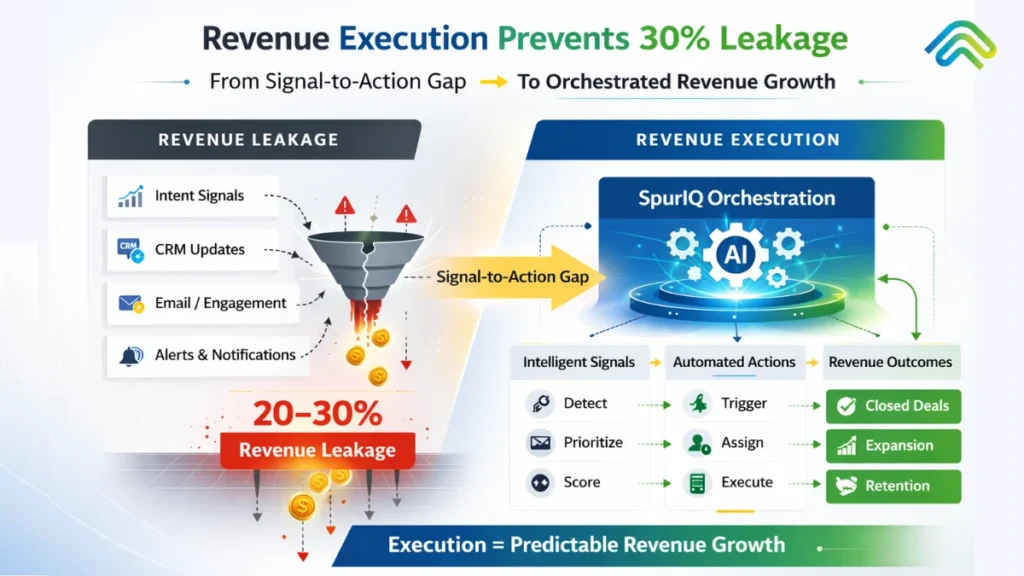
What Is Revenue Execution? (And Why B2B Teams Lose 30% Without It)

The 30% Problem: The Silent Killer of B2B Growth If you ask most sales leaders why they missed their quarter, you will hear a familiar refrain: “We didn’t have enough pipeline.” It is the standard diagnosis. The knee-jerk reaction is predictable: hire more SDRs, increase the paid search budget, and demand more activity. But for mature B2B organizations, this diagnosis is frequently wrong. B2B teams rarely lose revenue because they lack pipeline. They lose it because they fail to execute after the buyer interacts. Consider the reality of your current tech stack. It is likely overflowing with intelligence. You have intent data showing who is researching you. You have marketing automation tracking whitepaper downloads. You have product telemetry showing usage dips. The signals exist. However, the actions tied to those signals are inconsistent, delayed, or reliant on manual human memory. This phenomenon is known as the Signal-to-Action Gap. When a buying signal flashes but the corresponding sales action is delayed by 24 hours (or missed entirely), revenue leaks. Industry analysis suggests that this operational friction costs B2B organizations between 20% and 30% of their potential revenue. The uncomfortable truth? Your revenue strategy isn’t broken. Your execution is. What Is Revenue Execution? To fix the leak, you must first define the system required to plug it. Revenue Execution is the operational discipline that ensures every revenue signal – a pricing page visit, a stalled contract, a usage drop – triggers the right action, at the right time, with clear accountability across the entire funnel. It is not a philosophy. It is an operating system. And to understand it, we must ruthlessly distinguish it from the noise of general sales management. What Revenue Execution Is Not? ✗  It is not better forecast alignment meetings. Discussing a stalled deal on a Monday morning Zoom call does not move the deal. That is inspection, not execution. ✗  It is not colorful dashboards.Dashboards are passive. They depend on a human choosing to look, interpreting correctly, and then deciding to act. Dashboards observe. They do not execute. ✗  It is not a checklist of best practices.A playbook sitting in a Google Doc is not execution. If the process depends on human memory to function, it is already broken. ✗  It is not retrospective RevOps reporting.Telling a CRO they missed the quarter because pipeline velocity slowed in Week 8 is an autopsy. Revenue Execution is the intervention that prevents the death in Week 8. What are The True Essence of Revenue Execution? 1. Operationalized Action Ownership AI Revenue Execution eliminates the bystander effect inside your CRM. It removes ambiguity about who owns a signal. When a signal fires, the system explicitly assigns the ball to a specific player – an SDR, an AE, or a CSM. No handoff confusion. No diffusion of responsibility. 2. Automated Signal-to-Action Orchestration It bridges the gap between your tech stack’s intelligence and your team’s workflow – and removes the latency of human reaction time. If a buyer signals intent at 2:00 PM, the orchestration layer ensures the response happens at 2:01 PM. Not three days later when the rep clears their inbox. 3. Closed-Loop Accountability It tracks whether the action was completed – and critically, what the outcome was. If a high-priority signal goes unaddressed, the system doesn’t just log it. It escalates to management automatically. Also Read: Why AI Revenue Action Orchestration Beats Platform-Led RevOps Tools in 2026 The Core Distinction: Activity vs. Outcome Many competitors and legacy tools define execution as “managing revenue-generating activities.” That is a 2010 mindset. It focuses on logging calls, tracking email volume, and recording meeting notes. It measures effort. We define it differently. Revenue Execution is the science of converting revenue signals into accountable actions – without manual dependency. We measure outcomes. It is the difference between asking “Did you make 50 calls today?” and asking “Did we successfully engage every account that entered the buying window today?” Why B2B Teams Lose 20–30% Without AI Revenue Execution? Revenue leakage isn’t usually caused by one catastrophic event. It is death by a thousand cuts – hundreds of missed micro-moments across the customer lifecycle. Here is where the 30% disappears: 1. Post-Intent Inaction (Top of Funnel Leakage) 2. Pipeline Stagnation (Mid-Funnel Slippage) 3. Renewal & Expansion Blind Spots (Bottom of Funnel Leakage) 4. Fragmented Signal Systems Also Read: Revenue Intelligence vs Revenue Orchestration: Why Insights Alone No Longer Close Deals Revenue Execution vs. Revenue Operations (Critical Distinction) A common objection is: “We have a RevOps team, so we are already doing this.” This is a category error. Revenue Operations (RevOps) is the architect; Revenue Execution is the general contractor ensuring the work gets done. Feature Revenue Operations (RevOps) Revenue Execution Primary Goal Aligns teams, data, and processes. Ensures specific actions happen in real-time. Function Manages structure and strategy. Enforces accountability and speed. Output Creates visibility (Dashboards/Reports). Triggers execution (Plays/Tasks). Outcome Reports on past performance. Prevents future revenue leakage. The Bottom Line: RevOps optimizes the structure of your GTM motion. Revenue Execution optimizes the outcomes of that motion by engaging directly with the workflow. The Anatomy of the Execution Gap Why is this gap widening now? We identify five root causes that plague modern B2B teams: What True Revenue Execution Looks Like? To close the gap, organizations must shift from a passive data architecture to an active Execution Architecture. This involves four distinct stages: Stage 1: Signal Aggregation The system acts as a central nervous system, ingesting data from all sources: 6sense/Bombora (intent), Salesforce/HubSpot (CRM updates), Outreach/Salesloft (engagement), and product telemetry. Stage 2: Revenue Intelligence Layer The system applies logic to the noise. It evaluates buying probability and risk. It asks: Is this signal actionable? Is it high-priority? It filters out the noise so reps focus only on the signal. Stage 3: Automated Orchestration This is the engine of execution. Based on the intelligence, the system automatically triggers: Stage 4: Closed-Loop Accountability The system watches the watcher. Did the action happen? If not, the system identifies the

Revenue Action Orchestration
Thought Leadership, AI Strategy

Why AI Revenue Action Orchestration Beats Platform-Led RevOps Tools in 2026

Most B2B teams believe their revenue engine is in good shape. They have RevOps, CRM, dashboards, and AI insights. On paper, everything looks aligned. Yet revenue still slips. Deals don’t usually fail during calls, they fail between them. Follow-ups get delayed, risks stay hidden, CRM falls behind, and opportunities quietly lose momentum. Not because teams lack data, but because no one truly owns execution after buyer interactions. This is the gap AI Revenue Action Orchestration is designed to close. SpurIQ takes ownership of revenue execution, ensuring the right actions happen at the right time across the funnel. Instead of showing problems or suggesting tasks, it makes sure follow-through actually happens, so revenue doesn’t fade after the call. The RevOps Illusion: Why “Alignment” Still Leaks Revenue? For the last decade, RevOps has been sold as the fix for broken revenue performance. Align sales, marketing, and finance. Centralize data in CRM. Add dashboards, forecasts, playbooks, and AI-driven insights. On paper, everything looks “in sync.” Yet in practice, revenue keeps slipping. Most B2B companies today have strong revenue orchestration in theory, well-defined processes, reporting layers, and tools that show what should happen next. But when you look closely at what happens after a buyer interaction, things quietly fall apart. Follow-ups don’t go out on time. Deals sit idle for weeks. CRM updates happen late or not at all. Risks show up only when the quarter is already lost. This is why, despite heavy investment in RevOps tools and revenue orchestration software, companies still lose an estimated 20–30% of potential revenue every year. The common assumption is that the problem is insight: “If only we had better data, better dashboards, better AI.” But most teams already have enough information. Calls are recorded. Emails are logged. Pipelines are visible. Forecasts exist. What’s missing isn’t knowledge, it’s follow-through. Revenue doesn’t leak because teams lack intelligence. It leaks because no one owns execution once the call ends. Dashboards can flag a stalled deal. Playbooks can recommend the next step. Managers can point out a risk in pipeline review. But none of those things guarantee action. The burden still falls on humans to remember, prioritize, and manually execute, often across ten different tools. When they don’t, revenue simply decays without being marked as lost. This is the core flaw in traditional revenue orchestration: it coordinates systems, but it doesn’t ensure outcomes. Fixing this doesn’t require another dashboard or a better report. It requires a new layer in the revenue stack, one that doesn’t just surface signals, but turns them into actions automatically. That gap is exactly why AI revenue action orchestration exists. What Is Revenue Orchestration? (And Why Most Definitions Fall Short) If you search what is revenue orchestration, most definitions point to the same idea: coordinating systems, data, and workflows across go-to-market teams. In simple terms, revenue orchestration is meant to bring sales, marketing, and customer success onto a shared operating rhythm, using CRM, automation tools, analytics, and RevOps processes to keep everyone “aligned.” And to be fair, this approach did fix real problems. Before revenue orchestration became common, teams worked in silos. Data lived in disconnected tools. Sales didn’t trust marketing numbers, finance didn’t trust the forecast, and leadership had no single view of the pipeline. Modern revenue orchestration platforms solved much of that by centralizing data and making revenue activity visible. But visibility is where most revenue orchestration software stops. These systems are excellent at showing what’s happening: which deals are stalled, which leads went cold, where risk exists in the pipeline. They can even suggest best practices or recommended next steps. What they don’t do is make those steps happen. Execution is still manual. Reps are expected to remember to send follow-ups. Managers must chase updates before forecast calls. RevOps teams spend hours policing CRM hygiene. Even the most advanced AI revenue orchestration tools still rely on humans to turn insight into action and that’s where things break down. When execution depends on memory, discipline, and spare time, it’s inconsistent by default. Deals don’t die loudly; they fade. Revenue doesn’t collapse in one moment; it leaks quietly over weeks of inaction. This is the gap most definitions ignore. Revenue orchestration coordinates systems and signals, but it does not own outcomes. It aligns teams, yet leaves execution to chance. In practice, that makes it a passive layer in the revenue stack. Revenue orchestration without execution is still passive. That’s exactly where Revenue Action Orchestration emerges. What Is AI Revenue Action Orchestration? AI Revenue Action Orchestration is the continuous, autonomous conversion of revenue signals into executed actions across the funnel, without relying on human memory, manual follow-ups, or CRM hygiene. This is not about more insights. It’s about ownership. Instead of stopping at visibility or recommendations, AI revenue action orchestration ensures that critical revenue actions actually happen. At its core, the model rests on four pillars. 1. Signal ingestion Every meaningful revenue signal is captured automatically. Sales calls, email threads, CRM activity, buyer responses, and deal movement all flow in as raw inputs. Nothing depends on reps remembering to log activity or summarize calls. The system observes revenue as it unfolds. 2. Contextual understanding Signals alone are meaningless without context. AI revenue orchestration evaluates activity in relation to deal stage, buyer behavior, previous interactions, and known risk patterns. A missed follow-up early in the cycle doesn’t carry the same weight as silence after pricing or security review and the system knows the difference. 3. Decisioning Once context is clear, the system determines what must happen next. That includes identifying the right next step, assigning ownership, and setting urgency. This is not a generic recommendation engine; it is a judgment layer built around revenue outcomes. 4. Execution This is the defining difference. Actions are not left as tasks or reminders. Follow-ups are sent, CRM updates are made, risks are surfaced, and deal movement is enforced. Execution is no longer optional or dependent on human discipline, it is built into the revenue flow. This is why revenue action orchestration is fundamentally different from existing categories: In other words, traditional revenue technology observes revenue. Revenue action orchestration runs it. Why Gartner Says Revenue Action Orchestration Is Inevitable? The

Scroll to Top