Most B2B teams believe their revenue engine is in good shape. They have RevOps, CRM, dashboards, and AI insights. On paper, everything looks aligned.
Yet revenue still slips.
Deals don’t usually fail during calls, they fail between them. Follow-ups get delayed, risks stay hidden, CRM falls behind, and opportunities quietly lose momentum. Not because teams lack data, but because no one truly owns execution after buyer interactions.
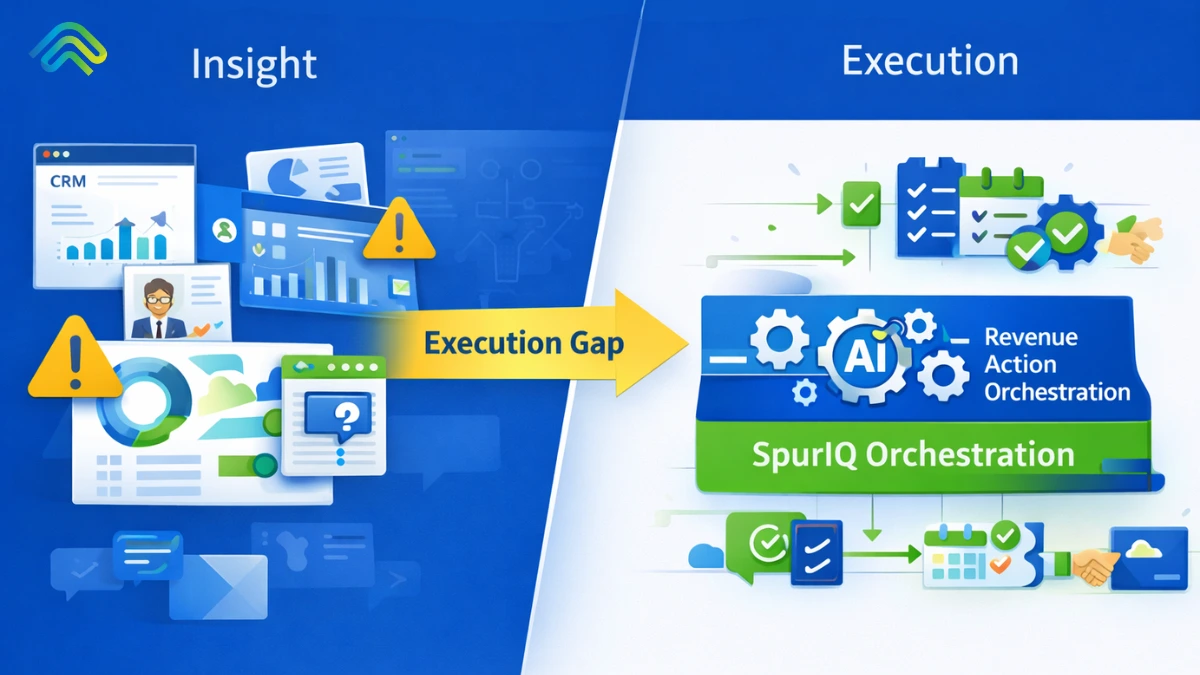
This is the gap AI Revenue Action Orchestration is designed to close.
SpurIQ takes ownership of revenue execution, ensuring the right actions happen at the right time across the funnel. Instead of showing problems or suggesting tasks, it makes sure follow-through actually happens, so revenue doesn’t fade after the call.
The RevOps Illusion: Why “Alignment” Still Leaks Revenue?
For the last decade, RevOps has been sold as the fix for broken revenue performance. Align sales, marketing, and finance. Centralize data in CRM. Add dashboards, forecasts, playbooks, and AI-driven insights. On paper, everything looks “in sync.”
Yet in practice, revenue keeps slipping.
Most B2B companies today have strong revenue orchestration in theory, well-defined processes, reporting layers, and tools that show what should happen next. But when you look closely at what happens after a buyer interaction, things quietly fall apart. Follow-ups don’t go out on time. Deals sit idle for weeks. CRM updates happen late or not at all. Risks show up only when the quarter is already lost.
This is why, despite heavy investment in RevOps tools and revenue orchestration software, companies still lose an estimated 20–30% of potential revenue every year.
The common assumption is that the problem is insight: “If only we had better data, better dashboards, better AI.”
But most teams already have enough information. Calls are recorded. Emails are logged. Pipelines are visible. Forecasts exist. What’s missing isn’t knowledge, it’s follow-through.
Revenue doesn’t leak because teams lack intelligence. It leaks because no one owns execution once the call ends.
Dashboards can flag a stalled deal. Playbooks can recommend the next step. Managers can point out a risk in pipeline review. But none of those things guarantee action. The burden still falls on humans to remember, prioritize, and manually execute, often across ten different tools. When they don’t, revenue simply decays without being marked as lost.
This is the core flaw in traditional revenue orchestration: it coordinates systems, but it doesn’t ensure outcomes.
Fixing this doesn’t require another dashboard or a better report. It requires a new layer in the revenue stack, one that doesn’t just surface signals, but turns them into actions automatically.
That gap is exactly why AI revenue action orchestration exists.
What Is Revenue Orchestration? (And Why Most Definitions Fall Short)
If you search what is revenue orchestration, most definitions point to the same idea: coordinating systems, data, and workflows across go-to-market teams. In simple terms, revenue orchestration is meant to bring sales, marketing, and customer success onto a shared operating rhythm, using CRM, automation tools, analytics, and RevOps processes to keep everyone “aligned.”

And to be fair, this approach did fix real problems.
Before revenue orchestration became common, teams worked in silos. Data lived in disconnected tools. Sales didn’t trust marketing numbers, finance didn’t trust the forecast, and leadership had no single view of the pipeline. Modern revenue orchestration platforms solved much of that by centralizing data and making revenue activity visible.
But visibility is where most revenue orchestration software stops.
These systems are excellent at showing what’s happening: which deals are stalled, which leads went cold, where risk exists in the pipeline. They can even suggest best practices or recommended next steps. What they don’t do is make those steps happen.
Execution is still manual.
Reps are expected to remember to send follow-ups. Managers must chase updates before forecast calls. RevOps teams spend hours policing CRM hygiene. Even the most advanced AI revenue orchestration tools still rely on humans to turn insight into action and that’s where things break down.
When execution depends on memory, discipline, and spare time, it’s inconsistent by default. Deals don’t die loudly; they fade. Revenue doesn’t collapse in one moment; it leaks quietly over weeks of inaction.
This is the gap most definitions ignore.
Revenue orchestration coordinates systems and signals, but it does not own outcomes. It aligns teams, yet leaves execution to chance. In practice, that makes it a passive layer in the revenue stack.
Revenue orchestration without execution is still passive.
That’s exactly where Revenue Action Orchestration emerges.
What Is AI Revenue Action Orchestration?
AI Revenue Action Orchestration is the continuous, autonomous conversion of revenue signals into executed actions across the funnel, without relying on human memory, manual follow-ups, or CRM hygiene.
This is not about more insights. It’s about ownership. Instead of stopping at visibility or recommendations, AI revenue action orchestration ensures that critical revenue actions actually happen.
At its core, the model rests on four pillars.
1. Signal ingestion
Every meaningful revenue signal is captured automatically. Sales calls, email threads, CRM activity, buyer responses, and deal movement all flow in as raw inputs. Nothing depends on reps remembering to log activity or summarize calls. The system observes revenue as it unfolds.
2. Contextual understanding
Signals alone are meaningless without context. AI revenue orchestration evaluates activity in relation to deal stage, buyer behavior, previous interactions, and known risk patterns. A missed follow-up early in the cycle doesn’t carry the same weight as silence after pricing or security review and the system knows the difference.
3. Decisioning
Once context is clear, the system determines what must happen next. That includes identifying the right next step, assigning ownership, and setting urgency. This is not a generic recommendation engine; it is a judgment layer built around revenue outcomes.
4. Execution
This is the defining difference. Actions are not left as tasks or reminders. Follow-ups are sent, CRM updates are made, risks are surfaced, and deal movement is enforced. Execution is no longer optional or dependent on human discipline, it is built into the revenue flow.
This is why revenue action orchestration is fundamentally different from existing categories:
- Revenue Intelligence shows what’s happening
- Sales Engagement suggests what could be done
- CRM records what already happened
- AI Revenue Action Orchestration ensures actions happen
In other words, traditional revenue technology observes revenue. Revenue action orchestration runs it.
Why Gartner Says Revenue Action Orchestration Is Inevitable?
The shift toward Revenue Action Orchestration isn’t coming from vendors trying to rename old software. It’s coming from analysts watching RevOps stall under its own weight.
Gartner has been explicit about this transition. For years, Revenue Intelligence helped teams understand pipeline health, deal risk, and forecast gaps. That category did its job, it made revenue visible. But visibility didn’t fix execution.
Gartner’s position is clear: AI cannot stop at insight if it’s going to materially impact revenue.
Insight without action simply moves the problem downstream.
That’s why Gartner now frames the evolution as Revenue Intelligence → Revenue Action Orchestration. The emphasis has shifted from “What’s happening in the pipeline?” to “What is being done about it, automatically, consistently, and on time?”
In their trend insight, Boost Sales AI Impact With Revenue Action Orchestration, Gartner highlights a simple but uncomfortable truth: most sales AI investments stall because humans are still responsible for turning signals into action. Reps are expected to read alerts. Managers are expected to enforce follow-ups. RevOps teams are expected to chase hygiene. Execution is optional and therefore inconsistent.
From Gartner’s perspective, this is not a missing feature. It’s a missing layer.
A true revenue orchestration platform, as Gartner now describes it, must go beyond analytics and recommendations. It must take responsibility for post-interaction execution, ensuring next steps actually happen without relying on rep discipline or manual workflows. That’s why revenue action orchestration Gartner positions this as the next phase of RevOps maturity, not an add-on to existing tools.
This is also why Gartner doesn’t treat Revenue Action Orchestration as just another AI capability inside CRM or sales engagement software. Those systems were built to record activity or assist humans. Orchestration is about ownership. It sits above tools, works across systems, and enforces outcomes.
From Revenue Intelligence to Autonomous Revenue Orchestration
Revenue technology didn’t evolve overnight. It moved in steps, each solving part of the problem, but never the whole thing.
Revenue Intelligence was the first big shift. It helped teams see what already happened and where things were going wrong. Leaders could spot stalled deals, missed activity, and forecast risk. That visibility was useful, but it came too late most of the time. By the moment risk showed up on a dashboard, the deal was often already drifting.
Next came revenue orchestration software. This brought structure. Teams defined workflows. Best practices were documented. Systems could suggest what to do at each stage of the deal. But execution was still left to people. Reps had to remember. Managers had to chase. RevOps had to clean up the gaps. The “orchestration” existed, but only if everyone followed it perfectly.
That’s where AI revenue action orchestration changes the equation.
Instead of waiting for someone to notice a problem, the system works in a simple loop: it detects what’s happening, decides what should happen next, and then executes it.
If a follow-up doesn’t go out after an important call, the system steps in.
If a deal sits idle when it shouldn’t, action is triggered.
If risk builds quietly, it’s surfaced and addressed immediately.
This is what autonomous revenue orchestration really means. Revenue doesn’t move in weekly reviews or quarterly forecasts, it moves every day, after every buyer interaction. An autonomous system works at that same pace. It runs continuously, not in batches, and it doesn’t rely on humans to catch every detail.
Revenue intelligence shows you the problem.
Revenue orchestration defines the process.
Autonomous revenue orchestration makes sure action happens, every time.
What a Modern Revenue Orchestration Platform Must Actually Do in 2026?
If you ask what is a revenue orchestration platform, most answers still describe software that organizes data, connects tools, and supports better decision-making. That description might have worked a few years ago. In 2026, it’s no longer enough.
A modern revenue orchestration platform has to take responsibility for what happens after buyer activity, not just record it or report on it.
First, it must observe live revenue signals. Every call, email, meeting, buyer response, and period of silence matters. These signals need to be captured automatically, without reps logging notes or checking boxes. Revenue doesn’t wait for clean data, so the system can’t either.
Second, it must understand buyer and deal context. A missed follow-up means different things at different stages. Silence after discovery isn’t the same as silence after pricing. A platform needs to recognize where the deal stands, who’s involved, and what risk is building, not treat all inactivity the same.
Third, it must assign ownership automatically. One of the biggest reasons execution breaks is confusion over who should act. A modern revenue orchestration platform removes that ambiguity. The right person is identified, and responsibility is clear, without managers chasing or RevOps stepping in.
Fourth, it must execute actions inside the tools teams already use. Follow-ups should go out. CRM updates should happen. Risk should be flagged and addressed in real time. If the platform only creates tasks or reminders, it’s still pushing work back onto humans.
Finally, it must work above CRM, not as another CRM add-on. CRM is a system of record. Revenue orchestration is a system of action. It should sit on top of existing tools, coordinating and executing across them, without forcing teams to change how they work.
This is the line that matters:
A revenue orchestration platform that doesn’t execute is just better reporting.
In 2026, orchestration isn’t about seeing revenue.
It’s about making sure nothing slips once the buyer has engaged.
Where SpurIQ Fits: Owning Revenue Execution (Not Another Tool)
At this point, it’s worth clarifying where SpurIQ fits, because it doesn’t sit neatly in any existing box.
SpurIQ wasn’t built to be another sales tool, another RevOps dashboard, or another layer of reporting. It was built to take on a role that most revenue teams struggle to assign: owning execution after buyer interactions.
Think of SpurIQ as a Revenue Action Orchestration Architect, the layer that ensures revenue doesn’t rely on memory, discipline, or last-minute heroics. Its job is simple in principle and hard in practice: make sure the right actions happen at the right time, across the funnel, without adding work for sellers or managers.
That ownership spans the entire revenue motion.
At the top of the funnel, Lead IQ represents Revenue Execution when leads first arrive. It focuses on speed, context, and follow-through, so inbound interest doesn’t get touched once and forgotten. The goal is straightforward: no lead left behind.
At the bottom of the funnel, Deal IQ represents Revenue Execution when deals are live and fragile. This is where most revenue quietly slips, missed follow-ups, stalled stages, hidden risk, and stale CRM masking reality. Deal IQ prevents deals from going dark by enforcing consistent post-call follow-through.
Together, these aren’t separate tools solving isolated problems. They form a single execution system.
From first response to final close, SpurIQ owns Revenue Execution end-to-end.
The impact shows up in three places that matter:
- Deals don’t fade quietly, they move or surface risk early
- Execution becomes consistent, not dependent on individual reps
- Slipped revenue is recovered because action is no longer optional
SpurIQ doesn’t replace your stack.
It makes sure your stack actually gets used.
And in a world where revenue is lost between interactions, not at them, that distinction matters.
Why Revenue Action Orchestration Wins in the Modern Revenue Stack?
Revenue Action Orchestration wins for a simple reason: it focuses on outcomes, not activity.
Modern revenue teams don’t suffer from lack of tools. They suffer from gaps between tools, especially after buyer interactions. Calls happen, interest is shown, signals are captured, but execution breaks down in the days that follow. That’s where revenue quietly slips.
By owning execution, Revenue Action Orchestration directly changes the metrics that matter most.
First, it recovers 15–25% of revenue that would otherwise be lost. This isn’t new demand or better targeting. It’s an existing pipeline that stops decaying because follow-ups happen, risks surface early, and deals don’t fade due to inaction.
Second, it improves deal velocity. When actions happen on time, stages don’t stall. There are fewer long gaps between interactions, fewer “we’ll get back to this” moments, and fewer end-of-quarter scrambles. Deals move because momentum is protected.
Third, it delivers forecast accuracy within ±5%. Not because forecasting models get smarter, but because execution becomes consistent. When CRM reflects reality automatically and inactivity is handled in real time, leaders aren’t reacting to surprises, they’re managing with confidence.
Finally, it gives reps their time back. Sellers spend less time remembering what to do, updating systems, or cleaning up notes and more time selling. The mental load shifts from tracking tasks to focusing on conversations that drive revenue.
This is why Revenue Action Orchestration shouldn’t be thought of as sales tech.
Sales tech helps individuals perform tasks.
Revenue Action Orchestration is revenue technology.
It operates across roles, across systems, and across the entire funnel, protecting revenue not by adding effort, but by removing the dependence on it.
How to Evaluate AI Revenue Action Orchestration Platforms?
As more vendors start using this language, buyers need a clear way to separate real AI revenue action orchestration from tools that simply sound modern. A serious revenue action orchestration review shouldn’t focus on features, it should focus on ownership.
The first question is simple: does the platform own execution, or does it just recommend actions?
If the output is another task, alert, or suggestion that a human must act on, execution is still optional. True revenue action orchestration takes responsibility for follow-through.
Second, does action actually happen automatically?
Follow-ups, CRM updates, risk surfacing, and deal movement should occur without someone clicking through reminders. If the system waits for rep discipline, you’re reviewing intelligence, not orchestration.
Third, is the platform independent of your existing stack?
A genuine solution works above CRM, sales engagement, and BI tools. It shouldn’t force teams into a new workflow or lock execution into a single system. Revenue happens across tools, so orchestration must span them.
Finally, is execution consistent without rep effort?
The real test shows up over time. Do deals receive the same level of follow-through regardless of who owns them? Does revenue performance depend less on individual habits and more on the system itself?
If the answer to these questions is yes, you’re looking at real orchestration.
If not, it’s just another tool being added to the pile.
This distinction is what separates a credible AI revenue action orchestration review from marketing noise.
Final Take: RevOps in 2026 Is Not About Insight — It’s About Ownership
RevOps has evolved in clear phases.
From 2018 to 2022, the focus was visibility. Teams worked to centralize data and understand what was happening across the funnel.
From 2023 to 2024, the shift moved toward intelligence. AI helped highlight risk, suggest next steps, and improve forecasting conversations.
But in 2025 and 2026, the real bottleneck is execution.
FAQs: AI Revenue Action Orchestration
Q. What is AI Revenue Action Orchestration, in simple terms?
It’s a system that makes sure important revenue actions actually happen after buyer interactions. Instead of showing problems or suggesting tasks, it observes activity, decides what needs to happen next, and executes those actions automatically.
Q. How is this different from revenue intelligence tools?
Revenue intelligence tells you u003cemu003ewhat’s going wrongu003c/emu003e. Revenue action orchestration fixes it.u003cbru003eIntelligence depends on humans to act. Orchestration takes ownership of execution so follow-through doesn’t depend on memory or discipline.
Q. Is revenue action orchestration just another sales tool?
No. Sales tools help individuals do tasks. Revenue action orchestration operates across the entire revenue system—sales, RevOps, leadership—and protects outcomes, not activity.u003cbru003eThat’s why it’s best viewed as u003cstrongu003erevenue technologyu003c/strongu003e, not sales tech.
Q. Do reps still need to manually update CRM or track follow-ups?
No, or far less than before. A core goal of AI revenue action orchestration is reducing reliance on manual updates and task chasing. Actions like follow-ups and updates happen automatically inside existing tools.
Q. Why is this becoming important now?
Because most revenue teams already capture every call, email, and signal, but still lose deals after them. AI has improved insight, but execution hasn’t kept up. Revenue action orchestration exists to close that final gap.