SpurIQ

sales

revenue leakage
Revenue Operations, Thought Leadership

What Is Revenue Leakage and Why Your Pipeline Isn’t the Problem?

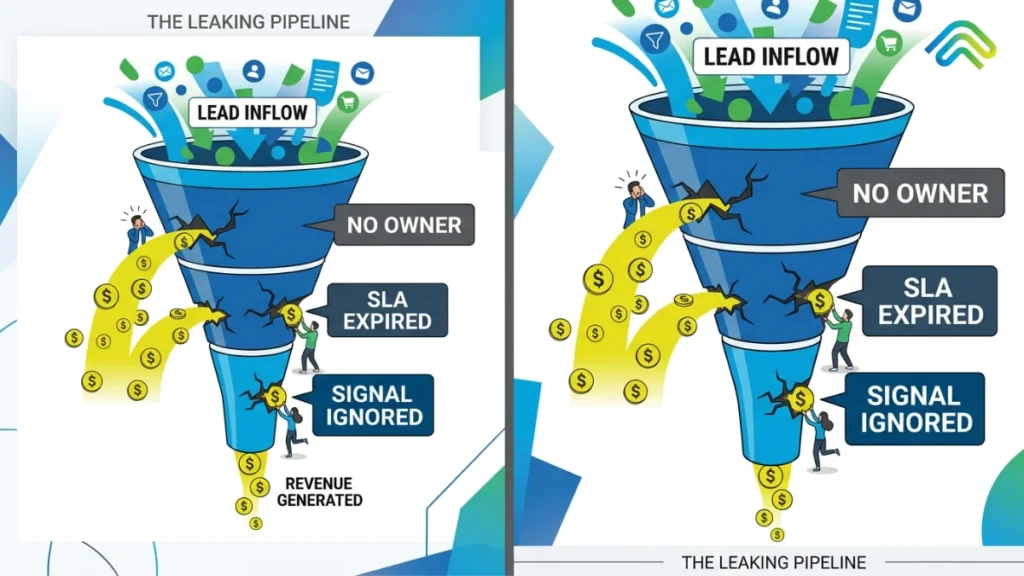
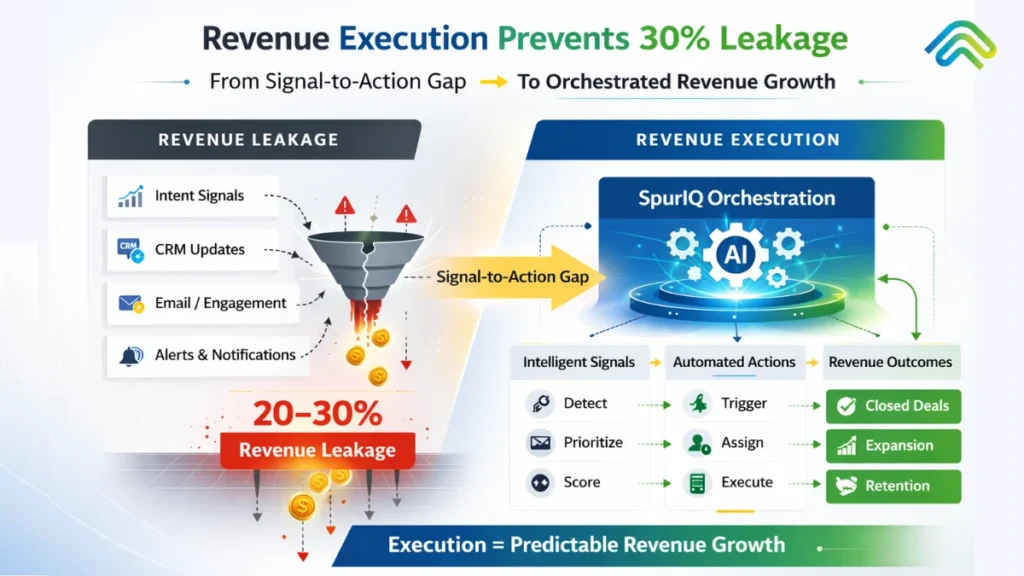
20–30% of revenue doesn’t disappear because your pipeline is thin. It slips away after the buyer has already signaled. Here’s what revenue leakage actually means in 2026 and how to stop it at its source. Picture a deal your team worked hard to move forward. The prospect opened your proposal four times in a 48-hour window. Your platform flagged the intent signal. The CRM note was logged. Someone was going to follow up, right after the next internal sync. Three days passed. The buyer went quiet. Then the email arrived: they’d signed with someone else. That’s not pipeline failure. That’s revenue leakage and it’s one of the most misunderstood, most expensive problems in B2B sales today. The conventional wisdom says revenue leakage is about billing errors, pricing inconsistencies, and missed invoices. And those things are real. But in 2026, the far larger and far more costly form of leakage happens somewhere else entirely: in the gap between a buyer signal and the action that was supposed to follow it. This piece is about that gap, what causes it, how to diagnose it and how to close it permanently. What Is Revenue Leakage? A Definition That Actually Fits 2026 Revenue leakage is the difference between the revenue a business should capture and the revenue it actually collects. It’s not because demand was absent, but because execution failed after the signal was present. That’s a deliberately different definition from the one you’ll find in most RevOps glossaries. The traditional revenue leakage definition focuses on back-office breakdowns: a discount that shouldn’t have been applied, a contract that renewed at the wrong tier, a service that was delivered but never invoiced. Those are real problems, and they deserve attention. But they describe a shrinking fraction of total leakage. The bigger story, the one that most organizations haven’t fully reckoned with — is this: buyers are generating more signals than ever. Intent data, engagement analytics, deal activity, usage patterns, buying committee movements. The signal infrastructure has never been richer. And yet revenue still leaks. Not because we can’t see the signals. Because the actions that should follow those signals aren’t consistent, aren’t fast and aren’t accountable. Insight ≠ Revenue. Revenue Execution = Revenue. The moment a signal fires without a corresponding action, you’ve already started leaking. There’s a name for this gap between signal and action. We call it signal-to-action latency. And in our experience working with B2B revenue teams, it’s the single largest driver of slipped revenue that almost nobody is directly measuring. 20–30% of potential revenue leaks post-buyer interaction, not from pipeline weakness, but from execution gaps that occur after signals are already present. (SpurIQ Revenue Execution Research) Also Read: Revenue Intelligence vs Revenue Execution: Why Insights Don’t Close Deals Revenue Leakage Examples: What It Actually Looks Like? Revenue leakage doesn’t usually look dramatic. It rarely shows up as a single catastrophic event. It shows up as a collection of small, preventable moments, each one a signal that existed and an action that didn’t follow. Here are five examples that illustrate the full picture, from the traditional to the execution-gap scenarios that define leakage in the modern revenue environment. 1. The Prospect Who Was Ready and Then Wasn’t A mid-market prospect spends two days re-opening your proposal, forwarding it internally, and visiting your pricing page three times. Every signal says this is a high-probability, near-close deal. The rep who owns the account is in back-to-back meetings. The alert sits in a dashboard. No follow-up fires automatically. By day four, the prospect has moved on, not because they lost interest, but because your competitor responded faster. The signal was there. The execution was not. That’s revenue leakage. 2. The Champion Who Moved On and Nobody Noticed Your internal champion at a key account accepts a new job. LinkedIn shows the move on the day it happens. Your CRM reflects it two weeks later, when someone manually updates the contact. By then, no re-engagement sequence has fired. The relationship has gone cold. The renewal is at risk. This is a signal-to-action gap measured in weeks, not hours. In a market where champions carry institutional relationships with them, that latency is often fatal to the deal. 3. The Renewal That Wasn’t Saved A long-standing customer’s usage data drops 30% over six weeks. Every customer success playbook says this pattern predicts churn. But the signal sits in a health dashboard. The CSM has sixteen other accounts. No automated outreach fires. The customer churns at renewal. This is bottom-of-funnel revenue leakage. The signal was rich. The execution ownership was absent. 4. The Discount That Didn’t Need to Happen A rep, trying to accelerate a deal close before quarter-end, applies a 15% discount without finance approval. The deal closes, but at an eroded margin. No workflow flagged the deviation. No approval path enforced the pricing governance. This is the classic example of revenue leakage and it’s real. But notice something: it, too, is an execution gap. The process existed. The enforcement of it did not. 5. The Hot Lead That Arrived at the Wrong Desk An inbound lead scores 94 out of 100 on your ICP model. It routes to an SDR who is already at capacity. The lead sits for 72 hours before first contact. By the time someone reaches out, the buyer has already spoken to two competitors. Signal-to-action latency at the top of the funnel. The lead was as warm as it gets. The routing and response execution failed. The Pattern Across All Five Examples:In every case, the revenue signal was present. Intent data. Engagement signals. Usage drops. Champion changes. ICP scores. The leak didn’t happen because the signal didn’t exist, it happened because no accountable, automated action followed the signal with sufficient speed. Why Revenue Leakage Is Getting Worse, Not Better? If you’d asked a revenue leader about leakage 5 years ago, the answer would have been about data quality, billing systems and contract management. Those are still valid concerns. But the dominant driver
Revenue Execution
Thought Leadership, AI Strategy

What Is Revenue Execution? (And Why B2B Teams Lose 30% Without It)

The 30% Problem: The Silent Killer of B2B Growth If you ask most sales leaders why they missed their quarter, you will hear a familiar refrain: “We didn’t have enough pipeline.” It is the standard diagnosis. The knee-jerk reaction is predictable: hire more SDRs, increase the paid search budget, and demand more activity. But for mature B2B organizations, this diagnosis is frequently wrong. B2B teams rarely lose revenue because they lack pipeline. They lose it because they fail to execute after the buyer interacts. Consider the reality of your current tech stack. It is likely overflowing with intelligence. You have intent data showing who is researching you. You have marketing automation tracking whitepaper downloads. You have product telemetry showing usage dips. The signals exist. However, the actions tied to those signals are inconsistent, delayed, or reliant on manual human memory. This phenomenon is known as the Signal-to-Action Gap. When a buying signal flashes but the corresponding sales action is delayed by 24 hours (or missed entirely), revenue leaks. Industry analysis suggests that this operational friction costs B2B organizations between 20% and 30% of their potential revenue. The uncomfortable truth? Your revenue strategy isn’t broken. Your execution is. What Is Revenue Execution? To fix the leak, you must first define the system required to plug it. Revenue Execution is the operational discipline that ensures every revenue signal – a pricing page visit, a stalled contract, a usage drop – triggers the right action, at the right time, with clear accountability across the entire funnel. It is not a philosophy. It is an operating system. And to understand it, we must ruthlessly distinguish it from the noise of general sales management. What Revenue Execution Is Not? ✗  It is not better forecast alignment meetings. Discussing a stalled deal on a Monday morning Zoom call does not move the deal. That is inspection, not execution. ✗  It is not colorful dashboards.Dashboards are passive. They depend on a human choosing to look, interpreting correctly, and then deciding to act. Dashboards observe. They do not execute. ✗  It is not a checklist of best practices.A playbook sitting in a Google Doc is not execution. If the process depends on human memory to function, it is already broken. ✗  It is not retrospective RevOps reporting.Telling a CRO they missed the quarter because pipeline velocity slowed in Week 8 is an autopsy. Revenue Execution is the intervention that prevents the death in Week 8. What are The True Essence of Revenue Execution? 1. Operationalized Action Ownership AI Revenue Execution eliminates the bystander effect inside your CRM. It removes ambiguity about who owns a signal. When a signal fires, the system explicitly assigns the ball to a specific player – an SDR, an AE, or a CSM. No handoff confusion. No diffusion of responsibility. 2. Automated Signal-to-Action Orchestration It bridges the gap between your tech stack’s intelligence and your team’s workflow – and removes the latency of human reaction time. If a buyer signals intent at 2:00 PM, the orchestration layer ensures the response happens at 2:01 PM. Not three days later when the rep clears their inbox. 3. Closed-Loop Accountability It tracks whether the action was completed – and critically, what the outcome was. If a high-priority signal goes unaddressed, the system doesn’t just log it. It escalates to management automatically. Also Read: Why AI Revenue Action Orchestration Beats Platform-Led RevOps Tools in 2026 The Core Distinction: Activity vs. Outcome Many competitors and legacy tools define execution as “managing revenue-generating activities.” That is a 2010 mindset. It focuses on logging calls, tracking email volume, and recording meeting notes. It measures effort. We define it differently. Revenue Execution is the science of converting revenue signals into accountable actions – without manual dependency. We measure outcomes. It is the difference between asking “Did you make 50 calls today?” and asking “Did we successfully engage every account that entered the buying window today?” Why B2B Teams Lose 20–30% Without AI Revenue Execution? Revenue leakage isn’t usually caused by one catastrophic event. It is death by a thousand cuts – hundreds of missed micro-moments across the customer lifecycle. Here is where the 30% disappears: 1. Post-Intent Inaction (Top of Funnel Leakage) 2. Pipeline Stagnation (Mid-Funnel Slippage) 3. Renewal & Expansion Blind Spots (Bottom of Funnel Leakage) 4. Fragmented Signal Systems Also Read: Revenue Intelligence vs Revenue Orchestration: Why Insights Alone No Longer Close Deals Revenue Execution vs. Revenue Operations (Critical Distinction) A common objection is: “We have a RevOps team, so we are already doing this.” This is a category error. Revenue Operations (RevOps) is the architect; Revenue Execution is the general contractor ensuring the work gets done. Feature Revenue Operations (RevOps) Revenue Execution Primary Goal Aligns teams, data, and processes. Ensures specific actions happen in real-time. Function Manages structure and strategy. Enforces accountability and speed. Output Creates visibility (Dashboards/Reports). Triggers execution (Plays/Tasks). Outcome Reports on past performance. Prevents future revenue leakage. The Bottom Line: RevOps optimizes the structure of your GTM motion. Revenue Execution optimizes the outcomes of that motion by engaging directly with the workflow. The Anatomy of the Execution Gap Why is this gap widening now? We identify five root causes that plague modern B2B teams: What True Revenue Execution Looks Like? To close the gap, organizations must shift from a passive data architecture to an active Execution Architecture. This involves four distinct stages: Stage 1: Signal Aggregation The system acts as a central nervous system, ingesting data from all sources: 6sense/Bombora (intent), Salesforce/HubSpot (CRM updates), Outreach/Salesloft (engagement), and product telemetry. Stage 2: Revenue Intelligence Layer The system applies logic to the noise. It evaluates buying probability and risk. It asks: Is this signal actionable? Is it high-priority? It filters out the noise so reps focus only on the signal. Stage 3: Automated Orchestration This is the engine of execution. Based on the intelligence, the system automatically triggers: Stage 4: Closed-Loop Accountability The system watches the watcher. Did the action happen? If not, the system identifies the

AI Revenue Orchestration SpurIQ
Thought Leadership

What Is AI Revenue Action Orchestration and Why It’s the Future of RevOps in 2026

Most B2B teams believe their revenue engine is in good shape. They have RevOps, CRM, dashboards, and AI insights. On paper, everything looks aligned. Yet revenue still slips. Deals don’t usually fail during calls, they fail between them. Follow-ups get delayed, risks stay hidden, CRM falls behind, and opportunities quietly lose momentum. Not because teams lack data, but because no one truly owns execution after buyer interactions. This is the gap AI Revenue Action Orchestration is designed to close. SpurIQ takes ownership of revenue execution, ensuring the right actions happen at the right time across the funnel. Instead of showing problems or suggesting tasks, it makes sure follow-through actually happens, so revenue doesn’t fade after the call. The RevOps Illusion: Why “Alignment” Still Leaks Revenue? For the last decade, RevOps has been sold as the fix for broken revenue performance. Align sales, marketing, and finance. Centralize data in CRM. Add dashboards, forecasts, playbooks, and AI-driven insights. On paper, everything looks “in sync.” Yet in practice, revenue keeps slipping. Most B2B companies today have strong revenue orchestration in theory, well-defined processes, reporting layers, and tools that show what should happen next. But when you look closely at what happens after a buyer interaction, things quietly fall apart. Follow-ups don’t go out on time. Deals sit idle for weeks. CRM updates happen late or not at all. Risks show up only when the quarter is already lost. This is why, despite heavy investment in RevOps tools and revenue orchestration software, companies still lose an estimated 20–30% of potential revenue every year. The common assumption is that the problem is insight: “If only we had better data, better dashboards, better AI.” But most teams already have enough information. Calls are recorded. Emails are logged. Pipelines are visible. Forecasts exist. What’s missing isn’t knowledge, it’s follow-through. Revenue doesn’t leak because teams lack intelligence. It leaks because no one owns execution once the call ends. Dashboards can flag a stalled deal. Playbooks can recommend the next step. Managers can point out a risk in pipeline review. But none of those things guarantee action. The burden still falls on humans to remember, prioritize, and manually execute, often across ten different tools. When they don’t, revenue simply decays without being marked as lost. This is the core flaw in traditional revenue orchestration: it coordinates systems, but it doesn’t ensure outcomes. Fixing this doesn’t require another dashboard or a better report. It requires a new layer in the revenue stack, one that doesn’t just surface signals, but turns them into actions automatically. That gap is exactly why AI revenue action orchestration exists. What Is Revenue Orchestration? (And Why Most Definitions Fall Short) If you search what is revenue orchestration, most definitions point to the same idea: coordinating systems, data, and workflows across go-to-market teams. In simple terms, revenue orchestration is meant to bring sales, marketing, and customer success onto a shared operating rhythm, using CRM, automation tools, analytics, and RevOps processes to keep everyone “aligned.” And to be fair, this approach did fix real problems. Before revenue orchestration became common, teams worked in silos. Data lived in disconnected tools. Sales didn’t trust marketing numbers, finance didn’t trust the forecast, and leadership had no single view of the pipeline. Modern revenue orchestration platforms solved much of that by centralizing data and making revenue activity visible. But visibility is where most revenue orchestration software stops. These systems are excellent at showing what’s happening: which deals are stalled, which leads went cold, where risk exists in the pipeline. They can even suggest best practices or recommended next steps. What they don’t do is make those steps happen. Execution is still manual. Reps are expected to remember to send follow-ups. Managers must chase updates before forecast calls. RevOps teams spend hours policing CRM hygiene. Even the most advanced AI revenue orchestration tools still rely on humans to turn insight into action and that’s where things break down. When execution depends on memory, discipline, and spare time, it’s inconsistent by default. Deals don’t die loudly; they fade. Revenue doesn’t collapse in one moment; it leaks quietly over weeks of inaction. This is the gap most definitions ignore. Revenue orchestration coordinates systems and signals, but it does not own outcomes. It aligns teams, yet leaves execution to chance. In practice, that makes it a passive layer in the revenue stack. Revenue orchestration without execution is still passive. That’s exactly where Revenue Action Orchestration emerges. What Is AI Revenue Action Orchestration? AI Revenue Action Orchestration is the continuous, autonomous conversion of revenue signals into executed actions across the funnel, without relying on human memory, manual follow-ups, or CRM hygiene. This is not about more insights. It’s about ownership. Instead of stopping at visibility or recommendations, AI revenue action orchestration ensures that critical revenue actions actually happen. At its core, the model rests on four pillars. 1. Signal ingestion Every meaningful revenue signal is captured automatically. Sales calls, email threads, CRM activity, buyer responses, and deal movement all flow in as raw inputs. Nothing depends on reps remembering to log activity or summarize calls. The system observes revenue as it unfolds. 2. Contextual understanding Signals alone are meaningless without context. AI revenue orchestration evaluates activity in relation to deal stage, buyer behavior, previous interactions, and known risk patterns. A missed follow-up early in the cycle doesn’t carry the same weight as silence after pricing or security review and the system knows the difference. 3. Decisioning Once context is clear, the system determines what must happen next. That includes identifying the right next step, assigning ownership, and setting urgency. This is not a generic recommendation engine; it is a judgment layer built around revenue outcomes. 4. Execution This is the defining difference. Actions are not left as tasks or reminders. Follow-ups are sent, CRM updates are made, risks are surfaced, and deal movement is enforced. Execution is no longer optional or dependent on human discipline, it is built into the revenue flow. This is why revenue

Scroll to Top