You know a deal is somewhere in your pipeline, but you’re not sure who’s ready, what triggered their interest, or when to reach out. Signals are everywhere, from website visits and content downloads to pricing page views. But without timely action, they lose value quickly.
This is where most revenue quietly slips away. Not because of a lack of data, but because of a lack of execution.
The challenge is that today’s buyers don’t announce their intent. They research quietly, compare vendors, and build shortlists before ever speaking to sales. According to a CEB study published in Harvard Business Review, B2B buyers complete nearly 60% of their purchase decision before speaking to a supplier.
This clearly shows that success is not just about identifying signals. It depends on how quickly and effectively teams act on them. In this guide, we’ll explore how to detect, prioritize, and act on buying signals in B2B so you can engage prospects at the right time and improve your chances of conversion.
Let’s move to the key concepts.
What are Buying Signals?
Buying signals are observable actions or events that indicate a prospect is entering or progressing through a buying decision window. If you’re wondering what are customers buying signals, they are essentially the digital breadcrumbs left behind during the buyer journey.
In simple terms, they are behavioral traces that reveal intent before a buyer ever speaks to sales. Understanding what are buying signals helps teams move from guesswork to precision.
A key distinction must be made here:
- A blog visit or single email open = engagement
- A pattern of repeated, high-intent behavior across stakeholders = buying signal
Recognising buying signals is not about tracking activity alone – it is about understanding context and intent.
Two Broad Categories of Buying Signals:
1. Explicit Buying Signals
Explicit buying signals are direct indicators of purchase intent, which may be as follows:
- Demo requests
- Pricing inquiries
- RFP submissions
- “Talk to sales” form fills
- Procurement questions
These signals are high intent but usually late-stage buying signals in sales processes.
2. Implicit Buying Signals
These are behavioral or contextual indicators that suggest early or mid-stage intent:
- Multiple visits to pricing or product pages
- Content downloads (case studies, ROI guides)
- Competitor comparison research
- Job changes in target accounts
- Funding announcements or hiring spikes
- Engagement with sales or marketing emails
These signals are subtle but often more valuable when detected early, especially when recognising buying signals before competitors do.
Moreover, you can go through the table below to better understand the type of signals and their intensity.
| Signal Type | Source | Example | Strength |
| First-Party | Your website | Pricing page visited 3 times in a week by 2 stakeholders | High |
| First-Party | Content engagement | Case study + ROI calculator downloaded in one session | Medium-High |
| Third-Party | Intent data providers | Topic surge on “CRM migration.” | Medium |
| Third-Party | Public data | Funding round + sales hiring spike | Medium-High |
The key takeaway is simple: B2B buying signals are never just one-off events. They are patterns of intent across time, people, and context, often supported by layered buying signals data.
Why Buying Signals Matter More in 2026 Than Ever Before?
Buying signals matter more in 2026 because buyer behavior has changed significantly. Sales teams can no longer rely on late-stage interactions to identify intent. Instead, early signal detection has become essential to engage buyers at the right time.
To understand why this shift has made buying signals so critical, let’s look at the key changes in how modern B2B buyers research and make decisions.
Shift 1: Buyers Research Independently Before Speaking to Sales
Buyers today are already well-informed before they contact any vendor. By the time sales enter, they already have:
- Preferred vendors
- Pricing expectations
- Feature comparisons
- Internal alignment
Why this matters: Since buyers research on their own long before reaching out, you should track engagement on key pages like blogs, service pages, case studies, and pricing pages. This helps you identify real interest before any sales conversation.
Responding to these signals quickly can help you stay ahead of competitors and improve your conversion rates, which is why identifying and analyzing buying signals at this stage is essential.
Shift 2: Buying Committees Have Expanded
Enterprise deals now involve multiple stakeholders, often 10 or more, each generating separate signals:
- Technical evaluation
- Financial review
- Operational validation
- Executive alignment
Why this matters: To understand real deal progress, track signals from the entire buying committee, not just a single contact. Monitor their activity across product pages, downloads, and webinars to see who is engaged and who still needs attention.
This helps you act at the right time and move deals forward more effectively.
Shift 3: Only a Small Portion of Your Market is Actively Buying
B2B purchases are rarely spontaneous. According to Gartner, 99% of B2B purchases are triggered by specific organizational changes, meaning your buyers only enter the market when a particular internal event or shift creates the need. Most of your addressable market is simply not in a buying window at any given time.
Why this matters:
Mass outreach to accounts that are not yet triggered is largely wasted effort. Instead, track behavioral and firmographic signals to identify which accounts are showing signs of an active buying window right now.
Teams that focus on signal-based outreach consistently outperform those blasting generic messages across their entire list, because they are reaching the right people at the right moment with the right context.
Focusing on the right accounts at the right moment is one of the highest-leverage moves a B2B revenue team can make.
How to Identify Buying Signals: The Complete Framework?
Here’s a complete framework for identifying buying signals across your business touchpoints.
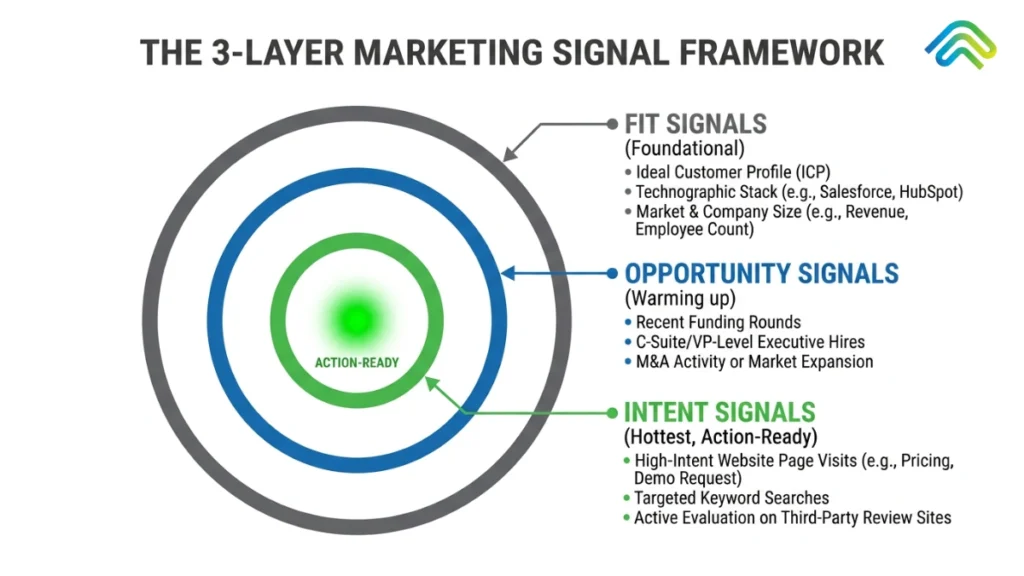
The 3-Layer Framework to Evaluate Buying Signals
Here are three-layered frameworks to help you evaluate buying signals.
Layer 1: Fit Signals
Fit signals tell you whether a company is a good match for your product in the first place. They don’t indicate buying intent, but they help you determine whether the account is worth focusing on. Below are the mentioned signals.
- ICP match
- Industry alignment
- Company size and revenue band
- Technology stack compatibility
Fit signals do not indicate intent. They indicate potential relevance.
Layer 2: Opportunity Signals
Opportunity signals indicate moments when a company is likely to have the budget, motivation, or internal pressure to make a purchase decision. These are external events that open a buying window, even if the prospect has not yet started actively researching.
- Funding announcements
- Leadership changes
- Expansion hiring in key departments
- M&A activity
- Competitor contract expirations
These signals often indicate budget availability or strategic readiness.
Layer 3: Intent Signals
Intent signals are the clearest sign that someone is actively researching and moving toward a decision. Unlike the other two layers (which fade quickly), speed matters most here.
- Pricing page visits
- Product comparison searches
- Case study downloads
- Review site activity (G2, etc.)
- Third-party intent data surges
These are the strongest indicators of purchase readiness.
Most teams track these layers independently. However, the real advantage comes from combining them and ensuring that each signal stack triggers a defined action. Without this, even strong signals remain unused.
Signal Stacking: Where Real Intent Appears?
A single signal rarely matters in isolation. Real buying intent appears when multiple signals combine.
- Fit + Opportunity + Intent = High probability deal
- Intent alone = curiosity
- Fit alone = potential account
When multiple stakeholders from the same account show signals at the same time, the likelihood of conversion increases significantly.
Signal Scoring Model:
To prioritize effectively, teams use a simple scoring model:
Signal Score = Depth × Frequency × Seniority × ICP Fit
This helps teams focus not just on activity volume, but on intent strength and deal readiness.
First-Party vs Third-Party Buyer Signals: What to Track?
First-party buying signals come from your own platforms, such as your website, CRM, and email. While third-party comes from external sources like intent tools and funding data. Knowing the difference helps you act on the right signal at the right time.
| Dimension | First-Party Signals | Third-Party Signals |
| Source | Your owned platforms (website, product, CRM, email). | External platforms and market intelligence tools. |
| What it shows | Direct engagement with your brand | Early-stage intent and market-level interest |
| Timing in the journey | Mid to late-stage intent | Early-stage discovery |
| Reliability | High (actual interaction) | Medium (intent inference) |
| Primary value | Conversion readiness | Opportunity discovery |
| Example signals | Pricing page visits, demo requests | Funding announcements, intent spikes |
First-Party Signals (Your Properties)
First-party signals come directly from your own systems and indicate real engagement with your brand. These are the most reliable signals because they reflect actual buyer interaction.
Key signals to track:
- Pricing page visits
- Demo requests or contact form submissions
- Content downloads (case studies, ROI guides)
- Email engagement (opens, clicks, replies)
- Product usage or feature adoption
These signals show how actively a buyer is evaluating your solution and are strong indicators of conversion readiness.
Third-Party Signals (External Sources)
Third-party signals come from external platforms and help you identify intent before a buyer engages with your brand. These are critical for early-stage discovery.
Key signals to monitor:
- Intent platforms like Bombora, G2, or 6sense
- Funding announcements or M&A activity
- Hiring trends in key departments
- Technology stack changes
These signals show market-level intent and help you identify opportunities before competitors do.
As an execution layer for the GTM stack, SpurIQ captures both first-party and third-party signals across the GTM stacks like; email, calendar, CRM, call recordings, and intent tools and turn them into executed actions rather than just dashboard alerts.
How to Respond to Buying Signals? (And Why Speed Kills)
Act on buying signals as soon as they appear. Every signal has a limited window during which it is most valuable and can be turned into a real opportunity. If you delay your response, the buyer’s interest can fade, or they may already move forward with another solution.
This limited time frame is called the signal decay window. It means that the longer you wait, the weaker the intent becomes. Responding quickly increases your chances of starting a meaningful conversation while the interest is still active, leading to higher conversion opportunities.
Signal Priority and Response SLAs
Not all signals are equal. High-performing teams prioritize signals based on urgency and respond accordingly.
| Tier | Signal Type | Decay Window | Response SLA |
| Tier 1 | Demo requests, pricing views, and champion job change | 24–48 hours | Within 2 hours |
| Tier 2 | Content engagement, website visits, and intent surges | 3–7 days | Within 24 hours |
| Tier 3 | Hiring signals, funding, tech changes | 2–4 weeks | Monitor + stack |
The math here is unforgiving. Responding to an inbound lead within 5 minutes makes you 21x more likely to qualify them. Meanwhile, 78% of buyers end up purchasing from the first vendor to respond, not necessarily the best one, the fastest one.
And here’s the uncomfortable truth sitting underneath both of those numbers: 73% of inbound leads never receive a first reply at all. Speed isn’t just a nice-to-have. It’s the game.
The Response Stack: From Signal to Action
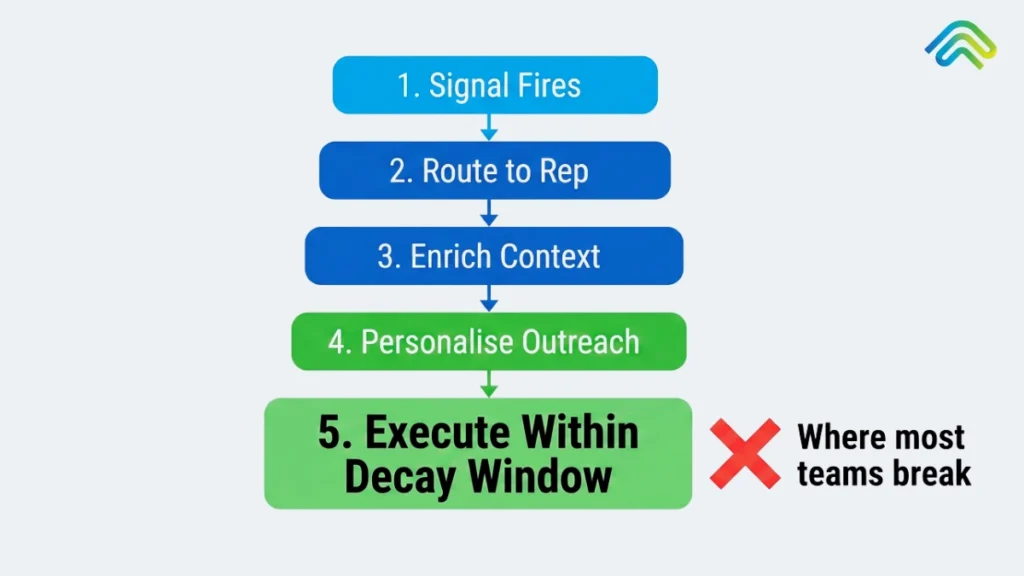
Knowing a signal fired is not the same as acting on it. High-performing GTM teams build a deliberate response stack that ensures no signal dies in a dashboard:
- Signal fires — intent data, engagement event, or behavioural trigger is detected across sources
- Route to the right rep — account ownership, territory rules, and deal stage determine who owns the response
- Enrich with buyer context — layer in firmographic data, persona fit, past interactions, and signal history before the rep touches the account
- Personalise outreach — the message references the specific signal, not a generic cadence template
- Execute within the decay window — every step above happens fast enough to matter
Most teams build steps one through four reasonably well. Step five is where the whole system collapses, because nobody ever built the routing rules, SLAs, or CRM integration to make the data actionable. The signal gets detected. It gets surfaced on a dashboard. Then it sits there while the rep works their existing pipeline, the decay window closes, and a competitor who responded first wins the meeting.
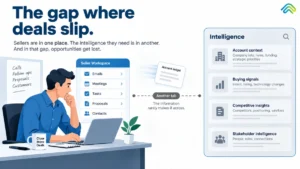
This is the signal-to-action gap and it’s the most expensive gap in the modern GTM stack. Most tools detect signals and surface them; the work of deciding what to do next and actually doing it still falls entirely on the rep. As a revenue execution platform SpurIQ closes that loop end-to-end, it detects the signal, determines the next best action, and executes it across your existing stack within minutes, not days. The difference isn’t intelligence. It’s activation.
Buying Signal Marketing Strategies: How B2B Sales and Marketing Align?
In modern B2B GTM systems, intent signals only convert when marketing and sales act on shared, real-time intelligence and not separate tools and timelines.
Marketing’s role: Create demand and capture engagement signals.
- Track content engagement (blogs, case studies, pricing pages)
- Flag high-intent behaviors like repeated visits or late-funnel downloads
- Launch campaigns by signal clustering, not just persona
- Pass signal-qualified accounts, not raw leads, to sales
Sales’ role: Convert captured intent into revenue, fast.
- Respond within the signal decay window
- Tailor outreach to actual buyer behavior
- Prioritize accounts showing multiple intent markers
- Align conversations with the buyer’s current journey stage
Marketing Generates Signals. Sales Acts on Them. The Gap Is Where Pipeline Leaks.
The division of labour makes sense on paper. Marketing owns top-of-funnel signals; content engagement, ad clicks, webinar attendance, website behaviour, third-party intent data. Sales owns the conversation.
But when those two functions operate in separate systems with separate metrics, you end up with a pipeline full of holes. Marketing sends MQLs that sales doesn’t trust. Sales ignores the queue and works their own list. The cycle repeats every quarter, and both teams quietly blame each other in the offsite.
The fix isn’t a weekly sync meeting. It’s a shared signal layer, a single source of truth where both teams are making decisions from the same data.
Signal-Based ABM: Letting Intent Drive the Air Cover
The most effective teams let intent signals determine which accounts get prioritised, not the other way around. When an account shows strong in-market behaviour, that’s a trigger for a full-funnel response: retargeting ads, personalised content, event invitations from marketing and an active sequence from sales. The account experiences your brand from multiple directions simultaneously, right when someone is quietly in buying mode.
Accounts showing weak or no signal don’t get the same resource allocation. You’re concentrating firepower where the data tells you the window is open. That’s what separates efficient pipeline from busy pipeline.
The Feedback Loop Nobody Builds (But Every Team Needs)
Marketing Needs Outcome Data. Sales Needs Signal Trust.
Signal-based alignment only compounds in value if both teams are learning from results, not just acting on inputs.
Marketing needs to know which signals actually converted to pipeline, not which ones generated clicks, but which ones preceded a meeting, an opportunity, a closed deal. That feedback changes how they prioritise channels, content, and the accounts they choose to activate.
Sales needs to trust marketing-sourced signals enough to act on them, and that trust only comes from seeing the data validate itself over time. When reps work a signal-sourced account and it closes, they remember it. When ten in a row go cold, they abandon the queue entirely.
The feedback loop is what calibrates signal quality over time and keeps both teams inside the system rather than around it.
SpurIQ sits at the intersection of marketing and sales signal data, unifying signals from CRM, email, calendar, and call recordings into a single execution engine that ensures both teams act on the same intelligence.
The Bottom Line
In conclusion, the real challenge in 2026 is no longer detecting buying signals. Every modern tool can do that. The challenge is what happens next. Between detection and action lies the real revenue gap, where opportunities are either captured or lost.
Winning teams are not those with the most data. They are the ones who act on every signal quickly, consistently, and with full context. Execution speed is what defines winners in modern B2B sales.
Are you acting on signals before they lose value?
If you want to close this gap and turn signals into real outcomes, explore how a revenue execution platform like SpurIQ helps teams move from insight to execution with consistency.
Frequently Asked Questions (FAQs):
Q. What are buying signals?
Buying signals are simple actions that show a person is interested in buying something. For example, they may visit your website, check your pricing, or look at your product details.
These actions help you understand who is serious, so you can reach out at the right time instead of waiting for them to contact you.
Q. What are examples of buying signals in sales?
Here are some examples of buying signals in sales:
– Pricing page visits
– Demo requests
– Case study or content downloads
– Product comparison searches
Q. How do you identify buying signals?
SpurIQ identify the buying signals by tracking how prospects interact with your brand and market over time. This includes analyzing behavior across three key layers:
– Fit signals (company relevance)
– Opportunity signals (timing and triggers)
– Intent signals (active research and engagement)
These signals are gathered from both first-party data and third-party sources to get a complete view of buyer behavior.
Q. What is the difference between buying signals and intent data?
Buying signals encompass all actions that indicate purchase intent at different stages of the journey. On the other hand, Intent data is a specific type of buying signal, usually collected from third-party sources that indicate research activity outside your direct platforms.
Q. How should you respond to buying signals?
Respond quickly with personalized outreach that aligns with the buyer’s intent and journey stage. The response should be timely, relevant, and aligned with the strength of the signal. As a Revenue execution platform, SpurIQ handles exactly this, detecting the signal, determining the right next action, and executing personalized outreach within minutes so your team never shows up late to a conversation that has already moved on.
Q. What is the signal-to-action gap?
It is the delay between identifying a buying signal and taking the right action on it. When this gap is too long, the opportunity loses value or is often missed completely. As an AI revenue action orchestration platform, SpurIQ is built specifically to close this gap, so the time between signal and action is measured in minutes, not missed opportunities.