Almost every “best outbound sales software” list on the first page of Google is written by a company that put itself at number one. Read enough of these guides and the pattern becomes obvious. The publisher’s own product tops the list, and every other tool gets measured against it. That’s not a buyer’s guide, that’s a sales page wearing a listicle’s clothes.
This guide is built differently. It’s organized by what each layer of the outbound stack actually does, not by which vendor paid for the placement. You’ll find honest picks across five layers most buyers already know, data and enrichment, sequencing and sending, deliverability, signals and intent, and CRM. Then there’s a sixth layer that almost no other list includes, and it’s the one where most outbound motions quietly break down.
The shift defining 2026 is a move from sending to orchestration. Buying a good sequencer is the easy part now. Making the whole motion run as one system, deciding who to contact and why right now, and keeping every tool talking to every other one, is the hard part. That’s the layer this guide names.
One thing upfront. I’ll tell you to buy Apollo if Apollo is what you need. This is Arush, and I’d rather earn your trust than rank myself first.
What is Outbound Sales Software (and Why “Software” is the Wrong Mental Model in 2026)
Outbound sales software is any tool that helps a team find, contact, and follow up with prospects proactively, rather than waiting for prospects to come to them. That covers a wide range of jobs. Sourcing verified contact data, building and running multi-channel cadences, protecting deliverability so messages land in an inbox instead of a spam folder, detecting who’s actually in-market right now, and logging all of that activity somewhere a manager can see it.
The mental model that trips up most buyers is treating this as one tool in the singular. It isn’t. It’s a stack of five to six layers, and no single outbound sales tools vendor covers all of them well. Buying one platform and expecting it to replace data, sending, deliverability, signals, and CRM in a single login is the most common reason outbound stacks underperform relative to what they cost.
There’s a cost reason this category exists in the first place. A single SDR’s fully loaded monthly cost, once base pay, benefits, tools, ramp time, and management overhead are counted, commonly lands between $85,000 $129,000 every year according to 2026 outsourced-SDR pricing data and SDR-to-AE ratio benchmarks, well above the base salary figure most budgets are built around. That gap between what an SDR costs on paper and what an SDR actually costs is exactly why buyers over-invest in tools, hoping software can quietly replace headcount. It rarely does on its own.
Understanding the six layers and what each one is actually responsible for is the starting point for building a stack that fits your team instead of one that just looks impressive in a demo.
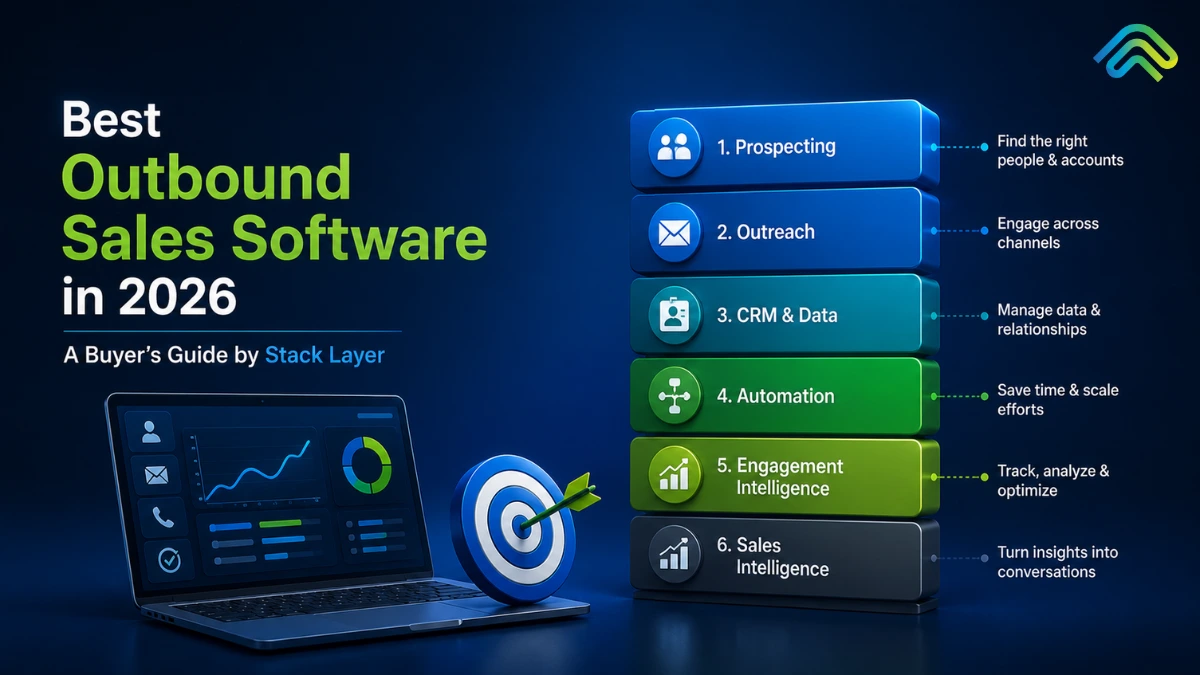
The 6 layers of the Modern Outbound Stack
Every mature outbound motion runs through six layers, whether a team has named them or not. Five of these are familiar to anyone who’s shopped for sales software before. The sixth almost never shows up on a vendor’s own list, for an obvious reason, it isn’t something any single vendor sells.
| Layer | What it does |
| 1. Data and enrichment | Collects, enriches, and verifies contact and company information while adding firmographic, technographic, and buying-intent data to help sales teams build accurate prospect lists. |
| 2. Sequencing and sending | Creates and manages multi-channel outreach sequences across email, LinkedIn, and phone, while automating follow-ups, scheduling, and response management. |
| 3. Deliverability infrastructure | Maintains email deliverability through inbox warm-up, authentication, inbox rotation, and sending limits, ensuring outreach reaches recipients’ inboxes instead of spam folders. |
| 4. Signal and intent | Identifies prospects who are actively in the market by monitoring buying signals such as funding announcements, hiring activity, job changes, website engagement, and online reviews. |
| 5. CRM and sync | Serves as the central source of truth by storing customer and prospect data, tracking deals and interactions, and synchronizing information across the entire sales technology stack. |
| 6. Orchestration and execution | Coordinates every layer of the outbound stack by determining who should be contacted, when outreach should happen, and which actions should be prioritized so every tool works together as a unified system. |
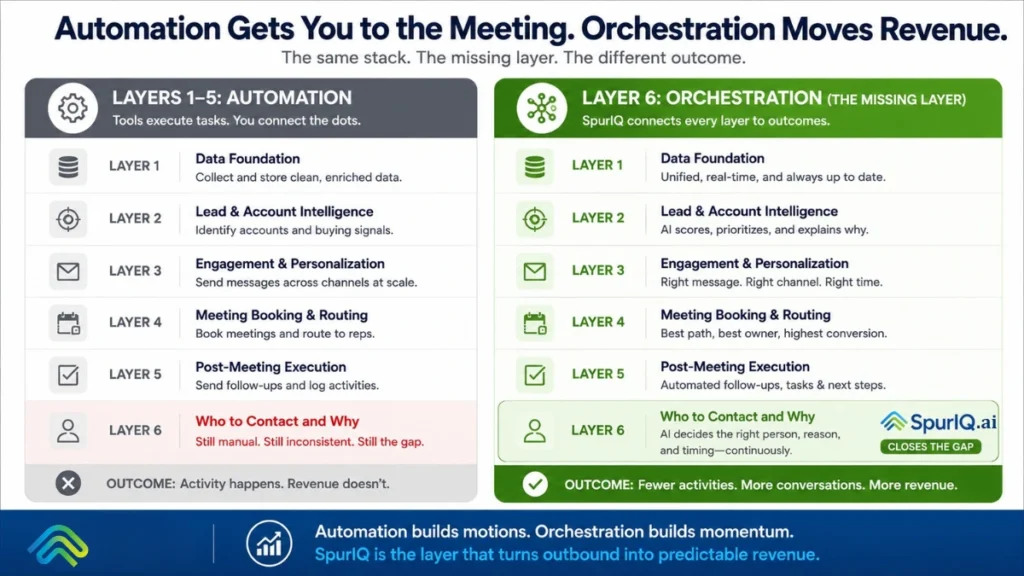
Layer 6 is worth sitting with, because it’s the one most “best software” lists skip entirely. The tools in layers 1 through 5 automate the mechanics of sending. What most of them don’t do is decide, in real time, which signal deserves action first, who gets contacted today versus next week, and what happens the moment a deal goes quiet.
Sales-engagement platform Unify has described this gap directly, framing legacy tools as built to automate sending, while deciding who to contact and why remains a manual, human judgment call at most companies. That distinction, between automating the send and orchestrating the decision, is the difference between a stack of tools and a stack that runs itself.
Best Outbound Sales Software by Layer
The best outbound sales stack isn’t built around a single platform. It’s a combination of tools that solve different parts of the outbound workflow. Below are our recommended tools for each layer, along with their strengths, ideal use cases, and limitations.
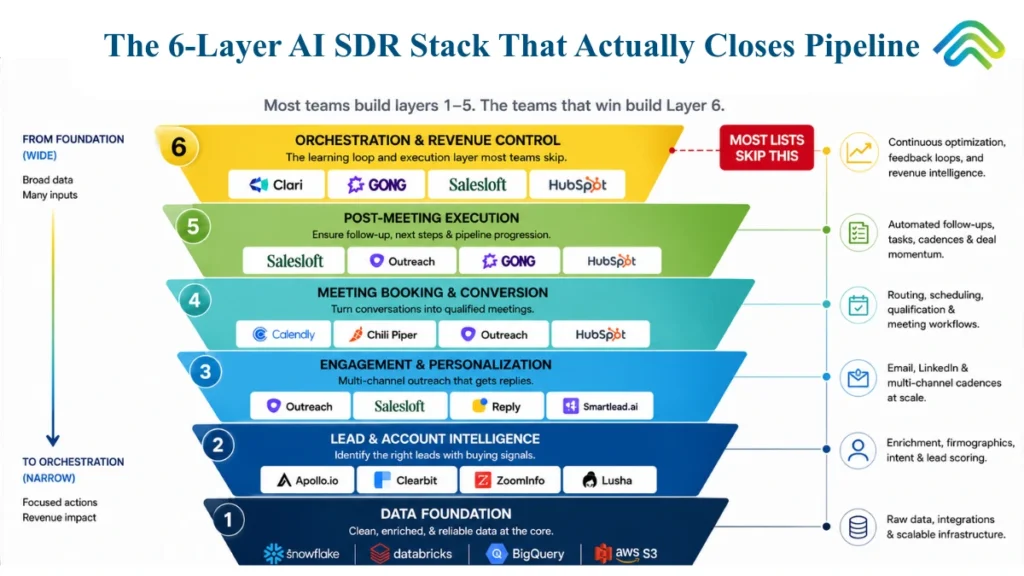
Layer 1: Data and Enrichment
1. Apollo
Apollo pairs a large searchable contact and company database with a native sequencer, so a smaller team can handle data and sending from one login. It’s best for earlier-stage teams that want data and sending together without stitching two platforms. The honest limitation, data accuracy varies noticeably by segment and geography, and the built-in sequencer is functional rather than best-in-class. Public pricing has historically run roughly $49 to $99 per user monthly, worth confirming directly since packaging changes often.
2. ZoomInfo
ZoomInfo offers some of the deepest enterprise-grade data available in this category, layered with intent data and a broader GTM workspace. It’s best for enterprise teams that need wide coverage and direct-dial accuracy. The honest limitation, it’s expensive, typically sold on annual contracts, and pricing isn’t published, so budgeting requires a sales conversation.
3. Clay
Clay orchestrates enrichment across 50-plus data sources and layers in AI-assisted research, which makes it a favorite for teams building signal-driven, highly personalized prospect lists at scale. The honest limitation, it has a genuinely steep learning curve, closer to a build-it-yourself power tool than a plug-and-play platform. Pricing is credit-based and scales with usage.
4. Cognism
Cognism specializes in phone-verified mobile data and is particularly strong across the UK and EU. It’s best for teams prospecting European markets or that need verified direct dials for senior contacts. The honest limitation, its US coverage is noticeably thinner than ZoomInfo’s. Pricing is custom and quote-based.
Layer 2: Sequencing, Sending, and Dialing
This layer is also where outbound sales automation does its most visible work, running cadences across channels without a rep manually triggering each touch.
5. Outreach and Salesloft
Outreach and Salesloft are the established enterprise sales-engagement platforms, combining cadences, a built-in dialer, and conversation intelligence in one system. Best for larger AE and SDR organizations that need all of that under one roof. The honest limitation, both are heavy and expensive, and often overkill for a small team. At a full-stack tier, pricing has historically run toward $800 to $1,000 or more per user monthly, a figure worth confirming directly given how often enterprise packaging shifts.
6. Instantly and Smartlead
Built for high-volume cold email with deliverability infrastructure, warmup, inbox rotation, unlimited inbox connections, built in rather than bolted on. Best for volume outbound and agencies managing multiple client sends. The honest limitation, they’re email-first and noticeably thinner on multichannel sequencing and native data. Entry tiers have run from roughly $30 to $100-plus monthly depending on volume.
7. Lemlist
Leans into personalization-first multichannel outreach, email, LinkedIn, calls, and dynamic image or video personalization. Best for founders and small teams testing messaging before scaling volume. The honest limitation, it’s less suited to enterprise-scale sending. Plans have started from around $39 monthly.
A quick note on dialers, since this is a real, separate sub-decision inside this layer. The outbound dialing software benefits for sales teams worth weighing are connect rate and rep talk-time per hour, not just raw call volume. Look for local presence dialing, power or parallel dialing, automatic call logging, and voicemail drop. Whether a dedicated dialer earns its line item depends on whether average deal size and sales motion genuinely justify the phone as a primary channel, rather than a supporting one.
Layer 3: Deliverability Infrastructure
Instantly and Smartlead show up again in this layer, since deliverability infrastructure and sending increasingly live in the same product. Native warmup pools, per-inbox send caps, and sender rotation across domains are table stakes now, not a nice-to-have.
What to look for in this layer, regardless of vendor, native warmup backed by a real engagement pool, unlimited inbox connections, configurable per-inbox send caps, SPF, DKIM, and DMARC validation, and inbox-level analytics so a team can isolate which specific mailbox is dragging performance down.
This layer matters more than it used to for a documented reason. Google and Yahoo began enforcing bulk sender authentication requirements, SPF, DKIM, and DMARC alignment, plus one-click unsubscribe, on February 1, 2024, and enforcement has tightened steadily since, moving from temporary deferrals to outright rejections for non-compliant senders. Google recommends keeping spam complaint rates below 0.1%, with 0.3% as the hard enforcement ceiling. Skipping this layer doesn’t just hurt open rates anymore, it can get a domain blocked outright.
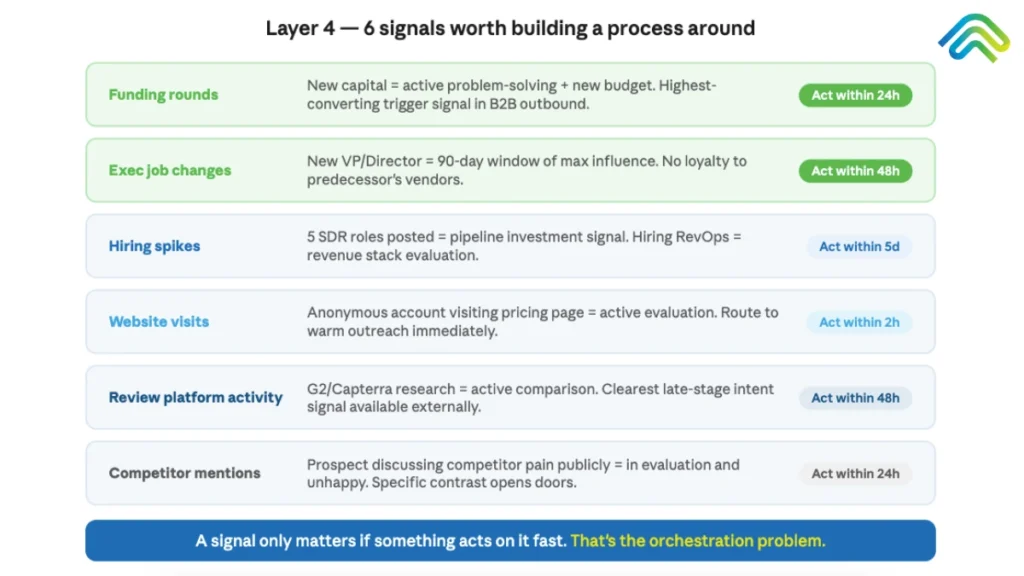
Layer 4: Signal and Intent
Signal and intent tools identify buying signals and intent data that help sales teams reach prospects when they are most likely to engage.
8. Clay
Clay also lives here, since it pulls and acts on trigger signals, funding events, hiring changes, tech-stack shifts, inside the same enrichment flow described above.
9. 6sense and Bombora
6sense and Bombora specialize in third-party intent data, surfacing which accounts are actively researching a category right now. Best for ABM and demand-gen alignment work.
The honest limitation, intent is directional; it signals interest, not a guarantee that an account is ready to buy.
The signals worth building a process around are funding announcements, hiring spikes, executive job changes, website visits, review-platform activity, and competitor mentions. None of these signals matter on its own. A signal only matters if something acts on it fast, which is exactly the problem the sixth layer exists to solve.
Layer 5: CRM and sync
A CRM provides the operational backbone of an outbound stack by centralizing customer data and keeping sales activities synchronized across every tool.
10. HubSpot
HubSpot is the default choice for SMB and mid-market teams, usable out of the box, with strong automation and a wide app ecosystem.
11. Salesforce
Salesforce is the enterprise standard, effectively infinitely customizable and built to serve as the system of record at real scale.
The real problem in this layer isn’t picking between these two. A CRM is only as good as what actually gets logged into it, and manual CRM updates are where most outbound data quietly goes stale. That’s not a CRM problem either; it’s the same layer-6 problem showing up again.
The Missing Layer in Most Outbound Stacks: Orchestration and Execution
Most outbound teams invest in the right tools, data providers, sequencing platforms, deliverability solutions, intent signals, and CRMs. Yet many still struggle to generate consistent pipelines because the tools don’t work together as one coordinated system.
The real challenge isn’t buying software. It’s deciding who to contact, when to reach out, how to act on buying signals before they go cold, and keeping the CRM updated. This orchestration layer is often handled manually, making it difficult to scale efficiently.
There are two ways to solve this problem:
- Hire a GTM engineer to integrate and manage the entire outbound stack. While effective, this approach is expensive, hard to hire for, and difficult to retain.
- Use a managed execution platform that sits on top of your existing tools and automates outbound execution.
SpurIQ acts as the revenue execution platform for your outbound stack. Instead of replacing your existing tools, it works alongside platforms like Apollo, HubSpot, Salesforce, LinkedIn, and Instantly to coordinate and execute outbound workflows.
Its Lead IQ Create module is designed to automate pipeline creation through three key workflows:
- Lookalike and Signal-Based Outbound: Identifies high-fit prospects using your ICP and real-time buying signals, then enriches and prepares them for outreach.
- Website Visitor Identification: Converts anonymous website visitors into identifiable, outreach-ready accounts while buying intent is still high.
- LinkedIn Intent Outbound: Turns engagement with your company’s or founders’ LinkedIn content into timely, personalized outreach.
Instead of managing multiple disconnected tools, teams get a unified outbound motion that runs as one system. The result is faster pipeline creation, less manual work, and agency-level execution without hiring an agency or building an in-house GTM engineering team.
What a Real Outbound Stack Actually Costs
Software line items rarely tell the whole story, so here’s a directional picture of what a real stack costs at each stage. Treat the ranges below as a planning starting point pulled from public vendor pricing and industry cost breakdowns, not a precise, independently audited benchmark, since exact totals shift with team size, negotiated terms, and usage.
| Stack Tier | Estimated Cost (Per User/Month) | Typical Tech Stack |
| Starter (Founder or SMB) | $150–350 | Prospect database, email outreach platform, and a starter CRM. |
| Mid-Market | $315–700 | Everything in the starter stack, plus sales intelligence, conversation analytics, and intent data. |
| Enterprise | $800–1,000+ | Enterprise-grade data platform, sales engagement software, conversation intelligence, and advanced data packages. |
None of these tiers includes the cost that actually explains most underperforming stacks, the hidden cost of operating them. Either reps spend real hours running the stack themselves, hours pulled directly from the $85,000 $129,000 every year a fully loaded SDR already costs, or a company hires a GTM engineer to wire and maintain it, a role that’s scarce and expensive to retain. That operating cost is the real line item every software pricing page leaves off, and it’s exactly what a managed execution layer is built to absorb.
How to Choose the Right Outbound Sales Stack by Team Stage
The right outbound sales stack depends on your team’s stage. What works for a founder-led startup may be excessive for a growing sales team or enterprise. Use this framework to invest in the tools you need today while avoiding costly mistakes that slow growth.
| Team Stage | Recommended Stack | Common Mistake to Avoid |
| Founder-Led (Pre-SDR) | Lightweight prospect data, an email outreach platform, a simple CRM, and a managed execution layer. | Buying enterprise-grade tools too early and paying for features or seats that go unused. |
| 1–5 SDRs | Data provider, sales sequencer, deliverability tools, intent data, and an orchestration layer. | Managing multiple disconnected tools without proper integrations or workflows. |
| Scaling or Enterprise | A complete outbound stack with a clear build, buy, or managed execution strategy for orchestration. | Assuming one GTM engineer can manage the entire outbound ecosystem without ongoing support. |
For a founder-led team specifically, this is where outbound sales software for small business decisions tends to go wrong twice. First, buying the enterprise-tier version of every layer before there’s a team large enough to justify it, which mostly buys seats that sit empty. Second, assuming a single well-priced tool can replace the judgment a rep or a founder is currently providing, when what’s actually missing is the orchestration layer connecting the tools already in place.
The math worth keeping in view here is cost per meeting held, not cost per seat. A cheaper stack nobody operates consistently ends up costing more, measured in missed pipeline, than a slightly pricier one that actually runs.
The Tool is the Easy Part
The idea running through this whole guide is a simple one. Choosing tools is the easy part. Operating them, consistently, across every layer, at the moment a signal actually appears, is what breaks most teams. The 2026 winners in this category won’t be the teams with the sharpest sequencer. They’ll be the teams that solved the orchestration layer, whichever way they chose to solve it.
For more on the broader motion this guide sits inside, see our outbound sales guide and our breakdown of outbound sales strategy. And if the sixth layer described here sounds like the gap in your own stack, you can see how SpurIQ handles it in a 10-minute walkthrough.
Frequently Asked Questions (FAQs):
Q. Do You Need Multiple Tools or One Platform?
No single platform excels across every outbound function. Most sales teams rely on three to four specialized tools that integrate with one another. The real priority isn’t minimizing the number of tools but ensuring they operate as a unified outbound system.
A typical outbound stack includes:
A prospect data provider
A sequencing platform
Deliverability tools
A CRM
Intent data or orchestration, depending on team maturity
Q. What Does a Full Outbound Sales Stack Cost?
The cost of an outbound sales stack varies based on team size and business needs. Public pricing suggests that founder-led teams can start with a relatively lean setup, while larger organizations require more advanced capabilities.
Estimated monthly cost per user:
Founder-led teams: $150–$350
Mid-market teams: $315–$700
Enterprise teams: $800–$1,000+
These estimates are based on publicly available pricing and do not include the operational cost of managing the stack.
Q. What’s the Difference Between a Sequencer and an Orchestration Layer?
A sequencer automates outreach after prospects have been added to a campaign. An orchestration layer goes a step further by identifying who should be contacted, responding to buying signals in real time, and keeping every tool in the stack synchronized.
Key differences:
Sequencer: Builds and automates email or call sequences.
Orchestration layer: Selects prospects, triggers outreach, updates systems, and coordinates the entire outbound workflow.
Q. Can AI Run Outbound Sales End to End?
AI can automate many outbound tasks, but it isn’t a complete replacement for human sales teams, especially in complex B2B environments.
Today, AI is best suited for:
Prospect research
Data enrichment
Personalization
Sequence creation
Outreach automation
Humans remain essential for:
Qualification
Objection handling
Relationship building
Complex deal management
Q. What’s the Best AI Outbound Sales Software for a Small B2B Team?
The ideal stack for a small team focuses on simplicity, affordability, and ease of execution instead of enterprise-level complexity.
A practical setup includes:
A lightweight prospect database
An email platform with built-in deliverability
A simple CRM
A managed execution or orchestration layer to reduce manual work
Q. What are the Benefits of Outbound Dialing Software?
Outbound dialing software helps sales teams spend more time talking to prospects and less time managing calls manually. Modern dialers improve productivity without simply increasing call volume.
Key benefits include:
Higher connect rates
More conversations per hour
Local presence dialing
Power or parallel dialing
Automatic call logging
Voicemail drop for faster follow-up