Every sales floor runs on the same unspoken rule, and that is inbound leads are worth chasing, and outbound leads are a gamble. So teams lean on hand-raisers, let outbound sit on the back burner, and still fall short at quarter close, wondering why the “good” leads aren’t converting fast enough.
That’s the myth costing you your pipeline. The data doesn’t back it up.
The real question in the inbound vs outbound leads debate was never which lead type is easier to work with. It’s which one drives more pipeline for a company like yours? What matters most is how efficiently each lead generates revenue by balancing cost, conversion, deal value, and sales velocity, not the source of the lead.
Deciding which sales motion to run? That’s a resourcing question, answered in our inbound vs outbound sales piece. Ready to execute outbound? Our outbound lead generation framework covers the how. This piece stays on lead quality.
Let’s break down the data behind inbound vs outbound lead generation, debunk the biggest misconceptions, and explore how leading teams maximize every lead instead of letting valuable opportunities slip away.
Inbound Leads vs Outbound Leads: The Real Difference
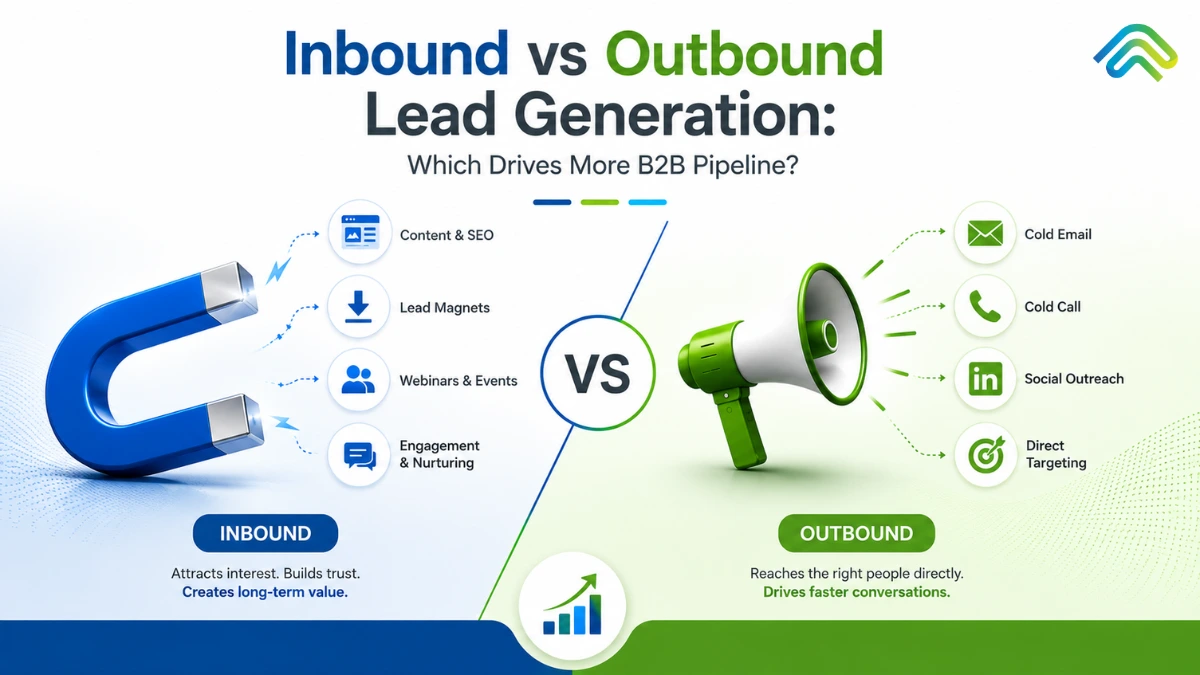
An inbound lead reaches out first, usually after discovering your business through search, content, referrals, social media, or events. These prospects often have some awareness of their problem and are actively looking for a solution.
An outbound lead is identified and contacted by your sales team through channels like email, LinkedIn, phone calls, or account-based outreach. These prospects typically start as cold or lukewarm leads, depending on how closely they match your ideal customer profile (ICP) and buying signals.
The real difference isn’t quality
The biggest difference between inbound and outbound leads isn’t quality. It’s how the relationship begins.
- Inbound leads initiate the conversation.
- Outbound leads are approached by your team.
The entry point is different, but that doesn’t determine lead quality.
The misconception worth dropping
A common misconception is that inbound leads are automatically more valuable. In reality, lead quality depends far more on ICP fit, buying intent, and sales readiness than on where the lead came from.
- A form submission from someone outside your target market may never convert.
- A carefully targeted outbound prospect can become a high-value customer after the right outreach.
What actually matters
The real comparison isn’t inbound vs outbound leads. It’s how much each channel costs to acquire, how efficiently it converts, and the revenue it generates over time. Those metrics reveal which approach delivers the strongest business impact.
The Lead Economics: Inbound vs Outbound Lead
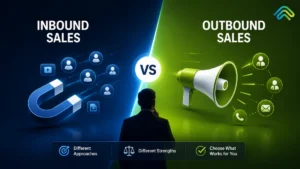
Inbound vs outbound lead generation follows different economic models, each with its own strengths and trade-offs. The comparison below shows how inbound vs outbound leads differ across the metrics that have the biggest impact on pipeline growth and revenue generation. Let’s discuss:
| Comparison Factor | Inbound Sales | Outbound Sales |
| Cost per Lead | In the inbound lead vs outbound comparison, inbound sales generally deliver a 60–62% lower cost per lead because content, SEO, and organic marketing continue generating demand over time. | Outbound sales usually have a higher cost per lead since every campaign requires continuous investment in SDRs, prospecting tools, and outreach efforts. |
| Lead Volume | Once established, inbound sales can generate around three times more leads because organic content and search traffic compound over time. | Outbound lead volume depends on the number of accounts your team actively targets, making growth directly tied to sales capacity and outreach efforts. |
| Conversion Rate | SEO-driven inbound leads typically achieve around a 14.6% close rate, making them more likely to convert because prospects have already shown intent. | Cold outbound campaigns generally convert at around 1.7–3% at the top of the funnel, as prospects are contacted before expressing buying intent. |
| Time to Build Pipeline | Inbound sales usually require three to six months before producing a consistent pipeline, as content and SEO need time to gain visibility and authority. | Outbound sales can start generating meetings within the first week of a campaign, making it the faster option for immediate pipeline creation. |
| Average Deal Size (ACV) | Inbound attracts buyers who discover your business organically, so average contract values may vary depending on who enters the funnel. | Outbound often delivers higher average contract values (ACV) because sales teams intentionally target high-value accounts that match their ideal customer profile. |
| Control Over Pipeline | Inbound offers less control because lead generation depends on search demand, content performance, and market interest. | Outbound provides greater control since sales teams decide exactly which companies and decision-makers to approach. |
| Pipeline Predictability | Inbound pipeline growth is influenced by external factors such as search trends, competition, and buyer behavior, making it less predictable. | The outbound pipeline is more predictable because pipeline generation closely follows the volume and consistency of sales outreach activities. |
| Pipeline Growth Over Time | Inbound creates a long-term, compounding pipeline that continues to grow as content assets accumulate and organic visibility increases. | Outbound generates a targeted, short-term pipeline that delivers faster results but requires ongoing investment to maintain momentum. |
| Best Use Case | Inbound is ideal for businesses focused on sustainable growth, long-term demand generation, and reducing customer acquisition costs over time. | Outbound is best suited for companies that need a qualified pipeline quickly, target specific accounts, or want predictable revenue generation in the short term. |
The Myth That Ruins Lead Strategy: “Inbound Good, Outbound Bad”
Most sales teams operate on an unspoken rule that inbound leads are worth pursuing, while outbound leads are a gamble. It sounds reasonable at first because inbound prospects found you. However, the data tells a different story.
The reality is that a well-targeted cold email can outperform a warm lead that was never a good fit to begin with, proving that the inbound lead vs outbound debate is really about fit rather than source. The deciding factor isn’t the channel a lead comes from. It’s how well that lead matches your ideal customer profile.
What the numbers actually show about inbound vs outbound leads:
- Well-targeted cold outbound to your ICP converts 30 to 50% higher than semi-warm leads with weak fit.
- Some analyses put that gap even wider: outbound beating inbound by as much as 34% when the ICP match is strong.
Meanwhile, inbound has a quiet problem: volume hides quality. A whitepaper download from a company that will never buy from you isn’t a lead. It’s a form-fill wearing a lead’s clothes.
So what actually separates a good lead from a good-looking one?
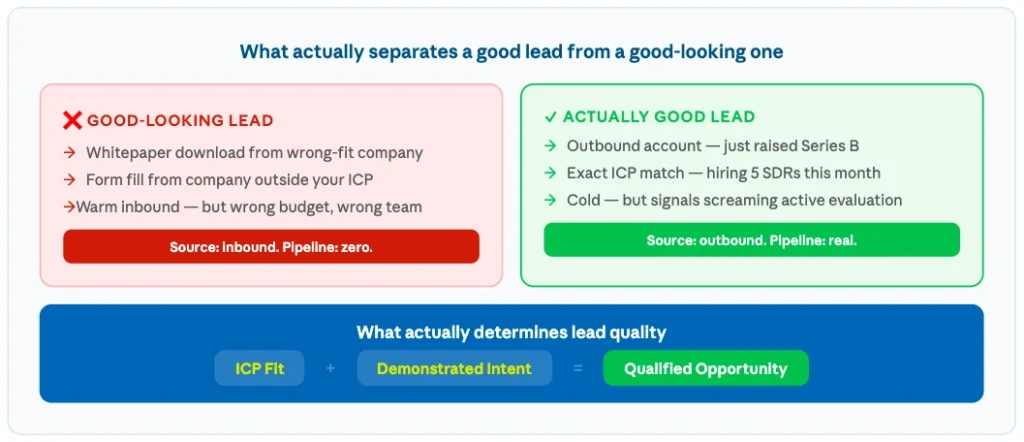
Not the channel it came through. Two things, and two things only:
- ICP fit. Does this account look like your best customers?
- Demonstrated intent. Are they showing signs they’re ready to act?
An outbound account that just triggered a funding round and matches your ideal customer profile is worth more than an inbound download from a company that was never going to close. Same logic, opposite channels.
Stop sorting inbound vs outbound leads by where they came from. Instead, sort them by fit and intent first, and let that determine how you work them. That’s the split we’ll break down next.
Also Read: Outbound Sales Strategy: 7 Proven Plays That Actually Work in 2026
Prospecting Outbound Leads vs Qualifying Inbound Leads
In the inbound vs outbound lead generation process, these leads don’t just enter the funnel differently; they also need to be worked differently from the very first touch.
| Comparison Factor | Inbound Sales | Outbound Sales |
| Buyer Intent | Inbound prospects already have buying intent because they have actively expressed interest in your product or service. | Outbound prospects may match your ideal customer profile, but they often have little or no awareness of the problem your solution addresses. |
| Primary Goal | The primary goal is to confirm that the lead is a good fit and quickly connect them with the right sales representative before their interest declines. | The primary goal is to create awareness, build interest, and gradually generate demand through strategic outreach. |
| Sales Approach | Inbound sales rely on responding quickly, qualifying leads accurately, and routing them to the appropriate representative without unnecessary delays. | Outbound sales rely on signal-led targeting, personalized messaging, and well-planned outreach sequences to engage potential buyers. |
| Key Success Factor | Success depends on speed to lead within minutes and on ensuring they are properly qualified before entering the sales pipeline. | Success depends on maintaining consistent follow-ups and delivering value across multiple touchpoints to build trust and interest. |
| Biggest Challenge | The biggest challenge is that slow follow-ups or weak qualification can cause highly interested prospects to lose interest before speaking with sales. | The biggest challenge is that most prospects do not convert after the first few interactions, making persistence and long-term nurturing essential for success. |
For a detailed strategy on building high-converting outreach campaigns, read our guide to Outbound Lead Generation.
The mistake that kills both motions: flattening them into one process.
- Drop a hand-raiser into a slow, multi-touch outbound sequence, and you’ve wasted the exact urgency they showed up with.
- Treat a cold outbound account like it’s already warm, skip the education, push straight to a pitch, and you’ll burn rep time on a deal that was never ready.
Prospecting outbound leads vs qualifying inbound leads demands different first steps, but both approaches share the same objective of converting qualified opportunities into revenue.
Which Drives More Pipeline by Stage, ACV, and Market
Inbound and outbound don’t perform equally in every business scenario. Their effectiveness changes based on where your company is in its growth journey, the value of your deals, the maturity of your market, and your revenue goals. Understanding these factors helps you choose the right inbound vs outbound lead generation strategy for your business.
| Factors | Favors Outbound | Favors Inbound |
| Company Stage | Early-stage companies usually depend more on outbound because buyers are not actively searching for a category they do not yet recognize. | Established companies benefit more from inbound because search demand already exists and buyers are looking for solutions. |
| Deal Size (ACV) | High ACV deals ($25K-$50K+) often justify targeted outbound because the revenue per account supports the cost of personalized outreach. | Lower ACV or volume-driven models usually see better economics from inbound, where content and search can generate leads at scale. |
| Time Horizon | If the goal is immediate pipeline, outbound is the faster lever because campaigns can be launched quickly and results are measurable within a quarter. | If the goal is a long-term growth engine, inbound becomes the stronger investment because content, SEO, and brand authority compound over 12-24 months. |
| Market Maturity | New or undefined categories need outbound first to create awareness and educate the market. | Mature categories reward inbound because buyers already know the problem and are actively searching for solutions. |
For most B2B companies under roughly $10M ARR, outbound tends to generate the most measurable near-term pipeline, while inbound gradually becomes the larger share of pipeline as search visibility and brand demand compound. The key insight is that this is not a winner-take-all decision. The highest-performing GTM teams use both channels in the right proportion and ensure that neither inbound leads nor outbound opportunities leak out of the funnel through slow follow-up or poor execution.
Where Both Lead Types Leak, and How the Best Teams Plug It
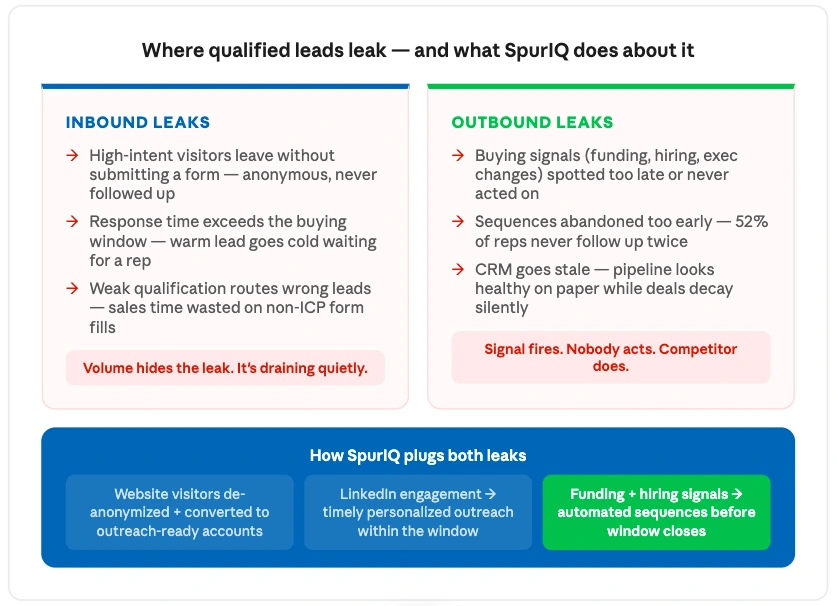
The biggest challenge isn’t choosing between inbound vs outbound leads. It’s preventing qualified leads from slipping through the cracks. Both inbound vs outbound leads generate valuable opportunities, but many are lost because of slow follow-ups, missed buying signals, or poor routing.
Common Pipeline Leaks
- Inbound: High-intent website visitors often leave without submitting a form, remaining anonymous.
- Outbound: Buying signals like funding, hiring, or leadership changes frequently go unnoticed or aren’t acted on quickly.
- Execution: Delayed follow-ups and weak lead qualification reduce conversion rates across both channels.
How SpurIQ Solves It
SpurIQ helps revenue teams capture and act on high-fit leads by automating workflows across HubSpot, Salesforce, Gmail, LinkedIn, and other GTM tools. Its LeadIQ workflows help teams:
- Identify anonymous website visitors and convert them into sales-ready accounts.
- Turn LinkedIn engagement into timely, personalized outreach.
- Act on buying signals like funding and hiring with automated outbound sequences.
The result is fewer lost opportunities, faster follow-ups, and more qualified pipeline from both inbound and outbound efforts.
Want to see where high-fit leads are leaking across your own funnel? Book a 10-minute walkthrough.
Final Words
After comparing inbound vs outbound leads across cost, quality, and pipeline impact, one conclusion stands out. The source of a lead matters less than what you do with it. The best leads are those that match your ICP, demonstrate buying intent, and receive timely follow-up.
If you had to summarize the inbound vs outbound lead debate in one sentence, here’s the answer. Outbound tends to drive more near-term, targeted pipelines. Inbound tends to drive a more durable, compounding pipeline. Which one wins for your business depends on stage, ACV, and how fast you need results, but only if both lead types actually get acted on rather than left to leak away.
If you’re deciding between inbound vs outbound lead generation, start here. If you’re ready to execute outbound, let’s walk through it step by step outbound lead generation strategies. And if you want help making sure neither lead type slips through the cracks, book a walkthrough with SpurIQ.
Frequently Asked Questions:
Q1. What’s the difference between an inbound and an outbound lead?
An inbound lead discovers your business through channels such as search, content, referrals, or events and usually has some awareness of their problem before reaching out. In contrast, an outbound lead is proactively identified and contacted by your sales team through channels like email, LinkedIn, or cold calls, often starting with little or no buying intent.
Q2. Are inbound leads always higher quality than outbound leads?
Not necessarily. Lead quality depends more on how well a prospect matches your ideal customer profile (ICP) and their buying intent than on the acquisition channel itself.
High-quality leads typically have:
- A strong fit with your ICP.
- Clear buying signals or genuine interest.
- A higher likelihood of converting into customers.
Q3. Which drives more B2B pipeline: inbound or outbound?
The answer depends on your company’s growth stage and objectives.
- Outbound is generally better for generating targeted, short-term pipeline.
- Inbound is more effective for building a scalable, long-term pipeline that compounds over time.
Q4. Do outbound leads take longer to convert?
Individual outbound leads often require more nurturing because they start with lower awareness. However, outbound campaigns can begin generating pipeline within days, while inbound strategies such as SEO and content marketing typically take three to six months to reach meaningful scale.
Q5. Which approach is better for early-stage B2B companies?
For most early-stage businesses, outbound is the faster path to pipeline because there is little existing search demand to capture. At the same time, investing in inbound helps build a sustainable demand generation engine for long-term growth.
Q6. Can inbound and outbound influence the same deal?
Yes. Many B2B buyers interact with both channels before making a purchase decision. For example, a prospect may discover your content through inbound marketing and later convert after receiving a well-timed outbound message. Tracking both touchpoints provides a more accurate view of pipeline attribution.
Q7. How can I improve inbound lead quality?
To increase inbound lead quality, focus on improving both targeting and follow-up.
- Refine your ideal customer profile (ICP) and qualification criteria.
- Collect relevant information through forms and gated content.
- Route qualified leads to sales representatives within minutes.
- Filter out low-fit inquiries before they enter the sales pipeline.