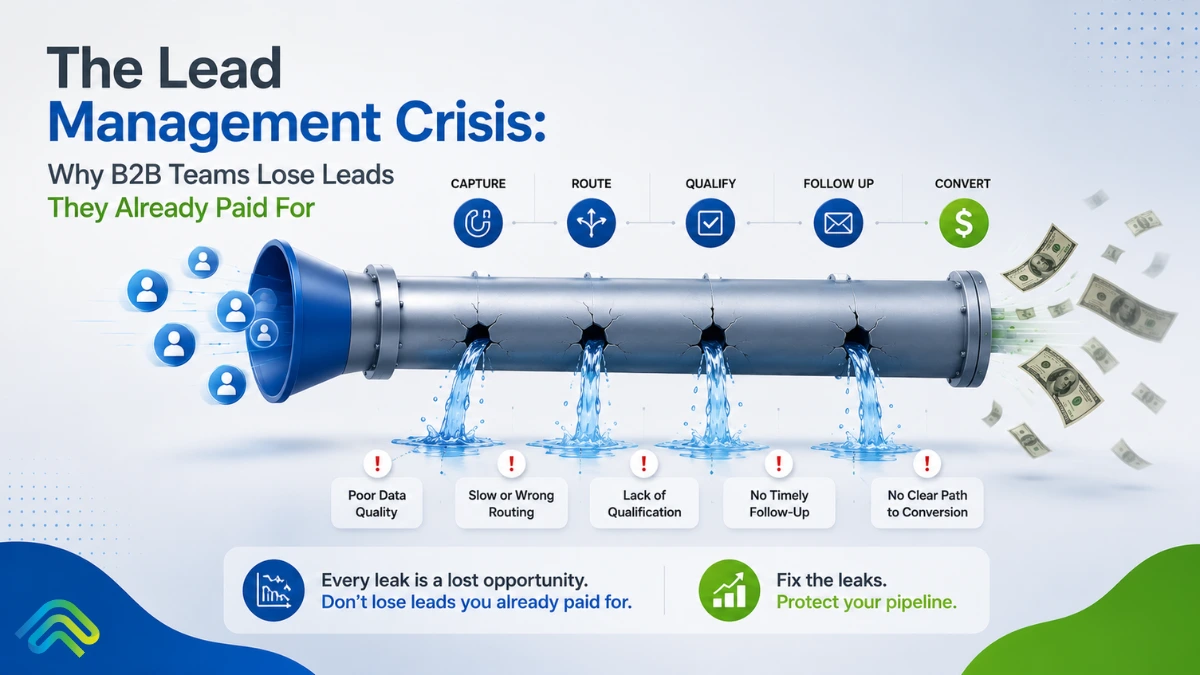
You are spending more on demand generation than you were a year ago. The leads are still coming in on schedule. Yet the pipeline refuses to move. The natural response kicks in fast: buy more leads, launch another campaign, bolt on one more channel. That instinct is the trap, because the problem was never how many leads you were generating in the first place.
Most B2B teams don’t actually have a lead generation problem. What they have is a B2B lead management problem, or more precisely, a lead-loss problem caused by gaps in the lead management process. The leads are already there, and you’ve already paid to acquire them. The problem is that they slip through a broken lead lifecycle before anyone can act, weakening the pipeline over time. By the time anyone notices, all that’s left is a pipeline number that refuses to move, no matter how much fresh spend you pour in at the top.
Here’s the idea the rest of this article builds on. Every lead you lose costs you twice. Once when you acquired it. Again, through a higher cost per acquisition, when you have to replace it. That second cost never shows up on a dashboard, which is exactly why it keeps repeating quarter after quarter, unfixed.
Ahead, we’ll break down exactly where leads fall out of the lifecycle, the leak nobody tracks, why it persists even at teams running a full CRM and marketing stack, and how to finally stop paying twice for the same pipeline.
The Hidden Price of a Broken Lead Lifecycle
Most founders think losing leads only affects conversions. In reality, it affects your customer acquisition cost (CAC) too.
Here’s a simple example. Imagine your business generates 100 leads this quarter. If 40 of those leads never receive a follow-up, are routed to the wrong person, or drop out before anyone qualifies them, you have not just lost 40 leads. To achieve the same number of qualified opportunities you originally expected, you now need to generate around 67 additional leads. Even though your marketing campaigns are performing the same way, your effective CAC has gone up because you’re paying to replace leads you already had.
That is why every lost lead costs you twice.
- First, you lose the money you already spent to acquire that lead.
- Second, you spend even more money to replace it and recover the pipeline you expected in the first place.
As customer acquisition costs continue to rise across industries, this hidden expense grows quarter after quarter. Yet very few companies actively measure it.
The biggest challenge is that you never see this cost as a separate line item in your reports. There is no “leads lost” section in your profit and loss statement. Instead, you notice the symptoms:
- Your CAC keeps increasing.
- Your sales cycle and payback period become longer.
- Your team asks for a larger marketing budget just to achieve the same pipeline targets.
This is what SpurIQ calls the signal to action gap. Businesses already have valuable buying signals, from website visits and form submissions to repeat engagement and marketing-qualified leads. The problem isn’t a lack of information. It’s that nobody acts on those signals before they go cold.
If you want to understand the full financial impact of these hidden losses across your entire revenue engine, our guide on revenue leakage breaks it down in detail. Here, we’ll stay focused on the operational side, showing exactly where leads slip through the lifecycle and why those losses keep happening.
Where Leads Actually Fall Out: The Lead Lifecycle, Leak by Leak
Most B2B teams lose leads through a series of small breakdowns throughout the lead lifecycle rather than a single major mistake. Understanding why B2B teams lose leads is the first step toward improving your lead management process. Each stage quietly chips away at the pipeline you’ve already paid to build. By the time those losses add up, your pipeline looks weaker even though lead generation hasn’t slowed down.
Think of these five stages as the foundation of an effective lead management process. Identifying and fixing the leak at each stage is one of the most important lead management best practices for improving conversions.
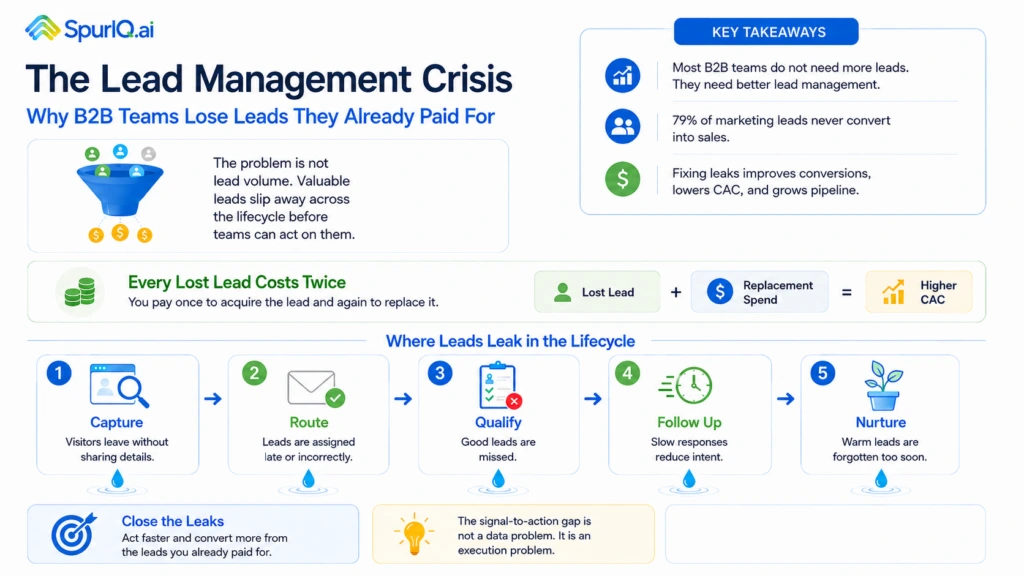
Stage 1: Capture (The Leak Nobody Counts)
Most businesses start measuring lead loss only after a lead enters the CRM. However, the biggest leak often happens much earlier.
Imagine an ideal customer visiting your pricing page, reading a case study, checking your integrations, and then leaving without filling out a form. You paid to bring that visitor to your website, but they never became a known lead. There is no contact record, no email address, and nothing for your sales team to follow up on.
This is the largest and most overlooked leak in the entire lifecycle. Unlike other leaks, it never appears in your CRM or reports because the lead was never captured in the first place. You only discover it when you actively look for anonymous buying intent.
Stage 2: Route (The Form Submission Cliff)
Capturing a lead is only the beginning. What happens next determines whether that lead moves forward or slips away.
Around 30–40% of leads are lost soon after submitting a form because they are routed slowly, assigned to the wrong person, or never receive a follow-up. Speed plays a major role here. Research shows that responding within five minutes makes a lead 21 times more likely to qualify than waiting thirty minutes because buyer intent fades quickly.
However, response time is only one part of the problem. Routing rules, ownership, and timely follow-up all matter. We explore these factors in greater detail in our guide on “Speed-to-Lead in 2026: Why Response Time Still Wins (And How AI Fixes It).”
Stage 3: Qualify (Good Leads Discarded, Bad Leads Chased)
Without a consistent qualification process, sales teams often focus on the wrong opportunities.
A lead that perfectly fits your ideal customer profile may be ignored simply because they are not ready to buy today. At the same time, another lead may receive all the attention despite being a poor long-term fit.
When qualification relies on instinct instead of a clear combination of fit and buying intent, value leaks in both directions. Sales teams spend time chasing prospects who were unlikely to convert while overlooking those who simply needed more nurturing. Even when the top of the funnel looks healthy, this hidden leak quietly reduces conversion rates.
Stage 4: Follow Up (The Give-Up Gap)
This is one of the biggest and most well-documented leaks in the lead lifecycle.
Nearly 48% of marketing-generated leads never receive any follow-up. Among the leads that do receive an initial response, 80% of B2B sales require at least five follow-up touches before a deal is won. Yet around half of sales representatives stop after just one attempt.
The result is simple. Many businesses abandon qualified opportunities just before they are most likely to convert.
Once a lead becomes an active sales opportunity, maintaining consistent follow-up requires a different approach. We cover that process in our guide on post-call execution.
Stage 5: Nurture (The Slow Fade to “Dead”)
Not every qualified lead is ready to buy immediately. That does not mean they have no value.
Many businesses mark these leads as “dead” and move on, even though they still match the ideal customer profile and already know the brand. Without an ongoing nurture programme, those prospects gradually disappear from view.
Months later, companies often spend more money targeting the very same people through new campaigns, treating them as completely new prospects. Instead of converting leads already in the database, they pay to acquire them all over again.
The financial impact of this extends well beyond lead management. If you want to explore how these hidden losses affect your entire revenue engine, read our guide on revenue leakage. For what happens after an opportunity enters the sales pipeline and begins to stall, our article on why deals decay continues the discussion.
Why It Keeps Happening (It’s Not a Tooling Problem)
Most businesses don’t lose leads because they lack the right software. They lose them because they don’t have a reliable lead management system to manage leads from capture through nurturing.
The data tells the same story.
- 78% of businesses lose potential customers because they don’t have a proper process to track, nurture, and follow up with leads.
- Most marketing-generated leads never receive a follow-up.
- 80% of B2B sales require at least five follow-up attempts before a deal closes.
- Around 70% of companies struggle to connect their CRM with their marketing automation platform, allowing leads to fall through the cracks before sales ever sees them.
The surprising part is that most of these businesses already own a CRM. They already use marketing automation, and many even have a sales engagement platform. Yet the leaks continue. Why? Because buying another tool doesn’t solve a process problem.
The real issue is the signal-to-action gap. Businesses already have valuable buying signals, such as form submissions, repeat website visits, and marketing-qualified leads.
The challenge is that lead management is still heavily dependent on manual work. Someone has to:
- Route every lead to the right owner.
- Qualify each lead using fit and buying intent.
- Follow up consistently.
- Nurture prospects who aren’t ready to buy yet.
No sales team has enough time to do all of this for every lead, every day. As more leads come in, it becomes impossible to act on each one before the buyer’s interest fades.
That’s why this is a capacity problem wearing a tooling costume. The gap isn’t between the tools you have and the tools you need. It’s the gap between the number of leads entering your pipeline and the number your team can realistically manage.
The only long-term solution is a modern lead management system that automates the entire lead management process, keeping the lifecycle moving from capture and routing to follow-up and nurturing. So, no valuable lead depends on someone remembering to take the next step.
What It Looks Like When the Lifecycle Stops Leaking
You don’t need more leads. You need the lifecycle to run on every lead you already have, including the ones you’re not currently even counting because they never showed up as a record anywhere.
This is the shift SpurIQ makes possible. SpurIQ is a revenue execution platform and the execution layer above the CRM and sales tools you already use. Every workflow runs on SpurIQ’s Company Brain, a shared understanding of how your business sells, including your ideal customer profile, messaging, proof points, buying signals, and CRM history.
That shared context keeps every action relevant instead of generic, while every interaction feeds back into the Company Brain so future execution becomes even smarter.
Every workflow follows the same execution loop:
Observe → Determine → Execute → Make Visible → Learn.
SpurIQ continuously watches for buying signals, decides the best next action, executes it across your existing tools, makes every action visible inside your CRM, and learns from the results so future execution becomes even more relevant.
It works with the tools you already use, including your CRM, website, email platform, calendar, and LinkedIn. There’s no rip-and-replace. It also simply adds the execution layer that turns buying signals into action.
- Website Visitor Intelligence helps recover anonymous buying interest that most businesses never even know they lost. Instead of letting high-intent visitors disappear after leaving your website, it identifies companies that match your ideal customer profile, turns anonymous paid traffic into known opportunities, and sends outreach-ready accounts into your CRM.
- Signal-Based Outbound captures, enriches, and acts on buying signals such as funding rounds, hiring activity, lookalike accounts, and other indicators of buyer intent. It routes the right prospects into timely outreach, keeps follow-up moving while interest is still high, and helps prevent leads from slipping through the Stage 2 to Stage 4 gaps.
Both workflows run under LeadIQ, helping capture anonymous buying interest, enrich high-fit prospects, trigger timely outreach, and keep the lead lifecycle moving before opportunities are lost. Together, they help businesses generate more qualified pipeline from the same marketing spend while lowering effective customer acquisition costs.
When your lead management system keeps the lead lifecycle from leaking, you stop paying twice for the same pipeline. You generate more qualified opportunities from the same marketing spend, improve conversion rates, and bring your customer acquisition cost (CAC) back under control instead of watching it rise quarter after quarter.
See how many leads you’re paying for but losing. Get a GTM revenue-leak assessment.
Stop Buying Leads You’re About to Lose
The solution to a leaking lead lifecycle has never been to generate more leads. It has always been to make sure the leads you already paid for are captured, routed, followed up, and nurtured before they slip away.
Every lead you lose costs you twice. You pay once to acquire it, and you pay again to replace it with a new one. That’s why improving your lead management process isn’t just another business expense. It’s one of the highest-return investments a B2B team can make because the opportunities are already there. They simply need a system that ensures every lead gets the attention it deserves.
When your lead lifecycle stops leaking, you don’t just recover lost opportunities. You generate more qualified pipeline from the same marketing budget, improve conversion rates, and bring your customer acquisition cost (CAC) back under control.
If you’d like to understand the broader financial impact of hidden pipeline losses, explore our guide on revenue leakage. If your biggest challenge is responding to leads quickly, our speed-to-lead guide takes a deeper look at that critical stage. And if you’re ready to see where your own pipeline is leaking, request a GTM revenue-leak assessment and discover how many valuable leads you’re losing today.
Frequently Asked Questions (FAQs):
Q1. What is B2B lead management?
B2B lead management is the process of moving potential buyers through every stage of the sales journey, from their first interaction to conversion or disqualification. A strong lead management process typically includes:
Capturing new leads.
Qualifying them based on fit and buying intent.
Routing them to the right sales representative.
Following up consistently.
Nurturing leads until they are ready to buy.
When this process runs as a system, fewer leads slip through the cracks. When it relies on manual follow-ups, valuable opportunities are often lost.
Q2. Why do B2B teams lose so many leads?
Most B2B teams don’t lose leads because they lack demand. They lose them because the lifecycle depends on manual execution.
Common reasons include:
Slow or incorrect lead routing.
Inconsistent qualification.
Delayed or missed follow-ups.
Limited time for sales teams to engage every lead.
Research shows that around 78% of businesses lose potential customers because they lack a structured lead management process.
Q3. What are the stages of the lead management lifecycle?
A typical lead management lifecycle consists of five stages:
Capture: Turn website visitors into known leads.
Route: Assign leads to the right owner quickly.
Qualify: Identify which leads are the best fit.
Follow Up: Engage leads consistently.
Nurture: Stay connected until they’re ready to buy.
One of the biggest leaks happens before the first stage, when anonymous visitors leave your website without ever becoming a recorded lead.
Q4. How much do lost leads actually cost?
The cost goes far beyond the money spent to acquire the lead.
Hidden costs include:
Wasted acquisition spend.
Higher customer acquisition costs (CAC) to replace lost leads.
Missed revenue opportunities.
Longer sales cycles and lower marketing efficiency.
Missed follow-ups alone can cost the average business close to $127,000 per year, making lead loss far more expensive than many companies realize.
Q5. Is losing leads a sales problem or a marketing problem?
It is neither. It is a lead management problem that affects both teams.
Lead loss often happens because:
Marketing and sales systems are not fully connected.
CRM and marketing automation platforms don’t share data effectively.
Leads are delayed or lost during the handoff between teams.
Without a connected process, valuable opportunities can disappear before sales ever gets the chance to engage them.
Q6. Can you recover leads you’ve already lost?
Yes, in many cases you can.
The best opportunities to recover are:
Leads that were marked as inactive too early.
Prospects who still match your ideal customer profile.
Contacts who stopped engaging but remain interested.
A strong nurture strategy helps re-engage these prospects and reduces the need to acquire them again through new marketing campaigns.
Q7. Do I need new software to fix lead management?
Usually not.
Most businesses already have the essential tools in place, including:
A CRM.
A marketing automation platform.
Sales engagement tools.
The real challenge isn’t missing software. It’s creating a system that consistently captures, routes, qualifies, follows up with, and nurtures every lead without relying on manual effort alone.