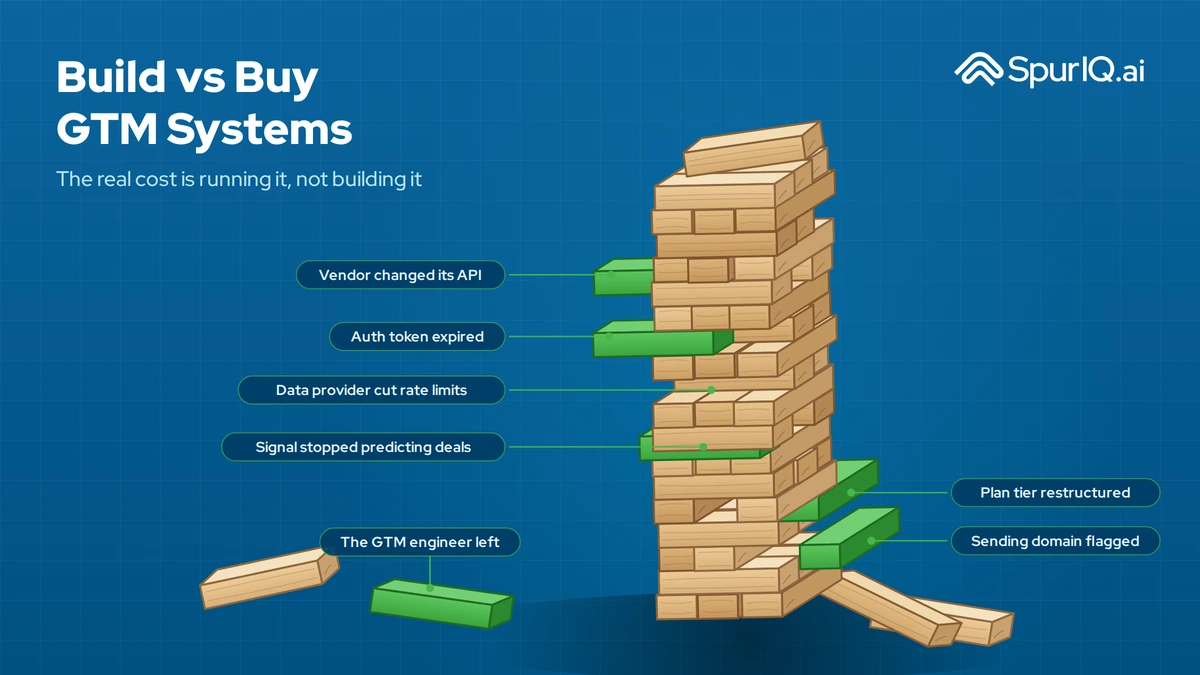
Every build-vs-buy debate fixates on the build. The build is the cheap part. The expensive part is keeping the thing alive after it ships, and that is where most in-house GTM systems quietly fall over.
At some point every revenue leader has the same thought. We could just build this ourselves. The integrations are documented, the logic is not rocket science, and buying yet another tool feels like paying someone else to do something your team could do in a quarter.
And you probably could build it in a quarter. That is exactly what makes the decision so easy to get wrong. The build is a project with an end date. Running a GTM system is not. It is a standing commitment that keeps asking for attention long after the person who built it has moved on to something else.
So the useful question is not can we build this. You almost certainly can. The useful question is who keeps it working for the next two years, and what it costs to keep the answer to that question employed. Let us walk through where the real cost actually hides, and then a two-sided way to make the call.
Why the integrations are a maintenance surface, not a one-time connection in a GTM system?
A GTM system is only as useful as the tools it plugs into. CRM, email, LinkedIn, data providers, calendar, call intelligence. On the day you build it, each of those is a connection you make once and tick off. Six months later, each of those is something you maintain.
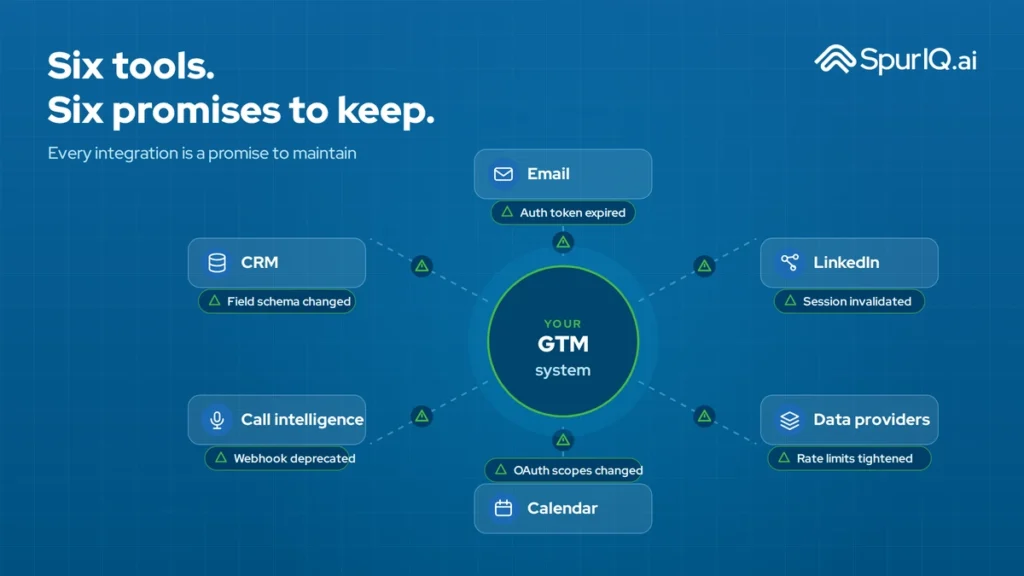
This is the part that looks free and is not. APIs change without asking your permission. An auth token expires and a flow stops. A data provider quietly tightens its rate limits, and your enrichment step starts returning half the results it used to. None of this announces itself. The workflow does not throw a big red error. It just starts producing less, or nothing, and it usually picks the worst possible moment to do it.
Multiply that by six or seven connected tools, each on its own release schedule, none of them coordinating with you, and you do not have a set of integrations. You have a small, permanent maintenance job that belongs to somebody, whether or not you have decided who.
“ Every integration you connect is a promise to maintain it. Six integrations is six promises, and they come due on the vendor’s schedule, not yours. ” – Vijay Agarwal , Co Founder of SpurIQ
Why GTM workflows are never actually finished?
People picture a GTM workflow like a piece of plumbing: build it once, and it runs. Real ones behave more like living things. They need tending, because the sales motion underneath them will not hold still. In practice, that tending shows up as five very GTM-specific problems, and most in-house builds hit all of them.
You are limited by the one or two data tools you built on
Most in-house systems get built around the one or two tools the team already has, a Clay here, a Smartlead or a Sales Navigator there. That is fine for a narrow play. But a GTM system that actually covers the motion can need anywhere upward of twenty to twenty-five different integrations across data, enrichment, sending, signals, CRM and intelligence. Very few companies can realistically build and maintain that many connections, so the home-built version quietly caps out at what its two tools can see.
Someone has to map how sellers actually behave, not just how the system works
A RevOps or GTM team can absolutely build the workflow. The harder part comes after. When the AEs and BDRs start using it, they hit one or two things that are broken or awkward, a step that does not fit how they work, an interface that is not built for their convenience. Fixing that is not a backend job. It needs someone who understands product and user behaviour, because there is one skill in making a tool and a completely different one in getting sellers to actually use it day after day.
A technical snag with no spare bandwidth turns it into an expensive toy
The most common way these builds die is undramatic. The team runs into one or two technical challenges, and there is simply not enough bandwidth to solve them. So the thing becomes a fancy-looking toy the company spent three months building, with not enough adoption, not enough usage, and not enough real integration to matter. It looks impressive in a demo and produces very little pipeline.
You cannot easily replicate battle-tested GTM skills
A build-vs-buy decision is not only about workflows. It is also about the skills inside them: messaging skill, ICP skill, scoring skill, signal-finding skill. What a professional operator brings is a skill that has already been tested across many industries and many data sources, so it is far more refined than a first internal attempt. It is unlikely a single company, working from its own data alone, can replicate that level of finesse quickly.
The workflows are mappable, but the sales logic behind them is the hard part
A company can map its own workflows. What is much harder to encode is the sales logic underneath: which signal should lead to which kind of campaign, what movement in a deal should trigger what action, what wording in a sales conversation should change what state in the CRM. That judgment is the difference between an automation that runs and a system that actually sells, and it is the part that takes real operating experience to get right.
“ The failure mode of a home-built GTM workflow is not a crash. It is a slow, silent decline you notice a month too late, in the pipeline number. “ – Arush Lakhani, Co-Founder SpurIQ
Why the seller interface is the hidden build inside the build
Say you get the integrations solid and the workflows disciplined. You are still not done, because you have not yet solved the part that decides whether any of it gets used.
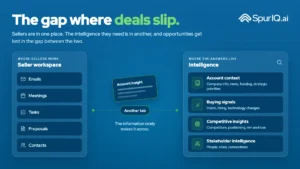
The output has to reach a seller in a form they will actually act on, in the surfaces they already work in. That is not a reporting problem, it is a product problem, and it is a hard one. A dashboard nobody opens produces zero pipeline no matter how good the intelligence behind it. If the seller has to leave their inbox, their calendar or their CRM to go and find what your system produced, most of them, most of the time, will not.
This is the build inside the build, and it is the one in-house projects consistently underestimate. The engineering to generate the intelligence is the visible half. The design work to deliver it where a busy seller will use it is the half that decides adoption, and adoption is the only thing that turns any of this into revenue.
And there is a running cost sitting underneath all those tools that rarely makes it into the build estimate. Every tool in the stack carries its own subscription, and those change: prices move, plans get restructured, and you end up re-buying capacity you already had. Each tool also caps you at a plan tier, so you are paying for a band of capacity whether or not you use it. When adoption is low, that gap becomes pure waste, capacity you are paying for and not consuming, multiplied across twenty-odd tools. The interface problem and the subscription problem compound: weak adoption means you are both failing to create pipeline and paying for headroom nobody touches.
Why you still need the person, even after it is built
Here is the cost that survives even a flawless build. Someone has to run the thing.
Not a caretaker. Someone who understands both sides at once: the sales motion and the stack it runs on. That is a GTM engineer or a RevOps owner who can look at a dip in replies and know whether it is the copy, the data, an integration, or the market. People who can do both are rare, and they are not cheap. In most markets that salary comfortably exceeds the annual cost of the tool you were trying to avoid buying.
And there is a quieter risk underneath the salary. All the knowledge of how your home-built system actually works, the undocumented fixes, the reason step four exists, the config nobody wrote down, lives in that one person’s head. When they leave, and eventually they leave, a large part of your GTM capability walks out with them. You are not just replacing a hire. You are trying to recover a system whose manual was never written.
The honest test of any build: can you name the person who maintains it eighteen months from now? If you cannot, you have not decided to build. You have decided to depend on someone who has not agreed to it yet.
When to build, and when to buy a GTM system?
None of this means always buy. There are real cases for building, and pretending otherwise would be dishonest. The decision comes down to how unusual your motion is, how much engineering slack you genuinely have, and how stable the workflow is once it works.
Two more factors deserve weight, and both cut toward buying for most teams. The first is market movement. GTM tactics, data sources and signals keep shifting, and a bought system absorbs those upgrades for you, whereas a home build has to be re-worked every time the ground moves, and then needs time to stabilise before it produces again. That stabilisation lag is real cost, paid in flat pipeline while your team debugs. The second is a simple thumb rule worth keeping in mind: build what you can sell, buy what you only self-consume. If a capability could become a product in its own right, building it may be justified. If you are only ever going to consume it internally, buying is almost always the cheaper and faster path.
| Build when… | Buy when… |
|---|---|
| Your motion is genuinely unusual, and no existing system fits how you actually sell. | Your workflows are common ones plenty of teams run: outbound, visitor follow-up, deal review. |
| You already have engineering and RevOps capacity that is not fully spoken for. | You depend on many integrations that change often and would need constant tending. |
| The workflow is stable and rarely changes once it works. | Your motion is still changing: ICP, messaging and signals are all moving. |
| You can absorb market-trend upgrades yourself and wait out the time a new build takes to stabilise. | The market keeps shifting under you and you cannot afford the lag while a home build settles. |
| It is a capability you could sell, not just self-consume. | It is something you only consume internally, where buying is almost always cheaper. |
| You can name the person who owns and maintains it eighteen months from now. | You cannot honestly name that person, or you can, and you would rather they sold. |
Read the two columns honestly against your own situation. If you land mostly on the left, building may be the right call, and you should resource the running of it, not just the building of it. If you land mostly on the right, which most teams do, you are better off buying the coverage and spending your scarce engineering and RevOps time on the parts of your motion that are genuinely yours.
How SpurIQ fits the buy side of a GTM System?
This is the exact problem SpurIQ is built to take off your plate, and it is worth being specific about how, because the running cost above is precisely what a managed model absorbs.
SpurIQ runs as a company-specific GTM system with two lanes, Spur Create for building qualified pipeline and Spur Convert for progressing deals and growing accounts, sitting on a shared memory of how your company sells, the Revenue Brain. But the relevant part for this decision is the delivery model underneath it.
SpurIQ maintains the integrations, so a broken API is never your 2am problem: In a managed engagement, SpurIQ owns the tooling, the domains, the mailboxes and the sending and data infrastructure, and keeps the many connections a real GTM motion needs alive as vendors change underneath them.
The testing and monitoring you would have to build is the service itself: Configuring the workflow around how your team sells, watching whether it is still producing, and adjusting when your ICP, messaging or signals move, that ongoing tending is what a managed deployment is. It is not a tool you are handed and left to run.
The battle-tested skills come with it: The messaging, ICP, scoring and signal-finding skills inside SpurIQ have been refined across many industries and data sources, so you are not starting those from scratch and hoping to reach that finesse on your own data alone.
The rare person who understands both the motion and the stack comes with the engagement: You do not have to hire and retain that skill set yourself, so the knowledge does not walk out of your door when one person leaves.
Two honest notes, because this piece is about making a clear-eyed decision. First, SpurIQ is delivered as a managed deployment, not a self-serve tool you switch on alone. That is deliberate, and it is what makes the running-cost promise real. Second, its coverage varies by workflows: Signal-Based Outbound workflow and LinkedIn Intent workflow are live and managed with customers today, while other workflows sit at ready-to-deploy, build or pilot. We scope each engagement to what is actually ready for you rather than implying the whole funnel is live.
Buying is not paying someone to build what you could. It is paying someone to keep it running, so the running never becomes your problem.
The takeaway
The build-vs-buy question is really a running-vs-running question in disguise. Anyone can stand up a workflow. The cost that matters is the integrations that drift, the workflows that need constant tending, the skills that take years to refine, the seller interface that decides adoption, the subscriptions you keep re-buying, and the rare person who has to hold all of it together. That cost does not appear in the build estimate, and it does not go away.
So before you build, run the honest test. Name the person who owns this in eighteen months, and price them in. Ask whether you could sell this capability or only self-consume it. If you land on build, and the motion is unusual and stable enough to justify it, build with your eyes open. If you cannot, buy the coverage, and put your best people on the part of your go-to-market that is actually unique to you.
Build More Pipeline. Close More Deals.
Frequently asked questions:
Isn’t building a GTM system cheaper than paying for one?
On the build alone, often yes. But the build is the small, finite cost. The large, recurring cost is running it: maintaining the twenty-odd integrations a real motion needs, testing and monitoring workflows that are never finished, re-buying tool subscriptions as plans change, and employing someone who understands both the sales motion and the stack. That running cost usually exceeds the price of buying, and unlike a subscription, it does not stop.
Why can’t our RevOps team just build and run it?
They can build it. The harder parts come after. A real GTM system may need twenty to twenty-five integrations, not the one or two tools most in-house builds start from. Someone has to map how sellers actually behave and fix the interface so AEs and BDRs use it daily. And the messaging, ICP, scoring and signal-finding skills inside a good system are refined across many industries and data sources, which is hard to replicate from your own data alone. Most builds stall on bandwidth, not ambition.
What actually breaks in a home-built GTM workflow?
Rarely the code itself. What breaks is quieter: an API changes, an auth token expires, a data provider tightens rate limits, or a signal stops predicting deals. The workflow does not crash, it just starts producing less. Without staging, testing and monitoring, teams usually discover it a month later through a flat pipeline number rather than the week it happened.
We have engineers. Doesn’t that make building the obvious choice?
Having engineers who can build it is not the same as having engineers with spare capacity to run it for years, plus a RevOps owner who understands the sales motion. Build makes sense when your motion is genuinely unusual, that capacity is truly free, and the workflow is stable. If the workflows are common and your motion is still changing, that same engineering time is usually better spent on what is unique to your business.
What is the single best question to decide build vs buy?
Two questions, really. Can you name the person who maintains this eighteen months from now? And could you sell this capability, or do you only self-consume it? A good thumb rule is build what you can sell, buy what you only consume internally. If you cannot name the owner and you only consume it yourself, you have not chosen to build, you have chosen an unowned dependency, which is the most expensive option of all.
How does a managed model like SpurIQ change the math?
It moves the running cost off your team. In a managed engagement SpurIQ owns the tooling, domains, mailboxes and infrastructure, maintains the integrations, runs the production discipline of testing and monitoring, brings skills refined across many industries, and provides the person who understands both the motion and the stack. You get the coverage without hiring and retaining that rare skill set yourself, or absorbing the stabilisation lag every time the market moves. It is delivered as a managed deployment, not self-serve, which is what makes that promise real.