The call went exactly the way you had hoped it would. The prospect was engaged throughout the conversation, asked thoughtful questions, acknowledged the challenges they were facing, and agreed that your solution could be a good fit. By the time you ended the call, it genuinely felt like the deal had real momentum and that the next step was only a matter of time.
Then nothing happened.
A day passes without a response. Then another. By the third day, you send a follow-up, but all you get is silence. It feels like the prospect lost interest, but that’s rarely the whole story.
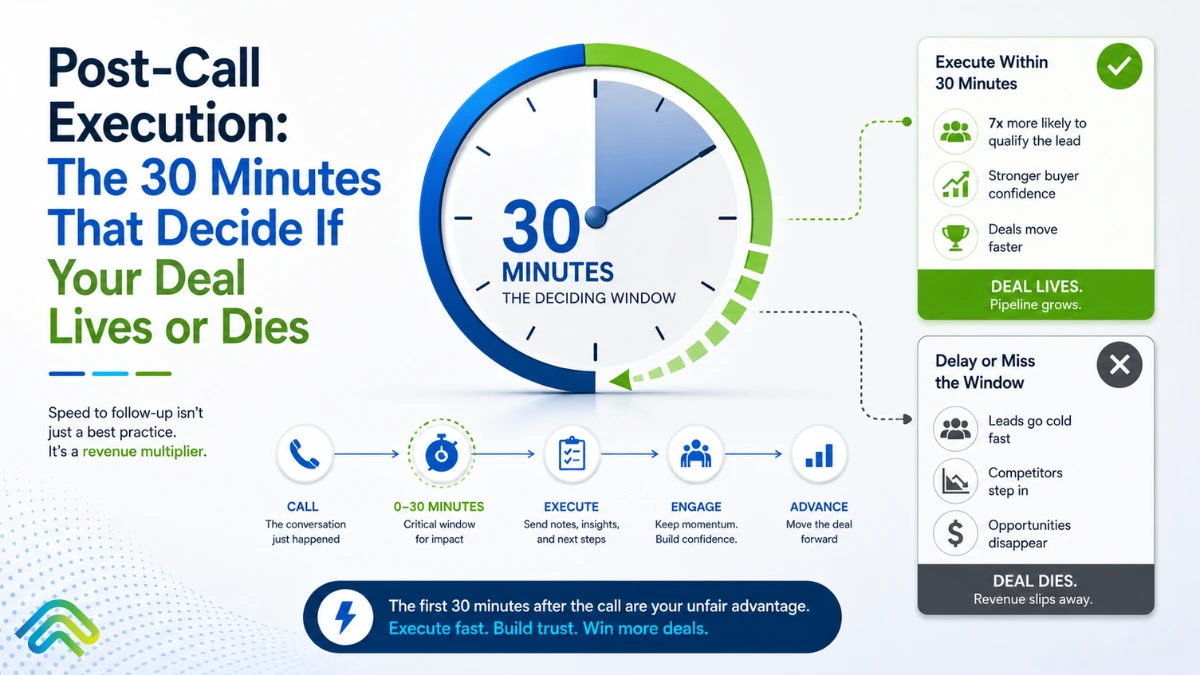
The uncomfortable reality is that the deal didn’t die on the call. It died in the 30 minutes after it, when the chance to lock in momentum was still there, but no meaningful action followed. Instead of reinforcing next steps and turning insights into action, those tasks get pushed aside. Meanwhile, buyers forget nearly 70% of what they hear within 24 hours, making every hour of delay more costly.
This isn’t a guide to sales follow-up emails. That’s a separate topic, and we’ve covered it in detail in our follow-up templates guide.
This isn’t a guide to sales follow up emails. This is about what to do after a sales call once you’ve hung up: the six-step post-call process that helps keep a deal moving after every conversation.
The Deal Doesn’t Die on the Call. It Dies in the 30 Minutes After
Sellers spend enormous energy on the call itself, from the pitch, and objection handling to the tone. Almost none of that energy carries into the window right after, even though that window is where the call’s value either gets locked in or quietly evaporates.
The math is not on your side:
- Memory decays roughly 70% within 24 hours, on both ends of the table.
- The prospect starts forgetting why they were excited.
- The rep starts forgetting the specific objection, the exact phrase the buyer used, and the name of the other stakeholder who needs to be looped in.
- Every hour that passes, the recap that eventually gets sent is a little vague, and the CRM note that eventually gets written is a little less useful.
Speed changes the outcome, and not by a small margin:
- Reps who act while the conversation is still fresh, inside roughly the first 30 minutes, see meaningfully higher reply rates than those who let it sit.
- That’s not about being polite. It’s about acting while the memory on both sides is still sharp enough to be worth acting on.
Reframe post-call as a task and it’s easy to deprioritize; there’s always a next call, a next email, a next fire. Reframe it as a window, and the deadline pressure becomes obvious. Windows close. And once this one closes, nothing you do afterward gets back what was lost inside it.
Why Post-call Execution Fails (It’s Not a Skills Problem)
Ask any rep whether they know they should follow up fast, lock a next step, and update the CRM right after a call, and they’ll say yes. They know. This isn’t a knowledge gap. It’s a capacity gap, and that distinction matters more than it sounds like it should.
The window opens at the exact moment the rep is least equipped to use it well:
- Right after a 45-minute, cognitively demanding call, often with the next call starting in minutes.
- The recap slips to “I’ll do it later”.
- The CRM update becomes a one-line stub, or nothing at all.
- The next step, which needed to be locked live on the call, gets left as “I’ll send over some times”.
- The internal note that would have told a sales manager this deal needs attention never gets written.
Now multiply it:
- A rep running five calls a day hits this exact window five times, every single day.
- Twenty-five times a week.
- Skipping it isn’t laziness, it’s arithmetic.
- A task that has to happen perfectly, from scratch, dozens of times a week, on top of everything else a rep is doing, will not survive contact with a busy quarter.
- Manual post call execution simply doesn’t scale with call volume.
Which means the fix was never “try harder” or “be more disciplined.” The fix is removing the manual load from the window itself, so it happens the same way every time, whether the rep just closed their best call of the month or their worst.
The 30-minute Execution Window: 6 Things That Must Happen
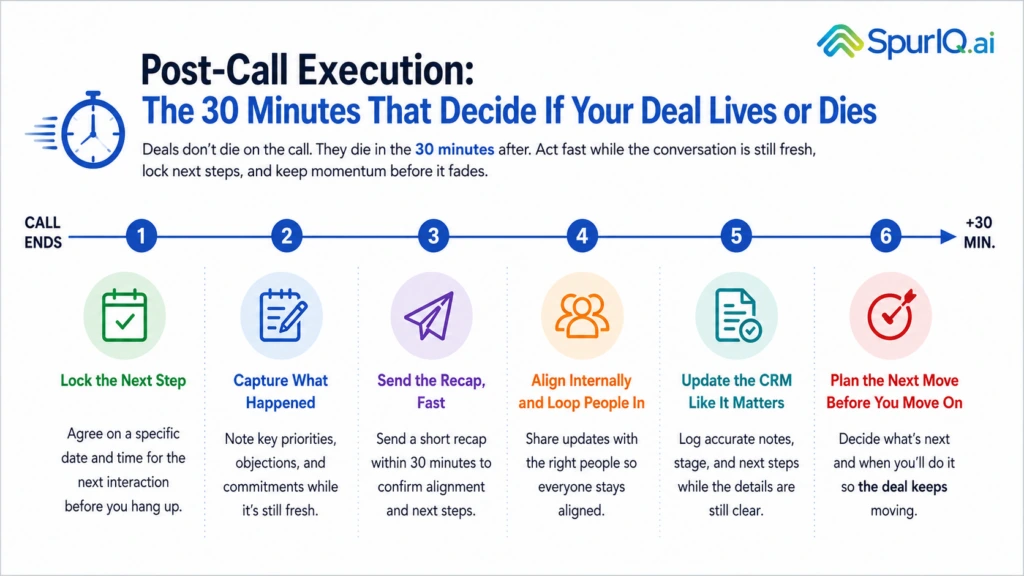
Most deals don’t stall because the sales call went poorly. They stall because the right actions never happen after the call ends. The first 30 minutes are when you have the best chance to reinforce the conversation, confirm next steps, and keep everyone aligned before momentum starts to fade.
Here’s the six-step post-call process that keeps deals moving. Think of it as your post-call follow-up process, completed while the conversation is still fresh.
1. Lock the Next Step, Ideally Before You Hang Up
The first of your sales call next steps should always be locking a specific date and time for the next interaction while both people are still on the call. “I’ll send over some times” is where deals go to die slowly over email threads that never quite land. Sellers who close fastest discuss next steps 53% more often than the ones who don’t.
The failure mode here is familiar: you leave the call with no booked next step and spend the following week chasing a calendar invite instead of moving the deal forward.
2. Capture What Actually Happened, While It’s Fresh
Not a sanitized summary written from memory two days later, but the real priorities, the actual objection, and the specific commitments, in the prospect’s own words. Memory decays roughly 70% within 24 hours, so this has a short shelf life.
Skip this step and the failure mode is a vague, generic note that’s useless to you next week, useless to the AE if it gets handed off, and useless to a manager trying to understand deal health from the CRM.
3. Send the Recap, Fast and Relevant
A recap that reflects the prospect’s actual words and states one clear next step, sent inside roughly 30 minutes while the conversation is still fresh, drives materially higher reply rates than one sent hours or days later.
This is the one action on this list that deserves its own deep dive rather than a paragraph here: writing the recap well, including what to say, how to time it, and which subject lines actually get opened, is covered in full in 12 proven follow-up templates and the timing framework.
4. Update the CRM: Stage, Next Step, Fields
Move the deal stage, log the next step, and fill in the fields the forecast actually depends on. This is the action every rep skips most and every sales manager needs most, because it’s invisible until the moment it matters. A lot of this comes down to legacy CRM problems that were never built for a rep updating records seconds after a draining call, so the update gets deferred and then forgotten.
The failure mode is a pipeline that looks perfectly healthy on a dashboard while it’s actually built on stale, optimistic, or missing data, and pipeline velocity numbers that look fine on a spreadsheet but don’t hold up under a real deal review.
5. Check the Buying Group: Are you Single-Threaded?
Most people picture B2B sales as a conversation between two people. It rarely is. The average B2B purchase involves close to 7.4 decision-makers, and one engaged champion is not a strategy; it’s a single point of failure. This is the moment, right after the call, to note who was actually on it, who wasn’t, and who needs to be brought in next before the gap becomes a problem.
Skip it, and the failure mode is a deal that depends entirely on one contact who eventually goes quiet, taking the whole deal with them, with nobody else in the account who even knew there was a deal in motion.
6. Flag the Risk: Is this Deal Weaker Than it Looks?
Ask the question nobody likes asking while the details are still fresh: did we actually get a real next step, or a soft one? Did the economic buyer engage, or just listen? Did a new objection surface that wasn’t there before? This is the same logic behind AI deal risk scoring: risk is rarely a single dramatic event; it’s a pattern of small missed signals that only adds up if someone is checking for it after every call.
Naming risk inside the window is how it gets addressed while there’s still time to fix it. The failure mode is risk that stays invisible for weeks, until the deal has already gone cold and there’s nothing left to do but explain it in the forecast review.
One Skipped Window Is Invisible. A Quarter of Them Is Your Forecast
A single skipped post-call execution window rarely looks like a problem. The deal doesn’t disappear overnight, no notification tells you something went wrong, and your pipeline still looks healthy on the surface. That’s exactly why the habit is so easy to repeat. Every missed action only costs a little momentum, a little context, or a little data, making the impact almost impossible to notice in isolation.
The problem is that skipped windows don’t stay isolated. Across an entire sales team and over the course of a quarter, those small misses begin to compound into much bigger problems that directly affect pipeline quality and forecast accuracy.
- Deals sit in the pipeline without a confirmed next step, even though they appear active.
- CRM records become incomplete or outdated, leaving sales managers with forecasts they can’t fully trust.
- Champions stop responding because no additional stakeholders were identified or engaged.
- Deal risks remain invisible because no one reviewed the conversation while it was still fresh.
This is the gap between the forecast and what actually closes. It’s also leak 2 in action: revenue leaking out after the pipeline already exists, one skipped 30-minute execution window at a time. The issue is rarely one major mistake. It’s the accumulation of small execution gaps that slowly weaken otherwise winnable deals.
The only fix that consistently scales is making the post call execution window run itself. When critical actions happen automatically instead of relying on a tired rep remembering them after a full day of calls, momentum is preserved, CRM data stays accurate, and every deal has a much better chance of reaching the finish line.
What It Looks Like When the Window Runs Itself
The post-call window shouldn’t depend on how much energy a rep has left after four back-to-back calls. It should just happen, every call, every time, without anyone remembering a checklist or hunting for ten free minutes that never show up.
That’s what SpurIQ is built to do. It’s the execution layer that sits above your CRM: rather than replacing the tools your team already lives in, it works alongside Gmail, your calendar, your CRM, and call recorders like Fireflies, running the post-call window for you through DealIQ’s convert-side workflows.
The workhorse is Meeting Intelligence. Before a call, it hands the rep a brief so they walk in with context. The moment the call ends, while it’s still fresh, it turns the conversation into a recap email draft, a structured CRM note, a suggested stage change, and a recommended next step. That’s the capture, the recap, and the CRM update, the three things reps skip most, compressed from a 45-minute chore into a one-click review. And because it runs on your Revenue Brain, the recap sounds like how your team actually sells, not a generic template.
Once the essentials are handled, Pipeline Health and Deal Risk takes over the watching. It checks whether a real next step is actually on the calendar, flags deals riding on a single stakeholder, and catches buyer engagement fading before the deal quietly stalls, so risk surfaces while there’s still time to do something about it.
The result: post-call execution that happens the same way for every rep, a CRM that finally reflects reality, and more deals that keep moving instead of slipping silently into a forecast that was never real.
See what changes when the 30 minutes after every call runs itself, book a 10-minute walkthrough.
The Call is the Easy Part
The deal was never decided by the call itself. It was decided by what happened, or didn’t happen, in the 30 minutes that followed. That’s the window where momentum is reinforced, next steps become actions, and deals either keep moving or slowly lose traction.
Post-call execution isn’t a discipline problem, and it isn’t a better-template problem either. Most reps already know what to do after a sales call. The challenge is turning those sales calls into consistent action after every conversation. The real challenge is making those actions happen consistently, even when the next meeting is about to start and time is already running short. Knowing how to keep a deal moving after a call.
And if you want to see what consistent post-call execution looks like without relying on manual effort, book a 10-minute SpurIQ walkthrough.
Frequently Asked Questions (FAQs):
Q1. What is post-call execution?
Post-call execution is the set of actions completed immediately after a sales call to maintain deal momentum and improve the chances of moving the opportunity forward. Rather than being a single follow-up task, it includes several activities that help capture context, align stakeholders, and prepare for the next stage of the sales process.
Key post-call activities include:
Confirming a specific next meeting or action.
Capturing accurate notes while the conversation is still fresh.
Sending a personalized recap email.
Updating the CRM with the latest deal information.
Identifying additional stakeholders involved in the buying decision.
Reviewing the conversation for potential risks or objections.
Q2. How soon should you follow up after a sales call?
The sooner, the better. Most sales experts recommend sending a follow-up within a few hours of the meeting, and ideally within 30 minutes whenever possible. A timely follow-up reinforces the discussion while it’s still fresh, confirms agreed-upon next steps, and demonstrates responsiveness.
Best practices include:
Send the recap while the conversation is still top of mind.
Personalize the message using key discussion points.
Include one clear next step or action item.
Share any promised resources or documents.
Q3. What should you do in the first 30 minutes after a sales call?
The first 30 minutes after a sales call are critical because important details are still fresh and buyer momentum is at its highest. Using that time effectively helps reduce missed follow-ups and keeps the deal progressing.
Prioritize these actions:
Confirm or schedule the next meeting.
Document key discussion points and commitments.
Send a personalized recap email.
Update the CRM with the latest deal stage and next steps.
Identify whether additional stakeholders need to be involved.
Record any new risks, objections, or buying signals.
Q4. Why do reps skip post-call follow-up even when they know it matters?
In most cases, the challenge isn’t knowing what needs to be done, it’s finding the time to do it consistently. Sales reps often move directly from one meeting to the next, leaving little room for administrative work. As a result, CRM updates, meeting notes, and follow-up emails are delayed or skipped altogether.
Common reasons include:
Back-to-back meetings throughout the day.
Manual CRM updates that take time.
Context switching between multiple tools.
Administrative work competing with selling time.
Relying on memory instead of documenting conversations immediately.
Q5. What should go in a post-call CRM update?
A CRM update should capture enough detail for anyone reviewing the opportunity to understand the current state of the deal without relying on memory. Accurate records also improve forecasting, reporting, and collaboration across the sales team.
Include information such as:
Current deal stage.
Confirmed next step and scheduled date.
Key customer priorities and pain points.
Decision-makers and stakeholder involvement.
Budget, timeline, and buying process updates.
New objections, risks, or commitments discussed during the call.
Q6. How do you know if a deal is at risk after a call?
The best time to assess deal health is immediately after the conversation, while the details are still fresh. Small warning signs identified early are often easier to address than problems discovered weeks later.
Review questions such as:
Was a clear and specific next step agreed upon?
Were the right decision-makers involved in the discussion?
Did any new objections or concerns emerge?
Is buyer engagement still strong?
Are there unanswered questions or unresolved blockers?
If the answer to one or more of these questions is no, the opportunity may require additional follow-up or stakeholder engagement before it continues progressing.
Q7. Should the follow-up email or the CRM update come first?
Neither task is effective without accurate meeting notes. The priority should be capturing the conversation while it’s still fresh, since those notes become the foundation for both a personalized follow-up email and a reliable CRM update.
A simple sequence is:
Capture key discussion points and commitments.
Update the CRM with accurate deal information.
Send a personalized follow-up email that reflects the conversation and confirms the agreed next steps.
Following this order helps ensure consistency across your sales process while reducing the risk of missing important details.