
I’ve spent the last six months working inside other people’s sales motions, different clients, different stages and I kept running into the same three things. Not reading about these teams. Inside them. Watching where deals stall, why good reps miss, and what all the AI tooling everyone rushed to buy is, and isn’t, doing.
Here’s the pattern I couldn’t unsee. The teams that were stuck weren’t stuck because they lacked tools. They had plenty. They were stuck because their stack had no layers. Context lived in the founder’s head. Sales judgment lived in one great rep’s instinct. Signals were scattered across ten tools. Execution depended on whether someone remembered to follow up. Everything was tangled together, so nothing compounded.
When I finally sketched what a working GTM stack should look like, it had a clear shape. Four layers, in a deliberate order, with one shared memory underneath. This is that architecture, what each layer does, why the order matters, and how they fit together into a system that gets smarter over time instead of starting from zero every Monday.
Start with the gap everyone feels but nobody names
Before the stack, the problem. There’s a specific failure at the heart of almost every stuck revenue team, and it has a name: the signal-to-action gap. Your systems know things they never act on. A prospect raises a round. A champion changes jobs. A fit-profile account reads your pricing page twice. Every one of those is a reason to do something, and in most teams, nothing happens, because the signal is sitting in a tool nobody’s watching.
I used to think that gap was a discipline problem, reps needing to try harder. It isn’t. It’s an architecture problem. The layers that turn a signal into the right action either don’t exist or don’t talk to each other. You can’t discipline your way out of a missing layer. You have to build it.
So let’s build it, from what your company knows, down to the action that lands in a buyer’s inbox.
The three things every scaling team is trying to bring together
Strip away the jargon and every revenue team is trying to connect the same three things. I find it easier to start here, in plain language, before we talk architecture:
| The thing | What it really is |
|---|---|
| Company context | What the company knows — your ICP, buyer personas, positioning and messaging, sales playbooks, use cases and proof points, product and market context. |
| Sales judgment | How good sellers decide — which accounts qualify, which buyer to approach, how to prioritise outreach, which angle to use, what counts as deal risk, and what the next best action is. |
| Live signals | What’s happening right now — email and call activity, CRM activity, hiring and funding updates, website visits, leadership and market signals, LinkedIn engagement. |
Here’s the problem in almost every company I’ve watched: these three live in different places and never come together.
Take the ICP. The founder can look at an account and tell you in ten seconds whether it’s worth chasing. Everyone else, marketing, RevOps, the sellers, got the ICP slide. They have the definition. They never got the instinct behind it.
Company context thins out as the team grows. Positioning, proof points, the real reasons people buy, all of it drifts a little from one seller to the next, until the version a new rep is working from barely resembles the one that actually wins.
And signals are everywhere but never in one place, CRM, email, LinkedIn, calls, hiring, funding. Each one useful on its own. All of them useless at the exact moment someone has to decide what to do next.
Then there’s the tax nobody budgets for: every time your ICP or messaging changes, someone has to go update it again, across every team, tool and workflow. So even the teams that bring the three together once watch them scatter the next time something changes. Three things that only create value together, kept permanently apart.
Bringing them together is the whole game. And under the hood, doing that is a four-layer stack.
Under the hood: the four-layer GTM stack
Here’s the architecture. Four layers — and I’ll say this up front because it matters: the two in the middle, Skills and Orchestration, work as a single bucket. They’re the sales logic. I’ll treat them together, because in practice you can’t have one without the other.
| Layer | What it does | In the human version above |
|---|---|---|
| 1 · Context | Holds what your company knows, where software can use it | Company context |
| 2+3 · Skills + Orchestration | Decides what a good seller would do, and coordinates it | Sales judgment, made repeatable |
| 4 · Execution | Does it, across the tools you already use | (where it all lands) |
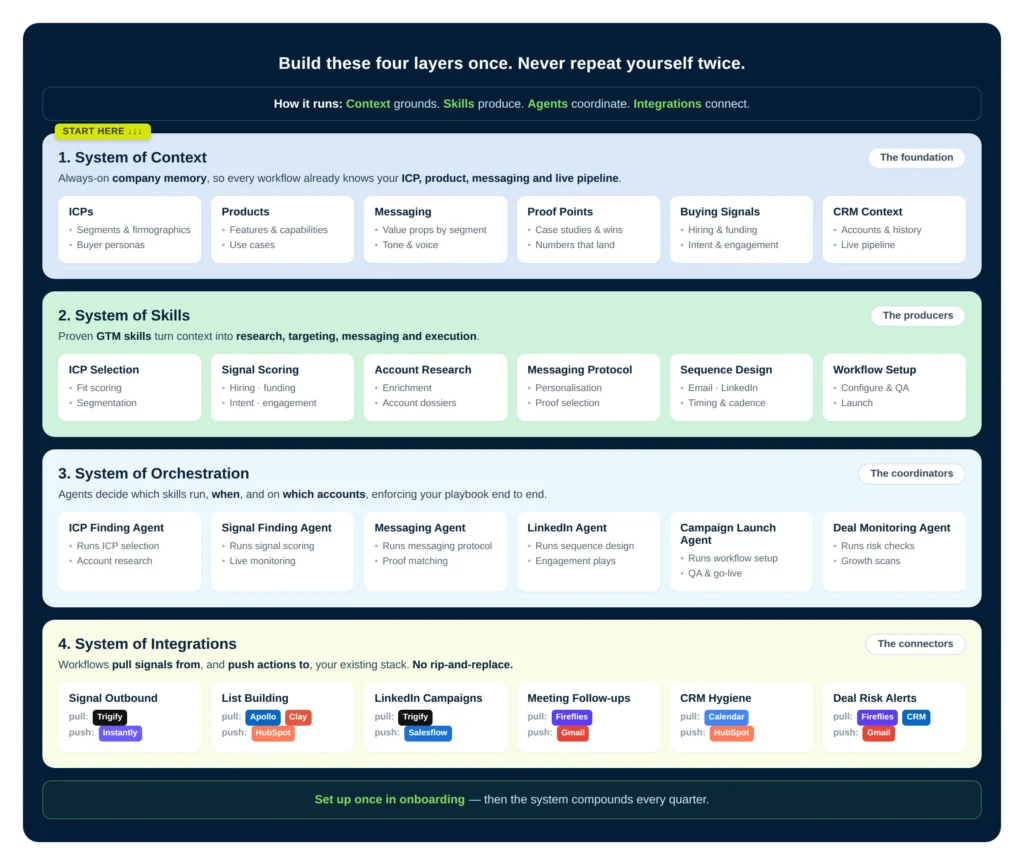
And live signals are the fuel that runs through all of it, pulled in through the execution layer, then interpreted by the sales logic and grounded against your context before they turn into action. Let’s take the layers one at a time.
Layer 1- Context: what your company knows
This is the foundation, and it’s the one everyone underinvests in. Context is the written-down memory of how your company sells: your ideal customer profile and buyer personas, your positioning and messaging, your sales playbooks, your use cases and proof points, your product and market context.
Here’s why it’s the foundation. If this isn’t captured somewhere software can actually use it, every tool you own is guessing. Your AI writes generic copy because it doesn’t know your positioning. Your targeting is broad because your ICP lives in a slide, not a system. The context layer is what makes everything above it specific to you instead of generic. Get this wrong and no amount of clever automation saves you, you’ve just automated guessing.
Layers 2 & 3- Skills + Orchestration: the sales logic
This is the bucket most people skip, because it’s the hardest to name. It’s the sales logic, how good sellers decide, and it’s really two things working as one.
Skills: the know-how
Skills are the individual judgments a strong seller makes without thinking: which accounts actually qualify, which buyer to approach inside them, how to prioritise outreach, which angle to lead with, what counts as real deal risk, and what the next best action is. Each is a discrete, repeatable skill. In most companies they live only in your best rep’s head, which means they don’t scale and they don’t survive turnover.
Orchestration: the coordination
Skills on their own are just capabilities sitting on a shelf. Orchestration is what decides which skill runs, when, on which account, and in what order, so your playbook runs end to end instead of depending on whether a rep remembers step four on a Friday afternoon. It’s the difference between having good instincts and running a consistent motion.
Put them together and you get the sales logic: the judgment of your best seller, made repeatable and coordinated across every account. This is the layer that turns context and signals into the right action rather than just an action.
Layer 4- Execution: doing it, where work already happens
The best logic in the world is worthless if it can’t act. The execution layer is where decisions become real: sending the sequence, drafting the follow-up, updating the CRM, booking the next step, across the tools your team already uses. Your CRM, email, LinkedIn, data providers, call intelligence, calendar.
The non-negotiable here is no rip-and-replace. A GTM stack that demands you throw out your CRM and re-platform your whole team is a stack nobody adopts. Execution has to pull information from, and push action into, the systems where work already happens. It meets your team where they are.
Live signals: the fuel, not a layer
A quick but important note, because people get this wrong constantly. Live signals aren’t a layer of the stack, they’re the fuel that runs through it. Hiring and funding updates, website visits, LinkedIn engagement, email and call activity, CRM changes, leadership and market moves.
A signal on its own is just noise. It becomes valuable the moment it flows through the stack: pulled in through the execution layer, scored and interpreted by the sales logic, grounded against your context, and turned into a specific action. A funding round means nothing until your stack knows it maps to your ICP, knows your best angle for a newly-funded team, and acts on it before your competitor does. Signals are inputs. The stack is what makes them matter.
The memory underneath: what holds the four layers together
One last architectural point, and it’s the one that decides whether any of this compounds. You can build all four layers and still be stuck, if they don’t share a memory.
If your context lives in one system, your sales logic in another, your signals in ten tools, and your execution in yet another, you don’t have a stack. You have four piles. Each starts from zero every time. The context layer never learns what messaging actually converted; the sales logic never finds out which signals predicted a fast close. Nothing compounds, because nothing is connected.
What connects them is one shared memory sitting underneath the stack, holding your company context, sales judgment, and live signals in one place, and feeding every result back in. That memory is the Revenue Brain. It isn’t one of the four layers; it’s the connective tissue that makes the four behave as one. Put simply: the layers are the machine, and the Revenue Brain is the memory the machine runs on.
| Two teams can own the exact same tools. The one whose shared memory has been learning for a year pulls away from the one still managing four piles. The advantage compounds, and it’s very hard to copy. |
That’s a whole topic on its own, what the memory holds, why it matters, and how it makes the stack learn. We cover it in full here: What Is a Revenue Brain? For this piece, just hold the architectural role in mind: four layers, one memory underneath.
Bring the layers together → better seller actions
Layers aren’t the goal; better seller actions are. When the four layers run on one shared memory, here’s what changes, and it changes differently depending on where you sit.
For a seller, it comes down to four questions, answered at the moment they’re needed rather than after:
| Which account. Which buyer. Which message. What next. |
For a leader, it’s a different win from the same architecture: the team executes the same way instead of twelve different ways, new positioning lands in days instead of quarters (because you update one memory, not every tool and workflow), and you see a deal going quiet before it dies rather than after. Here’s how it shakes out across the org:
| For sellers | For sales leaders | For the business |
|---|---|---|
| Clearer priorities | More consistent execution | Better pipeline quality |
| Better messaging | Earlier risk visibility | Stronger conversion |
| Faster follow-up | Easier rollout of change | Better account growth |
The seller gets a better day, the leader gets a more predictable team, and the business gets better numbers, from the same underlying architecture. That’s what tells you it’s a real system and not just a feature. It pays off at every level at once.
Where SpurIQ fits?
I’ll be direct, because you’ve read this far and deserve it. SpurIQ is this stack, run for you, the four layers, held together by one shared memory (the Revenue Brain), built and operated on the tools your team already uses. No rip-and-replace, no re-platforming.
What the stack produces is six workflows across your revenue cycle, three that create pipeline (under LeadIQ) and three that convert it (under DealIQ). And you drive the whole thing from one place, in plain English: type a request, and the stack turns it into executed action. That flow is its own story, we walk through it step by step in How SpurIQ Turns One Request Into an Executed Campaign.
But honestly, whether or not you ever use SpurIQ, build the layers. Write down your context. Make your sales logic repeatable. Connect your execution. And put one memory underneath to hold it together. That’s the move, with us or without us.
Build the layers, in order
Six months inside other people’s sales motions taught me one thing more than any other: the teams that win aren’t the ones with the most tools. They’re the ones who stopped buying piles and started building layers.
Context, so software knows how you sell. Sales logic, so good judgment becomes repeatable. Execution, so decisions actually land. And one shared memory underneath, so the whole thing gets smarter every quarter instead of starting over every Monday.
That’s the stack. That’s the architecture behind revenue execution. Build it in that order, and the signal-to-action gap, the thing quietly costing you the most, finally closes.
Want to see the stack running on how your company sells? Book a walkthrough and we’ll map where the layers are broken in your motion, and what it’s costing you, in under 10 minutes.
Frequently asked questions (FAQs):
Q. What is a GTM stack?
It’s the set of layers that turn what your company knows into the right go-to-market action. A working one has four layers, Context (what you know), Skills and Orchestration (how you decide, working as one bucket), and Execution (doing it across your tools), sitting on one shared memory.
Q. What are the layers of the GTM stack?
Context, Skills, Orchestration, and Execution. In practice Skills and Orchestration work as a single bucket, the sales logic, because capabilities are useless without something coordinating which one runs when. Live signals are the fuel that flows through all of it, not a layer of their own.
Q. Why combine Skills and Orchestration into one bucket?
Because they only work together. Skills are the individual judgments a good seller makes; orchestration decides which one runs, when, and on which account. Skills without orchestration are capabilities gathering dust; orchestration without skills has nothing to coordinate. Together they’re the sales logic.
Q. What’s the difference between the GTM stack and the Revenue Brain?
The stack is the four layers, the machine that acts. The Revenue Brain is the shared memory underneath it, holding your context, sales judgment and live signals so the layers act as one system and compound over time. The Brain isn’t one of the layers; it’s what connects them.
Q. Do I need to replace my existing tools to build this?
No. The execution layer is built on integrations, it pulls information from and pushes actions into the CRM, email, LinkedIn, data and calendar tools you already use. A stack that demands you re-platform your whole team is a stack nobody adopts.
Q. Where do buying signals fit in the stack?
They’re inputs, not a layer. A signal like a funding round or a website visit flows in through the execution layer, gets scored by the sales logic, grounded against your context, and turned into a specific action. On its own a signal is noise; the stack is what makes it matter.