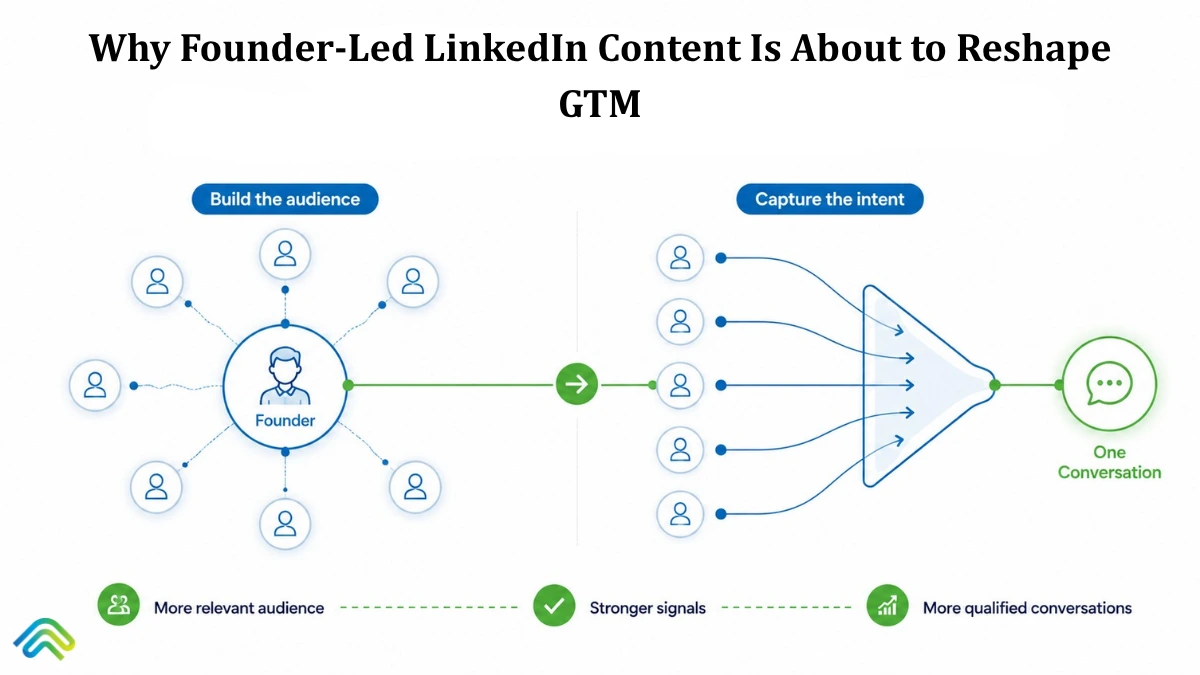
Founder-led content is quietly becoming one of the most reliable ways to build a B2B pipeline. The founders getting it right treat it as a system, not a willpower streak. Here’s how it usually goes. You sit down on a Sunday, force out three posts, publish them across the week, and feel productive. One lands. Two hundred people react. And then… nothing. The post scrolls into the archive. The two hundred people go back to their day. And you go back to treating the next post as another thing to grind out.
The most valuable asset a founder has is their own point of view, in public, in front of exactly the people they want to sell to. When content is run as an occasional burst of effort, that asset mostly goes to waste.
Founder-led content works best as a two-part machine. The first half builds an audience and creates intent. The second half captures that intent and turns it into conversations. Most people only ever build the first half, and even that without much of a plan.
Let’s build both properly.
Part one: build an audience before you build a pitch
Here is the mistake that quietly kills most founder outreach on LinkedIn. You load a list of ICPs, connect with them, and start pitching almost immediately. From your side it feels efficient. From their side, a stranger just showed up in their inbox asking for time and attention they never agreed to give. You have earned no permission yet, so the pitch has nothing to stand on.
The better approach is slower on the surface and far more effective underneath. You build an audience first. You connect with the right people, the ones who could genuinely buy what you sell one day, and you let your content do part of the selling before you ever open a conversation. By the time you do reach out, you are not a cold stranger. You are the person whose posts they have been reading for weeks.
This changes what a first message is for. When you connect with someone new, the goal is not to pitch. The goal is to start a relevant conversation. Something tied to their world, their role, or something they recently shared or engaged with. Familiarity and credibility get built over time, through what you publish and how you show up, not manufactured in a single opening line.
Now the myth worth killing outright: the belief that you need exceptional writing or design skills to matter on LinkedIn.
You almost certainly do not. Most founders are sitting on something far more valuable than polish. You have years of experience, a real understanding of your market, and a genuine point of view on:
- What is changing in your space, and what most people have not caught up to yet.
- What your buyers actually struggle with day to day.
- Why certain solutions work and others quietly fail.
- Where the real business value sits, as opposed to where the marketing says it sits.
Talking clearly and consistently about those things is usually enough. You do not need sophisticated graphics or heavily produced “content.” You need a useful perspective your audience actually cares about, shared often enough that people start to recognise your name. A plain post with a sharp insight will almost always outperform a beautiful one that says nothing.
So the first half of the machine is really two habits running together: deliberately growing an audience of the right people, and consistently sharing the perspective you already have. One builds the room. The other gives the room a reason to pay attention.
This is also where the difference between generic AI content and useful content becomes obvious. Generic AI writes generic commentary because it knows nothing about you or your market. A system grounded in your positioning, your proof points and your actual language does the opposite. It helps you turn your point of view into consistent posts in your voice, so you are not starting from a blank page every time, without flattening what makes your perspective worth reading.
Part two: the half where everyone stops
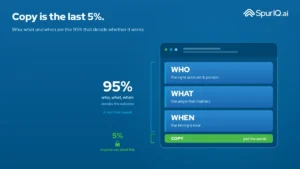
This is the part almost everyone skips, and it starts earlier than people assume. Working founder-led content is not simply posting and then looking at who happened to react. It begins before the post ever goes out, with a deliberate decision about who you are trying to reach.
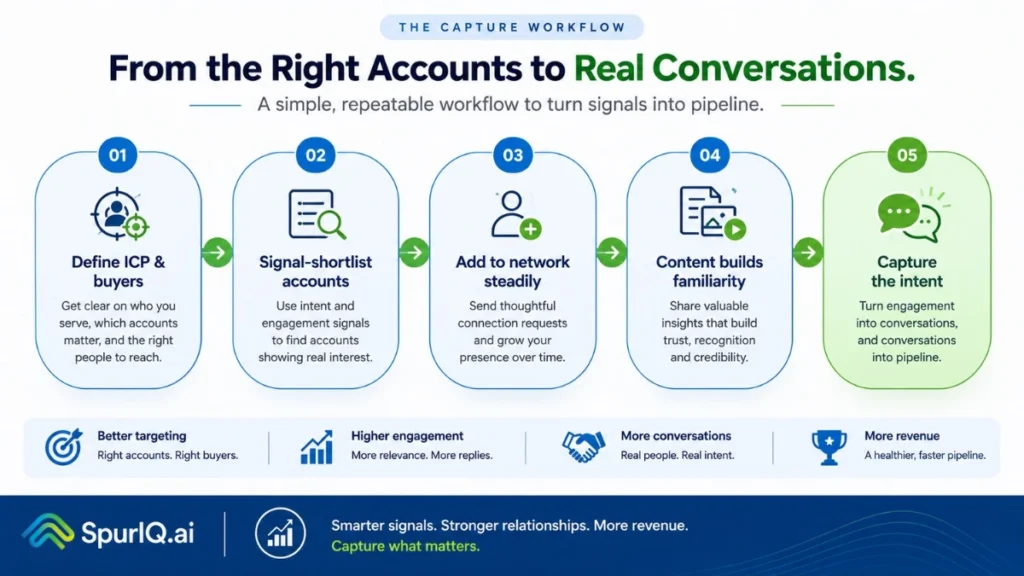
The actual workflow looks like this:
- Define your ICP and identify the real buyers: Be specific about the companies you serve and the roles that actually make or influence the decision. This is the filter everything else runs through.
- Use signals to keep shortlisting accounts and people: Hiring, funding, leadership changes, product moves, market events, whatever indicates a company might soon care about what you do. Signals turn a static list into a live, refreshing shortlist of accounts and the buyers inside them.
- Add those buyers to your network on a regular basis: Not in one giant blast, but steadily, week after week. You are deliberately assembling an audience of people who could eventually buy your solution.
- Let content and engagement build familiarity over time: As these people see your perspective in their feed, you stop being a stranger. Your posts do part of the selling quietly, in the background, before any conversation starts.
- Capture the intent when it shows up: When someone in that audience reacts, comments, or engages, that is a signal in its own right. Now a conversation makes sense, because you already have context and they already know who you are.
Notice what this changes. You are not hoping the right people stumble across a post. You have deliberately built an audience of qualified buyers first, then used content to warm them, so that engagement becomes a meaningful signal rather than random applause.
And when you do reach out, fit matters more than volume. Loud does not mean relevant. The person who left a five-paragraph comment might be a competitor or a curious student. The quiet “like” from a VP at an account you have been targeting for a month is the one that matters. Rank by ICP fit, check whether they are already in an open conversation or your CRM, and follow up while the post is still fresh, with something tied to what they engaged with rather than a template.
That distinction is the whole game. “Thanks for the like, let’s connect” is spam with a smile. “You reacted to the point about signal decay, curious how your team handles it today” is a conversation. One gets ignored. The other gets a reply.
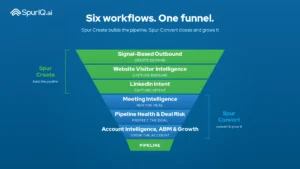
At SpurIQ, this end-to-end motion is what the LinkedIn Intent workflow inside LeadIQ is built for. It helps define the ICP and buyers, uses signals to keep shortlisting the right accounts and people, and turns genuine engagement on your content into qualified, contextual follow-up rather than letting it evaporate. We deliver it as a managed workflow today, run alongside the rest of your outbound, because the judgment about who is worth reaching out to and how is the part that has to be right.
And that judgment is not guesswork. Deciding who fits your ICP, which signals matter, and why a given buyer is worth a message now is exactly the kind of expert sales logic SpurIQ is built to make repeatable, so the standard your best seller would apply gets applied across your whole audience, not just the handful of people you had time to check by hand.
The close: build the audience, then capture the intent
Put the two halves together and the picture is simple.
You deliberately build an audience of the right buyers, use your perspective to earn familiarity and credibility over time, and then capture intent when it shows up. One half without the other is a leak. An audience you never engage is a list. Content with no audience of real buyers behind it is a performance for the wrong room.
The founders who win the next few years won’t be the ones who post the most. They’ll be the ones who quietly assembled an audience of qualified buyers, showed up consistently with a point of view worth reading, and had a workflow ready to turn genuine engagement into conversations while the moment was still warm.
Here’s the part that should encourage you if you’re doing this solo. You don’t need a content team and a separate SDR team to run this. Building the audience and sharing your perspective is something you’re already equipped for, and the capture side is a repeatable workflow rather than a headcount problem. The same motion that helps a twenty-person revenue team stay consistent is the one that lets a solo founder perform well above their weight. Same person, different scale.
Conclusion
Founder-led content is moving from a nice-to-have to a core GTM motion for one simple reason: a founder’s point of view, shared consistently with the right audience, is the most trusted and lowest-cost way to build familiarity with future buyers, and the systems to capture the intent it creates finally exist.
The founders who pull ahead won’t be the ones with the best design or the most posts. They’ll be the ones who do the unglamorous work well: define who they’re actually trying to reach, use signals to keep adding the right buyers to their network, show up consistently with a useful perspective, and follow up on real engagement while it’s still warm, to start a conversation rather than force a pitch.
Build the audience, then capture the intent. If your posts are landing and nothing’s happening afterward, the missing half is usually the one that turns attention into pipeline. That is exactly what SpurIQ’s LinkedIn Intent workflow is built to run.
Build More Pipeline. Close More Deals.
Frequently asked questions:
Q. Is founder-led content really better than company-page content?
For most growth-stage B2B companies, yes, at least at the top of the funnel. People trust and engage with a person more readily than a logo, and a founder carries a point of view a brand account rarely can. The company page still matters for reposts and credibility, but the intent is created by the human voice. The practical model is founder posts first, company page amplifies within a couple of hours.
Q. I only get 20 or 30 reactions per post, not 200. Is this still worth it?
It’s arguably more worth it. Thirty reactions you actually qualify and follow up on will beat two hundred you ignore, every time. The number that matters isn’t reactions, it’s how many of the engagers fit your ICP and how many you reached while the post was still warm. A small, high-fit audience is easier to work by hand and easier to systematise.
Q. What’s the follow-up window? How fast do I have to move?
Reach out while the post is still fresh in the person’s mind, ideally within the first day or two of them engaging. The exact window varies, but the principle is fixed: relevance decays fast. A message that references a post someone reacted to last week lands very differently from one that references a post they reacted to an hour ago.
Q. Should I pitch people as soon as they accept my connection request?
No. That is the fastest way to waste a connection. When you add someone new, you are still a stranger who has given them no reason to engage with a sales message. The goal of a first message is to start a relevant conversation, not to pitch. Let your content build familiarity and credibility over time, and let engagement tell you when someone is genuinely worth a direct conversation.
Q. Do I need great writing or design skills to do this?
No. This is one of the biggest myths holding founders back. You do not need polished graphics or professional copywriting. What actually works is your perspective: what is changing in your market, what buyers struggle with, why certain solutions work, and where the real value sits. A plain post with a sharp insight beats a beautiful one that says nothing. A context-aware system can help you turn that perspective into consistent posts in your voice, but the insight has to be yours.
Q. Can a solo founder actually run both halves without a team?
Yes, that is the whole point of framing it as one machine. Building an audience and sharing your perspective is something a founder already has the raw material for, and the capture side, shortlisting the right buyers from signals and following up on genuine engagement, is a repeatable workflow rather than a headcount problem. Both are within reach of a single founder, which is exactly why it lets a solo operator perform above their weight.
Q. Where does SpurIQ fit into this?
This whole motion maps to a LeadIQ workflow called LinkedIn Intent. It helps define your ICP and buyers, uses signals to keep shortlisting the right accounts and people to build your audience, and turns genuine engagement on your content into qualified, contextual follow-up rather than a template. SpurIQ delivers it as a managed workflow today, configured around how your team sells, so the sales judgment about who to reach out to and how is applied consistently rather than left to whoever has time that week.