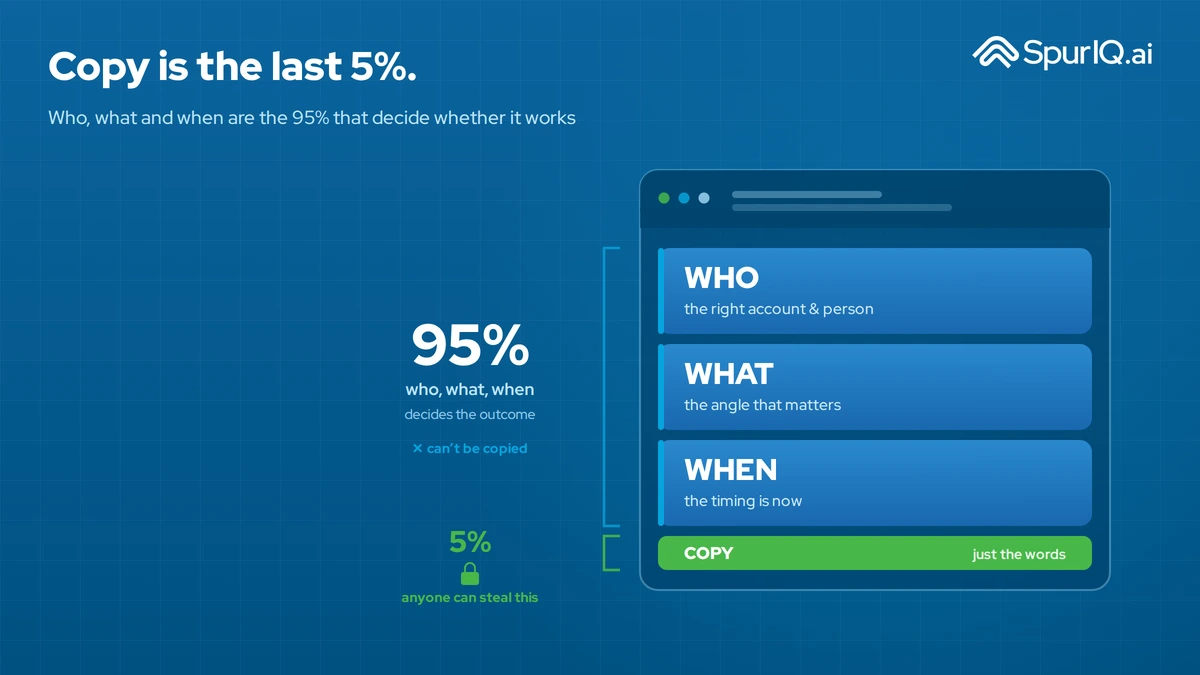
The whole industry obsesses over the copy. But the copy is the most replicable part of your outbound. The part that actually decides whether a message works is the part nobody can steal.
Open any sales community in 2026 and the conversation is the same as it was five years ago. Subject-line tests. The perfect opener. A new framework for the first line. Swipe files traded like currency. Everyone is trying to write the email that wins.
There is something odd about all that effort. The copy is the easiest part of the whole motion to copy. Anyone can lift your subject line, your structure, your clever opener, word for word, in an afternoon. What they cannot lift is why you sent that email to that account, in that week. That decision never shows up on the page, and it is the part that actually works.
Your copy is the one thing a competitor can steal
It sounds obvious once you say it out loud, but almost nobody acts on it. Your competitor can subscribe to your emails, screenshot your best-performing sequence, and run a near-identical version by Friday. The words are public the moment they land in an inbox.
The reasoning behind the words is not. Why this account and not the one next to it on the list. Why this angle instead of the three others you could have led with. Why now, and not last month or next quarter. That judgment is invisible, it is specific to your business, and it is what a good message is actually built on. The writing just carries it the last few feet.
Three decisions decide the outcome, and none of them are the words
Before a single sentence gets written, three decisions have already settled whether the message has a chance.
Who you reach out to
The account, and the specific person inside it. A real fit for what you sell, or just a name that survived a filter?
What you lead with
The offer, the angle, the proof point. The one thing this particular buyer cares about, or a generic pitch that could go to anyone?
When you send it
The timing. Something is happening at this account right now that makes your reason to reach out real, or it is just another Tuesday for them?
Get those three right and average copy performs perfectly well. Get them wrong and the best-written email in the world is still a stranger showing up at the wrong moment with the wrong thing. No opener rescues that.
Copy is the last five percent of the work, and the only part your competitor can steal. Who, what and when are the ninety-five percent that decides the outcome.
Also Read:- Outbound Sales Strategy: 7 Proven Plays That Actually Work in 2026
Where the who and the what come from: your company knowledge
The who and the what do not come from a copywriting framework. They come from knowledge about your own company and this specific account.
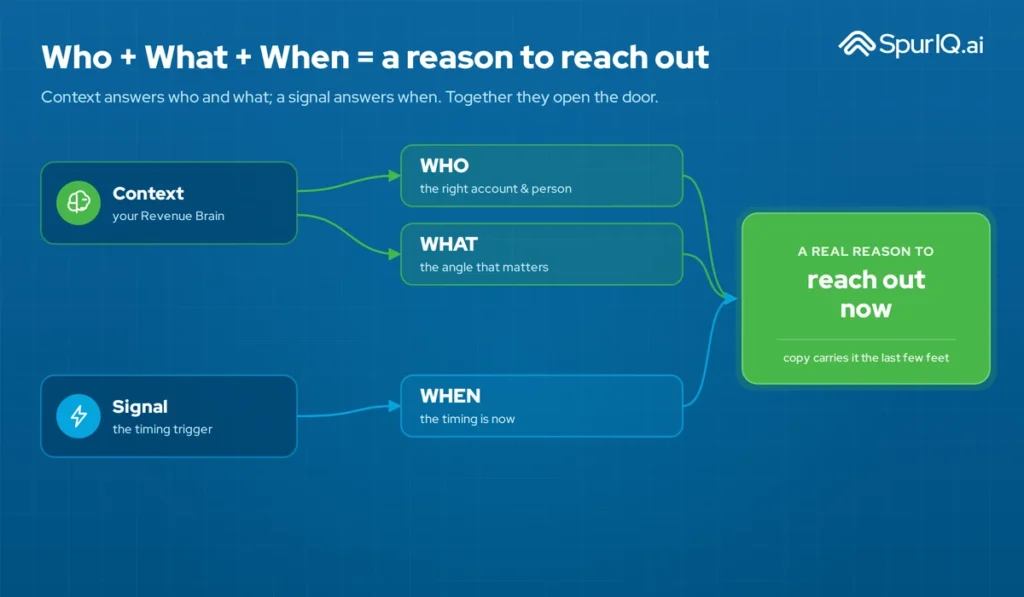
Your ICP, not as a slide, but as your best sellers actually apply it when they decide an account is worth their time. Your positioning. Which proof point lands with which segment, because the story that convinces a fintech buyer is not the one that convinces a manufacturer. And everything you have already learned about this account from prior touches. That body of knowledge is your context, and it is what tells you who to write to and what to lead with.
Here is the catch. Most teams never write any of it down. It lives in the heads of two or three strong sellers, and it leaves when they do. Turning it into something the whole team can use, consistently, is real work, and it is exactly the work most outbound programmes skip on their way to arguing about subject lines.
The when comes from a signal
Context tells you an account is a fit. It does not tell you that this week is the moment. That is what a signal is for.
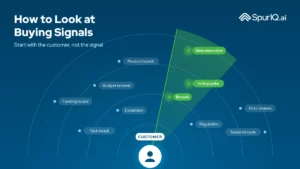
A signal is something you can observe that suggests the timing is now: a hire, a funding round, a leadership change, a product move, an industry event that only means something if you know the space. It is the difference between reaching out because an account looks good on paper and reaching out because something just happened that makes your offer relevant today.
And the two halves need each other. Neither works alone.
- A signal on its own tells you something happened, but not whether it matters to you. A funding round is just news until your company knowledge explains why it changes anything for this buyer.
- Context on its own tells you an account is a fit, but not that now is the time. You know they should buy eventually, you just have no reason to write this week.
Put them together and you get the one thing that actually opens the door: a specific, relevant reason to reach out now. That reason is what makes a message worth reading, and it is decided long before anyone picks a single word.
A signal tells you when. Context tells you whether it matters. Only together do they give you a reason to reach out that earns the buyer’s attention.
Also Read:- Buy Signals vs Intent Data: What Actually Triggers a Sale in 2026
What this looks like in real campaigns
The theory is clean, but it only lands in the specifics. Here are three cases from how signal-led outbound actually plays out. In each one, watch the who, the what and the when do the work, and notice that the copy itself was nothing special.
The same signal, two companies, two different angles
Two vendors both spot the same trigger at a target account: the company just hired its first VP of Sales. Identical signal. But the right message is different for each, because their context is different.
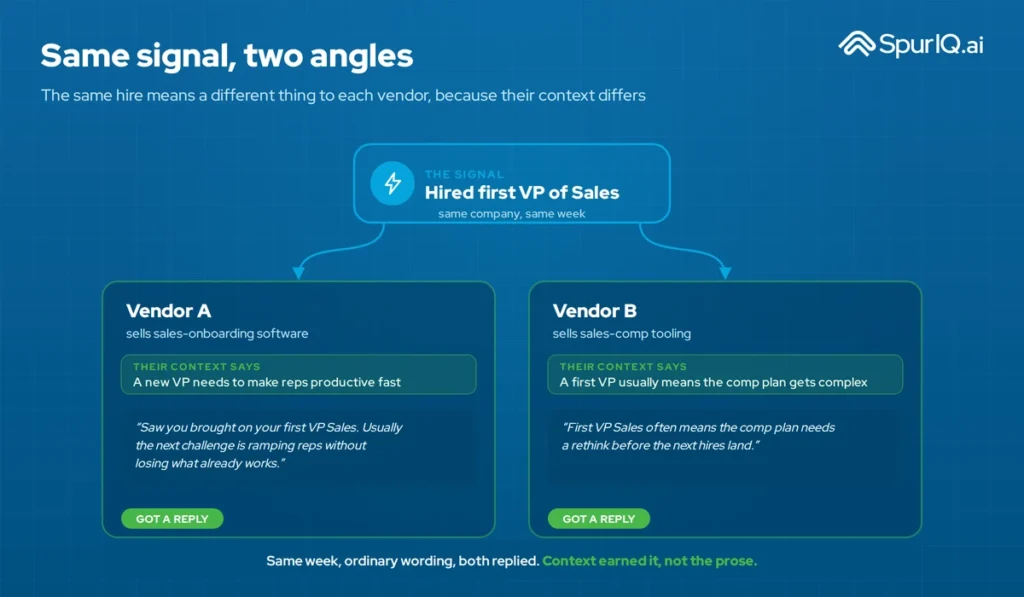
The first vendor sells sales-onboarding software. Their context tells them what that hire means for their buyer: a new VP will need to make new reps productive fast. So that is the angle they lead with, the week the hire happens.
| “Saw you brought on your first VP Sales. Usually the next challenge is ramping reps without losing what already works.” Plain wording. Nothing clever about it. |
The second vendor sells sales-compensation tooling. Same company, same hire, but their context points somewhere else entirely: a first VP usually means the comp plan is about to get more complicated.
| “First VP Sales often means the comp plan needs a rethink before the next hires land.” Equally ordinary. Also a reply. |
Same signal, same week, two messages that work. Not because either was well written, but because each vendor’s company knowledge told them what that hire meant for their buyer. Relevance earned the reply, not the prose.
The signal everyone sees, versus the one only an insider catches
Everyone can see a funding round. It shows up in every tool, which means every competitor emails that account the same congratulations note in the same week. The signal is real, but it is crowded, and it rarely says anything specific about the buyer’s actual problem. A “congrats on the raise, we help companies scale” message lands in a pile of twenty identical ones. Well written or not, it is noise.
Now take a signal that only someone who knows the space would even recognise. A fraud-related spike surfacing in a company’s app reviews. A compliance deadline specific to their sector. A shift in how their industry buys. The wording of the outreach can be just as ordinary, but the reason to reach out is precise, so it reads as “this person understands my business,” not “this person saw my press release.”
The second one converts better, and not because it is written better. It converts because the sender knew which signal actually predicts a need in that industry, and most competitors never even see it. That is context doing its job.
When the fit is right but the timing is not
Sometimes an account is a clean ICP fit and there is simply no signal. The context says yes, this is a buyer. The timing says not this week. The wrong move is to force a message anyway, because a strong fit with no real reason to reach out is just a well-targeted stranger.
What a good system does here is not send and hope. It holds the account, keeps it in view, and waits for the signal that makes the timing real, then reaches out with the angle the context already worked out. Deliberate patience beats a forced email that teaches the buyer to ignore you.
How SpurIQ turns this into a repeatable motion?
This is the model SpurIQ is built on, so it is worth being specific about how the three decisions map to the product.
The who and the what come from the Revenue Brain, SpurIQ’s living memory of how your company sells: your ICP as your best sellers actually apply it, your positioning, your proof points by segment, and your account history. That is what lets a workflow decide who to write to and what angle to lead with, specific to your business rather than a generic template.
The when comes from signals worked out for your business. During setup we do not stop at the obvious triggers everyone can see. We work out, with you, which events actually predict a need in your world, including the industry-specific ones a generic tool would never flag, and the workflow watches for those.
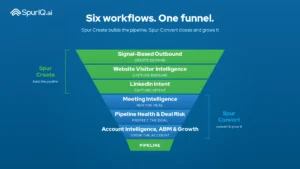
The point of both is to take the judgment your strongest sellers make in their heads, who, what and when, and turn it into logic the whole team runs consistently. That is what scales your best seller instead of losing them. In practice this runs through Spur Create, the pipeline side of SpurIQ, with Signal-Based Outbound workflow as the live, managed workflow doing exactly this today. The copy still matters at the end, but it is the last step, sitting on top of a message that already has a real reason to exist.
Give a workflow the context and the signals, and average copy is enough. That was always the point: the hard part was never the writing.
Final Words
Copy is the last five percent of outbound, and the only part a competitor can lift from you. Who you target, what you lead with and when you reach out is the ninety-five percent that decides whether a message works. It compounds over time, it cannot be copied, and that is exactly why almost nobody invests in it. They argue about subject lines instead.
If your reply rates are flat, the fix is almost never a better opener. It is a better reason to be in that inbox at all. Get the context and the timing right, and the words take care of themselves.
Build More Pipeline. Close More Deals.
Frequently asked questions:
Does copy not matter at all, then?
It matters, but it is the last five percent, not the first. Clear, relevant, human writing helps. The mistake is spending most of your effort there while the decisions that actually determine the outcome, who you target, what angle you lead with, and when you reach out, get almost no attention. Fix those first and ordinary copy performs. Perfect the copy on top of bad targeting and you have polished a message nobody had a reason to open.
What is the difference between a signal and context?
A signal tells you when: something observable just happened that suggests now is the moment, like a hire, a funding round or an industry-specific event. Context tells you who and what: your ICP, positioning, proof points and account history, the knowledge that decides whether that signal matters to you and what angle to lead with. A signal without context is just news. Context without a signal is a fit with no reason to act this week. You need both.
Why would an industry-specific signal convert better than a funding round?
Because everyone can see a funding round, so the account gets the same congratulations email from twenty vendors in the same week. An industry-specific trigger is one only someone who understands that market would recognise, so far fewer competitors act on it, and the reason to reach out is precise. It reads as “this person understands my business,” which is what earns a reply, rather than “this person saw my press release.”
What should you do with a perfect-fit account that has no signal?
Usually, wait. A strong fit with no live signal is a well-targeted stranger, and forcing a message teaches the buyer to ignore you. The better move is to hold the account, keep it in view, and reach out the moment a real signal fires, using the angle your context already worked out. Deliberate patience beats a forced email almost every time.
How does SpurIQ help with this?
SpurIQ holds your company context in the Revenue Brain, your ICP, positioning, proof points and account history, so a workflow can decide who to write to and what to lead with. It pairs that with signals worked out for your specific business, including industry-specific ones, so it knows when. Signal-Based Outbound is the live, managed workflow that runs this today on the Spur Create side. The result is messages with a real reason to exist, where the copy is genuinely the last step.