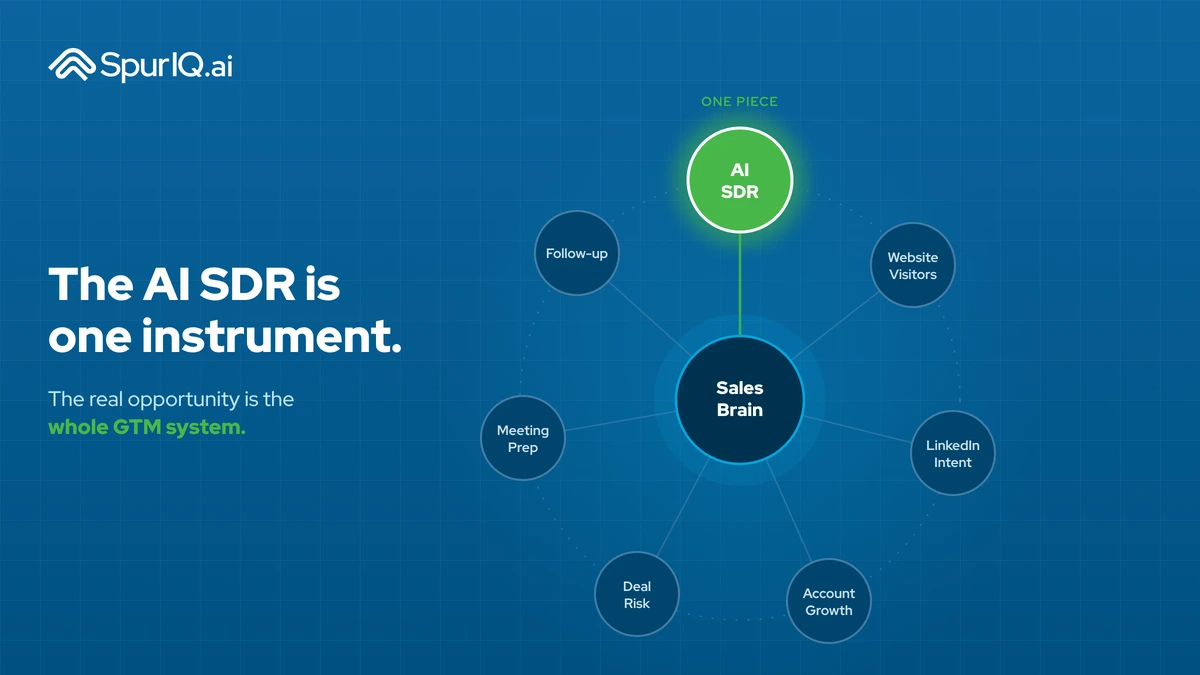
The AI SDR is having its moment. It deserves some of the attention. But it is one function inside a much bigger opportunity, and treating it as a category of its own is where teams get the decision wrong.
Scroll through any GTM feed right now and you will see the same promise on repeat: hire an AI SDR, point it at a list, and watch the pipeline appear. The pitch is clean, the demos look slick, and plenty of teams are buying.
There is something real underneath the hype. Software can genuinely take a lot of the manual grind out of outbound. That part is worth being excited about. The problem is the framing. An AI SDR is being sold as a new category of product, when it is really one job inside a larger system. Understand that difference and you will spend your budget on the thing that actually moves revenue, rather than the thing that is trending.
Two simple ideas explain why.
What is an AI SDR?
An AI SDR is software that does the job of a sales development rep: it sends outbound. It builds or takes a list, writes the emails, and runs the sequence. For that narrow job it can genuinely help, and that is the part of the hype that holds up.
The limit shows up the moment you ask it to be smart about who it writes to and what it says. On its own, an AI SDR sends without really knowing how your company sells. There is no lasting memory of your ICP as your best reps actually apply it, your positioning, the proof points that land with each segment, or the history you already have with an account. So every campaign starts from a blank slate, and you end up teaching it the same things over and over. Load the ICP again. Re-explain the angle. Paste in the context. Next campaign, repeat.
What is an AI GTM system?
An AI GTM system is the bigger thing the AI SDR is one piece of. Instead of a single tool that sends, it is a set of workflows that run the whole go-to-market motion, and they all share one memory of how your company sells.
That shared memory is the difference. The knowledge about your business lives in one place and stays there, so the targeting, the messaging and the follow-through all reason from the same picture. You set it once, and every workflow draws from it. In that setup, the AI SDR is simply one of the things the memory powers, rather than a tool you re-brief each Monday. Here is the contrast, side by side.
| An AI SDR, on its own | An AI GTM system |
|---|---|
| Sends outbound | Runs the full revenue motion, from first touch to account growth |
| Starts each campaign from a blank slate | Carries your ICP, positioning, proof and account history across every workflow |
| Works the top of the funnel only | Works pipeline creation and deal progression together |
| One function | A set of workflows sharing one memory |
| You re-teach it every time | It learns once and applies that everywhere |
An AI SDR sends. An AI GTM system remembers how you sell and acts on it everywhere. One is a feature of the other.
Why outbound is only half the job
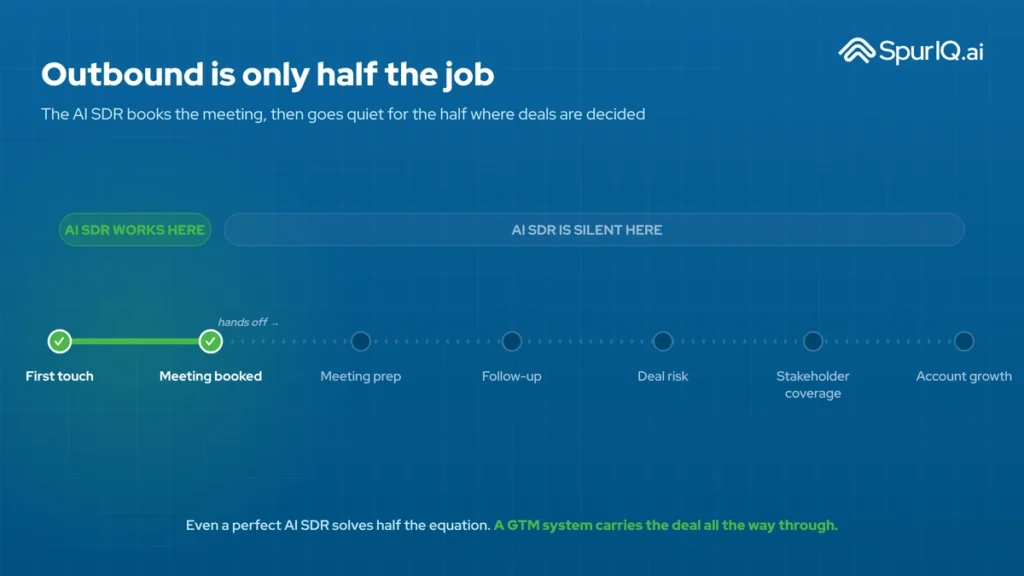
Here is the second idea, and it is the one most teams feel in their numbers before they can name it.
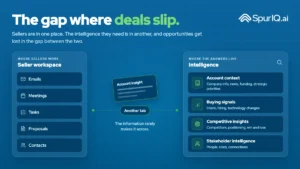
Creating pipeline is only half of how revenue actually happens. An AI SDR lives entirely in that first half. It books the meeting and hands off. Everything that comes after, the part where a lot of hard-won pipeline quietly slips away, sits completely outside what any AI SDR touches.
Think about where deals actually stall once they exist:
- Meeting prep: A rep walks into a call carrying whatever they happen to remember, because pulling the full history from four tools takes time nobody has.
- Follow-up: The recap and the next step slip to tomorrow, then to next week, and the momentum cools.
- Deal risk: A deal goes quiet, loses its next step, or rests on a single champion, and the warning signs surface at the forecast review instead of while there is still time to act.
- Stakeholder coverage: One contact is engaged and the other five decision-makers are strangers to the deal.
- Account growth: The renewal creeps up and the expansion opportunity goes unnoticed, which is the cheapest revenue in the building left on the table.
An AI SDR is silent through all of that. It was built to start conversations, not to carry them through to closed and then to grown. So even a perfect AI SDR solves half the equation, and it is usually the half that was already working better than the second.
The real opportunity: one system that runs both halves
Put the two ideas together and the picture is clear. The opportunity worth chasing is not a smarter outbound bot. It is a system that understands how your company sells and uses that understanding across the entire revenue motion, from the first touch all the way through to a renewed and growing account.
That is a system that creates pipeline and also progresses it. One that drafts the cold email and also preps the meeting, writes the follow-up, flags the deal going quiet, and surfaces the expansion play, all reasoning from the same memory of your business. The AI SDR is one contributor inside it, doing its one job well, with the context it was always missing on its own.
How SpurIQ runs both halves on one memory
A system that runs the full motion on one shared memory is exactly the model SpurIQ is built on, so it is worth being specific about how the two halves fit together.
Everything runs on a shared memory of how your company sells, the Revenue Brain: your ICP as your best sellers apply it, your positioning, your proof points by segment, and your account history. Every workflow reasons from that same understanding, which is what makes the output specific to your business rather than a generic template, and what means you set the context once instead of re-teaching it every campaign.
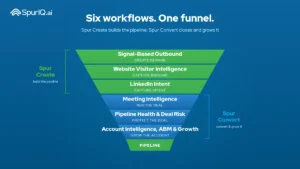
SpurCreate handles the first half
The pipeline-creation workflows, including, which is the live, managed workflow that does the job an AI SDR claims to do, except grounded in your company knowledge and your real buying signals rather than a blank list.
SpurConvert handles the second half
The workflows for everything after pipeline exists: meeting prep, follow-up, deal risk, stakeholder coverage and account growth. This is the half an AI SDR never reaches, and the half where a lot of revenue is decided.
One honest note, because this is a decision piece. These workflows sit at different stages of maturity today: Signal-Based Outbound workflow and LinkedIn Intent are live and managed with customers now, while the Spur Convert workflows are available to build or in pilot. SpurIQ is delivered as a managed deployment, and we scope each engagement to what is genuinely ready for you. The point stands either way: the value is in one system that runs both halves on one memory, not in a bolt-on bot for the first half alone.
The goal was never a better SDR in a box. It is one memory of how you sell, working across the whole motion, with outbound as a single piece of it.
How to tell a feature from a system in one question
If you are weighing an AI SDR against a GTM system, one question cuts through most of the noise.
Ask what happens after the meeting is booked. If the answer is “it hands off and the rest is on us,” you are looking at a feature. If the answer covers the meeting, the follow-up, the deal risk and the account afterward, all from the same understanding of how you sell, you are looking at the actual opportunity.
Final Words
The AI SDR earns a share of the attention it is getting, because taking the grind out of outbound is real progress. It just is not the whole story, or even half of it in value. It is one function, it starts cold each time without a memory of your business, and it goes quiet the moment a meeting is booked.
The bigger prize is a GTM system that remembers how your company sells and acts on that across the full motion, creating pipeline and then carrying it through to a closed, growing account. Outbound is one instrument in that. Worth having. Just not the whole orchestra.
Frequently asked questions:
Are AI SDRs useless, then?
Not at all. An AI SDR can genuinely reduce the manual work in outbound, and that is worth something. The caution is about framing: it is one function, not a category. Sold as a standalone product, it starts cold every campaign and stops the moment a meeting is booked. As one workflow inside a system that knows how you sell, the same capability becomes far more useful.
What does an AI SDR miss that a GTM system covers?
Two things. First, memory: an AI SDR has no lasting understanding of your ICP, positioning, proof or account history, so you re-teach it each time, while a system holds that once and shares it everywhere. Second, scope: an AI SDR works outbound only, while a system also runs meeting prep, follow-up, deal risk, stakeholder coverage and account growth, which is where a lot of created pipeline is won or lost.
Why does a shared memory matter so much?
Because it is what makes every action specific to your business instead of generic. When your ICP, messaging, proof and account history live in one place, a cold email, a meeting brief and an expansion play all reason from the same picture of how you sell. You set it once, and it compounds across every workflow rather than being re-explained for each one.
Where does SpurIQ fit in?
SpurIQ is a GTM system built on a shared memory called the Revenue Brain. Spur Create covers pipeline creation, including Signal-Based Outbound, the live managed workflow that does the AI SDR job grounded in your company knowledge. Spur Convert covers meeting prep, follow-up, deal risk and account growth. It is delivered as a managed deployment, and coverage is scoped to what is ready for you, with the convert-side workflows at build or pilot stage today.
Should I buy an AI SDR or wait for a full system?
Start with the half that is losing you the most revenue. If you need qualified pipeline and have none, a signal-led outbound workflow is a sensible first step, as long as it carries your company context rather than starting cold. If pipeline exists but keeps slipping after the meeting, the second half matters more. The advantage of a system is that you can begin with one workflow and extend across the motion on the same memory, rather than buying a separate tool for each stage.