
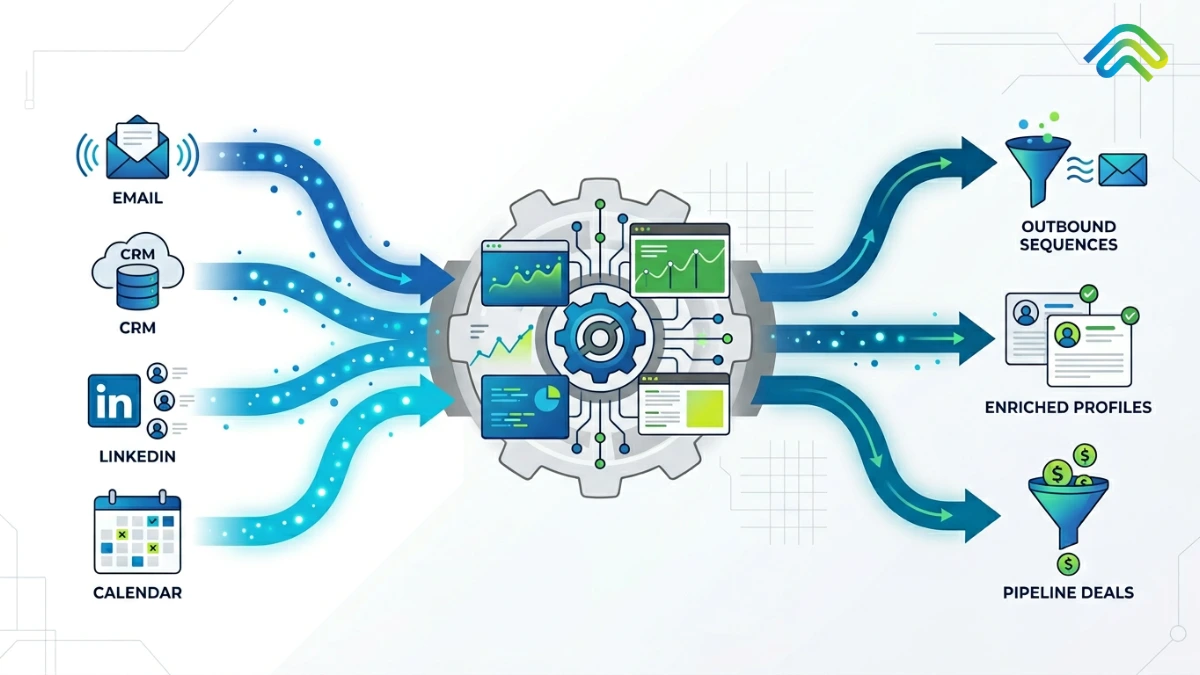
If you’ve been anywhere near B2B sales or marketing conversations lately, you’ve probably heard someone mention GTM engineering. Maybe it was a LinkedIn post about a “GTM engineer” replacing an entire SDR team. Maybe it was a job listing with a $135K median salary for a role that didn’t exist two years ago.
Either way, the buzz is real. And it’s not just hype.
GTM engineering is one of the fastest-growing disciplines in B2B revenue and for good reason. As customer acquisition costs climb (now roughly $2 in sales and marketing spend for every $1 of new ARR, a 14% increase since 2024), companies need a fundamentally different approach to building pipeline.
This guide breaks down what GTM engineering actually is, why it emerged, how it works as a framework, the tools that power it, and, critically, where most GTM engineering setups still fall short on execution.
What Is GTM Engineering?
GTM engineering is the practice of designing, building, and maintaining automated systems that power B2B revenue operations. Instead of relying on manual sales outreach and disconnected marketing tools, GTM engineers create integrated workflows that connect data enrichment, lead scoring, CRM management, intent signals, and outbound sequences into a single, automated revenue engine.
Think of it this way: if your go-to-market strategy is the what and why, GTM engineering is the how, the technical infrastructure that turns strategy into repeatable, scalable execution.
The role sits at the intersection of sales, marketing, and engineering. A GTM engineer doesn’t just operate existing tools. They build the connective tissue between them, stitching together APIs, configuring automation workflows, setting up signal-based triggers, and designing data pipelines so that the right action reaches the right buyer at the right time.
GTM Engineering in a Nutshell
| Aspect | Description |
| Definition | The technical discipline of building automated systems that power B2B revenue operations |
| Core Function | Connects data, tools, and workflows into a unified pipeline generation engine |
| Key Shift | Moves outbound from volume-based (blast and pray) to signal-based (detect and act) |
| Who Does It | GTM engineers — a hybrid of RevOps, sales engineering, and data engineering |
| Why Now | Rising CAC, tool sprawl, and AI maturity make manual GTM unsustainable |
Why Did GTM Engineering Emerge?
GTM engineering didn’t appear out of thin air. It emerged around 2024 as a response to three converging pressures that made traditional outbound models increasingly unsustainable.
1. Customer Acquisition Costs Are Rising Fast
According to the 2025 Benchmarkit report, the blended customer acquisition cost (CAC) ratio is now 10% higher than in 2022. Companies are spending more to acquire each dollar of revenue, and simply adding more SDRs to the headcount doesn’t scale the way it once did.
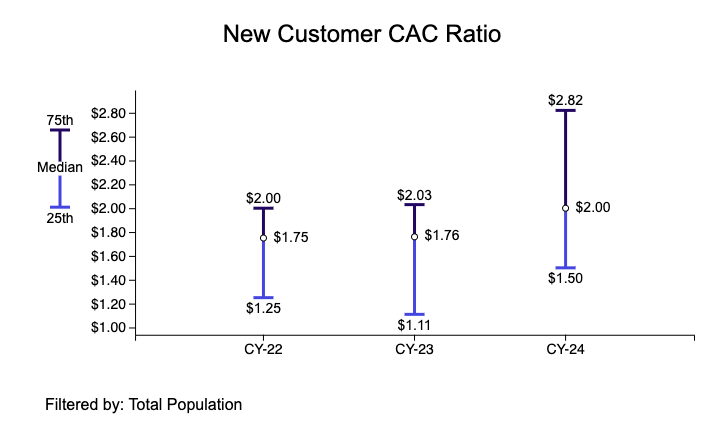
The math is clear: one strong GTM engineer who builds workflows that dozens of reps can leverage produces better ROI than hiring five additional SDRs to manually prospect from static lists.
2. Tool Sprawl Has Created Fragmentation
The average B2B sales team now uses more than 10 different tools daily. Intent data flows in from one platform, enrichment happens in another, CRM sits separately, and outbound sequences run in yet another tool. The result is fragmented workflows, duplicated data, and reps who spend more time context-switching between tabs than actually selling.
Research consistently shows that sales reps spend approximately 70% of their week on non-selling activities, admin tasks, data entry, research, and tool management. GTM engineering addresses this by creating a unified system where data flows automatically between tools, eliminating the manual glue work that eats up selling time.
3. Buyers Have Changed
Over 80% of B2B buyers finalise mid-market purchasing decisions within six months, often without ever contacting a vendor directly. By the time a sales rep gets involved, the buyer has already done extensive independent research. This means outbound needs to be timely, contextual, and triggered by actual buying signals, not blasted from a static list.
GTM engineering makes this possible by detecting intent signals (website visits, content downloads, job changes, funding announcements) and automatically routing them to the right action at the right time.
What Does a GTM Engineer Actually Do?
A GTM engineer’s day-to-day responsibilities vary depending on the company’s maturity, but the core work falls across six stages of what’s often called the GTM engineering framework. Here are the 6 stages GTM Engineering Framework:
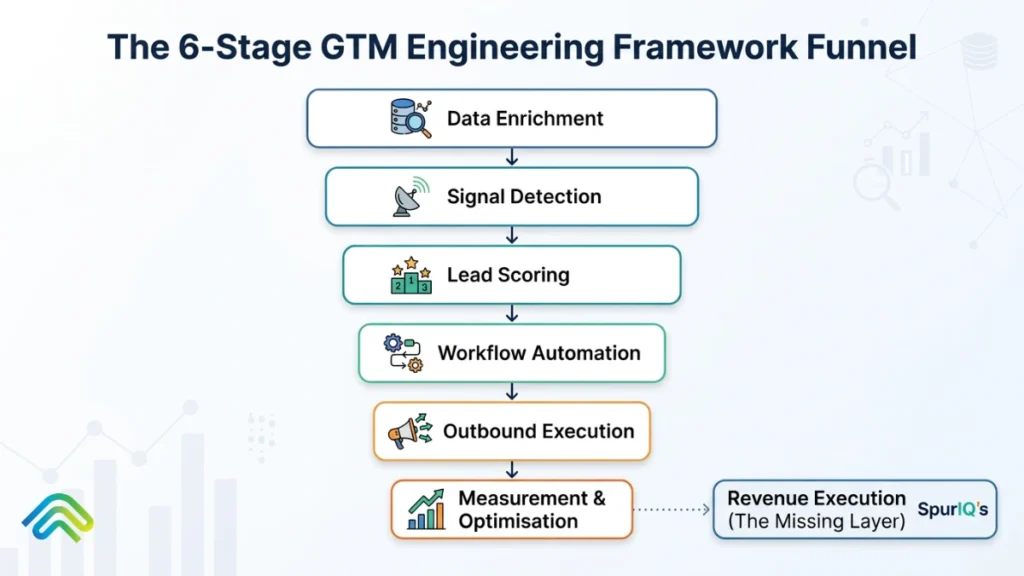
Stage 1: Data Enrichment
Building and maintaining the data layer that powers everything else. This includes setting up enrichment pipelines using tools like Clay, Apollo, or ZoomInfo to automatically pull firmographic, technographic, and contact data into the CRM. Without clean, enriched data, everything downstream breaks.
Stage 2: Signal Detection
Configuring systems that monitor buyer intent signals, website visits, pricing page activity, content engagement, job changes, funding rounds, tech stack changes. The goal is to identify accounts showing active buying behaviour before a competitor does.
Stage 3: Lead Scoring and Prioritisation
Building scoring models that move beyond static firmographic rules. Modern GTM engineers use a combination of intent signals, engagement data, and contextual factors to dynamically rank which accounts deserve immediate attention.
Stage 4: Workflow Automation
Designing the automated workflows that connect signals to actions. When an account hits a threshold score, the system automatically triggers the right response, whether that’s adding the account to an outbound sequence, alerting a rep, or enriching the contact with additional buyer research.
Stage 5: Outbound Execution
Building multi-channel outbound sequences (email, LinkedIn, phone) that are triggered by signals rather than calendars. The personalisation layer is critical here, sequences pull enriched data to customise messaging at scale without losing relevance.
Stage 6: Measurement and Optimisation
Tracking the metrics that actually matter: meetings booked, pipeline generated, conversion rates by signal type, and cost per qualified meeting. GTM engineers run this as an iterative engineering loop, testing, measuring, and optimising continuously.
GTM Engineering vs RevOps: What’s the Difference?
This is one of the most common questions in the space, and the distinction matters.
RevOps manages and optimises existing tools and processes. RevOps professionals maintain CRM hygiene, build reporting dashboards, manage sales territories, and ensure operational consistency across the revenue organisation.
GTM engineering builds net-new infrastructure. GTM engineers create the automated systems from scratch, the data pipelines, enrichment workflows, signal engines, and outbound automation that generate pipeline.
A Bloomberry analysis found that nine out of ten RevOps responsibilities also appear in GTM engineering job listings. The difference lies in the build-versus-operate distinction. RevOps keeps the current engine running smoothly. GTM engineering builds a faster engine.
In practice, the two roles are complementary. A GTM engineer designs and builds the automated outbound machine. RevOps ensures the CRM, reporting, and process infrastructure supports it. The most effective revenue teams have both.
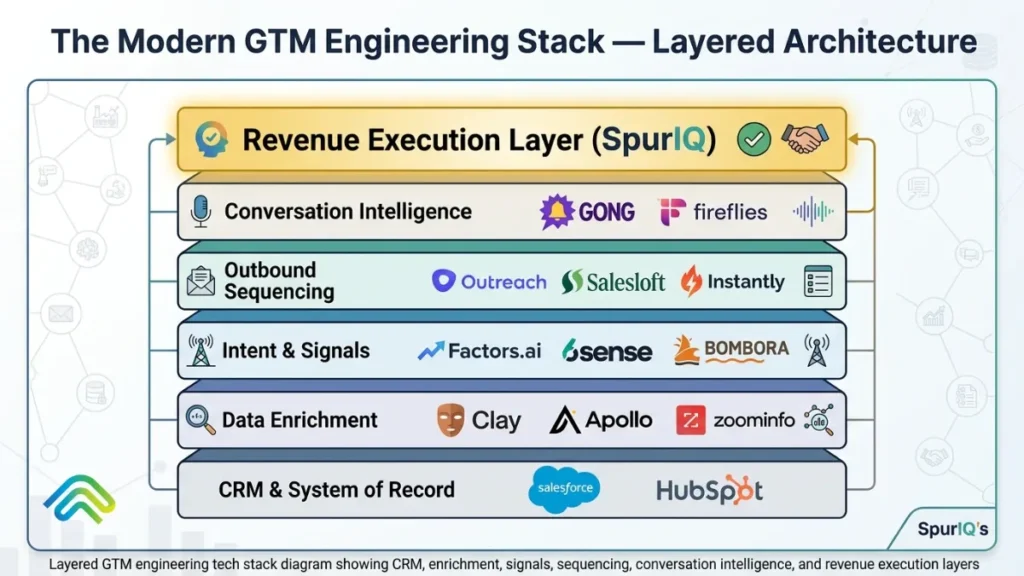
What are the GTM Engineering Tech Stacks in 2026?
The tooling landscape for GTM engineers has consolidated around several core categories. Here’s what the best growth engineering software for GTM looks like in 2026.
1. Data Enrichment and Prospecting
Tools like Clay, Apollo.io, ZoomInfo, and Wiza form the data foundation. Clay has become particularly popular with GTM engineers because of its waterfall enrichment approach, pulling data from multiple providers in sequence to maximise accuracy.
2. Workflow Automation
Zapier, Make (Integromat), and n8n handle the automation glue between systems. For more technical GTM engineers, Claude Code and custom Python scripts are increasingly used to build complex, logic-driven workflows that no-code tools can’t handle.
3. Intent and Signal Detection
Factors.ai, 6sense, Bombora, and G2 provide the intent signal layer. These platforms detect which accounts are actively researching solutions and surface that intelligence to sales teams.
4. Outbound Sequencing
Outreach, Salesloft, Instantly, and Apollo power the actual outbound execution, email sequences, call cadences, and LinkedIn touchpoints triggered by enriched data and intent signals.
5. CRM and System of Record
Salesforce, HubSpot, and Zoho remain the CRM backbone. The GTM engineer’s job is to ensure data flows cleanly into these systems automatically, rather than depending on reps to manually update records.
6. Conversation Intelligence
Gong, Fireflies.ai, and similar tools capture and analyse sales conversations. The best setups use these insights to feed back into the GTM engine, adjusting sequences, scoring models, and enrichment based on what’s actually happening in conversations.
What Is a GTM Engineering Framework?
A GTM engineering framework is the structured methodology that connects strategy, systems, and execution into a repeatable pipeline generation machine.
The most effective frameworks share four common principles:
1. Signal-First, Not List-First
Instead of building static prospect lists and blasting them, the framework starts with signals, buying intent indicators that suggest an account is actively in-market. Everything downstream triggers from these signals.
2. Enrichment at Every Stage
Data isn’t enriched once and forgotten. The framework continuously enriches accounts and contacts at each stage, adding buyer research before calls, updating CRM fields after interactions, and appending new intent signals as they emerge.
3. Automation With Human-in-the-Loop
The framework automates repetitive execution (data entry, enrichment, CRM updates, initial outreach) while keeping humans in the loop for high-judgement activities (complex conversations, deal negotiation, relationship building).
4. Closed-Loop Measurement
Every workflow feeds data back into the system. Sequence performance, conversion rates, and revenue outcomes are tracked and used to optimise future iterations. The framework treats pipeline generation as an engineering problem, not a volume problem.
The Missing Layer: Why GTM Engineering Alone Isn’t Enough
Here’s where most conversations about GTM engineering stop, and where the real problem begins.
GTM engineers are brilliant at building the top-of-funnel machine. They can detect signals, enrich data, automate outbound, and generate pipelines with remarkable efficiency. But what happens after the pipeline is generated?
What happens after the first call? After the demo? After the proposal is sent?
This is the gap that most B2B organisations still haven’t solved. We call it the revenue execution gap, the space between generating a signal and consistently executing every revenue action that needs to follow.
Consider the data:
- 52% of sales reps never make a second follow-up attempt, despite research showing 80% of deals need 5–12 touchpoints to close.
- 70% of a rep’s week is spent on non-selling activities like CRM updates, buyer research, and admin work.
- 45% of sales contacts never get logged in CRM systems, meaning leadership can’t coach what they can’t see.
- B2B contact data decays 30–70% annually, which means even well-enriched CRM records go stale fast.
The GTM engineer builds the engine that generates the lead. But once that lead enters the pipeline, execution depends on human memory, manual CRM updates, and individual rep discipline. Deals don’t get lost because the outbound was bad. They quietly decay because nobody owned the follow-through.
Where Revenue Execution Plugs Into GTM Engineering?
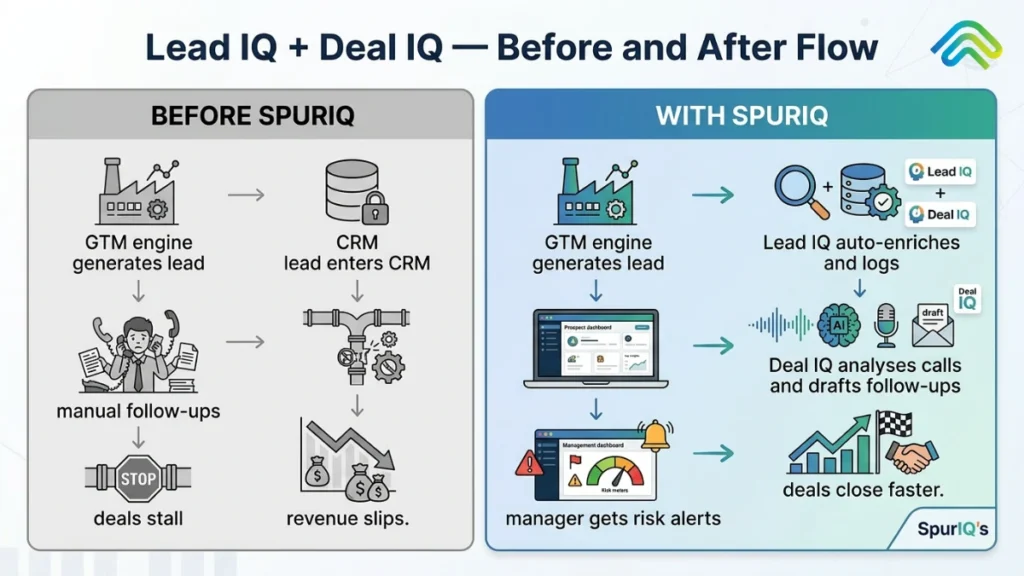
This is where the concept of revenue execution, the discipline of ensuring every revenue action gets completed consistently after buyer interactions, becomes critical.
The best GTM engineering setups in 2026 don’t just stop at pipeline generation. They include an execution layer that ensures the actions downstream of signal detection and outbound actually happen.
At SpurIQ, this is the exact problem we solve. Our AI orchestration layer sits on top of the GTM stack that engineers have already built, Salesforce, HubSpot, Outreach, Gong, and others and automates the execution that falls through the cracks after the first interaction.
Lead IQ, our top-of-funnel execution agent, works at the stage where GTM engineering hands off to sales. When a new lead is detected, from a booked meeting, an email reply, a form fill, Lead IQ automatically enriches the buyer profile, logs the interaction in the CRM, prepares contextual talking points for the rep, and ensures the first response happens within minutes, not hours.
Deal IQ, our bottom-of-funnel execution agent, takes over once a deal is in motion. It analyses call transcripts, drafts contextual follow-up emails, scores deal health, flags risks to managers, and keeps CRM data accurate without reps touching a keyboard.
In our live pilots, CRM data quality jumped from roughly 40% to 95% within three weeks. Reps reclaimed 30–60 minutes per day. Deals that previously sat idle for 30+ days started moving through the pipeline again.
The insight for GTM engineers is straightforward: your outbound engine generates the opportunity. An execution layer ensures it doesn’t die of neglect once it’s in the pipeline.
GTM Engineer Salary and Career Outlook
For professionals considering a move into GTM engineering, the compensation data is encouraging.
According to a 2026 survey of 228 GTM engineers, the median base salary in the United States is approximately $135,000, with top-end compensation at companies like Vercel ($252,000), OpenAI ($250,000), and Ramp ($184,000) well above that figure.
Non-US GTM engineers report a median closer to $75,000, reflecting an 80% geographic premium for US-based talent.
The salary range is wide because the role itself spans a broad skill spectrum:
- Low-code operators (Clay, Zapier, Make) — median around $90,000
- Mid-level technical builders (scripting, APIs, data engineering) — median around $120,000–$140,000
- High-code engineers (Python, SQL, custom integrations) — median $150,000+, with some exceeding $200,000
LinkedIn listed over 3,000 open GTM engineering positions in January 2026, and the demand curve shows no sign of flattening.
Most Common Career Paths Into GTM Engineering
- SDR/BDR → GTM Engineer: The most common transition. Former reps bring pipeline instincts and apply technical skills to automate what they once did manually.
- RevOps/Sales Ops → GTM Engineer: Operations professionals add engineering capabilities to their existing process knowledge.
- Marketing Ops → GTM Engineer: Marketers with technical skills who want to move closer to revenue outcomes.
- Software Engineering → GTM Engineer: Engineers attracted to the business impact and faster iteration cycles of revenue systems.
What are the best Practices for GTM Engineering in 2026?
Based on what the best-rated growth engineering companies for GTM are doing, here are the practices that separate high-performing GTM engineering teams from the rest.
Fix Your Data Before You Automate
Automated systems amplify bad data. If your CRM records are outdated or duplicated, enrichment pipelines and outbound sequences will propagate errors at scale. Invest in data hygiene infrastructure before layering on automation.
Start With One Workflow, Not Ten
Resist the urge to automate everything simultaneously. Build one complete signal-to-meeting workflow, prove it generates a qualified pipeline, and then expand. The most common failure mode in GTM engineering is building complex systems that nobody maintains.
Consolidate Before You Expand
According to Forrester, two-thirds of teams juggle 16 or more martech solutions. Before adding new tools, audit your stack for overlap. The winning GTM stack in 2026 is simple: one clean CRM, one signal layer, one outbound engine, and one execution layer, working together with tight workflows and AI automation.
Build For Signal-Based, Not Volume-Based
Signal-based outbound campaigns consistently achieve reply rates of 15–25%, compared to the 3–5% average for generic cold outreach. Configure your systems to trigger on buyer behaviour (pricing page visits, funding announcements, hiring surges) rather than blasting static lists.
Don’t Forget Post-Pipeline Execution
The most sophisticated GTM engineering setup in the world is worthless if deals die in the pipeline from neglected follow-ups, stale CRM data, and missed touchpoints. Build or plug in an execution layer that ensures every post-signal action gets completed, automatically.
Final Words
GTM engineering is not a trend, it’s a structural shift in how B2B companies build revenue. The discipline takes what used to be manual, headcount-dependent outbound and transforms it into an automated, signal-driven system.
But here’s the part most articles miss: generating pipeline is only half the equation. The other half, ensuring every revenue action gets executed consistently after the first interaction, is where most B2B teams still lose 20–30% of their potential revenue.
The companies winning in 2026 aren’t just building better outbound engines. They’re building complete revenue execution systems, from first signal to final close, where nothing falls through the cracks because execution is owned by AI agents, not human memory.
That’s the future of GTM engineering. And it starts with asking a harder question than “how do we generate more pipeline?” It starts with: “What happens to the pipeline after we generate it?”
Frequently Asked Questions (FAQs):
Q. What is GTM engineering?
GTM engineering is the technical discipline of designing, building, and maintaining automated systems that power B2B revenue operations, including data enrichment, intent signal detection, lead scoring, outbound sequencing, and CRM management.
Q. What does a GTM engineer do?
A GTM engineer builds the automated infrastructure that connects a company’s go-to-market tools and data. This includes creating data enrichment pipelines, configuring signal detection systems, designing outbound workflows, and measuring pipeline performance.
Q. What is a GTM engineering framework?
A GTM engineering framework is the structured methodology that connects signal detection, data enrichment, workflow automation, outbound execution, and measurement into a repeatable pipeline generation system. The best frameworks are signal-first, continuously enriched, and measured in closed loops.
Q. How is GTM engineering different from RevOps?
RevOps manages and optimises existing tools and processes. GTM engineering builds net-new automated infrastructure for pipeline generation. They’re complementary: GTM engineers build the engine, RevOps keeps it running.
Q. What are the best platforms for growth engineering in GTM?
The core GTM engineering stack in 2026 includes Clay (enrichment), Apollo or ZoomInfo (prospecting), Outreach or Salesloft (sequencing), Factors.ai or 6sense (intent signals), Salesforce or HubSpot (CRM), and Gong (conversation intelligence). Increasingly, AI orchestration layers like SpurIQ are added for post-pipeline execution.
Q. What is the average GTM engineer salary?
The median base salary for GTM engineers in the United States is approximately $135,000, with top-end compensation exceeding $250,000 at leading AI and SaaS companies. Non-US salaries average closer to $75,000.
Q. What skills do you need to become a GTM engineer?
Core skills include API integrations, workflow automation, CRM configuration, data analysis, and commercial understanding of pipeline mechanics. Approximately 38% of GTM engineering job postings require SQL or Python. Soft skills like cross-functional communication and systems thinking are equally important.