
Modern SaaS revenue teams don’t suffer from a lack of data.
They suffer from fragmentation.
Sales works inside CRM and sales engagement tools.
RevOps toggles between forecasting systems and spreadsheets.
Marketing tracks pipeline contribution in dashboards that sales rarely sees.
Individually, each system works. Together, they create blind spots.
The result is familiar to most revenue leaders:
- Deals stall after “good” calls
- Follow-ups weaken or disappear
- CRM hygiene decays quietly
- Forecasts look stable, until quarter-end surprises hit
Over the last few years, revenue intelligence platforms emerged to solve this visibility problem. And they helped. Leaders finally gained insight into pipeline health, deal risk, and rep activity.
But something didn’t change.
Execution still broke down.
Deals continued to slip not because teams lacked insight, but because no system owned what happened after the insight.
That’s the inflection point where Revenue Orchestration begins.
The Core Difference (In One Sentence)
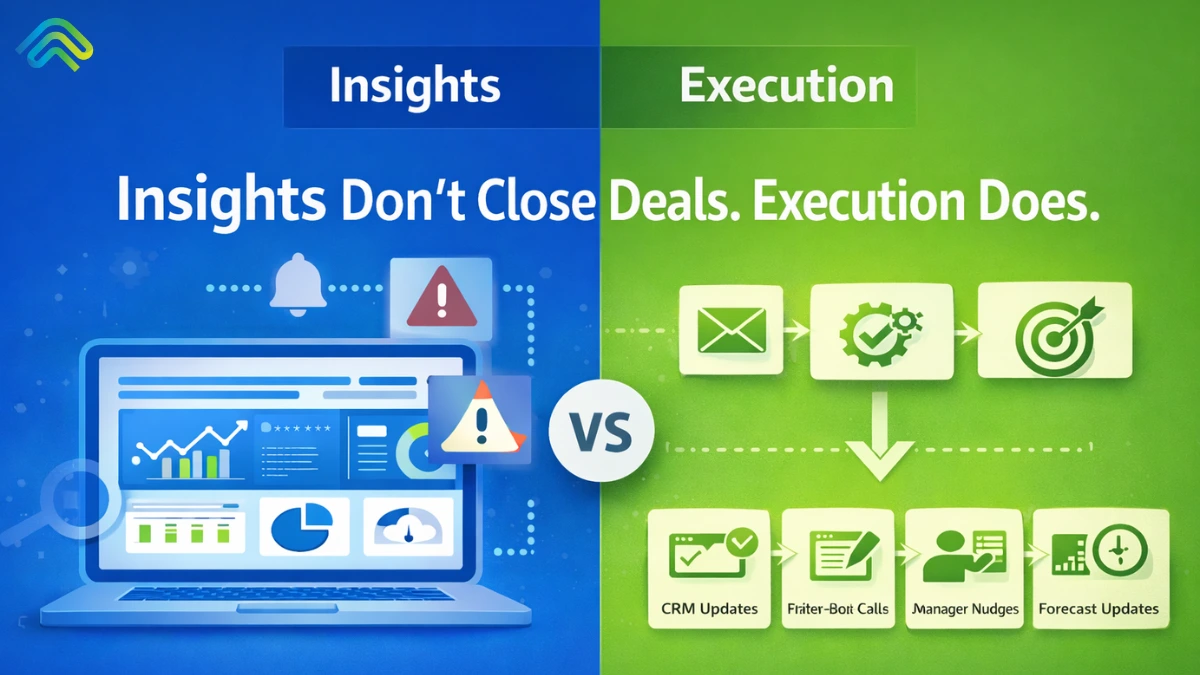
Revenue intelligence tells you what’s happening.
Revenue orchestration ensures the right actions actually happen.
This distinction is subtle, but decisive.

What Revenue Intelligence Actually Does Well?
Revenue intelligence platforms are designed to observe and interpret revenue activity.
They aggregate signals from:
- CRM activity
- Call recordings and transcripts
- Emails and meetings
- Historical performance data
From there, they provide:
- Pipeline visibility
- Deal risk indicators
- Forecasting support
- Sales performance analytics
This category includes widely adopted platforms like:
- Clari
- Gong
- People.ai
- Aviso
- Salesforce Einstein
These systems answer important questions:
- Which deals look risky?
- Where is pipeline slowing down?
- Which reps are missing activity?
For awareness and diagnosis, revenue intelligence is valuable.
But awareness is not action.
Also Read: Why AI Revenue Action Orchestration Beats Platform-Led RevOps Tools in 2026
Where Revenue Intelligence Stops Short?
The limitation isn’t technological, it’s operational.
After an insight surfaces, a human still has to execute:
- Decide the next step
- Remember to follow up
- Update CRM fields
- Coordinate across tools
- Ensure nothing slips
In practice, that handoff fails more often than teams admit.
Revenue leaders end up with:
- More dashboards
- More alerts
- More post-call summaries
But the same problems persist:
- Deals decay quietly
- Follow-ups weaken over time
- CRM updates happen late or never
- Forecast accuracy erodes
A useful analogy:
Revenue intelligence is a diagnostic report.
Revenue orchestration is the treatment.
What Revenue Orchestration Does Differently?
Diagnosis alone doesn’t restore revenue health.
Revenue orchestration is built around a simple idea:
“If revenue outcomes depend on actions, execution must be owned, not advised“.
Instead of telling sellers what’s wrong, orchestration systems make the right actions happen automatically inside the existing GTM stack.
This is where SpurIQ operates, intentionally outside the “dashboard race.”
SpurIQ’s View: Execution Is the Missing Layer
SpurIQ is designed around Revenue Execution, with Revenue Orchestration as the mechanism.
Rather than replacing tools, SpurIQ sits between them, connecting signals to actions.
What that means in practice:
- Buyer interactions are observed across calls, emails, and CRM
- AI agents interpret context, risk, and intent
- Next actions are executed automatically or nudged in real time
- CRM hygiene is handled without seller effort
- Forecasts reflect real execution, not stale fields
No new interface to learn.
No behavior change forced on reps.
No “remember to follow up” dependency.
Execution is owned.
Revenue Intelligence vs Revenue Orchestration (Clear Comparison)
| Dimension | Revenue Intelligence | Revenue Orchestration |
|---|---|---|
| Primary purpose | Visibility & insight | Execution & follow-through |
| Outcome | Awareness | Measurable revenue movement |
| Action dependency | Human-driven | System-driven |
| CRM hygiene | Remains manual | Automated |
| Forecast reliability | Insight-based | Execution-based |
| Scope | Mostly sales | GTM-wide |
This is not an upgrade to intelligence, it’s a shift in responsibility.
SpurIQ vs Traditional Revenue Intelligence Platforms
Platforms like Clari, Gong, People.ai, and Aviso are strong at surfacing signals. That remains valuable.
But SpurIQ is built for what happens next.
Where others stop at:
- “This deal looks risky”
SpurIQ continues with:
- Drafting follow-ups
- Updating CRM stages
- Nudging owners
- Surfacing manager interventions
- Preventing deals from going dark
In short:
Clari identifies risk.
SpurIQ resolves it.
This is why comparing SpurIQ as “another revenue intelligence tool” misses the point entirely.
It’s not a tool comparison, it’s a category shift.
Why Orchestration Is Becoming the RevOps Standard?
Most SaaS teams don’t need more insight. They need:
- Fewer tools
- Fewer decisions
- Cleaner data
- Predictable execution
Revenue orchestration delivers that by:
- Reducing manual RevOps work
- Eliminating execution gaps
- Increasing pipeline movement consistency
- Improving forecast confidence
As GTM stacks grow more complex, execution ownership becomes more important, not less.
When Revenue Orchestration Becomes Necessary?
Orchestration typically becomes essential when a company reaches:
- Multi-tool GTM environments
- 150–500+ employees
- Forecast volatility
- CRM trust issues
- RevOps bottlenecks
At that stage, insight without execution becomes a liability.
The Bigger Shift: From Insight to Autonomous Revenue Execution
The future of RevOps isn’t more dashboards, it’s autonomous execution.
Revenue systems are moving toward:
- Agent-driven workflows
- Real-time response to buyer behavior
- Zero-touch CRM hygiene
- Continuous pipeline correction
SpurIQ is built for that future, where revenue doesn’t depend on memory, discipline, or heroics.
Final Takeaway
Revenue intelligence helped teams see the problem.
Revenue orchestration ensures the problem is handled.
In the long-running debate of Revenue Intelligence vs Revenue Orchestration, the answer is no longer theoretical.
Visibility was step one.
Execution is step two.
And execution is where revenue is won or lost.
FAQs:
What is the difference between revenue intelligence and revenue orchestration?
Revenue intelligence platforms analyze sales data to provide visibility into deal health, forecasting, and pipeline risks. Revenue orchestration goes further by automatically executing next-best actions across Sales, Marketing, and Customer Success, turning insights into measurable outcomes.
What is revenue intelligence?
Revenue intelligence refers to AI-powered platforms that capture CRM, email, call, and meeting data to generate dashboards, risk alerts, deal scoring, and forecasting insights. These tools help revenue leaders understand what is happening in the pipeline but typically require manual follow-up.
Is revenue intelligence enough for modern SaaS companies?
For early-stage startups, revenue intelligence may be sufficient. However, as companies scale beyond 150+ employees with complex GTM stacks, insights alone often create dashboard overload. Orchestration becomes critical for eliminating execution gaps and reducing manual RevOps work.
Which is better: Clari or SpurIQ?
Clari specializes in forecast visibility and revenue intelligence dashboards. SpurIQ focuses on AI-powered revenue orchestration that executes workflows inside your existing GTM tools. The better choice depends on whether you need visibility (intelligence) or execution (orchestration).
How does AI improve revenue operations?
AI improves RevOps by:
Automating CRM updates
Predicting pipeline risks
Triggering next-best actions
Reducing manual data entry
Improving forecasting accuracy
Coordinating cross-functional workflows
The most advanced systems use Agentic AI to autonomously execute tasks.
What is the best AI tool for sales in 2026?
Revenue intelligence platforms like Gong and Clari lead in analytics and forecasting. However, AI orchestration platforms like SpurIQ are gaining traction because they directly execute workflows rather than only providing insights.
What is Agentic AI in revenue operations?
Agentic AI refers to AI systems capable of taking autonomous action across tools. In RevOps, this means automatically updating CRM data, triggering tasks, sending follow-ups, and optimizing seller workflows without manual intervention.
When should a SaaS company adopt revenue orchestration?
Companies typically need orchestration when they face:
CRM hygiene issues
Inconsistent forecasting
Multi-tool GTM complexity
Tool fatigue among reps
Manual RevOps bottlenecks
This usually becomes evident in scaling SaaS teams between 150–500 employees.
Does revenue orchestration require replacing existing tools?
No. Modern revenue orchestration platforms integrate with Salesforce, HubSpot, Gong, Outreach, and other GTM systems. They operate as an execution layer without requiring CRM migrations.