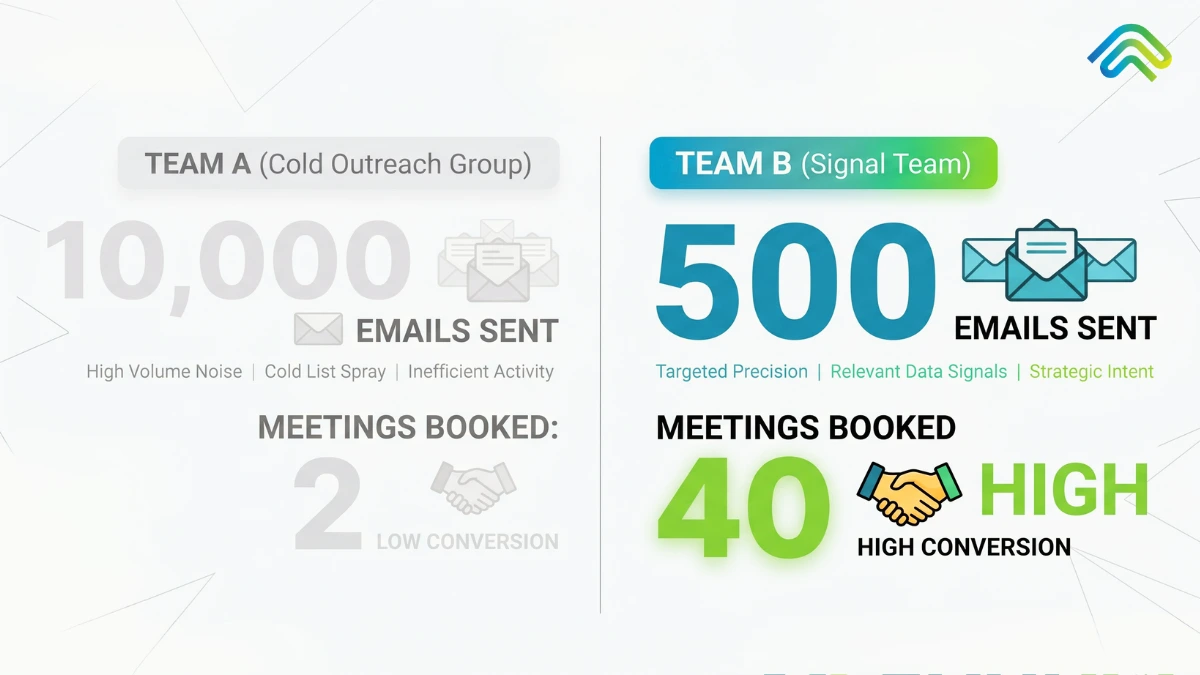
Two SDR teams. Same ICP. Same target market. Same week.
Team A sends 10,000 cold emails to VP Sales contacts at SaaS companies. They book 23 meetings.
Team B sends 500 emails, but only to people whose company raised funding last week, just hired a new CRO, or visited the pricing page that morning. They book 47 meetings.
Same offer. Same copy structure. 20x times fewer emails. More than 2x the meetings.
That gap isn’t a quirk of one quarter. It’s the shape of B2B outbound in 2026.
Cold email reply rates have collapsed to an average of 3.43%, according to Instantly’s 2026 Benchmark Report, the lowest figure on record since they started tracking it. Signal-based outbound, in the same year, consistently lands between 15 and 25%, with elite teams pushing past 30%.
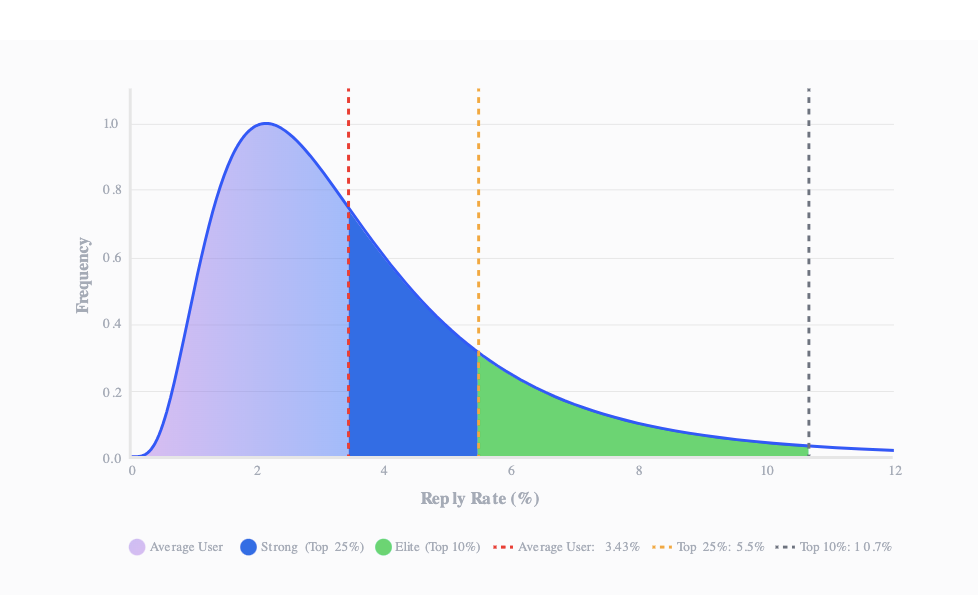
That’s not a gradual decline of one approach and a slow rise of another. That’s a category shift. The teams winning outbound in 2026 aren’t the ones sending more emails. They’re the ones sending fewer, better-timed ones.
In this guide, we are going to break down four critical things you need to know: the hard data behind this market shift, the underlying mechanics of how each sales motion works, exactly when each approach still makes sense (because cold outreach isn’t entirely dead, it is just narrower), and the one defining factor that dictates whether a signal-based motion will actually work for your sales floor.
What Is Cold Outbound? (And Why It Stopped Working)
Cold outbound is the traditional method of reaching out to a static list of prospects matched purely on firmographic and demographic data. You filter by industry, company size, and job title, build a list, and hit send.
In this model, there is no underlying indication that the prospect is actively in the market for your solution. It is a volume-driven, spray-and-pray mechanism. The entire foundation of cold outbound is built on a mathematical assumption: if you contact a large enough pool of qualified-on-paper prospects, a predictable percentage will inevitably respond.
For a long time, that math worked. Today, the math is fundamentally broken.
The Numbers in 2026
If you want to understand the state of outbound, look at the telemetry data across the industry. The benchmarks tell a story of an infrastructure pushed beyond its limits:
- 3.43%: The average reply rate B2B across billions of emails analyzed (Instantly 2026 Benchmark Report).
- 8.5%: The percentage of cold outreach emails that receive any reply at all, and crucially, this number includes “unsubscribe me,” “take me off your list,” and “not interested” (Backlinko, 12 million emails analyzed).
- 2.1%: The reply rate for mass campaigns sent to lists of 500+ recipients in a single blast (Belkins 2025 B2B study).
- 120+: The staggering number of sales emails the average B2B buyer receives every single week (Sopro 2026).
- $2 spent for $1 ARR: The current ratio of B2B sales and marketing efficiency in 2026, marking a 14% increase in acquisition costs since 2024 (Industry Data).
What are the 3 Structural Reasons Cold Outbound Failed?
The collapse of cold outbound didn’t happen overnight. It was driven by three compounding structural failures.
1. Inbox Saturation: The barrier to entry for sending a thousand emails dropped to zero. With the proliferation of cheap data providers and automated sequencing tools, every company on earth scaled their volume. When buyers receive 120+ pitches a week, cognitive fatigue sets in. Buyers no longer read cold emails; they pattern-match them and mass-delete them based on subject lines alone.
2. Deliverability Collapse: Spam filters didn’t just get smarter; they got militant. Following the aggressive Google and Yahoo sender guidelines enforced in 2024, the infrastructure for mass emailing shattered. You can no longer blast thousands of identical emails from a primary domain without destroying your domain reputation. The technical overhead required to manage burner domains, warm-up pools, and IP rotations simply to achieve a 3% reply rate has made the ROI of cold outbound increasingly negative.
3. The 95:5 Problem: Research from the B2B Institute has long shown that only 5% of your total addressable market is actively looking to buy at any given time. The other 95% is out of market. Cold outbound, by definition, targets 100% of the list with equal aggression. You are inevitably burning brand equity by annoying the 95% who don’t care, just to blindly stumble across the 5% who might.
What Is Signal-Based Outbound? (The 2026 Definition)
Signal-based outbound (frequently referred to as signal-led outbound, intent-driven outbound, or a cold outbound alternative) is outreach triggered by a real-time event that indicates an emerging business need. It is not triggered by a static list.
In signal-based selling, the trigger comes first. The list is built dynamically, minute-by-minute, around buyers who fit your ICP and have just done something that suggests genuine buying intent.
To master signal-based prospecting, you must understand the triggers.
The Three Categories of Signals
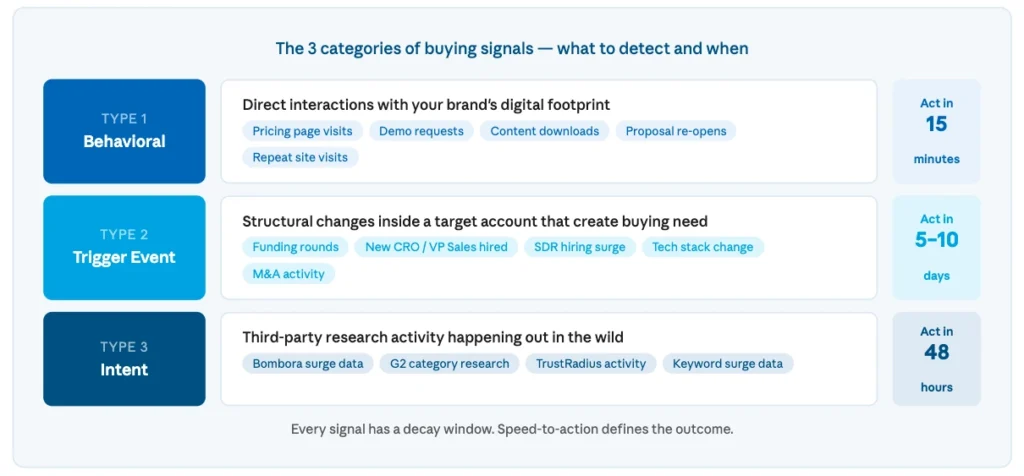
- Behavioral Signals: These are direct interactions with your brand’s digital footprint. Examples include deep pricing page visits, specific demo requests, gated content downloads, repeat website visits from the same IP, competitor comparison searches on your site, or document tracking opens (e.g., someone opening a proposal you sent three months ago).
- Trigger Event Signals: These are structural changes within a target account that historically create a need for new software or services. Examples include fresh funding rounds, major leadership changes (like a newly hired VP of Sales, CRO, or Head of Marketing), hiring surges (e.g., “posted 5+ SDR roles in the last 30 days”), technology stack changes (adding Salesforce or ripping out a competitor), M&A activity, or geographic expansion announcements.
- Intent Signals: These are third-party research activities happening out in the wild. This includes intent surge data from providers like Bombora, category research surges on G2, heavy interest shown on TrustRadius, keyword surge data, or peer company activity within highly specific micro-segments.
How a Signal-Based Motion Actually Runs
Moving from static lists to signal-led outbound requires a complete rewiring of how an SDR works. Here are the actual mechanics:
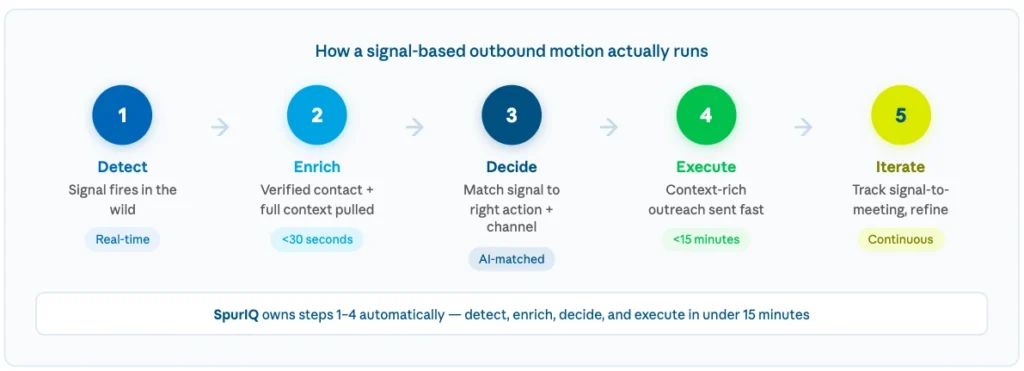
- Step 1: Detect. A signal fires in the wild. Acme Corp’s newly appointed CRO updated their LinkedIn profile 18 minutes ago. Alternatively, their VP of Engineering just visited your enterprise pricing page twice this week.
- Step 2: Enrich. You must immediately pull verified contact data. This isn’t just an email address; it’s the exact job title, recent social activity, current tech stack, historical deal context (did we pitch them in 2024?), and peer signals at the same account.
- Step 3: Decide. Match the specific signal type to the appropriate action and channel. A new CRO requires a highly personalized LinkedIn message coupled with a tailored email referencing the specific mandate of their new role. A deep pricing page visit requires an immediate phone call within 15 minutes while your brand is top of mind.
- Step 4: Execute. Send context-rich, highly relevant outreach. The message is never “I noticed your company.” It is specific and anchored to reality: “Congratulations on the new CRO role at Acme. Companies in the logistics space that promote internally to CRO typically see [specific dynamic]. I wanted to share how we solve that.”
- Step 5: Iterate. You track the signal-to-meeting conversion rate, completely abandoning vanity metrics like “emails sent.” You relentlessly refine which signals actually convert to revenue.
The theory is straightforward. The execution is where most teams collapse, and we’ll cover why later.
Signal-Based Outbound vs Cold Outbound – Side-by-Side Comparison in 2026
To clearly understand the operational differences between these two motions, look at how they stack up across critical sales dimensions in 2026.
| Dimension | Cold Outbound | Signal-Based Outbound |
| Trigger | Based on a fixed list of company traits. | Based on a recent action or sign of interest. |
| Approach | High volume, hoping for a match (“spray and pray”). | Highly targeted with precise timing. |
| List Building | Made once, reused all month. | Updated constantly as new actions happen. |
| Personalization | Basic templates (swapping name/company). | Deeply customized to the specific recent action. |
| Reply Rate (2026) | 1–5% (3.43% average). | 15–25% (up to 40% for top performers). |
| Meeting Rate | 3–6 meetings. | 12–32 meetings. |
| Volume | Very high (10,000+/month per team). | Low (200–500/month per team). |
| Domain Reputation | High risk of being blocked or marked as spam. | Safe, due to low sending volume. |
| Sales Cycle Length | Standard speed. | Up to 40% faster. |
| Key Risk | Annoying people, getting blocked, low replies. | Acting too slowly and missing the window of interest. |
| Best For | Brand awareness, market testing, cheaper products (<$1K). | Medium to large businesses, expensive products ($5K+). |
| Cost per Meeting | $50–$100 (just for software tools). | Practically free (no extra costs per meeting). |
Reply rate scales with signal precision, not message volume. While pure cold outreach hovers around 3.43%, signal-based outreach jumps to 15-25%, and multi-signal stacked outreach (where a company raises funding AND visits a pricing page) pushes past 30%.
Why the Shift Is Happening Right Now
If signal-led outbound is so much better, why didn’t the entire industry switch to it a decade ago?
The answer is that this isn’t just about changing preferences; it is a market-level inflection point. Here are the Five specific forces that have converged in 2026:
1. Buyers Run the Process Now
According to a recent 2025 Gartner study, an incredible 61% of B2B buyers now prefer a completely rep-free buying experience. This is a massive leap from 33% just a few years ago. By the time a buyer is willing to engage a seller, they have already done their shadow research and formed strong opinions.
2. Email Infrastructure Has Hardened
We touched on this earlier, but it bears repeating: you cannot outrun the spam filters anymore. The golden age of creating 50 secondary domains and blasting 5,000 emails a day per rep is over. Email providers look at engagement rates (opens, replies, forwards) to determine if you are a legitimate sender.
3. Signals Are Now Measurable at Scale
Five years ago, finding out if a company hired a new VP of Sales required a rep to manually scour LinkedIn for hours. Knowing if an account was researching your category on G2 was a black box. Today, the data layer has matured. APIs and specialized signal detection tools scrape, categorize, and deliver these in real time.
4. AI Made Personalization Practical
Before modern LLMs (Large Language Models), standardizing unstructured signal data into a readable, human email took a rep 15 minutes per prospect. Now, AI can ingest a press release about a funding round, match it with the prospect’s LinkedIn work history, and draft a hyper-contextualized email in milliseconds. The bottleneck shifted from content creation to timing.
5. The First-Mover Effect Compounded
As the first wave of forward-thinking sales teams adopted intent-driven outbound, they set a new standard for buyer expectations. Buyers became accustomed to hyper-relevant, perfectly timed outreach. Consequently, their tolerance for generic, spray-and-pray messaging dropped to zero. The first movers raised the bar, and the rest of the market is now forced to adapt.
How to Build a Signal-Based Outbound Motion
Understanding the concept is easy. Operationalizing it across a sales floor is incredibly difficult. If you want to transition your team, you cannot just buy a new tool and tell your reps to “be more relevant.” You need a rigorous process. Here are the five concrete steps to building a high-performing motion.
Step 1: Pick One Signal to Start
The most common trap RevOps leaders fall into is trying to stack five different signals on day one. Do not do this. While it is true that teams using 3+ stacked signals see 2.4x higher conversion rates, they only achieve that after they have fully operationalized a single signal.
Start with the highest-converting, lowest-friction entry points. The two best starting points are job changes (specifically a new CRO, a new VP of Sales, or a new Head of Marketing) or pricing page visits. Both of these signals have incredibly clear timing windows and obvious, natural outreach hooks that reps understand easily.
Step 2: Build Your Detection Layer
Once you have chosen your signal, you must match that specific signal type to the right data source.
- Job changes: You need LinkedIn Sales Navigator, Champify, or Hireforce.
- Funding rounds: You need tools like Crunchbase, PitchBook, or Tracxn.
- Website visits: You need deanonymization tools like RB2B, Common Room, or Clearbit Reveal.
- Intent surge: You need platforms like Bombora, G2 buyer intent, or TrustRadius.
- Tech stack changes: You need BuiltWith, Wappalyzer, or Datanyze.
Step 3: Make Your Data Layer Bulletproof
This is the stage where the vast majority of teams collapse. A signal-based motion is completely useless if the underlying contact data is garbage. Between 20% and 35% of B2B contact records at any given time contain outdated information.
Think about the math: a perfect buying signal routed to a bounced email address is worse than no signal at all because you officially burned the timing window. You must implement waterfall enrichment. This means using a system that checks multiple data providers sequentially (e.g., checking Apollo, then if blank, checking ZoomInfo, then checking Clearbit) to achieve an 85–92% verified email find rate.
Step 4: Close the Timing Window
Signals are highly perishable. They decay fast. A pricing page visit at 2:00 PM is piping hot at 2:15 PM. By 4:00 PM, it is lukewarm. By tomorrow morning, it is entirely cold. A Series B funding round announcement creates a tight 5-to-10-day window of opportunity before every other vendor in your category catches up and floods their inbox.
The faster you act, the higher your conversion rate climbs. Most modern sales teams possess signal detection. Very few possess true execution speed. The operational gap between “we got the Slack alert” and “the rep actually sent the customized message” is where signal-based motions go to die. You must close the .
Step 5: Measure Signal-to-Meeting, Not Sends
If you run a new motion on old metrics, you will fail. Traditional cold outbound metrics like open rates, click rates, and total send volume are the entirely wrong KPIs for a signal-based motion.
Instead, you need to track:
- Signal-to-first-touch latency: How long did it take to reach out after the signal fired? ( is paramount).
- Signal-to-meeting conversion rate: Out of 100 detected signals, how many booked a call?
- Signal type performance: Which specific signals (e.g., funding vs. job changes) are actually generating pipeline?
- Meeting-to-pipeline rate: Are these meetings resulting in qualified opportunities?
Remember, reply rate alone can be deeply misleading. A signal-based motion with an 18% reply rate but agonizingly slow follow-up will continually lose deals to a competitor with a 12% reply rate who consistently books meetings inside a 24-hour window.
This is where a revenue execution platform earns its place. SpurIQ detects signals across your existing stack, from LinkedIn job changes and intent platforms to website visits and CRM activity, and turns them into executed outreach in under 15 minutes. The contact gets enriched, the message gets context-anchored to the specific signal, and the right rep gets the action item with full prep already done. No new tools to learn, no manual triage, no signal decay. Signal-based outbound only works if execution keeps up.See how SpurIQ turns signals into executed outreach at or book a .
When Cold Outbound Still Makes Sense
If you have read this far, you might think cold outreach should be entirely abandoned. That is a dangerous oversimplification. Sophisticated revenue teams understand that cold outbound is not dead; it has simply been demoted from the default strategy to a specialized tactic.
There are three narrow but highly valid use cases where cold outbound still makes business sense:
1. Brand Awareness in Unfamiliar Markets: If your company is entering a brand new geography (e.g., a US company expanding to the UK) or pivoting into a new industry vertical where you have exactly zero existing brand recognition, signal-based motions will struggle. You can’t capture intent if no one knows you exist. In these scenarios, highly targeted, broader cold outreach helps build the initial market awareness that eventually generates the signals you need.
2. Transactional ACV under $1K: The math of signal-based selling dictates its use case. Building the infrastructure for detection, enrichment, and rapid response costs money. If your product is a low-ticket, high-volume transactional tool (e.g., a $49/month widget), the ROI on a complex signal architecture simply doesn’t pencil out. Signal-based motions cost more than they return at sub-$1K deal sizes, where broad cold outreach paired with a self-serve funnel is far more efficient.
3. Net-New ICP Exploration: When you are testing whether a completely new persona or market segment responds to your value proposition at all, you are flying blind. You don’t have historical signal patterns to rely on. In this phase of exploration, controlled volume helps you generate the initial data necessary to figure out what messaging resonates.
The Hybrid Approach: The most elite sales teams in 2026 run hybrid programs. They use signal-led outbound for their high-priority Tier 1 and Tier 2 target accounts, reserving cold outbound for broader, lower-tier reach. Among teams consistently crushing quota, the split is roughly 70% signal-based and 30% cold.
The point is not that cold outbound is dead. The point is that the default has officially flipped. Signal-based must be your primary, driving motion. Cold should be your secondary, used deliberately for specific, strategic scenarios, not as the default just because it is what you are used to.
5 Mistakes Teams Make When Switching to Signal-Based Outbound
Transitioning from a volume game to a precision game requires behavioral change. Many teams fail the transition because they carry their old bad habits into the new framework. Here are the five most common pitfalls to avoid.
Mistake 1: Treating signal-based as cold outbound with better targeting
It is not simply a better list. The motion is fundamentally different: it requires vastly lower volume, ruthlessly faster execution, and deeply contextual messaging. Teams that attempt to scale a signal-based strategy using their old cold-outbound infrastructure (like mass sending platforms and generic templates) strip away the personalization that makes it work in the first place.
Mistake 2: Stacking too many signals before operationalizing one
As mentioned earlier, ambition can be dangerous here. Trying to wire up intent data, website visits, and job changes all at once leads to system failure and confused reps. One well-executed, perfectly timed signal beats five poorly wired, chaotic ones every single time. Pick one. Master the routing. Train the reps. Then add the next.
Mistake 3: Ignoring data decay
Static lists age poorly; signals age instantly. A job change spotted three weeks ago is no longer a buying signal, it is ancient history. The new VP has already made their 30-60-90 day plan and bought their software. You must refresh your detection layer daily or weekly, not monthly.
Mistake 4: Slow follow-up
This is the silent killer of pipelines. A buying signal is detected at 2:00 PM on a Tuesday. The rep doesn’t see the alert, format the data, and send the email until 11:00 AM on Wednesday. The psychological window has completely closed. Most intent-driven outbound motions fail not at the detection layer, but at execution speed.
Mistake 5: Measuring sends instead of conversions
When a sales manager asks, “How many emails did you send today?”, they are reinforcing a cold outbound mindset. “We sent 200 signal-based emails this week” is the entirely wrong KPI. “We converted 45 detected signals into 12 meetings within an hour of detection” is the right one.
Tools That Power Signal-Based Outbound (Category Overview)
To build a modern architecture, you need to understand the distinct tool categories that make up the stack. No single tool does everything, but linking the right categories together creates an unstoppable pipeline engine.
| Tool Category | What It Does (In Simple Terms) | Common Examples |
| Signal Detection Platforms | Finds clues that a company might be ready to buy (like job changes, new funding, or website visits). | Common Room, Champify, Clay, RB2B |
| Intent Data Providers | Shows which target companies are actively researching your type of product or industry online. | Bombora, G2 Buyer Intent, TrustRadius, 6sense |
| Enrichment & Verification | Finds and double-checks contact details (like email addresses) to make sure they are accurate and deliverable. | Clearbit, Apollo, ZoomInfo, Prospeo |
| AI Outbound Sequencers | Sends out automated, highly customized emails and messages based on the clues found above. | Instantly, Smartlead, Outreach, Salesloft |
| Revenue Execution Platforms | Ties everything together automatically: spots the clue, finds the contact info, sends the message, and updates your records instantly. | SpurIQ |
The Bottom Line
In conclusion, the era of blasting thousands of generic emails into the void and praying for a 3% reply rate is firmly behind us. The modern buyer demands relevance, context, and perfect timing. The shift to intent-driven outreach is no longer a luxury; it is the baseline expectation for any B2B sales floor operating in 2026. Stop fighting inbox algorithms and start meeting your buyers exactly when they raise their hands.
SpurIQ closes the gap between signal and action. See how it works at spuriq.ai
Frequently Asked Questions (FAQs):
What is signal-based outbound?
Signal-based outbound (or signal-led outbound) is a sales strategy where outreach is triggered by real-time events, such as a job change, funding round, or website visit, indicating a prospect has an immediate, active need for your product, rather than relying on static cold lists.
What’s the difference between signal-based outbound and cold outbound?
Cold outbound sends high volumes of generic messaging to static lists of prospects who fit a demographic profile. Signal-based outbound sends low volumes of highly contextual messaging only to prospects who have triggered a real-time behavioral or intent event.
What are the best signals for B2B outbound?
The highest-converting B2B signals generally include executive job changes (e.g., a new CRO or VP of Sales), deep pricing page visits, recent rounds of funding, and active software category research on review platforms like G2 or TrustRadius.
Is cold outbound dead in 2026?
No, but it is no longer the default. Cold outbound remains useful for very narrow scenarios: exploring net-new markets, building brand awareness from zero, or selling highly transactional products with an ACV under $1,000. For mid-market and enterprise SaaS, it is a secondary tactic.