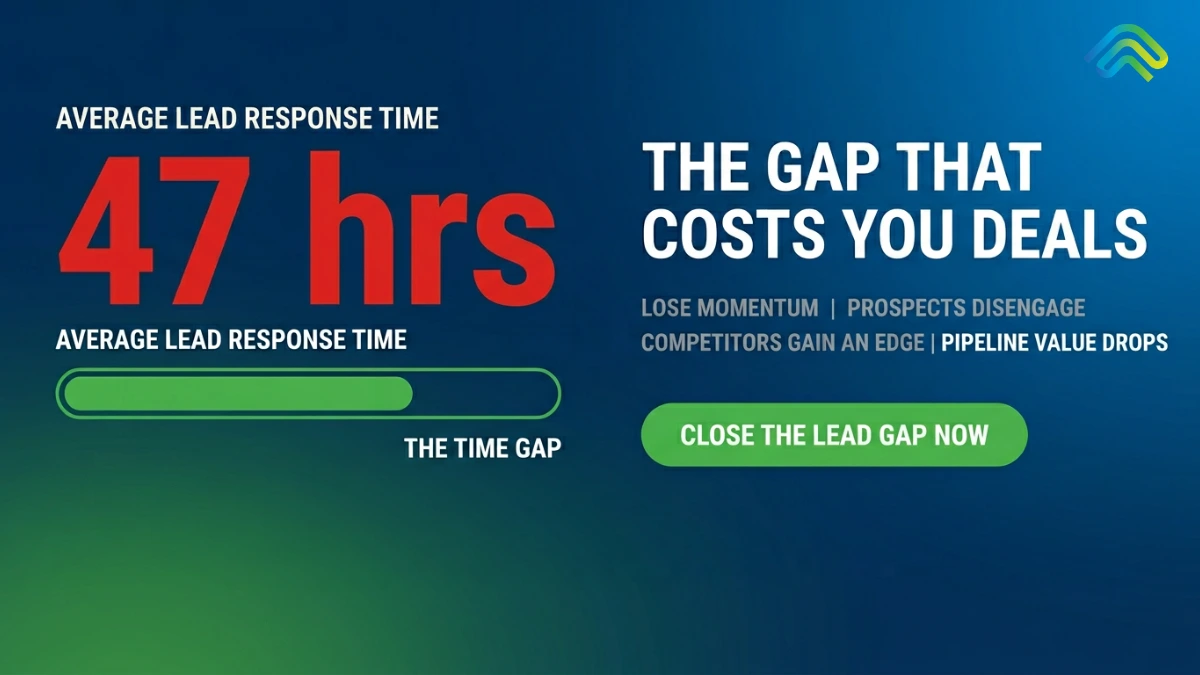
Speed-to-lead in 2026 is still the simplest and most overlooked predictor of revenue performance.
It’s Monday morning. You sit down with your coffee, log into your CRM, and see the damage: there are 47 demo requests from the weekend sitting untouched. The oldest one came in on Friday evening. It was a VP of Operations filling out your high-intent form while actively comparing three different vendors.
That was 63 hours ago. By the time your SDR sends the first “Just following up” email, she’s already taken two meetings and signed a contract with a competitor.
Everyone in B2B sales knows that speed-to-lead matters. It is not a new concept. The data proving that faster response times equal higher conversion rates has been consistent for more than 15 years. And yet, the reality on the ground is astonishing: the average B2B lead response time is still 47 hours, according to the Optifai 2026 Pipeline Study. Only 23% of companies manage to respond within 5 minutes, while a staggering 63% never respond to an inbound lead at all.
In this guide, we are going to break down exactly what is happening. We will share the 2026 data that proves why response time still dictates who wins the deal. We will unpack the structural, systemic reasons most revenue teams fail at this despite knowing better. Finally, we will show you how AI-driven revenue execution finally fixes this gap – not by hiring a massive army of new SDRs, but by fundamentally owning the signal-to-action moment.
What Is Speed-to-Lead? (And What It Really Measures)
If you ask ten sales leaders, “What exactly does ‘speed to lead’ mean?”, you might get ten slightly different answers. Let’s define it in plain, operational language.
Speed-to-lead is the exact measurement of time between a prospect submitting an lead form (such as a demo request, a contact form, a pricing enquiry, or a chat initiation) and the moment your sales team makes their first deliberate contact with that prospect by phone, email, or direct messaging.
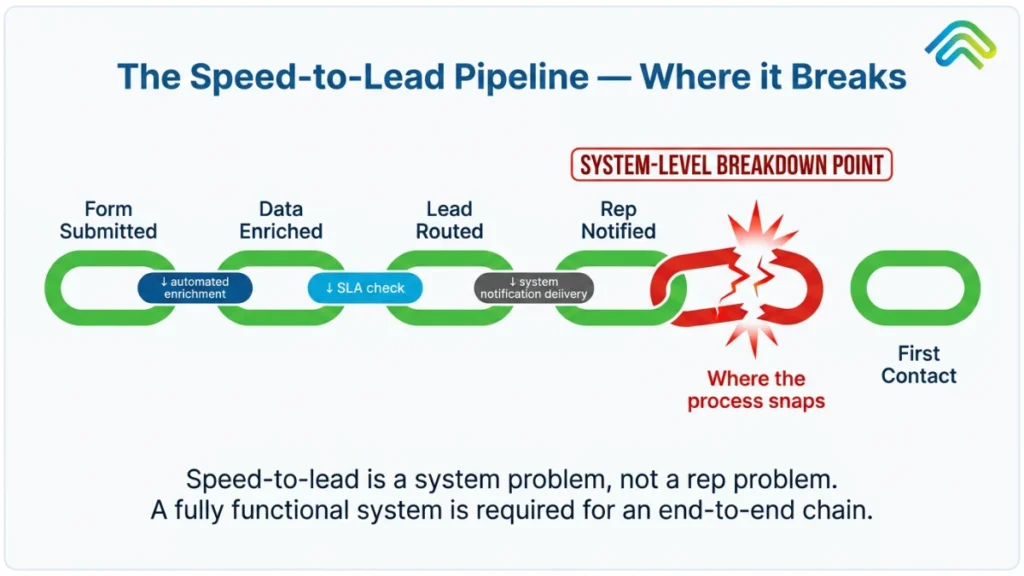
To build a system that works, it is crucial to distinguish speed-to-lead from other related metrics that often get incorrectly lumped together:
- Speed-to-lead vs. lead response time: These terms are often used interchangeably, but there is a subtle difference in modern RevOps. Lead response time is the raw technical metric (e.g., 4 minutes and 12 seconds). Speed-to-lead is the broader strategic discipline of optimizing that metric.
- Speed-to-lead vs. lead engagement: Lead engagement measures the quality and depth of multi-touch conversations over weeks or months. Speed-to-lead measures only the critical first touch.
- Speed-to-lead vs. signal-to-action: Speed-to-lead is just one specific type of signal-to-action gap. It is the gap triggered specifically by inbound interest. Signal-to-action is the broader, overarching execution discipline that covers every single buying signal, including stalled deals, champion job changes, and product usage spikes – not just inbound form fills.
Most importantly, you have to understand what speed-to-lead actually measures. It does not measure how fast an individual human can type an email. It measures execution discipline. If you achieve a 5-minute response time, it means your entire pipeline machinery – the form submission, the routing logic, the data enrichment, the rep notification, the rep availability, and the first dial – worked flawlessly end-to-end in under 300 seconds. A 47-hour response time means that pipeline broke somewhere along the way, or most likely multiple times.
The 2026 Speed-to-Lead Statistics That Should Terrify You
If you think your team is immune to the speed-to-lead problem, the industry benchmarks tell a different story. The data for 2026 is unambiguous. When we look at speed to lead statistics, they group naturally into three terrifying narratives: how teams actually perform, what that performance costs in revenue, and what modern buyers expect.
The Performance Gap: What Teams Actually Deliver
We have more sales technology than ever before, yet our baseline execution remains shockingly slow.
- 47 hours: The average B2B lead response time across industries (Optifai 2026 Pipeline Study, N=939 companies).
- 63.5%: The percentage of B2B companies that never respond to a lead at all (RevenueHero 2026, N=1,000).
- 23%: The percentage of B2B companies that actually respond within the optimal 5-minute window.
- 42%: The percentage of B2B companies that take longer than 24 hours to respond.
- 74%: The percentage of teams that miss the 5-minute response window entirely (Blazeo 2026 Benchmark, N=573).
- 1.3: The average number of call attempts a rep makes before giving up entirely (MIT data shows the optimal number of attempts to maximize contact rate is 6).
The Revenue Impact: What Speed-to-Lead Is Actually Worth
Every minute a lead sits in a queue, the probability of closing that deal plummets. How does speed to lead impact revenue generation?
- 21x: Leads contacted within 5 minutes are 21 times more likely to enter the sales qualification process compared to those contacted after just 30 minutes (InsideSales/MIT study analyzing 15,000 leads).
- 391%: Prospects called within 1 minute of their inquiry are 391% more likely to convert (Velocify).
- 78%: The percentage of customers who buy from the very first company to respond to their inquiry (Lead Connect).
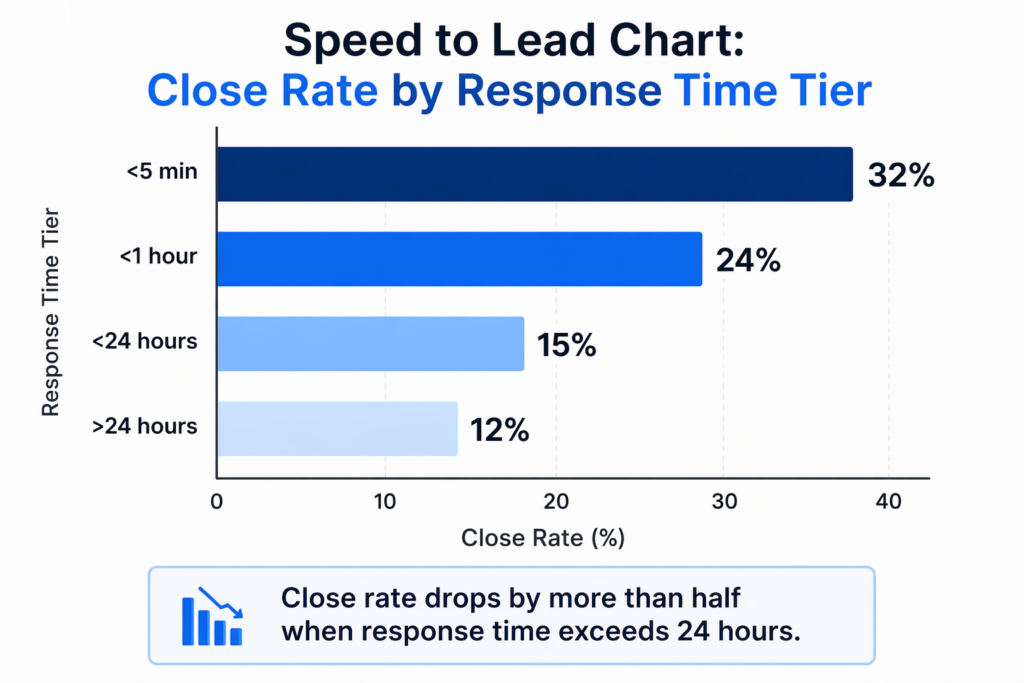
- 2.6x: The close rate for sub-5-minute responses compared to 24+ hour responses is massively disproportionate (32% vs 12% – Optifai 2026).
- 8x: The overall pipeline conversion improvement teams see when reducing their response time from hours down to minutes (Chili Piper).
- 50%: Of all competitive B2B deals are won strictly by the first responder.
The Expectation Gap: What Buyers Now Demand
The consumerization of B2B is complete. Buyers no longer tolerate the “we will get back to you in 1-2 business days” auto-responder.
- 82%: Of B2B buyers expect an immediate response to their sales or marketing inquiries (Salesforce).
- 90%: Of consumers rate an “immediate” response as important or very important when asking a customer service or sales question (HubSpot).
- 10 minutes: The majority definition of what constitutes an “immediate” response in consumer psychology.
- 40%+: Of high-intent sales inquiries arrive during evenings and weekends – exactly when nobody on your team is working (Blazeo 2026).
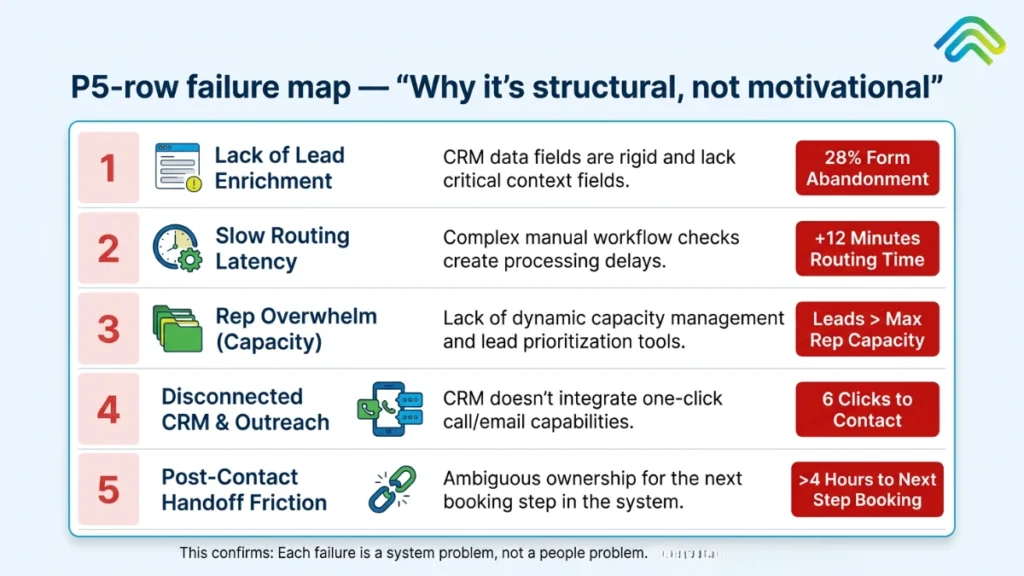
Why Most Teams Fail – And Why It’s Structural, Not Motivational
When leaders see the data above, the initial reaction is usually to call a high-urgency sales meeting, yell at the SDR team, and demand they move faster. But this is the wrong approach. The failure is not motivational; it is entirely structural.
Speed-to-lead can’t be fixed with a pep talk. To understand why deals decay in a B2B pipeline, we have to look at the five structural failure modes of modern sales environments.
Failure Mode 1: Reps Don’t Have 5 Minutes
The modern SDR is drowning in administrative tasks. Studies show that SDRs spend only 30% of their actual workday on active selling. The other 70% goes to manual CRM updates, internal meetings, account research, and inbox management. Even the most highly motivated rep cannot physically respond to an inbound demo request in 5 minutes if they are buried inside Salesforce, manually logging detailed notes from their previous discovery call. Speed-to-lead isn’t failing because your reps don’t care. It’s failing because the system they work inside is not built for speed.
Failure Mode 2: Routing Logic Breaks
When a lead arrives, a massive amount of invisible logic has to execute perfectly. The lead needs to be enriched with external data, scored for qualification, assigned to the correct geographic or vertical territory, and finally routed to a rep who is actually online and available. If even one step breaks – perhaps a routing rule relies on stale territory logic, or the assigned rep is out sick, or an enrichment API times out – the lead drops into a holding queue. Companies with a rigorously defined SLA respond within 15 minutes at nearly double the rate of those without (54.9% vs 29.5%, Blazeo 2026). But in most companies, these SLAs exist on a PDF, not in the actual routing infrastructure.
Failure Mode 3: Data Quality Kills Speed
Imagine achieving a 3-minute response time, only to dial a disconnected phone number and send an email that hard-bounces. A 5-minute response to a bad record is a 5-minute response to nobody. Currently, 20–35% of B2B contact records contain outdated or entirely incorrect information. Every time a rep rushes to follow up on a bad record, it burns their time and their motivation. Consequently, the next lead in the queue gets less energy and urgency than the last. Fast execution on terrible data is not a strategy.
Failure Mode 4: After-Hours and Weekends
As noted in the statistics above, over 40% of high-intent inquiries arrive outside of standard business hours. The prospect is doing their vendor research at 9 PM on a Thursday or 10 AM on a Sunday. No team of humans, no matter how dedicated or well-compensated, can respond to these inquiries in 5 minutes at 11 PM on a Sunday. This is a fundamental coverage problem that no amount of hiring can solve without operating a 24/7 global call center.
Failure Mode 5: The “We Have a Tool for That” Trap
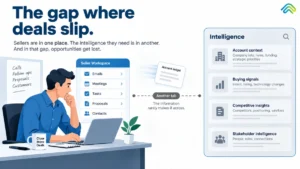
Most revenue teams have attempted to fix this by purchasing a “Speed to Lead” software or tool. They buy a sophisticated lead router, a real-time Slack notification system, and an automated sequencer. These tools successfully detect the signal. But detection is not the same as execution. When your SDR opens their inbox at 9 AM on Monday and sees 47 urgent notifications from the weekend, the tool didn’t solve the problem – it simply queued the work up for a human bottleneck.
The structural problem is clear: speed-to-lead can’t be solved by hiring more reps, adopting another notification tool, or writing another SLA. It has to be owned by a system.
How AI Fixes the Speed-to-Lead Gap (Without Replacing Your Sales Team)
This is where AI speed to lead comes into play. It is critical to frame this correctly: AI is not here to replace your sales team. Complex B2B sales will always require human trust, negotiation, and relationship building. What AI does is remove the administrative execution bottleneck so your human reps can actually respond to the people who want to talk to them.
Here are the 5 capabilities of an AI-driven speed-to-lead system.
Capability 1: Instant Signal Detection and Enrichment
An AI agent constantly monitors every inbound signal across your entire digital footprint in real time. This includes form submissions, chat initiations, pricing page visits, and demo requests. The very millisecond a signal fires, the agent instantly enriches the contact with up-to-date, third-party data. It pulls the prospect’s verified job title, their company size, their tech stack, recent company news, and behavioral context. This entire process – from raw signal to fully enriched context – happens in under 30 seconds.
Capability 2: Intelligent Routing That Actually Works
Instead of relying on rigid, static territory rules that break when someone goes on vacation, AI routes leads based on live context. The system evaluates which rep has the right specific expertise for the prospect’s industry, who is actively online and available, and which target account already matches an SDR’s existing book of business. Crucially, if the assigned rep does not engage within the designated SLA, the AI agent automatically escalates and reroutes the lead. The prospect never sits idle in a queue waiting for a human to notice them.
Capability 3: First Response That Doesn’t Need a Human
For high-priority inbound leads, AI can autonomously send a contextual first response – whether that is a deeply personalized email, a calendar booking link, or an SMS message – within seconds. This is clearly tagged as an AI-assisted communication to maintain transparency. Importantly, this is not a generic, canned autoresponder. The AI references the specific landing page the lead just visited, the exact whitepaper they downloaded, or the specific question they submitted in the chat. The lead stays warm, engaged, and advancing while the human rep prepares for the actual discovery call.
Capability 4: 24/7 Coverage Without 24/7 Staffing
Because 40%+ of leads arrive outside business hours, the AI seamlessly covers the night shift. A lead that submits a pricing inquiry at 11 PM gets immediately acknowledged, fully enriched, and queued for a rep to follow up at exactly 9 AM. The rep arrives in the morning to find a context-rich brief waiting for them, allowing them to walk into the follow-up conversation fully prepared.
Capability 5: Post-Response Execution
Here is where traditional speed to lead automation stops, and where the most revenue is lost. A lightning-fast first response doesn’t mean much if the second and third follow-ups lag by a week. AI-driven execution continues far past that initial first touch. Subsequent follow-ups are automatically drafted, the CRM is updated with the latest interaction data, next steps are strictly tracked, and stalled conversations are immediately flagged to management. This is the part of the signal-to-action gap in the B2B GTM stack that nobody talks about, and it’s where most of your pipeline decays.
This is what revenue execution looks like in practice. SpurIQ is a revenue execution platform that detects every revenue signal, inbound form fills, buying signals, stalled deals, pipeline risk — across your existing GTM stack, decides the next best action, and ensures it actually gets executed. For inbound leads, that means sub-15-minute signal-to-action with full enrichment, contextual first response, and automated follow-through. No new tools to learn. No reliance on human memory. Just execution that happens, every time.
How to Build a Speed-to-Lead System That Actually Works
Whether you adopt a revenue execution platform or attempt to rebuild your current stack, the operational playbook remains the same. Here are the five steps to building a system that turns inbound interest into real revenue.
Step 1: Measure Your Current Speed-to-Lead Honestly
You cannot fix what you refuse to measure accurately. Do not look at the theoretical speed you report to your board; look at the actual speed. Pull 30 days of raw CRM data. For every single inbound lead, measure the time from the creation timestamp to the very first logged rep activity (a connected call, a sent email, or a meeting booked). Segment this data by lead source, time of day, and day of the week. If your average is over 1 hour, you have a serious execution problem. If it’s over 24 hours, you have a catastrophic execution problem that is actively destroying your marketing ROI.
Step 2: Set a Real SLA (Not a Goal)
An SLA (Service Level Agreement) is enforceable. A goal is optional. As the Blazeo data proved, companies with defined SLAs respond within 15 minutes at double the rate of those without. Set a specific, non-negotiable SLA. For example: sub-5 minutes for demo requests, and sub-15 minutes for other high-intent signals. Most importantly, build the technological escalation logic so the SLA is strictly enforced by the system, rather than relying on managers to manually audit reps.
Step 3: Fix Your Data Before You Fix Your Speed
Responding to a bad contact record in 5 minutes is fundamentally worse than responding to a highly accurate record in 30 minutes. Audit your lead data immediately. Ensure you are enriching contacts before routing them to reps. Verify emails and validate phone numbers at the point of capture. Fast execution on bad data is a waste of your sales team’s energy.
Step 4: Automate the Pipeline, Not Just the Notification
In other technical disciplines, the connection between streamlined architecture and performance is deeply understood. IT professionals know exactly how does more bandwidth lead to faster data speed. Aviation engineers know how critical speed can lead to engine failure if the internal systems aren’t synchronized. Even web designers know that a simple reduction in digits on a lead capture form can lead to greater speed of completion.
Yet, in B2B sales, we ignore the system architecture and leave execution up to chance. Most teams have a lead notification tool that pings Slack when a form is filled. That is not automation – it is simply a louder alarm clock reminding humans that they still have to do all the manual labor. Real automation enriches, routes, responds, logs the data, and schedules the follow-up without a rep ever having to click a single button.
Step 5: Measure Execution, Not Just Activity
Open rates, click-throughs, and raw response counts are not revenue metrics. You need to track the leading indicators that actually move the needle: time-to-first-response, time-to-meeting-booked, qualification rate, and first-touch-to-close-rate. Build real-time dashboards that show leadership exactly where leads are going cold in the funnel. Make that data visible to the frontline managers who have the power to step in and coach the fix.
Best Speed-to-Lead Tools for B2B Sales in 2026 (Category Overview)
If you are evaluating a speed to lead service or platform, the market is crowded. To find the right fit, it helps to break the landscape down into functional categories rather than just looking at feature checklists.
| Tool Category | What It Does | When You Need It | Common Vendors |
| Lead Routers | Acts like a traffic cop, automatically handing new leads to the right salesperson based on region or rotation. | Smaller teams with straightforward rules for dividing up leads. | LeanData, Chili Piper, RouteAI |
| Scheduling & Form Tools | Lets buyers skip the “when are you free?” emails and book a meeting directly on your calendar from your website. | Teams focused heavily on booking live product demos fast. | Chili Piper, Calendly, RevenueHero |
| AI Voice Agents | Uses AI to instantly call a prospect the second they submit a form – zero human effort required. | High-volume businesses that need to call hundreds of leads immediately to close simple deals. | Setter AI, Apten, Conversica |
| Speed-to-Lead Platforms | Automatically researches the lead, assigns them to a rep, and aggressively sends alerts to ensure a fast reply. | Growing teams that need a specific tool to organize the lead pile and enforce quick responses. | Outreach, Salesloft, LeadAngel |
| Revenue Execution Platforms | Takes over the busywork. It autonomously researches the lead, sends a personalized first reply, handles the follow-ups, and logs everything. | Teams losing deals because their salespeople are too buried in admin work to actually sell. | SpurIQ |
The Bottom Line
Speed-to-lead has technically been a solved problem for 15 years – on paper. The data is entirely unambiguous. The playbooks have been written, rewritten, and published a thousand times. The point-solution tools to notify reps exist in abundance.
And yet, in 2026, the average B2B revenue team still takes 47 hours to respond to a qualified lead. 63% of companies never bother to respond at all. And 78% of deals still go to the first vendor who simply manages to show up.
The gap here isn’t a lack of knowledge. It isn’t a lack of SDR motivation. It’s a lack of execution.
The revenue teams winning in 2026 aren’t the ones who managed to hire the fastest-typing SDRs. They are the ones who finally stopped asking humans to do what systems should inherently own (More like an AI SDR or AI outbound Agent) They built an execution layer that turns every inbound signal into a timely, contextual action, every single time.
Speed-to-lead is the very first test of whether your revenue execution actually works. It’s certainly not the last. But if you can’t get the first 5 minutes of the buyer journey right, every other execution gap deeper in the funnel – the stalled deals, the missed follow-ups, the stale CRM data – is already costing you far more than you know.
See how SpurIQ closes the gap between signal and action, from first inbound lead to final close.
Frequently Asked Questions (FAQs):
What does speed to lead mean?
Speed to lead is the time between a prospect submitting an inquiry – such as a demo request, contact form, or chat message – and the moment a sales rep makes first contact. It measures how fast your team moves from receiving a signal to acting on it. In 2026, the benchmark is under 5 minutes. The average B2B team still takes 47 hours.
How does speed-to-lead impact revenue generation?
Speed-to-lead directly impacts conversion, close rate, and pipeline velocity. Leads contacted within 5 minutes are 21x more likely to qualify than those contacted after 30 minutes. 78% of buyers purchase from the first vendor to respond. Close rates for sub-5-minute responses are 2.6x higher than 24+ hour responses (32% vs 12%). Every minute of delay is measurable revenue leakage.
Which CRM offers the quickest speed-to-lead?
No CRM natively delivers fast speed-to-lead – CRMs store data, they don’t execute actions. Speed-to-lead depends on the layer above the CRM: the routing logic, enrichment system, and automated response engine. Salesforce and HubSpot can support fast speed-to-lead when paired with the right routing and execution platform. The CRM isn’t the bottleneck. The execution layer is.
What’s the best GTM agent for speed-to-lead?
The best GTM agent is one that owns the full signal-to-action cycle, not just the first touch. That means it detects the signal in real time, enriches the contact automatically, routes to the right rep, responds contextually within minutes, and continues to execute follow-ups, CRM updates, and next steps without rep intervention. Revenue execution platforms like SpurIQ are purpose-built for this.
What are the 4 types of B2B marketing?
The four main types of B2B marketing are: inbound marketing (attracting buyers through content and SEO), outbound marketing (proactive outreach via email, cold calls, and ads), account-based marketing (highly targeted campaigns to specific accounts), and partner/channel marketing (leveraging third parties to reach buyers). Speed-to-lead primarily impacts inbound, but the underlying discipline – executing on signals – applies to all four.
What is the 3-3-3 rule in marketing?
The 3-3-3 rule is a copywriting framework: you have 3 seconds to catch attention, 30 seconds to make a case, and 3 minutes to close. In the context of speed-to-lead, the rule translates to response time: 3 minutes is the window where prospects still remember you. After that, you compete with memory erosion, buying-committee conversations, and competitor responses.
How much is speed-to-lead software?
Speed-to-lead tools range from $50/month for basic routing (round-robin CRM tools) to $500–$2,000/month for dedicated platforms (Chili Piper, LeanData), up to $35,000+/year for AI-driven revenue execution platforms that own the full pipeline. Pricing depends on volume, integration depth, and whether the platform executes on signals or just detects them.