AI SDRs are the fastest-growing category in B2B sales tech right now. They are also one of the most disputed. The marketing pages promise an outbound team that never sleeps and never asks for a raise. Then you talk to the teams that actually bought one, and the story gets a lot more complicated.
Industry analysis shows somewhere between 50 and 70 percent of AI SDR tools get cancelled within their first year, roughly double the turnover rate of the human reps they were meant to replace. That is not a small footnote. That is more than half the category failing to stick.
So what is actually going on here? AI SDRs are real, the technology behind them genuinely works, and plenty of teams get real value out of them. But the gap between what gets promised on a demo call and what survives a renewal conversation a year later is wide, and almost nobody explains why.
This guide walks through what AI SDRs actually do in 2026, where they earn their keep, where the wheels come off, why so many buyers end up disappointed, and what teams who want the outcome without the gamble are doing instead.
What is an AI SDR?
An AI SDR is software that automates the work of a human sales development representative. That means finding prospects, researching accounts, writing personalised outreach, managing follow-up sequences, and booking meetings, all without a person doing it by hand.
In 2026, the category covers two fairly different things. On one end you have fully autonomous agents, tools like 11x, Artisan, and AiSDR, built to replace the SDR role outright. On the other end you have signal-led execution systems, built to support a human SDR by stripping away the manual research and admin work while a person still handles the actual conversation.
Both get filed under the same loose label, which is a big part of why the category feels confusing the moment you start comparing tools.
The appeal is obvious on paper. AI SDRs handle the part of the job that eats most of an SDR’s week: the prospecting, the list building, the first draft of every email, the endless follow-up chasing. The promise is more pipeline with less headcount and outreach that runs around the clock. The reality, once you look past the demo, is a lot more nuanced, and we will get into exactly where that nuance shows up later in this guide.
What an AI SDR is not, matters just as much. It is not a chatbot bolted onto your website. It is not a CRM plugin with a fancy new name. It is not plain email automation wearing an AI label for marketing purposes. A genuine AI SDR makes decisions, such as whom to contact, when to reach out, what to say, when to follow up based on live data rather than a fixed set of rules. That distinction also separates it from the narrower AI outbound agent category, which usually focuses on one channel, often voice, rather than the full multi-channel motion.
How Do AI SDRs Actually Work?
AI SDRs automate the prospecting process, from identifying potential buyers and enriching contact data to personalizing outreach, managing follow-ups, and booking meetings. Here’s how the process typically works.
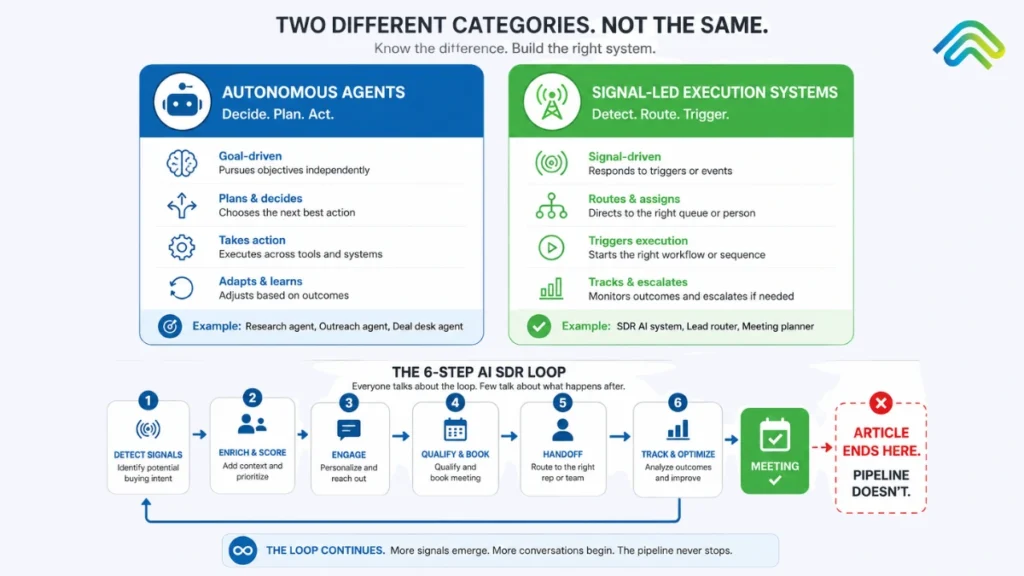
1. ICP targeting: The tool builds a prospect list by matching your ideal customer profile against firmographic data and early intent signals, things like company size, industry, and recent activity that suggest genuine fit.
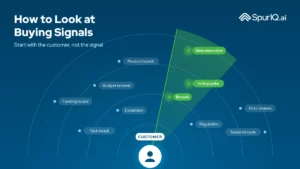
2. Signal detection: It keeps watch for job changes, funding announcements, new tech adoption, pricing page visits, and other moments that suggest a company is actually showing buying behaviour, not just sitting on a static list.
3. Contact enrichment: It pulls verified emails, phone numbers, and LinkedIn details, usually through what the industry calls waterfall enrichment, checking one data source and falling back to the next when the first one comes up empty.
4. Personalised outreach: It drafts emails and LinkedIn messages that pull in real context about the prospect’s company, rather than just swapping a first name into a template.
5. Multi-touch follow-up: It manages a sequence across channels and adjusts timing based on how the prospect responds, or does not respond.
6. Meeting booking: Once someone replies with genuine interest, the system qualifies them and gets a meeting on the rep’s calendar.
That is the loop almost every AI SDR article on the internet walks you through, and it is accurate as far as it goes. Here is the part that gets left out nearly every single time. The meeting gets booked, and the article ends there.
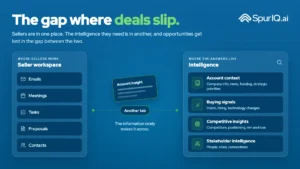
The real challenge begins after the meeting is booked. Ensuring CRM records stay accurate, deals continue progressing, and warning signs of stalled opportunities are caught early is where many pipelines begin to leak. We’ll come back to why that matters in a moment.
Where AI SDRs Genuinely Deliver
AI SDRs are not good at everything, but they excel in a few areas that have a direct impact on pipeline generation. Their biggest strengths are speed, consistency, scale, and rapid response to buyer intent signals.
- Speed is the obvious one. Research, list building, and a first draft used to take a human SDR four to six hours. An AI SDR does the same work in minutes, which means time to first touch can drop from days to under an hour.
- Consistency comes next. Every prospect gets researched. Every follow-up actually goes out. There is no Friday slump and no Monday backlog because the system does not get tired and does not forget what it was supposed to send.
- Scale follows naturally from that. A human SDR can realistically keep up with somewhere around 30 to 50 accounts at once. An AI SDR can work hundreds, and often between 500 and 1,000 accounts at the same time, depending on the platform.
- Signal responsiveness is where the gap really shows. The strongest AI SDRs act on a buying signal within minutes of it firing. Human teams, by comparison, are often still catching up days later. The average B2B lead response time is around 47 hours, close to two full business days. That speed advantage can translate into 3 to 5 times higher reply rates for teams that engage buyers while interest is still fresh.
The impact extends beyond outreach efficiency. Sales reps already spend a large portion of their week on activities that have little to do with actual selling, including data entry, manual research, and administrative work. By taking over much of that workload, AI SDRs free reps to focus on conversations and relationship building.
The results show up in pipeline performance as well. Saleshandy’s 2026 analysis found that companies using AI to support human SDRs generated 2.8 times more pipeline than teams relying on manual processes alone. None of this is hype. AI SDRs can deliver real value. The more important question is what happens after the meeting gets booked, and that is where the category starts to wobble.
Where AI SDRs Break and Why So Many Buyers Walk Away
AI SDRs are great at creating activity, but activity alone does not guarantee results. Challenges around execution, visibility, personalization, and learning are often the reasons many companies fail to see long-term value. Let’s take a closer look at where these systems tend to break down:
Problem #1: Volume Without Execution
AI SDRs made booking meetings roughly ten times easier than it used to be. They did not make it any easier to turn those meetings into closed deals. Everything that happens after the meeting still relies heavily on human effort. Tasks such as pre-call preparation, contextual follow-ups based on the conversation, CRM updates, and identifying deals that have quietly gone cold must typically be managed by a sales rep. The pipeline went up. Conversion did not follow it.
Problem #2: Autonomy Without Control
A fully autonomous AI SDR takes the rep out of the loop completely. For complex B2B deals with six to ten people sitting on the buying committee, that is a real risk. Founders and sales leaders lose visibility into what is actually being said, to whom, and why. Meetings get booked that the team cannot close because nobody curated the targeting in the first place.
Problem #3: Personalisation that does not Land Anymore
AI-generated personalisation has a pattern buyers can now spot in about three seconds flat. A line like “I noticed your company just raised funding” reads as machine-written almost instantly. According to Instantly’s 2026 Cold Email Benchmark Report, the average reply rate across billions of cold emails analysed has dropped to 3.43 percent as inboxes saturate with exactly this pattern. More AI plus more volume just adds up to more noise.
Problem #4: No Learning Loop
Most AI SDRs get configured once and then left to run on autopilot. They rarely learn which signals actually led to a closed deal. They do not adjust when outreach to a particular segment quietly stops converting. There is no feedback loop running from closed revenue back into how prospecting decisions get made. The system stays still while the market keeps moving around it.
Put those four problems together, and the churn number stops being a mystery. Teams buy an AI SDR expecting a pipeline, and they get meetings. The meetings do not convert, because the system sitting between “meeting booked” and “deal closed” is still being run entirely by hand. After six to nine months of strong volume, flat conversion, and a sender reputation that is starting to take damage, most teams cancel.
The tool itself usually worked exactly as advertised. The system surrounding it did not. That gap is the real story behind the churn statistic everyone quotes, and almost nobody actually explains.
The Alternative: A Modular Revenue Execution System
The real question is not which AI SDR to buy. It is whether you need a fully autonomous agent or a system that combines outbound execution and deal follow-through while keeping your team in control.
For founder-led B2B teams, the answer is usually the latter. Most do not need full autonomy. They need signal-led outbound that removes manual research, paired with deal execution that ensures booked meetings turn into real pipeline progress. Just as importantly, they need visibility into the entire process without jumping between multiple tools and dashboards.
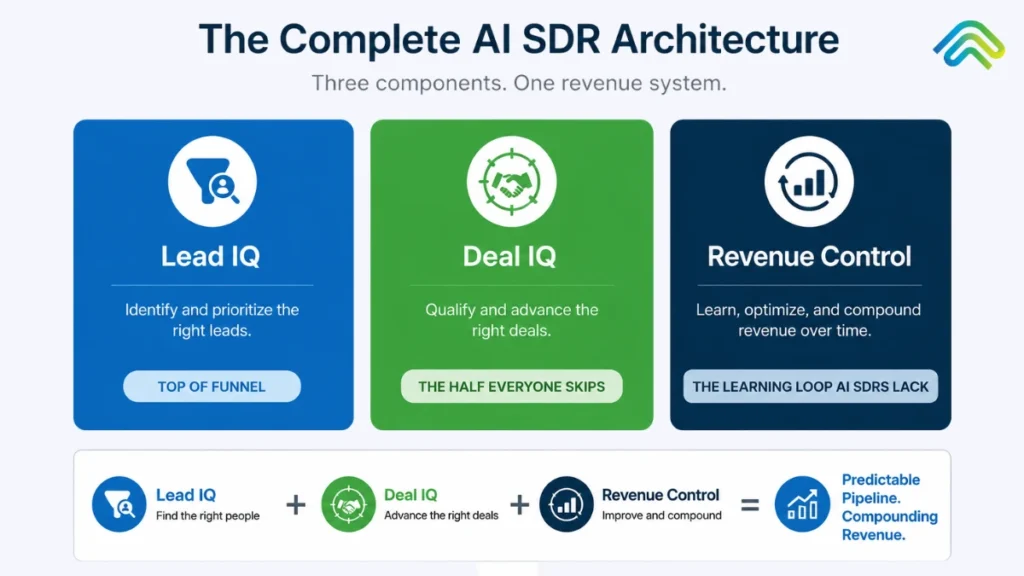
This is closer to how SpurIQ approaches the problem. Lead IQ handles the outbound side. It detects buying signals, researches the account, drafts outreach anchored to that specific signal, routes it through your existing sequencer, and books the meeting. This is the same territory covered in more depth in SpurIQ’s breakdown of signal-based outbound versus cold outbound, which lays out why a smaller, better-timed batch of emails consistently beats a much larger generic one.
Deal IQ picks up from there, which is the half of the story most AI SDR coverage leaves out entirely. It captures what actually happened on the call, drafts the follow-up based on that real conversation, keeps the CRM updated automatically, and flags a deal the moment it starts to stall rather than weeks later when the quarter is already in trouble. Revenue Control sits across both tracks, enforcing execution discipline and feeding performance data back into the system so it keeps improving instead of running the same playbook forever, a gap SpurIQ explores in more detail in its piece on what most AI sales agents actually get wrong.
This setup is built to solve the exact problem that explains AI SDR churn in the first place. AI SDRs lose customers because the system around the tool is broken, not because the underlying technology is bad. SpurIQ is built to be that system. Lead IQ replaces the all-or-nothing autonomous agent bet with modular outbound your team can actually see and steer. Deal IQ closes the execution gap that swallows pipeline after the meeting gets booked.
In short, Agency-like lead generation outcomes, product-led sales acceleration, and the flexibility of having your own GTM engineer, without the cost and rigidity of a full-service agency, and without betting your pipeline on an autonomous agent you cannot see inside of.
AI SDR vs Modular Execution System: How To Decide
Not every team needs the same solution. Here’s a simple framework to help you decide whether an AI SDR, a modular execution system, or a combination of both makes the most sense.
| Option | Best Fit When | Why It Makes Sense |
| Fully Autonomous AI SDR | You operate in a large, relatively undifferentiated market, need maximum outreach volume, have a mature sales team, and already maintain healthy conversion rates. | Your primary bottleneck is top-of-funnel activity. An autonomous AI SDR can generate and manage high volumes of outreach efficiently. |
| Modular Revenue Execution System | You are a founder-led B2B team, lead flow is inconsistent, deals take longer than expected to close, follow-ups often slip through the cracks, and CRM data requires constant manual cleanup. | You need support across the entire revenue process, from pipeline creation to pipeline conversion, rather than simply adding more meetings to the calendar. |
| Both Together | You want high-volume outreach while also maintaining strong deal execution and visibility across the sales process. | An AI SDR can drive outreach at scale, while a modular execution system handles signal-led outbound, follow-through, CRM discipline, and deal progression. The two approaches can complement each other rather than compete. |
The Bottom Line
AI SDRs are real, and this category is not going anywhere. But the gap between a meeting booked and a deal closed is exactly where most teams lose the return promised on the demo call. The winning move in 2026 is not chasing more autonomy. It is building better execution across the entire revenue cycle, from the first signal all the way through to a closed deal.
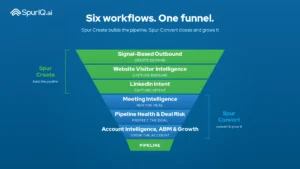
SpurIQ is the modular revenue execution system built for founder-led B2B companies. Lead IQ builds the pipeline. Deal IQ converts it. Revenue Control keeps the whole thing visible. See how it works at spuriq.ai/demo.
Frequently Asked Questions:
Q. Can AI SDRs replace human SDRs?
For simple, high-volume outbound with short sales cycles, increasingly yes.
For complex B2B sales involving multiple stakeholders, not yet.
The highest-performing teams typically combine AI and human SDRs:
AI handles research, outreach, and repetitive tasks
Humans handle judgment, relationship building, and sales conversations
Q. Why do AI SDRs have such high churn rates?
Most AI SDRs solve the pipeline volume problem but not the pipeline conversion problem.
– Meetings get booked
– Follow-through still depends on sales reps
– Conversion rates remain flat
– Teams fail to see the expected ROI
After six to nine months, many teams decide to cancel. The real solution is closing the execution gap between a booked meeting and a closed deal.
Q. What is the difference between an AI SDR and a revenue execution system?
An AI SDR is designed to automate prospecting and outreach, helping sales teams generate more meetings and pipeline. A Revenue Execution System goes much further by supporting the entire revenue lifecycle, from identifying high-intent prospects to advancing deals and improving revenue performance. Platforms like SpurIQ combine Lead IQ for signal-based outbound, Deal IQ for deal execution, and Revenue Control for visibility and accountability. In simple terms, an AI SDR helps you start conversations, while a Revenue Execution System helps you turn those conversations into revenue.
Q. How much do AI SDRs cost?
Entry pricing for fully autonomous tools starts around $250 a month with Artisan’s Intern plan and $900 a month with AiSDR’s Explore plan. 11x.ai does not publish pricing and routes buyers through a sales conversation instead. Modular platforms such as SpurIQ typically use tiered pricing that scales with team size, including a free Lead IQ tier for teams getting started.