Your AI stack keeps getting bigger and your pipeline keeps looking the same. Here’s the piece almost everyone is missing, and why it changes everything downstream.
Here’s something strange about selling in 2026. Revenue teams have never had more AI, more copilots, more agents, more tools that research, draft, score, summarise and send. And yet, for a lot of teams, the pipeline number at the end of the quarter looks suspiciously like last year’s.
More activity. Not more revenue.
If that sounds familiar, the problem probably isn’t the AI. It’s what the AI is standing on. Most of these tools got bolted onto a CRM built to store information, not act on it. So every tool works in its own little box, every interaction starts from zero, and none of them actually knows how your company sells. You didn’t buy intelligence. You bought a faster way to run the same broken playbook.
The fix isn’t another tool. It’s a Revenue Brain, and it’s quietly becoming the most important layer in the modern go-to-market stack. Let’s take it in order: what a Revenue Brain actually is, how it works, why your company needs one, and then a quick look at what it powers once it’s running.
What is a Revenue Brain?
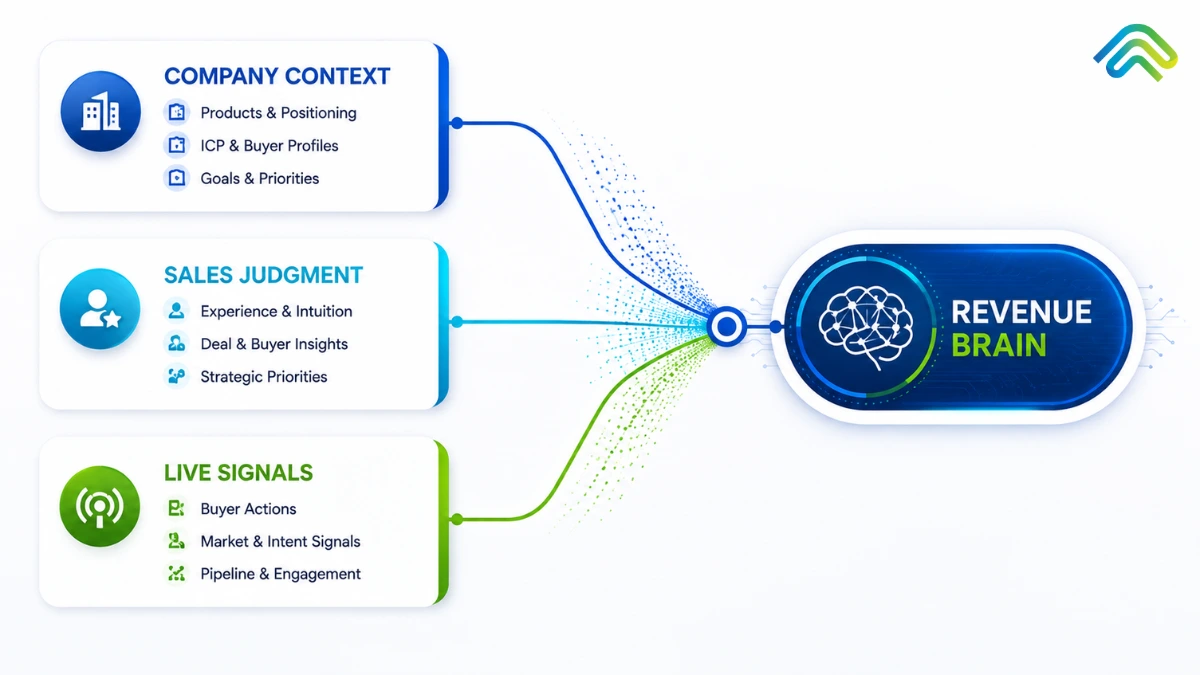
A Revenue Brain is the one layer that holds three things together:
- The memory of how your company sells: your ICP, messaging, proof points, playbooks, and sales history.
- The sales judgment that decides what matters: which accounts qualify, which buyer to approach, which angle to use, what counts as risk, what to do next.
- The live signals that show when it matters: hiring, funding, website visits, email and call activity, LinkedIn engagement, CRM changes.
Held in one place and kept current, those three become something more than the sum of their parts: your company’s best sales judgment, made available to every rep at the exact moment they need it.

It’s not a bigger database. A database stores facts and waits for a human. A Revenue Brain holds the judgment behind the facts, and it’s wired to act on it. The simplest way to hold the idea in your head: there’s a difference between AI that knows facts about your company and AI that knows how your company wins. A Revenue Brain is the second one.
What it actually stores?
Concretely, this is the memory a Revenue Brain keeps and keeps current:
| What it remembers | What that means in practice |
|---|---|
| Products & Services | What you actually sell, and the use cases that land |
| ICPs & Personas | Who’s a fit, by segment, firmographics and persona |
| Messaging & Positioning | Your value props by segment, and your tone of voice |
| Sales Playbooks | The plays that work, codified so they run consistently |
| CRM / Account History | Your accounts, your live pipeline, what’s happened before |
| Past Outcomes | What’s converted, so the brain keeps getting sharper |
A quick example
A new rep pulls up an account and wonders, “is this one worth my time?” A CRM shows them a screen of fields and leaves them to guess. A Revenue Brain tells them what your founder would say in ten seconds: yes, this fits our ICP because they just raised and they’re hiring for exactly the pain we solve; lead with the follow-up-gap angle; and here’s the proof point that lands with teams this size. Same account. One of them is looking at a database. The other is borrowing your best seller’s instinct. That gap is the whole reason a Revenue Brain exists.
How does a Revenue Brain work?
Mechanically, it does two simple things, constantly. Every workflow reads from it before acting, so nothing goes out generic, and every result writes back into it, so it keeps learning. One always-on memory that everything checks with, and everything reports back to.
That sounds obvious until you look at why it’s so rare. In almost every scaling company I’ve worked inside, those three ingredients; context, judgment, signals, live in different places and never come together. Three failures, over and over:
1. The instinct never transfers
The founder can look at an account and tell you in ten seconds whether it’s worth chasing. Everyone else, marketing, RevOps, the sellers, got the ICP slide. They have the definition. They never got the instinct behind it. A Revenue Brain captures the instinct, not just the slide, and hands it to everyone.
2. Context thins as the team grows
Positioning, proof points, the real reasons people buy, all of it drifts a little from one seller to the next, until the version a new hire is working from barely resembles the one that actually wins. A Revenue Brain is the single source everyone pulls from, so context stops degrading as you add headcount.
3. Signals are everywhere, useful nowhere
Buying Signals sit scattered across CRM, email, LinkedIn, calls, hiring and funding feeds. Each one useful on its own. All of them useless at the exact moment someone has to decide what to do next. A Revenue Brain gathers them into the same place as the context and the judgment, so a signal actually turns into a decision.
Hold all three together in one memory that reads before it acts and learns after, and you’ve fixed the thing no individual tool can: you’ve made your company’s way of selling shared, current, and usable, instead of trapped in one person’s head.
Why does your company need a Revenue Brain?
Two reasons. First, because of what it stops leaking. Second, because of what it gives you back.
What it closes: the signal-to-action gap
The single problem behind flat revenue has a name, the signal-to-action gap. Your systems know things they never act on. And it opens in two places, which is why a Revenue Brain has to cover the whole cycle, not one end of it.
Before pipeline exists: A company raises a round. A fit-profile account reads your pricing page twice. Every one of those is a reason to reach out now, but nobody’s watching all of it, scoring it against how you sell, and acting. The moment passes, and pipeline that should have existed never does.
After pipeline exists: The deals you did create decay quietly. Follow-up slips, the next step never gets booked, a deal goes single-threaded and nobody notices. Risk lands on the forecast weeks after it was knowable. Pipeline you already paid to create leaks straight back out.
Your CRM can’t close either one, because it was built to remember, not to decide. It holds the facts and waits for a person to notice, and with hundreds of accounts, nobody does. A Revenue Brain flips that: instead of storing until a human acts, it knows how you sell and drives the next action itself, whether that’s creating an opportunity or saving one. (We go deeper on why the CRM falls short in why legacy CRMs are failing.)
What it gives you back
Close the gap and 4 things change that founders and sales leaders feel directly:
- Everyone works from the same truth: Context stays current in one place, so marketing, sales, and every new hire are selling the same way, not 12 slightly different ways.
- You can scale without diluting: The company’s selling knowledge doesn’t thin out as you add reps, because it lives in the Brain, not in your best rep’s memory.
- Reps know exactly what to send: The right message, the right proof, for this buyer, right now, without pinging three people or guessing.
- You change it once, not everywhere: Update your ICP or messaging in the Brain and every workflow reflects it immediately. New positioning lands in days instead of quarters, you’re not rebuilding twelve workflows every time your story shifts.
The point was never more data. It’s making your company’s best sales judgment available to every seller, at the moment they need it. – Vijay Agarwal (Co-Founder of SpurIQ)
What it powers: SpurIQ’s Revenue Engine
A Revenue Brain isn’t the whole machine, it’s the intelligence at the centre of it. The machine around it is the Revenue Engine, and inside SpurIQ it runs as a GTM command centre: one place where you type what you want in plain English and watch it become executed action.
Say the word and it moves. “Launch a campaign targeting SaaS companies hiring their first VP of Sales.” SpurIQ checks the Revenue Brain to ground the request against how you actually sell, finds the accounts showing that trigger right now, identifies the real buyers inside them, drafts outreach in your voice, launches across the tools you already use, and syncs every result back into the Brain so the next campaign starts smarter. One sentence in, 40 matching companies, 86 relevant buyers, 3 messaging variants, synced to your CRM and email, out.
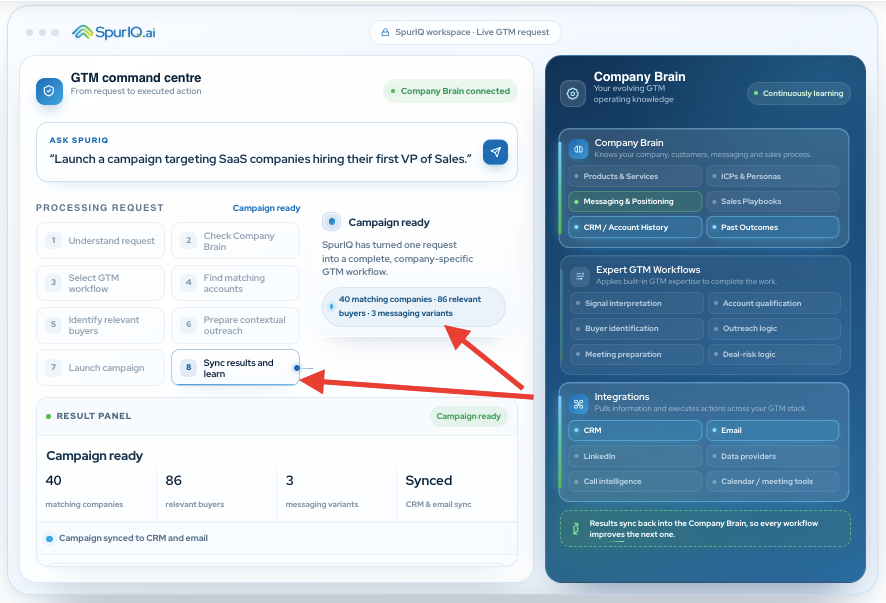
That’s the Brain doing its two jobs inside a live motion: grounding the work up front, and learning from it at the end. The full eight-step walkthrough, and how the same command centre runs convert-side plays like call prep and deal-risk alerts, is its own piece: How SpurIQ’s Revenue Engine works, from request to executed action.
And if you want the real architecture underneath, how context, skills, orchestration and execution fit together, that’s the 4-Layer GTM Stack. The Revenue Brain is one layer of it; this piece is about that layer. The rest of the machine is that one.
The part most people miss: memory has to produce action
Here’s where a lot of the current “revenue brain” talk stops short. Most of it is about shared memory, one place where all your data and context finally live together. That’s necessary. It is nowhere near sufficient.
A brain that remembers everything and acts on nothing is just an expensive database. It’s the signal-to-action gap with a new name. – Arush Lakhani (Founder & CEO of SpurIQ)
Think about it. If your beautifully unified memory still needs a human to notice the signal, decide the play, write the message, and update the system, you haven’t closed the gap. You’ve just made the place where nothing happens more organised.
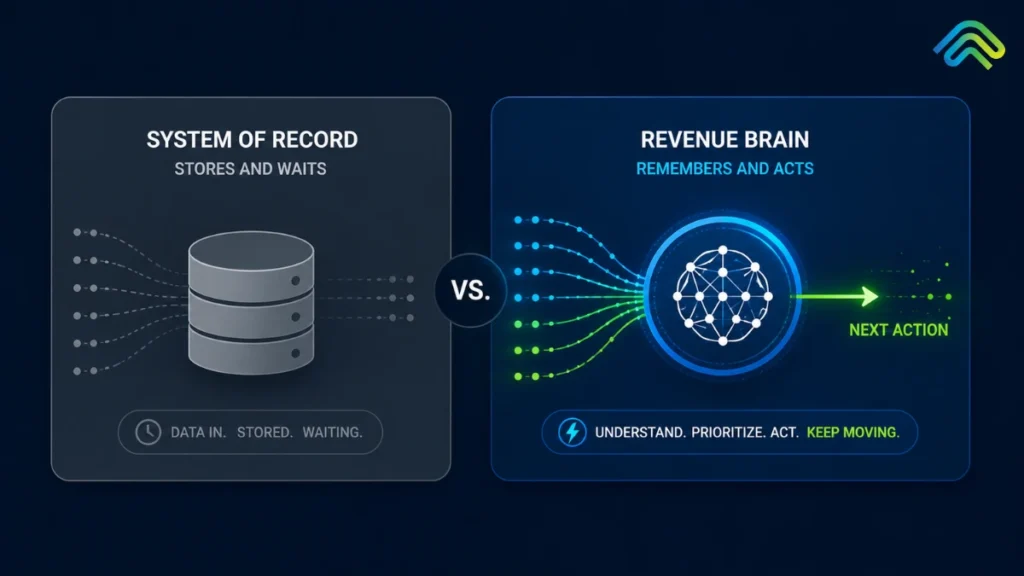
The real test of a Revenue Brain isn’t how much it knows. It’s whether it drives the next action. Context has to become execution, or it’s just storage with better marketing. That’s why a Revenue Brain is wired to the engine that does the work, so the moment a signal fires (a funding round, a VP hire, a deal going quiet) the system doesn’t just notice. It acts. That’s the line between an intelligence layer that advises and one that executes.
Why it gets smarter every single quarter
The most underrated thing about a Revenue Brain is that it compounds. It runs a simple loop across your whole motion; observe, decide, execute, make visible, learn, and because every result feeds back in, the whole system improves together. When one workflow learns that a certain message converts founder-led teams, or that a certain signal predicts a fast close, that lesson updates the memory the entire operation runs on. A siloed point tool can never do this; its lessons die inside it.
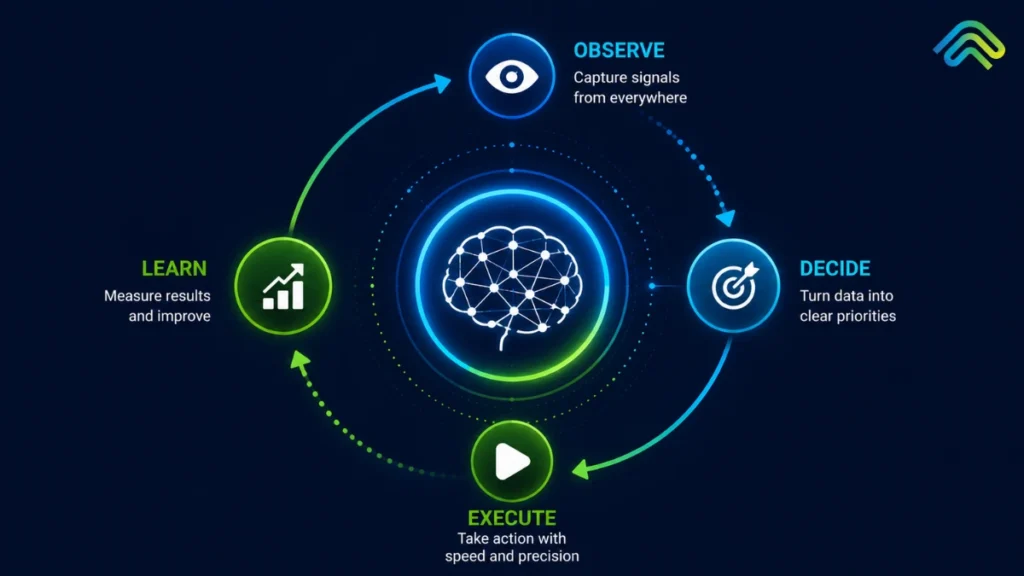
Which leads to a quietly brutal fact: two companies can buy the exact same tools, but the one whose Revenue Brain has been learning for a year pulls away from the one still bolting agents onto storage. The advantage compounds, and it’s hard to copy.
That intelligence expresses itself through six workflows across your revenue cycle, three that create pipeline (under LeadIQ) and three that convert it (under DealIQ). But those are the output. The Brain is the thing underneath, making all six specific to how you sell.
Do you already have a Revenue Brain? A 30-second gut check
You don’t need a vendor to answer this. Run these on your own stack:
- Do your AI tools share one memory of how you sell or does each one start from zero?
- When one tool learns something that works, does the rest of your stack adapt or does the lesson die where it started?
- Does your system act on signals or just surface them on a dashboard for someone to notice later?
- Does your CRM reflect reality without someone updating it by hand every night?
If most of your answers are “no,” you don’t have a brain yet, you have a pile of tools, and you’re bolting agents onto storage. If most are “yes,” your memory is producing action, and you’re already compounding. Either way, now you know which side of the line you’re on.
The teams that build the brain first
Back to the paradox we started with. More AI didn’t create more revenue for most teams, because all that intelligence had nowhere to live. It was scattered across a dozen tools, each starting from zero, none of them knowing how the company actually sells.
The teams that win in 2026 won’t be the ones with the most AI tools. They’ll be the ones whose AI shares one memory of how they sell, and acts on it. That’s a Revenue Brain: the intelligence layer behind how your company sells, and the gap between the teams that build it and the teams still managing a pile of tools widens every day.
SpurIQ’s Revenue Brain is built to execute. It learns how your company sells, and drives the engine that turns one request into pipeline, and every result into a smarter next move.
See what a Revenue Brain does with how your company sells. Book a walkthrough and we’ll show you where revenue is leaking across your motion, and how to plug it, in under 10 minutes.
Frequently asked questions:
Q. What is a Revenue Brain in simple terms?
It’s the one layer that holds three things together, the memory of how your company sells, the sales judgment that decides what matters, and the live signals that show when it matters. It’s not a database that stores information; it’s the intelligence that grounds and drives the next action.
Q. How is a Revenue Brain different from a CRM?
A CRM is a system of record. It stores information until a human decides to act. A Revenue Brain is a system of intelligence: it knows how you sell and drives the next action itself. SpurIQ sits on top of your CRM and makes it better, it doesn’t replace it.
Q. Is a Revenue Brain the same as revenue intelligence?
No. Revenue intelligence mostly tells you what happened, it analyses calls or forecasts pipeline. A Revenue Brain decides what should happen next and drives it. Insight is a feature of it, not the whole of it.
Q. Do I need to replace my existing tools to build one?
No. A Revenue Brain connects to the tools you already use, your CRM, email, LinkedIn, data providers, calendar and call recorder, reading from them and pushing actions back out. With SpurIQ there’s no data migration and no rip-and-replace; most teams are live in about two weeks.
Q. Why isn’t shared memory enough on its own?
Because memory that doesn’t produce action is just an expensive database. If a human still has to notice the signal, choose the play, write the message and update the system, the gap between knowing and doing is still wide open. A real Revenue Brain closes it by driving the action.
Q. How does a Revenue Brain get smarter over time?
Every result feeds back into it. When a message, signal or play works, the memory updates, so the next workflow starts from a better place. It runs an observe-decide-execute-learn loop, and the advantage compounds every quarter.