Account-based marketing is back in the GTM conversation, and for good reason. The missing piece was never the target list. It was keeping the plan fresh enough to act on, week after week.
ABM keeps coming back around. Every couple of years a revenue team dusts off the idea, picks fifty or a hundred named accounts, aligns marketing and sales around them, and commits to going deep rather than wide. The logic is sound, and when it works, it works beautifully.
Then, for most teams, it quietly fades into a target list and some ads. The ambition was real. What broke was the upkeep. Let us look at why, and at what has changed to make ABM genuinely workable now.
Why ABM has always needed stakeholder mapping
At the heart of ABM is a simple discipline: know the account properly. Not just the logo, but every person inside the buying group, the role each one plays in the decision, and which of them you have actually spoken to versus which ones you have never touched.
That map is what separates ABM from a bigger email list. It tells you where the deal really stands: who your champion is, who signs the contract, who can quietly block it, and which decision-maker has never heard from you at all.
The trouble is that most teams build this map once, at kickoff, and then let it go stale. People change roles. Champions leave. New stakeholders join. Six weeks later the map describes an account that no longer exists, and the programme slowly decays into the target-list-and-ads version everyone recognises.
ABM does not fail because the idea is wrong. It fails because the account map is built once and then left to go out of date.
The new ingredient: signals that arrive account by account
Here is what has actually changed. It is now possible to pick up signals as they happen, account by account, just in time. A leadership change. A new initiative that lines up with what you sell. A stakeholder joining or leaving. An industry-specific event that means something to that particular buyer this week.
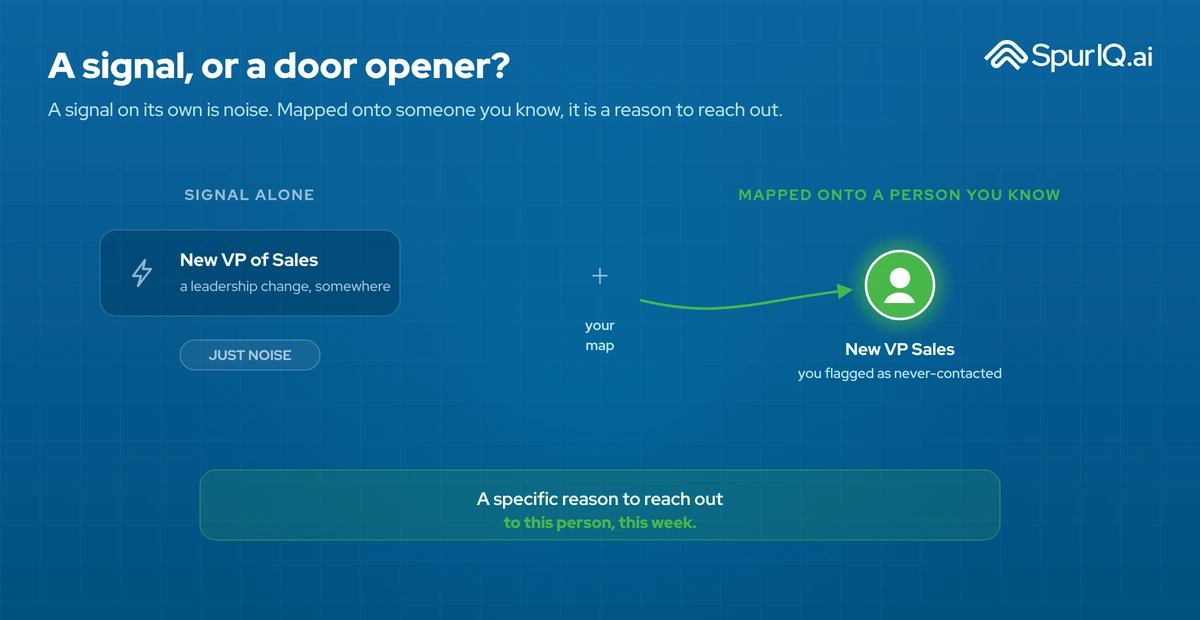
On their own, these signals are noise. A feed of funding rounds and job changes tells you a lot happened somewhere, and very little about what to do. The value appears when you lay a signal against a stakeholder map you already have.
Map the signal onto a person you already know exists inside the account, and it turns into something useful: a specific reason to reach out, to a specific person, right now. The new VP of Sales you had flagged as never-contacted just became the most relevant door in the building. That is the difference between a signal and a door opener.
A signal on its own tells you something happened. A signal mapped onto a stakeholder you already know gives you a reason to reach out to that person this week.
Where it becomes operational: the weekly account plan
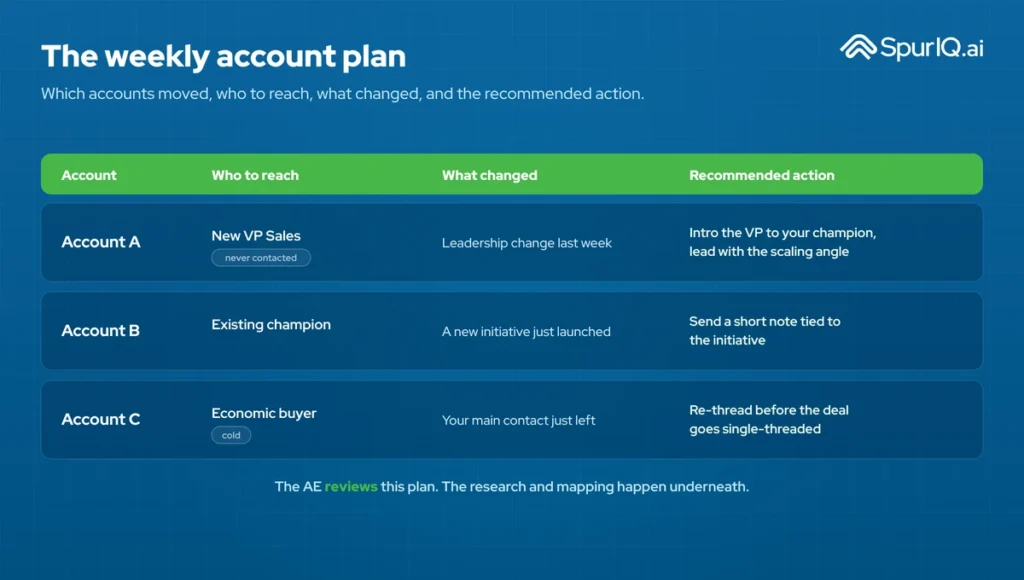
This is the part that turns a nice idea into something an AE can run. Combine three things, the stakeholder map, the account intelligence, and the sales context for how your company actually sells, and you can produce a weekly account plan for each rep.
A good weekly plan answers four questions at a glance:
- Which accounts moved this week, and are therefore worth attention now.
- Which stakeholder to reach inside each of those accounts.
- What changed that justifies the touch, so the outreach has a real reason behind it.
- What the recommended action is, so the rep starts from a draft rather than a blank page.
Here is what that looks like in practice.
| Account | Who to reach | What changed | Recommended action |
|---|---|---|---|
| Account A | New VP Sales (never contacted) | Leadership change last week | Intro the VP to your champion, lead with the scaling angle |
| Account B | Existing champion | A new initiative just launched that your product supports | Send a short, specific note tied to the initiative |
| Account C | Economic buyer (cold) | Your main contact just left the company | Re-thread before the deal goes single-threaded |
Notice the shift in who does the work. The AE reviews this plan rather than building it. The research, the mapping and the signal-watching happen underneath, and the rep spends their time on judgment and conversations, which is the part only they can do.
Why weekly cadence is the whole point
The cadence matters more than almost anything else, and it is where most ABM programmes get it wrong. They run the plan quarterly. The signals, meanwhile, arrive daily.
A quarterly plan built on daily signals is out of date before the ink dries. The leadership change you needed to act on in week one gets noticed in the week-ten review, long after the moment has passed. Weekly is the cadence that matches the pace at which accounts actually move. It keeps the map current, catches the signal while it still means something, and gives the rep a fresh, specific list to work every single week.
ABM fails when the plan is quarterly and the signals are daily. A weekly plan is what keeps the two in step.
How SpurIQ runs this as a continuous motion?
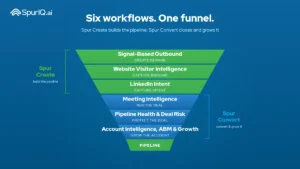
This is exactly the motion SpurIQ is built to run, and it fits across two of our four sales plays: Meet, where you reach specific target accounts, and Grow, where account intelligence keeps those relationships expanding after the win.
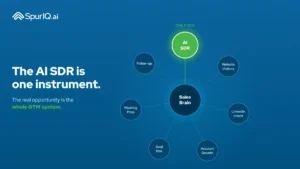
Underneath both is the thing that makes the weekly plan possible, what we call GTM Context: your company knowledge, how your best sellers actually qualify and approach an account, combined with live intelligence about what is happening inside each one. The Spur Sales Brain holds that context and keeps it current as the account moves, so the stakeholder map does not go stale and the signals are read against how you specifically sell.
The stakeholder map stays alive: Instead of a kickoff artefact that decays, the buying group is kept current as people join, leave and change roles.
Signals are read in context, not in isolation: A leadership change or a new initiative is matched against the people you already know in the account, so it becomes a specific reason to reach out rather than another alert.
The weekly plan is produced for the AE to review: Which accounts moved, which stakeholder to reach, what changed and the recommended action, prepared each week so the rep acts instead of researching.
One honest note, because it matters for a buying decision. The Account Intelligence, ABM & Growth workflow of this is where SpurIQ is piloting today rather than broadly live, and everything is delivered as a managed deployment, configured around how your team sells, rather than a self-serve tool. We scope each engagement to what is genuinely ready for you.
The real unlock in modern ABM is continuous context: an account map and its signals kept current week to week, so the next action is always based on what is true now.
The takeaway
ABM is rising again because the hardest part has finally become doable. The target list was never the bottleneck. Keeping the account map alive, reading each signal against the people inside the account, and handing the AE a fresh plan every week is what separates real ABM from a list and some ads.
Get that rhythm right and ABM stops being a quarterly project that fades by month two. It becomes a weekly motion that compounds, because every week the plan reflects what actually changed in the account.
Frequently asked questions (FAQs):
Why does most ABM decay into a target list and some ads?
Because the account map is built once at kickoff and then left to age. ABM depends on knowing every stakeholder, their role in the decision and who you have never contacted. People change roles, champions leave and new decision-makers join, so within weeks the map describes an account that no longer exists. Without a way to keep it current, the programme falls back to a static list and retargeting.
What is the difference between a signal and a door opener?
A signal is something observable that happened at an account, like a leadership change or a new initiative. On its own it is noise. It becomes a door opener when you map it onto a stakeholder you already know exists inside that account. Then it gives you a specific reason to reach out, to a specific person, this week. The map is what turns the signal into an action.
What goes into a weekly account plan?
Four things, per rep: which accounts moved this week, which stakeholder to reach inside each one, what changed that justifies the touch, and the recommended action. The point is that the AE reviews the plan rather than building it, so the research and mapping happen underneath and the rep spends time on conversations and judgment.
Why weekly and not monthly or quarterly?
Because signals arrive daily and a quarterly plan is out of date before it is used. The leadership change you needed to act on in week one gets noticed in the week-ten review, long after the moment passed. Weekly cadence matches the pace at which accounts actually move, keeps the map current and catches each signal while it still means something.
How does SpurIQ support ABM?
ABM spans two of SpurIQ’s sales plays: Meet, for reaching specific target accounts, and Grow, for account intelligence and expansion after the win. Underneath is GTM Context, your company knowledge plus live intelligence about each account, held in the Spur Sales Brain so the stakeholder map stays current and signals are read against how you sell. It produces a weekly account plan for the AE to review. The account-intelligence and growth side is piloting today, and everything is delivered as a managed deployment scoped to what is ready for you.