“In the next era of B2B, the winners won’t be the ones with the best database, but the ones with the best process for acting on that database.”
~ Aaron Ross (Author of Predictable Revenue)
A trader once said, “You can have all the ships, the maps, and the cargo. If you never sail, the port stays empty.” Today, the same story is playing out inside every B2B revenue team.
Revenue leaders are finally starting to admit a truth that has been whispered in boardrooms for years: their CRM is the most expensive address book in the company.
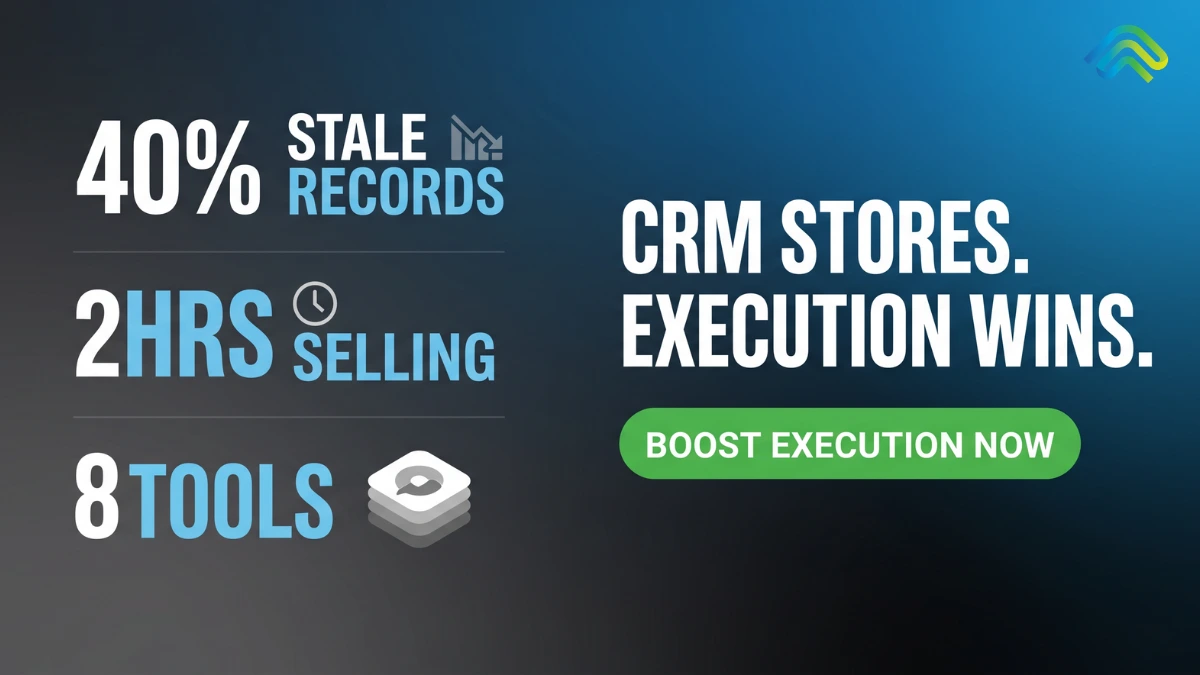
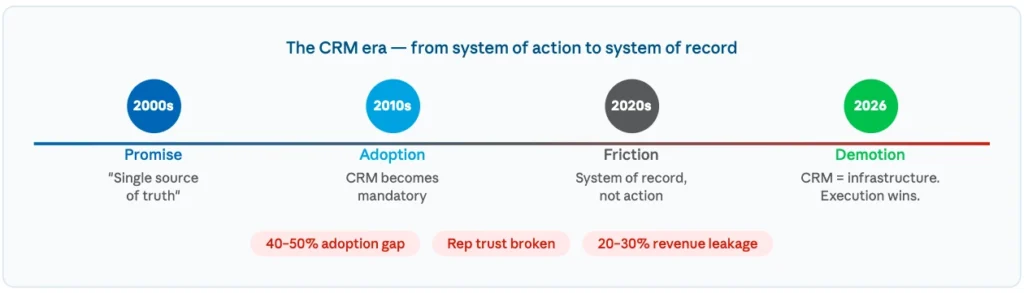
B2B teams spend millions of dollars every year on Salesforce and HubSpot, yet an estimated 20 to 30% of potential revenue still leaks after the first buyer interaction. The tools are not broken. The problem is that they were never built for what matters most: execution.
CRM systems were designed to record relationships, log calls, and track deals. In 2026, deals are not lost because of missing data. They are lost because no one acted on the data that was already there. People had notes, timelines, and contact history. They just never turned that information into timely, coordinated actions.
This signals a massive shift in the market. CRM is not necessarily dying; it has evolved. The real power in the tech stack is moving to the Execution Layer that sits above the database. Legacy CRMs are losing the war because they are trying to solve an execution problem with a storage solution.
How Salesforce and HubSpot Became the Center of Every Sales Org (And Why That Era Is Over)
Twenty years ago, customer data lived in a hundred places: spreadsheets, email threads, sticky notes, and hazy memory. Then Salesforce came along and said, ‘’Put it all in one place.’’ Slowly but surely, it became the default system that every serious sales organization was expected to run on. The promise was to give every rep a single source of truth, and your team would finally see the whole pipeline, not just a fragmented view.
HubSpot followed a similar path but with a different mission. While Salesforce leaned into the enterprise, HubSpot focused on SMBs and marketers. It offered a free CRM as a gateway to its marketing‑first stack, then built workflows that let growing teams track leads, touch points, and revenue in one interface. Within a few years, what started as a marketing tool quietly became a core CRM for thousands of companies.
At first, this was a clear win. Centralized data helped leaders see pipelines, forecast revenue, and measure performance in ways that simply weren’t possible before. But somewhere along the way, the magic faded. What was built as a system of action turned into a system of record: a place reps updated because leadership demanded it, not because it helped them close. The very thing meant to drive revenue became the chore no one wanted to do.
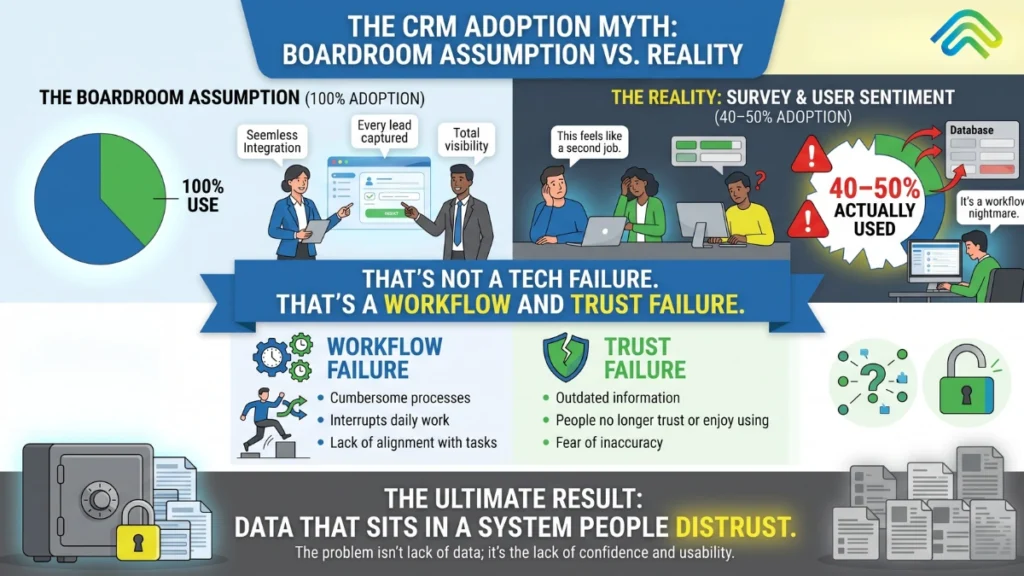
One revenue‑focused discussion put it clearly: “The CRM is not broken; your process is. You built a system to track leads, but you never built a system to follow up on them.” In that gap, the problems of CRM deepen: incomplete entries, missing context, and forecasts that feel like hopeful guesses rather than grounded predictions.
That’s the quiet reality of the Salesforce‑and‑HubSpot era. They succeeded in becoming the center of the sales org, and in doing so, they also became the center of friction. What started as a solution to the common CRM problems of the early 2000s, over time, has become a legacy CRM that is no longer enough for the execution-first world of 2026. That’s how the era where CRM was the undisputed center is ending! The power is shifting now.
5 Core Reasons Why Businesses Are Leaving Legacy CRMs in 2026
In the early days of enterprise software, management thinker Peter Drucker said, “You can’t manage what you can’t measure.” For decades, CRM systems have given teams the ability to measure. However, the 2026 update is that you can’t execute what you don’t automate.
That’s because businesses are realizing that knowing where every lead sits is no longer enough. Visibility isn’t the real challenge; it’s turning that visibility into coordinated and timely action. Legacy CRM systems were built to answer the question “What happened?” But B2B revenue teams are asking a new question: “What should happen next, and who is responsible for it?”
Simply put, legacy CRM systems are not dying because they are broken. They are being replaced because they were built for a world that no longer exists. As B2B selling becomes more complex, distributed, and signal-driven, the old playbook starts to crack.
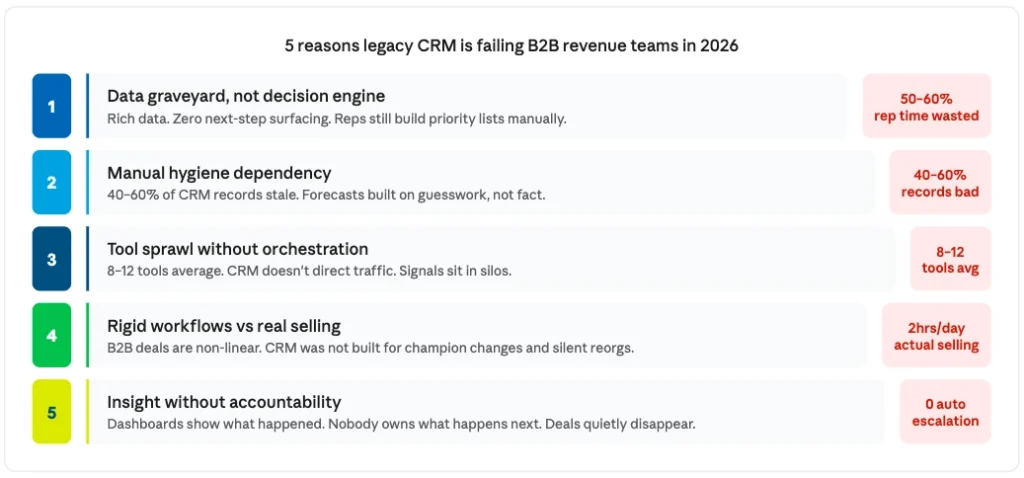
Here are five reasons teams are quietly moving away from Salesforce and HubSpot as their revenue core:
Failure 1: Data Graveyards, Not Decision Engines
Legacy CRMs are fantastic at collecting data. They log calls, store notes, track stages, and centralize customer history. But they rarely turn that data into decisions. In practice, this looks like a rep opening a spreadsheet every morning and sorting leads by hand because the CRM doesn’t surface what really matters.
Here’s how that gap usually shows up:
- The system sees that a lead visited pricing twice and opened your proposal, but it doesn’t say, “Call this one first.”
- Instead, the rep manually builds a priority list, pulling data out of the CRM and into a spreadsheet.
- The CRM could know the right next step, but it won’t act on it.
Case Studies in the AI‑CRM space show that modern systems that surface intent signals can cut rep analysis time by 50–60% compared to traditional CRM‑only workflows.
| As a Revenue Ops podcast host once put it, ‘You’re not paying for data. You’re paying for the ability to act on it. If your CRM doesn’t tell you what to do next, it’s a data graveyard, not a decision engine.’ |
This is one of the biggest problems with CRM: rich data, weak action.
Failure 2: Manual Hygiene Dependency
The quality of your CRM data rests almost entirely on your reps tying the right fields at the right time. That’s a tough bet. CRM deployment landscapes suggest that 40-60% of CRM records are incomplete or stale at any given time. Meaning that, half of your pipeline, give or take, is built on guesswork, not facts. And, forecasts based on that data aren’t just inaccurate but are fiction sold as insight.
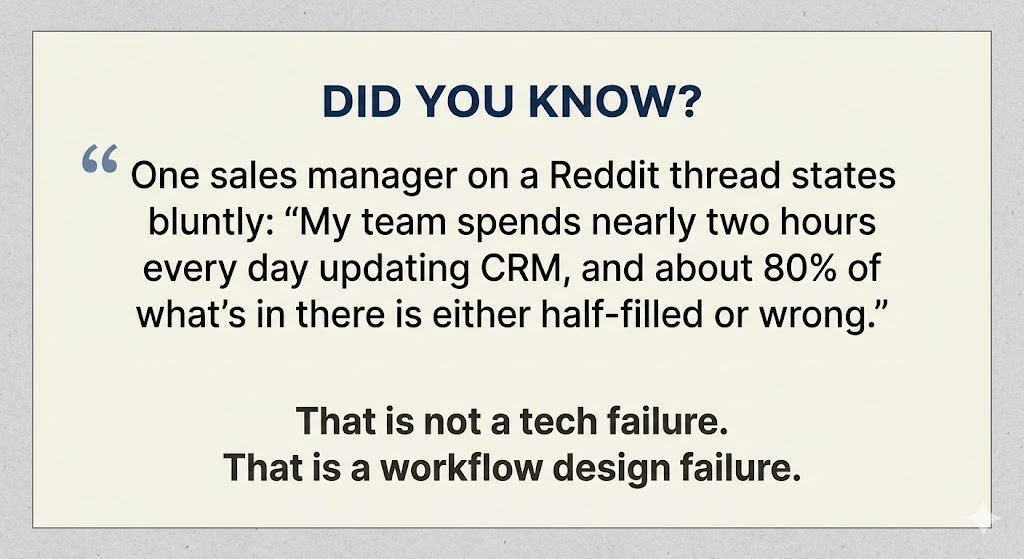
On Reddit threads about CRM frustration, reps often say the same thing: “I update the CRM because my manager says I have to, not because it helps me close.”
One sales leader on Quora described it as a “data hygiene tax,” i.e., every hour spent fixing fields is an hour not spent selling. The problems in CRMare not just in the design of the software. They live in manual, error‑prone, hygiene‑dependent workflows.
Failure 3: Tool Sprawl Without Orchestration
Today, the sales team runs on 8-12 tools on average. Starting from CRMs, outreach platforms, dialers, meeting schedulers, call intelligence tools, marketing automation, and customer success platforms.
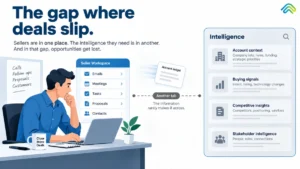
Your CRM might be the center of the universe, but it isn’t exactly directing traffic. Every tool in your stack is screaming for attention at the same time: one notification pops up because a prospect opened an email, while another tells you they mentioned a budget on a recorded call. Without a unified execution layer to connect the dots, these insights just sit in their own silos. The result? Your reps are staring at five different screens, trying to guess which fire they should actually put out first.
| Did You Know? In 2026, Gartner officially moved Revenue Action Orchestration into its own Magic Quadrant, specifically because legacy CRMs failed to “coordinate the action.” Gartner defines this new category as platforms that “move beyond insight to deliver structured, real-time action across complex journeys.” This supports your thesis that the industry has realized “observation” (CRM) is no longer enough. |
Failure 4: Rigid Workflows That Don’t Match Real Selling
The thing about B2B deals is that they don’t follow a script. Your champion gets promoted, and suddenly you’re starting over with someone who’s a stranger. Three stakeholders appear out of nowhere in week 6.
The budget that was “approved” gets frozen because of a reorg nobody saw coming. Real selling is messy, non-linear, and deeply human.
Legacy CRMs weren’t built for that reality. And the numbers show it. According to HubSpot’s 2025 State of Sales Report, reps spend just 2 hours a day actually selling. The rest disappears into admin, data entry, and wrestling with tools that don’t match how deals actually move.
Salesforce’s latest research adds to this: the average rep juggles 8 different tools to close a single deal, and 42% say they feel overwhelmed by the sheer number of systems they’re expected to use.
So what happens when the tool doesn’t match the motion? Reps adapt badly. They open a Word doc. They start a Slack thread. They keep a running note in their phone. And slowly, quietly, the CRM becomes a place where old information lives, not a place where actual selling happens.
As sales strategist Jill Konrath puts it, the best tools should reduce friction, not create it.
A CRM your team doesn’t trust is just an expensive spreadsheet with a login page.
Failure 5: Insight Without Accountability
Dashboards and reports are great at showing what happened. They are terrible at making sure the right thing happens next.
You can see how many leads came in, which deals closed, and where the pipeline is stuck. But no one can tell you, automatically, “This critical follow‑up hasn’t happened in 48 hours. Escalate to the manager. Change the owner. Adjust the SLA.” Visibility without clear ownership, SLAs, and automatic escalation turns insight into expensive observation.
In Short
These five failures are not random. They all come from the root cause. Legacy CRMs were built to record the revenue process, not to run it. They collect signals from email, calls, calendars, and meetings. They store everything. But they were never engineered to turn those signals into coordinated, time‑bound action. Observation was the goal. Execution was left to the rep, and it was almost always manual. That gap is where deals quietly disappear.
This is where a new category is taking shape: the AI revenue action orchestration layer. Think of it less as another tool and more as the connective tissue that the stack has always been missing.
SpurIQ is one example of this layer. It does not replace Salesforce or HubSpot. It sits above them, picks up the signals those CRMs already collect, and turns them into orchestrated, accountable actions. The right task goes to the right person at the right time, without waiting for someone to remember a follow‑up.
| Not a CRM replacement. A CRM multiplier. One that finally makes all that expensive data collection worth something by actually acting on it. |
CRM Isn’t Dying – It’s Being Demoted to Infrastructure
Across the industry, revenue teams are moving through a quiet but important evolution.
Here’s how you can think about it as a four‑level framework.
| Level | What It Means | What Teams Do | Where Most Companies Are Today |
| Level1 Descriptive | “We know what happened.” | Use dashboards and reports to track pipeline, velocity, and win rates. No deep explanation of why. | Most teams live at this stage: they see the pipeline but don’t understand the drivers. |
| Level 2 Diagnostic | “We know why it happened.” | Use tools like Gong, Clari, and similar platforms to identify patterns and root causes (why deals stall, why forecasts change). | Many orgs are here: they analyze but do not systematically act on the insights. |
| Level 3 Predictive | “We know what will happen.” | Use forecasting models and risk scores to predict which deals will slip, which stages are risky, and which accounts are heating up. | Many have invested here, but execution still lags behind; they can predict slippage but not prevent it. |
| Level 4 Executional | “The system automatically acts to change the outcome.” | When a signal fires (e.g., pricing‑page visit, drop in engagement, missed SLA), workflows trigger, ownership is assigned, and resolution is tracked without waiting for human initiative. | SpurIQ operates here, turning insights into orchestrated, time‑bound actions. |
Simply Put
The industry is moving from an insight‑first GTM model to an action‑first one. This is not a prediction. It is already happening. Gartner has identified Revenue Action Orchestration as the next maturity phase for RevOps, and leading teams are aligning their stacks around execution‑driven workflows instead of insight‑driven dashboards.
As a revenue execution platform, SpurIQ is designed specifically for Level 4; it not only generates more insights. SpurlQ takes the insights your existing stack already produces and ensures every one of them results in a specific, accountable, time-bound action by implementing ai revenue action orchestration.
Revenue Intelligence vs. Revenue Execution: Why Insights Alone Can’t Fix Revenue Leakage
Here’s an uncomfortable question for any CRO who invested in Salesforce, Gong, or Clari in the last 3 years. If your team can now see exactly which deals are at risk, which leads are hot, and exactly where the pipeline is leaking, why is the leakage number still the same?
The answer is not that these tools failed. They delivered exactly what they promised: visibility. The problem is that the industry is confused, unsure how to solve it. Knowing a deal is stalling is one thing. Automatically launching an intervention to save it is another. One requires a dashboard. The other requires an execution engine.
Most B2B revenue stacks today are built only two layers deep. A CRM to record, and intelligence tools to analyze. The third layer, the one that actually converts signals into closed revenue, is missing in most organizations. This is where revenue intelligence ends, and revenue execution begins.
What Revenue Intelligence Does Well?
Revenue intelligence tools like Gong, Clari, and People.ai have built the most sophisticated signal detection infrastructure in B2B history. They analyze call recordings and conversation patterns, surface deal risk scores and forecast models, and identify intent signals, engagement patterns, and hot leads.
Their contribution is real. They give leaders a far clearer picture of what is happening in the pipeline. But there is a hard limit. These tools stop at insight. They show you the risk. They highlight the opportunity. They built the dashboard. They do not assign ownership of the follow-up. They do not trigger the intervention. They do not track whether the action was taken. They do not escalate if the task was missed.
The result is better-informed inaction. Even after adopting intelligence tools, nearly half of users still struggle with manual follow-up, according to Gartner data. Better visibility did not produce better execution. It produced better-informed teams who still rely on memory, Slack messages, and ad hoc workflows.
And, here’s the technical reality: revenue execution cannot be done by dashboards or alerts alone. It can only be achieved by implementing AI revenue orchestration, a system that listens to signals, interprets them, and then automatically executes the right action across the connected sales stack.
| The One Line Distinction You can think of it this way. Revenue intelligence tells you which deal is at risk. Revenue execution powered by AI revenue orchestration reassigns the task, triggers the workflow across the sales stack, and confirms the outcome automatically.In 2026, the competitive advantage is no longer signal access. Every serious B2B team has intent data, call intelligence, and engagement analytics. The real edge goes to the organizations that execute on those signals with the most speed, consistency, and accountability. |
What Your Revenue Stack Can and Can’t Do Today
| Capability | Salesforce / HubSpot (CRM) | Clari / Gong / People.ai (Intelligence) | SpurIQ (Execution) |
| Stores contacts, deals, and activity history | ✅ | ❌ | ✅ |
| Centralizes pipeline visibility for leadership | ✅ | ✅ | ✅ |
| Analyzes call recordings and conversation patterns | ❌ | ✅ | ✅ |
| Predicts which deals are likely to slip | ❌ | ✅ | ✅ |
| Scores leads based on engagement and intent signals | ⚠️ Basic | ✅ | ✅ |
| Auto captures emails, calls, and meetings into CRM without rep effort | ❌ | ⚠️ Partial | ✅ |
| Triggers an automated intervention when a deal stalls | ❌ | ❌ | ✅ |
| Auto routes a new lead and starts an SLA clock on first contact | ❌ | ❌ | ✅ |
| Assigns a named owner to every revenue signal with a time bound SLA | ❌ | ❌ | ✅ |
| Escalates automatically when a critical action is missed or overdue | ❌ | ❌ | ✅ |
| Orchestrates coordinated actions across CRM, sequencing, CS, and marketing tools from a single signal | ❌ | ❌ | ✅ |
| Detects churn signals and triggers a retention play with CSM task and context | ❌ | ⚠️ Flags the risk | ✅ |
| Tracks whether the triggered action was actually completed and produced a result | ❌ | ❌ | ✅ |
| Works without replacing your current stack | — | — | ✅ |
The top half of this table is green across the board, and it should be. CRMs and intelligence platforms do their jobs well. But look at the bottom half.
Every capability that involves doing something about the signal, triggering, assigning, escalating, or verifying is red across two columns and green in only one.
That is the execution gap. It is not a missing feature in your CRM. It is an entire architectural layer that your revenue stack was never built with.
SpurIQ: The Missing Execution Layer
This is exactly why SpurIQ exists. Not to replace Salesforce, HubSpot, or Gong, but to sit above all of them as the revenue execution layer that was always missing. It connects to your existing stack, maps to your specific GTM workflows through a consulting-first approach, and ensures every revenue signal results in an accountable, time-bound action. No new platform for reps to learn. Just execute on the data your stack already captures.
Before You Go
To conclude, legacy CRMs have already won the system‑of‑record war. They sit at the center of every serious B2B stack, holding all the contacts, deals, tasks, and activity history. The next real battleground is execution: which organizations can turn the highest percentage of revenue signals into closed outcomes with the least human friction.
- Which strategy are you going to try from this blog post to move from insight to real revenue execution?
- Will you keep hoping that better dashboards and smarter alerts will somehow drive action, or will you introduce an actual execution layer that turns every signal into an owned, time-bound next step?
SpurIQ is the Revenue Execution layer for B2B organizations ready to close the gap between signal and action. See how it works with your existing stack!
Frequently Asked Questions (FAQs):
What is the main problem with today’s CRM systems?
The main problem is that CRMs like Salesforce and HubSpot were built as systems of record, not systems of execution. They store data beautifully but do little to turn that data into automatic, accountable actions. That leaves revenue teams with visibility into leakage but no builtin way to stop it.
How is a legacy CRM different from a modern Revenue Execution layer?
Legacy CRM focuses on recording contacts, deals, and activities. A Revenue Execution layer focuses on converting signals (stalled deals, hot leads, churn risks) into assigned, time bound actions that are tracked and escalated if missed. One is about data capture, the other is about workflow automation on top of that data.
What is the difference between Revenue Intelligence and Revenue Execution?
Revenue Intelligence tells you what is happening in your pipeline (risks, opportunities, forecasts). Revenue Execution tells the system what to do about it (trigger tasks, assign owners, enforce SLAs, verify outcomes). Intelligence surfaces insight. Execution drives action.
Do I need to replace Salesforce or HubSpot to use a Revenue Execution layer?
No. A Revenue Execution layer sits above your existing CRM and intelligence tools. It connects to Salesforce, HubSpot, Gong, Clari, and others through APIs and integrations. You keep your current stack; you just add an orchestration layer that turns signals into actions.
How does SpurIQ fit into my current revenue stack?
SpurIQ acts as the Revenue Execution layer in your stack. It listens to signals from your CRM, conversation intelligence, sequencing, and marketing tools, then turns them into workflows, tasks, and SLAs inside your existing systems. No rip and replace, just execution on the data you already collect.
Will this require heavy change management or training for reps?
Not in the way a new CRM rollout does. Instead of asking reps to adopt a brand-new platform, SpurIQ surfaces actions and tasks inside the tools they already use (Salesforce, HubSpot, email, messaging). Training is focused on workflow and behavior, not on learning a new interface.
How quickly can an organization see impact from adding a Revenue Execution layer?
Most teams see measurable impact inside the first quarter. Common early wins include faster lead follow up, fewer at‑risk deals slipping out of the quarter, and higher CSAT from faster, more consistent response to churn signals. The exact timeline depends on how quickly you define and digitize your GTM workflows.