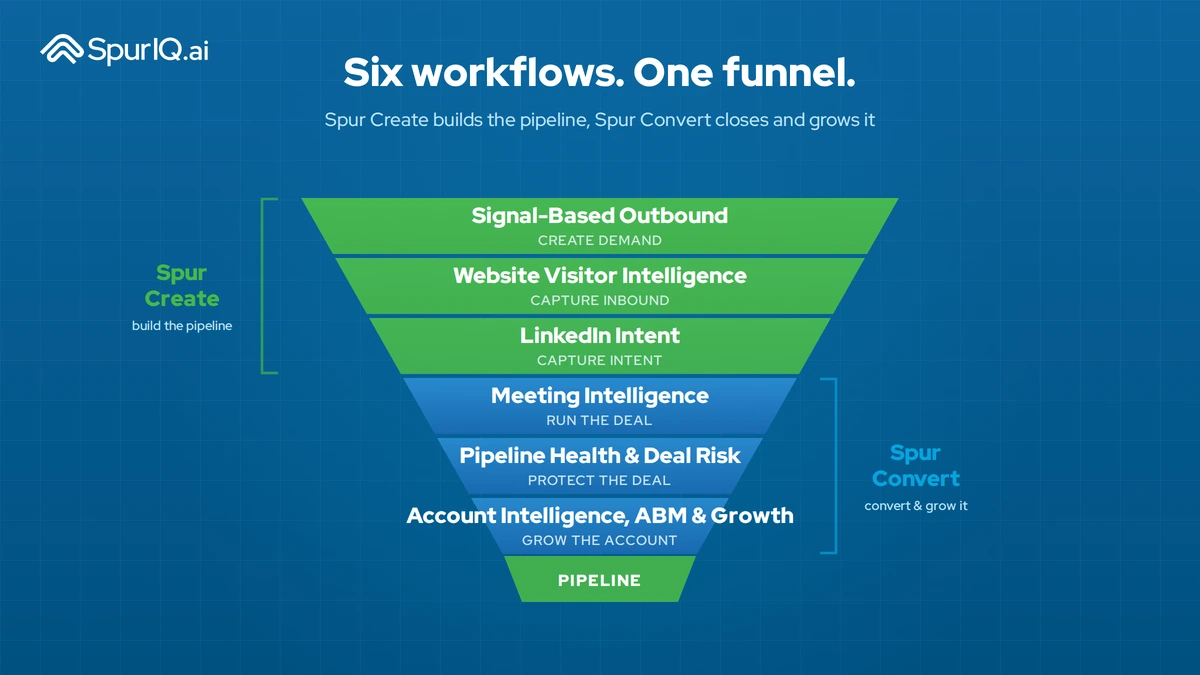
Every stage of your funnel can lose revenue, from the account you never reach to the renewal that slips by. Six SpurIQ workflows, across Spur Create and Spur Convert, cover the funnel end to end so each stage has an owner.
Picture your funnel as a series of stages. Demand gets created at the top. Interested buyers get captured. Deals get worked in the middle. Some slip, some close. And the accounts you win open a whole new stage: keeping and growing them.
Revenue can leak at every one of those stages. A good-fit account never gets found. A warm website visitor leaves without a trace. A deal goes quiet and nobody notices until the forecast review. A renewal sneaks up. Each leak is small on its own. Added up across a full funnel, they are most of the revenue a team never sees.
The usual fix is a different tool for each stage, none of which share a memory of how your company sells. SpurIQ takes a different route: six workflows that map onto the funnel stage by stage, all running on one shared brain. This piece walks the funnel top to bottom and shows exactly which workflow covers each stage.
The funnel in two moves: Create and Convert
SpurIQ groups its six workflows into two modules that follow the funnel.
Spur Create covers the top of the funnel: Three workflows that create and capture demand, turning signals, website visits and social engagement into qualified pipeline.
Spur Convert covers everything after pipeline exists: Three workflows for the AE motion: running deals, protecting them from stalling, and growing the accounts you have already won. Growth is part of Convert, because it is the same seller, working the same account, after the win.
Create the pipeline, then convert it, all the way through to expansion. Here is the whole funnel on one page before we walk each stage.
| Funnel stage | Where revenue leaks | SpurIQ workflow | Module |
|---|---|---|---|
| Create demand | Good-fit accounts get found and reached while the timing is right | Signal-Based Outbound | Spur Create |
| Capture inbound | Warm site visitors get identified and followed up | Website Visitor Intelligence | Spur Create |
| Capture intent | Social engagement becomes qualified follow-up | LinkedIn Intent | Spur Create |
| Run the deal | Every call is prepped and every follow-up captured | Meeting Intelligence | Spur Convert |
| Protect the deal | Stalling and single-threading surface early | Pipeline Health & Deal Risk | Spur Convert |
| Grow the account | Renewals and expansion become deliberate | Account Intelligence, ABM & Growth | Spur Convert |
Top of funnel: Spur Create turns demand into pipeline
The top of the funnel is really three different kinds of demand, and each needs its own play. Cold-but-fitting accounts. Warm anonymous inbound. Social engagement. Most teams do one of these well and quietly ignore the other two. Spur Create covers all three.
Stage 1 – Create demand: Signal-Based Outbound
STATUS: Live, managed workflow, running with customers today
The leak: Good-fit accounts sit in the market with a real reason to buy, and nobody reaches them in time. Static lists ignore that timing entirely.
How the workflow covers it: The Signal-Based Outbound workflow starts from a reason to reach out, a hiring move, funding, a technology change, expansion, finds the accounts showing that trigger now, identifies the buying committee, scores fit, and drafts outreach tied to the trigger. Lookalike logic lives here too: feed it your closed-won logos and it finds companies that share their DNA.
Stage 2 – Capture inbound: Website Visitor Intelligence
STATUS: Ready to deploy, switch it on as a channel when you want it
The leak: Some of your warmest demand is already on your site, on the pricing page, on the demo page, and it leaves anonymous and un-followed-up.
How the workflow covers it: The Website Visitor Intelligence workflow identifies the company behind the visit, keeps only ICP-fit accounts, finds the right buyer, checks the CRM for ownership, and drafts timely follow-up routed to the seller. It catches warm demand while it is still warm.
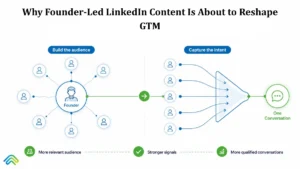
Stage 3 – Capture intent: LinkedIn Intent
STATUS: Live, managed workflow
The leak: A founder or the company posts, the right people engage, and all that intent evaporates because nobody works it in time.
How the workflow covers it: The LinkedIn Intent workflow watches selected posts, collects the people who engage, scores them against your ICP, checks whether they are already in a conversation, and drafts a message that references what they actually engaged with, not a template.
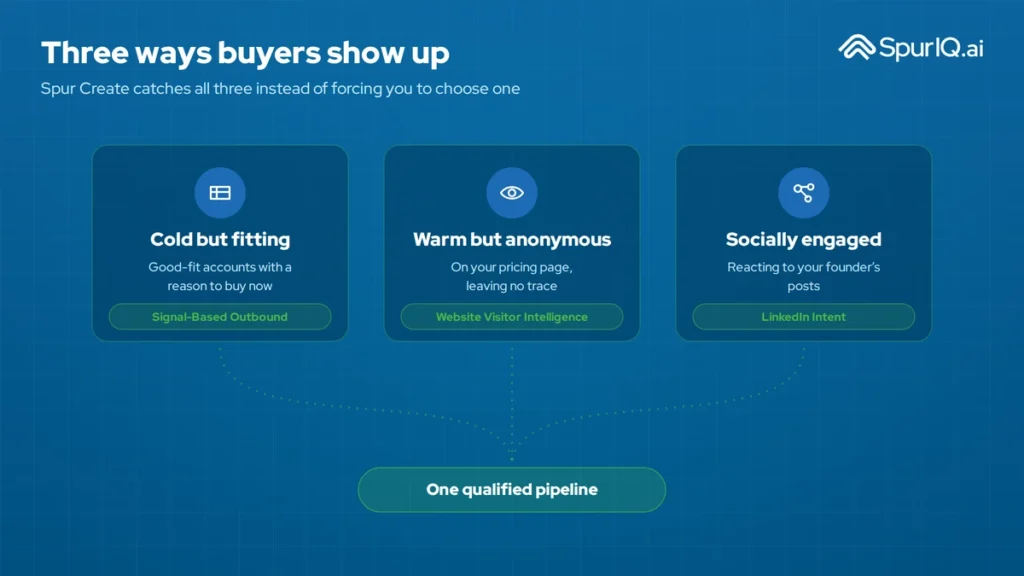
Three ways buyers show up at the top of the funnel. Spur Create catches all three instead of forcing you to choose one.
After pipeline exists: Spur Convert runs, protects and grows the deal
Creating pipeline is only half the funnel. Winnable deals slip after they are created, and the accounts you win get farmed reactively or not at all. Spur Convert covers the three stages where that happens, and all three sit with the same AE working the account.
Stage 4 – Run the deal: Meeting Intelligence
STATUS: Available to build through managed deployment
The leak: Reps walk into calls on memory, and post-call admin gets skipped, so follow-ups slip and the CRM goes stale.
How the workflow covers it: The Meeting Intelligence workflow pulls CRM, email and calendar history into a focused brief before a call. After the call it drafts the recap email and a structured CRM note from the transcript, so every meeting is prepped and captured.
Stage 5 – Protect the deal: Pipeline Health & Deal Risk
STATUS: Available to build through managed deployment
The leak: Deals rarely die loudly. They go quiet, single-thread onto one champion, or lose a next step, and the risk only surfaces at the forecast review.
How the workflow covers it: The Pipeline Health & Deal Risk workflow scans open pipeline, measures stage age and activity gaps, checks stakeholder coverage, flags the deals at risk, and notifies the owner with a recommended action while there is still time to act.
Stage 6 – Grow the account: Account Intelligence, ABM & Growth
STATUS: In pilot, being validated with early customers
The leak: The cheapest revenue in the building, your existing accounts, gets worked reactively, so renewals sneak up and expansion goes unnoticed.
How the workflow covers it: The Account Intelligence, ABM & Growth workflow scans existing accounts for renewal risk, usage spikes, product-qualified signals and cross-sell gaps, then recommends the play. Grow My Accounts, multi-threading and account mapping all sit inside this one.
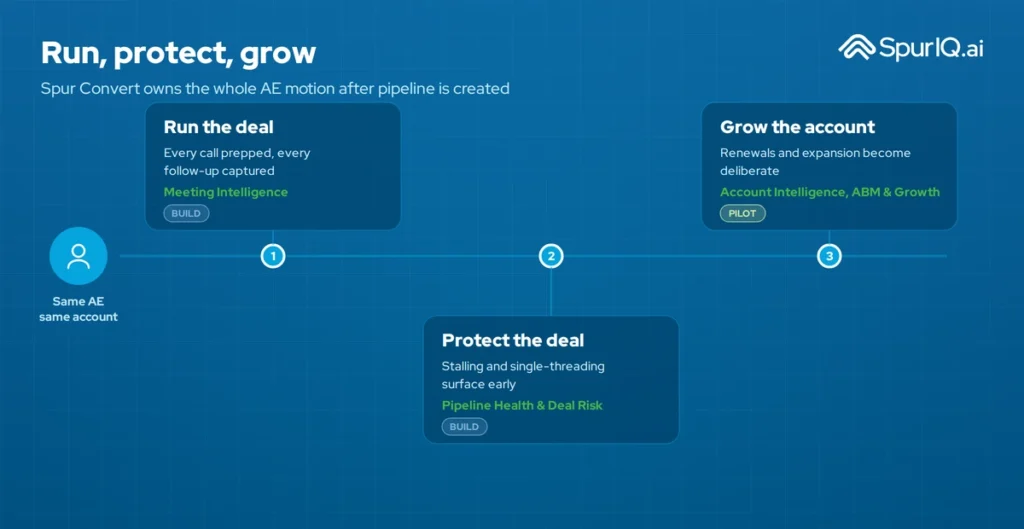
Run the deal, protect the deal, grow the account. Spur Convert owns the whole AE motion after pipeline is created.
Why six workflows cover the funnel better than six tools
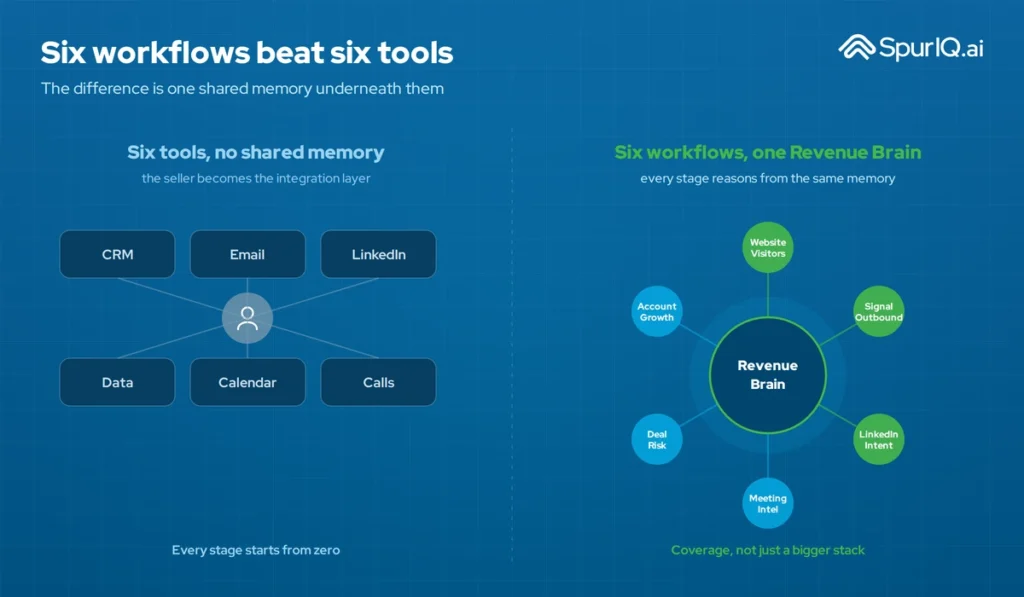
You could buy a separate tool for each of these stages. Plenty of teams have. The problem is that those tools do not share a memory, so every stage starts from zero and the seller becomes the integration layer, carrying context from one tool to the next.
What makes SpurIQ’s six workflows add up to full funnel coverage rather than six disconnected point tools is one shared memory underneath them, the Revenue Brain. It holds your ICP, messaging, proof, playbooks and account history, so a signal read at the top of the funnel, a follow-up drafted in the middle, and an expansion play at the bottom all reason from the same understanding of how you sell. Coverage without that shared memory is just a bigger stack.
If you want to see it run, the GTM command centre lets you describe what you want in plain English, prep tomorrow’s calls, flag deals gone quiet, launch a signal campaign, and it routes the request to the right workflow and runs it end to end. One request in, a running motion out, across any stage of the funnel.
What is live across the funnel today, honestly
Because this covers the whole funnel, it is worth being precise about which stages are live versus deployable versus in pilot, rather than implying all six are equally proven.
| Workflows | Where it stands today |
|---|---|
| Signal-Based Outbound | Live and managed with customers today |
| LinkedIn Intent | Live and managed alongside outbound |
| Website Visitor Intelligence | Ready to deploy as an additional channel |
| Meeting Intelligence | Available to build through managed deployment |
| Pipeline Health & Deal Risk | Available to build through managed deployment |
| Account Intelligence, ABM & Growth | In pilot, being validated with early customers |
The funnel coverage is real end to end. The maturity varies by stage: two workflows live and managed today, one ready to switch on, two built through managed deployment, one in pilot. We scope each engagement to what is actually ready for you.
You cover the funnel one stage at a time
You do not light up all six stages on day one, and SpurIQ does not ask you to. You start where the funnel leaks worst for you right now.
- Find the stage losing you the most revenue today, top, middle or bottom.
- Turn on the workflow that covers it, with a clear owner and success measure.
- Configure your company context: ICP, messaging, proof, playbooks, history.
- Connect only the systems that workflow needs, and launch.
- Measure the value, then extend coverage to the next stage.
Start with the leakiest stage. Prove it. Then cover the rest of the funnel one workflow at a time.
Do that a few times and the whole funnel is covered, not by buying a platform up front, but by closing your worst leak first and expanding from there until all six stages are running on the same brain.
Final Words
A funnel can leak at every stage, so a single-point tool was never going to cover it. SpurIQ’s six workflows map onto the funnel top to bottom: three on the Spur Create side to create and capture demand, and three on the Spur Convert side to run deals, catch risk early and grow the accounts you win.
What makes them cover the funnel rather than clutter it is the shared brain underneath, and what makes it practical is that you close your worst leak first and expand from there. Stage by stage, until nothing falls through.
Build More Pipeline. Close More Deals.
Frequently asked questions:
How do the six workflows map to the sales funnel?
Top of funnel is covered by Spur Create: Signal-Based Outbound creates demand, Website Visitor Intelligence captures warm inbound, LinkedIn Intent captures social intent. Everything after pipeline exists is covered by Spur Convert: Meeting Intelligence runs the deal, Pipeline Health & Deal Risk protects it, and Account Intelligence, ABM & Growth grows the account after the win. Six stages, six workflows, two modules.
Why is growing accounts part of Spur Convert and not its own module?
Because it is the same seller, working the same account, after the win. Running a deal, protecting it and expanding it are all the AE motion once pipeline exists, so they belong together under Spur Convert. Spur Create is the pre-pipeline half; Spur Convert is everything after.
Does SpurIQ really cover the entire funnel, or just outbound?
The whole funnel. Outbound is only the Create side. Everything after pipeline exists, running deals, catching risk early, and expanding existing accounts, is covered by three more Spur Convert workflows. That end-to-end coverage is the point; a create-only tool leaves the rest of the funnel leaking.
Do I have to adopt all six workflows to cover the funnel?
No, you start with the stage that is leaking worst for you, prove value there, then extend coverage stage by stage. The six workflows sharing one memory is what makes full funnel coverage possible over time; it is not a big-bang purchase on day one.
What makes these six a system rather than six separate tools?
A shared Revenue Brain. Every workflow reasons from the same company context, your ICP, messaging, proof, playbooks and account history, so a signal at the top of the funnel and an expansion play at the bottom are both specific to how you sell. That shared memory is what turns coverage into a connected system instead of a bigger stack.
Does this replace my CRM?
No, SpurIQ works across the CRM, email, calendar, LinkedIn and data tools you already use, reading from them and pushing actions back. The CRM stays your system of record; SpurIQ becomes the action layer that delivers the next step at each stage of the funnel, where your sellers already work.